
August 6, 2026
Understanding the Shadow Infrastructure of Global Energy Transport
Modern energy markets face unprecedented complexity as traditional transportation networks evolve alongside parallel systems operating beyond conventional oversight. The emergence of sophisticated maritime networks designed to circumvent international restrictions has fundamentally altered how petroleum products reach global consumers. These developments challenge basic assumptions about supply chain visibility and market price discovery mechanisms, particularly regarding US tariffs and inflation impacts on global trade flows.
Maritime transportation historically functioned through transparent, regulated channels where vessel movements, cargo documentation, and ownership structures remained largely visible to market participants. However, recent years have witnessed the development of alternative logistics networks that operate through deliberate opacity, creating a bifurcated global energy transportation system with profound implications for market stability and geopolitical power dynamics.
When big ASX news breaks, our subscribers know first
Iran's Dark Fleet: Strategic Architecture and Operational Mechanisms
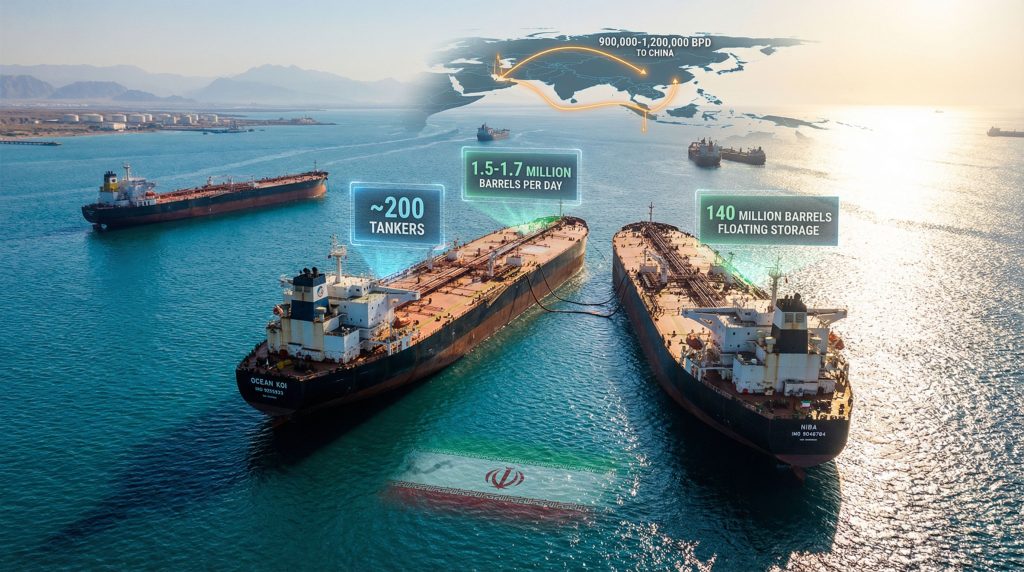
Iran's dark fleet represents far more than a collection of aging vessels. This network constitutes a parallel maritime infrastructure that has evolved into a sophisticated system capable of transporting substantial petroleum volumes despite comprehensive international sanctions. The fleet operates through approximately 200 vessels employing complex operational methodologies designed to obscure cargo origins and destinations.
Fleet Composition and Technical Specifications
The operational backbone consists primarily of Very Large Crude Carriers (VLCCs) and Aframax tankers, vessel categories that collectively handle the majority of global petroleum transportation. These ships typically possess cargo capacities ranging from 120,000 to 320,000 deadweight tons, making them ideal for high-volume operations requiring minimal port calls.
Key Fleet Characteristics:
• Vessel Age: Average age significantly exceeds conventional fleet standards, with many ships operating beyond 25-30 years compared to industry averages of 12-15 years
• Flag State Utilisation: Frequent employment of flags of convenience including Panama, Marshall Islands, Palau, and Barbados
• Ownership Structures: Multi-layered corporate arrangements spanning multiple jurisdictions to obscure beneficial ownership
• Technical Modifications: Enhanced capability for ship-to-ship transfers and extended offshore operations
Recent intelligence indicates the fleet expanded significantly throughout 2023-2024, with over 20 vessels added to meet growing demand from Asian refineries. Furthermore, this expansion occurred despite intensified international enforcement efforts, demonstrating the network's resilience and strategic importance to Iranian operations.
Advanced Evasion Techniques and Operational Security
The fleet employs sophisticated deception methodologies that have evolved considerably since 2018. These techniques represent adaptations drawn from lessons learned through years of sanctions enforcement and mirror innovations developed by other sanctioned entities operating similar networks.
Automatic Identification System (AIS) Manipulation:
AIS systems, designed primarily for maritime safety and traffic management, broadcast vessel identity, position, course, and speed information to nearby ships and coastal monitoring stations. Moreover, Iran's dark fleet systematically exploits weaknesses in this system through several methodologies:
• Coordinated Signal Blackouts: During critical voyage phases, multiple vessels simultaneously disable AIS transmission, creating information gaps in tracking systems
• False Position Broadcasting: Vessels transmit fabricated GPS coordinates, making accurate position determination impossible through conventional monitoring
• Identity Spoofing: Multiple ships may broadcast identical identification numbers, creating confusion in tracking databases
During the February 2026 Middle East escalation, intelligence sources documented over 40 vessels simultaneously disabling AIS systems, demonstrating coordinated operational planning and centralised command structures.
Documentation Fraud and Cargo Obfuscation:
The network employs sophisticated documentation manipulation to obscure cargo origins:
• Bills of Lading Falsification: Shipping documents deliberately misrepresent cargo type, origin, and destination information
• Transshipment Operations: Cargo blending in Malaysian and Singaporean waters allows Iranian petroleum to be mixed with legitimate supplies
• Route Modification: Vessels frequently alter declared destinations mid-voyage, complicating enforcement efforts
Current Export Volumes and Strategic Route Analysis
Despite comprehensive sanctions regimes, Iran maintains substantial export capabilities through this shadow network. Intelligence assessments indicate Iranian crude exports have remained surprisingly resilient, with volumes estimated between 1.5-1.7 million barrels per day during 2024-2025, contributing to broader concerns about tariff impact on markets globally.
Primary Export Corridors
| Route | Estimated Volume (bpd) | Key Destinations | Transshipment Hubs |
|---|---|---|---|
| Persian Gulf → China | 900,000-1,200,000 | Shandong, Dalian | Malaysia, Singapore |
| Jask Terminal → Asia | 200,000-400,000 | China, India | Fujairah, Khor Fakkan |
| Alternative Routes | 100,000-300,000 | Various | Multiple |
Jask Terminal Strategic Significance:
The Jask terminal on the Gulf of Oman represents Iran's most important strategic infrastructure development for sanctions circumvention. With theoretical capacity approaching 1 million barrels per day, Jask provides critical redundancy by enabling exports that bypass the Strait of Hormuz entirely. In addition, this facility became operational in 2017 and has since evolved into a cornerstone of Iranian export strategy.
Floating Storage Operations:
Iran maintains substantial petroleum inventories in floating storage, with estimates suggesting approximately 140 million barrels held in laden tankers at sea. This floating inventory serves multiple strategic functions:
• Market Timing: Allows Iran to release supplies when market conditions maximise revenue
• Operational Flexibility: Provides buffer capacity for ship-to-ship transfer operations
• Strategic Reserve: Creates emergency supply capability during crisis periods
Command Structure and Financial Networks
Revolutionary Guard Corps Control
Intelligence assessments indicate the Islamic Revolutionary Guard Corps (IRGC) exercises control over approximately 50% of Iranian petroleum exports through this shadow network. IRGC involvement extends beyond simple revenue generation to encompass broader strategic objectives including regional proxy support and military procurement, particularly relevant given current US–China trade war effects on global supply chains.
Revenue Utilisation Patterns:
• Regional Proxy Funding: Financial support for Hezbollah operations in Lebanon, Houthi activities in Yemen, and militia groups throughout Iraq and Syria
• Military Procurement: Advanced weapons systems, ballistic missile components, and drone technology acquisition
• Domestic Operations: Internal security apparatus funding and regime stability operations
Financial Architecture and Money Laundering
The network employs sophisticated financial mechanisms to process petroleum revenues while evading international banking restrictions. These include front companies across multiple jurisdictions, cryptocurrency conversion systems, and traditional banking relationships with non-compliant institutions.
Complex Transaction Patterns:
Petroleum sales proceeds flow through intricate financial channels designed to obscure ultimate beneficiaries and funding destinations. However, shell companies incorporated in jurisdictions with limited transparency requirements serve as intermediaries, while barter arrangements with strategic partners avoid traditional banking systems entirely.
Market Dynamics and Price Discovery Distortions
Iran's dark fleet operations create significant asymmetries in global petroleum market information systems. Conventional tracking methodologies systematically underestimate actual supply flows, leading to price discovery mechanisms that incorporate incomplete or inaccurate supply data, particularly affecting oil price movements during periods of geopolitical tension.
Regional Price Differential Impacts
The shadow network creates distinct regional market characteristics:
Asian Markets: Receive discounted Iranian petroleum through the shadow network, creating price advantages for refineries willing to accept compliance risks
European Markets: Face artificial supply constraints due to enhanced sanctions enforcement, resulting in premium pricing relative to actual global supply availability
Middle Eastern Benchmarks: Reflect political considerations rather than fundamental supply and demand dynamics
Information Asymmetry Consequences
Market participants operating with incomplete information about actual supply flows face several challenges:
• Risk Premium Miscalculation: Markets often price in supply disruption risks that exceed actual constraints
• Inventory Management Complexity: Refineries struggle to optimise purchasing strategies without complete supply visibility
• Hedging Inefficiencies: Financial instruments may not accurately reflect underlying physical market realities
Enforcement Challenges and International Response
U.S. Treasury Sanctions Escalation
Recent enforcement actions have intensified significantly, with over 1,000 sanctions targeting various aspects of the evasion network throughout 2025-2026. Furthermore, according to the U.S. Treasury's sanctions tracking system, the Office of Foreign Assets Control (OFAC) has designated multiple vessels and supporting entities in an effort to disrupt operations.
Notable Sanctioned Vessels:
• OCEAN KOI (Barbados-flagged, IMO 9255933): Documented transportation of millions of barrels since May 2025
• ATEELA 1 & 2 (Iran-flagged): Over 100,000 barrels transported for National Iranian Oil Company operations since late 2025
• NIBA (Palau-flagged, IMO 9046784): Millions of barrels of Iranian LPG transported since 2025
Structural Enforcement Limitations
Despite intensified efforts, enforcement faces fundamental constraints:
Jurisdictional Complexity: Multiple flag states with varying enforcement capabilities and political willingness create regulatory gaps
Naval Resource Constraints: Limited maritime interdiction capabilities relative to the geographic scope of operations
Economic Incentive Misalignment: Regional players may benefit economically from continued operations despite formal compliance commitments
Intelligence Gaps: Real-time tracking of sophisticated evasion networks requires substantial resources and international coordination
The next major ASX story will hit our subscribers first
Geopolitical Crisis Response and Adaptability
Strait of Hormuz Crisis Management
During the February 2026 Middle East escalation, Iran's dark fleet demonstrated remarkable operational adaptability. While conventional maritime traffic through the Strait of Hormuz declined by over 90%, shadow fleet operations maintained 60-70% of normal volumes through sophisticated crisis response protocols.
Operational Adjustments During Crisis:
• Enhanced Coordination: Increased cooperation with Iranian naval forces for safe passage
• Route Diversification: Greater utilisation of Jask terminal and alternative export infrastructure
• Inventory Management: Strategic release of floating storage to maintain market presence
• Technology Deployment: Advanced AIS manipulation and satellite communication jamming
Strategic Chokepoint Control
Iran has effectively transformed the Strait of Hormuz from a neutral maritime corridor into a selectively controlled strategic asset. This transformation represents a fundamental shift in global energy transportation dynamics, where political considerations increasingly determine access rights rather than traditional maritime law, contributing to oil price stagnation in global markets.
The bifurcated system now features parallel channels: regulated commerce that faces severe restrictions, and shadow network operations that continue with tacit tolerance. Consequently, this arrangement provides Iran with substantial leverage over global energy markets while maintaining plausible deniability regarding direct market manipulation.
Long-term Strategic Implications for Global Energy Security
Structural Market Evolution
The persistence and growth of Iran's dark fleet operations indicates broader structural changes in global energy transportation. Traditional assumptions about supply chain transparency, regulatory effectiveness, and market efficiency require fundamental reassessment.
Emerging Parallel System Characteristics:
• Regulatory Arbitrage: Increasing divergence between compliant and non-compliant transportation networks
• Technology Adaptation: Rapid innovation in evasion methodologies outpacing regulatory responses
• Political Mediation: State actors increasingly controlling access to energy transportation infrastructure
Future Scenario Analysis
Scenario 1: Enforcement Technology Advancement
Enhanced satellite tracking, artificial intelligence-based pattern recognition, and improved international coordination could significantly increase operational costs for shadow networks. However, historical evidence suggests such measures typically drive innovation rather than elimination of evasion capabilities.
Scenario 2: Diplomatic Resolution
Negotiated settlements reducing sanctions pressure could integrate shadow fleet operations into conventional markets. This would improve transparency but might reduce the leverage currently enjoyed by enforcement agencies.
Scenario 3: System Expansion and Normalisation
Other sanctioned producers adopting similar methodologies could lead to a substantial parallel global energy transportation system. This scenario presents the greatest long-term challenges to traditional market structures and regulatory frameworks.
Risk Assessment and Market Vulnerabilities
Short-term Stabilisation Effects
Iran's dark fleet currently provides several market stabilisation benefits that prevent more severe supply disruptions:
• Supply Shock Mitigation: Continued flows prevent extreme price volatility during geopolitical crises
• Regional Balance Maintenance: Alternative supply sources reduce dependency on single chokepoints
• Inventory Buffer: Floating storage provides emergency supply capabilities
Long-term System Fragilities
Despite current effectiveness, the shadow system introduces significant long-term vulnerabilities:
Environmental and Safety Risks: Aging vessels with limited insurance coverage and below-standard maintenance pose substantial accident risks, as highlighted by analysis from the Iranian shadow fleet operations
Operational Opacity: Limited visibility into actual supply flows complicates emergency response planning
Sudden Disruption Potential: Enforcement actions or technical failures could rapidly remove substantial volumes from markets
Systemic Instability: Growing reliance on politically-mediated transportation increases vulnerability to diplomatic developments
Strategic Response Framework for Industry Stakeholders
Enhanced Risk Assessment Protocols
Energy sector participants must develop comprehensive frameworks for understanding and managing exposure to shadow network operations:
Supply Chain Due Diligence: Enhanced verification procedures for petroleum origin and transportation history
Compliance Framework Evolution: Updated procedures reflecting the complexity of modern evasion techniques
Alternative Sourcing Strategies: Diversified supply relationships reducing dependency on potentially disrupted channels
Technology Investment Priorities
Tracking and Verification Systems: Advanced satellite monitoring, blockchain-based documentation, and artificial intelligence-based pattern recognition
Real-time Intelligence Integration: Commercial intelligence services providing enhanced visibility into shadow network activities
Risk Management Technology: Sophisticated modelling tools incorporating political and operational variables affecting shadow transportation networks
Market Psychology and Investment Implications
Information Asymmetry Trading Strategies
Market participants with superior intelligence regarding shadow network operations possess significant advantages in petroleum trading and related financial instruments. This creates incentives for enhanced intelligence gathering and analysis capabilities.
Key Intelligence Variables:
• Floating Storage Levels: Real-time tracking of laden tanker inventories
• Route Analysis: Understanding alternative transportation pathways and their capacity constraints
• Enforcement Probability: Assessment of political willingness to disrupt specific operations
Long-term Investment Positioning
The persistence of shadow networks suggests fundamental changes in global energy market structure that present both opportunities and risks for institutional investors:
Infrastructure Investment: Enhanced port facilities, alternative transportation routes, and monitoring technology
Regulatory Technology: Companies developing compliance and tracking solutions for complex supply chains
Alternative Energy Acceleration: Reduced reliability of traditional petroleum supply chains may accelerate transition to renewable energy sources
Conclusion: Navigating the New Energy Transportation Reality
Iran's dark fleet represents more than a sanctions evasion mechanism. It exemplifies fundamental changes in global energy transportation where political considerations increasingly determine market access and operational parameters. Understanding these developments becomes essential for navigating an energy landscape characterised by parallel systems operating under different regulatory frameworks.
The shadow network currently provides market stabilisation by maintaining supply flows during periods of conventional system disruption. However, this stability comes at the cost of increased long-term fragility and reduced transparency. Market participants must develop sophisticated frameworks for understanding and managing exposure to these evolving transportation networks.
The strategic implications extend beyond immediate market considerations to encompass broader questions about international law, regulatory effectiveness, and the evolution of state power in global economic systems. Furthermore, as other actors adopt similar methodologies, the current exception may become the new normal, requiring fundamental reassessment of how global energy markets function and how participants manage associated risks.
For policymakers, industry leaders, and investors, the key challenge lies in developing adaptive strategies that account for this new reality while working toward more transparent and stable long-term arrangements. The success of Iran's dark fleet demonstrates both the limitations of traditional enforcement mechanisms and the innovative capacity of motivated actors to circumvent conventional constraints.
This analysis reflects publicly available information and does not constitute investment advice. Readers should conduct independent research and consult with qualified professionals before making investment decisions related to energy markets or companies operating in this sector.
Ready to Navigate Complex Energy Market Opportunities?
Understanding the intricate dynamics of global energy transportation networks, including shadow fleet operations and their market impacts, requires sophisticated intelligence and rapid response capabilities. Discovery Alert's proprietary Discovery IQ model delivers real-time alerts on significant ASX mineral and energy discoveries, empowering subscribers to identify actionable opportunities ahead of the broader market whilst navigating complex geopolitical developments affecting commodity flows. Begin your 14-day free trial today and secure your market-leading advantage in an increasingly complex global energy landscape.