August 5, 2026
When an Industrial Gas Nobody Talks About Becomes the World's Biggest Tech Problem
Every major technology supply chain carries a hidden vulnerability, and the most dangerous kind is the one that nobody plans for until it is already too late. Industrial gases rarely feature in boardroom risk registers. They do not appear in earnings call transcripts. They are treated as utilities, something always available at a fixed price from a reliable supplier. Yet beneath the surface of the global semiconductor industry sits a dependency so structurally rigid, so geographically concentrated, and so physically irreplaceable that a single regional disruption can threaten production lines from Hsinchu to Seoul.
The Iran helium shortage and its consequences for chip supply is precisely that kind of scenario, and the scale of what is now unfolding across industrial gas markets, fabrication facilities, data centers, hospitals, and research laboratories represents a compounding crisis unlike anything the modern semiconductor era has encountered.
When big ASX news breaks, our subscribers know first
Why Helium Cannot Simply Be Swapped Out
The Physical Properties That Make Helium Structurally Irreplaceable
Understanding the severity of the current Iran helium shortage and chip supply disruption requires starting with the chemistry. Helium is not simply a convenient industrial gas that chipmakers happen to prefer. Its role in semiconductor manufacturing is locked in by physics, and no amount of engineering ingenuity has produced a viable substitute across its primary applications.
Helium has the lowest boiling point of any element at approximately minus 269 degrees Celsius. Its thermal conductivity is roughly six times higher than that of air, and its molecular diameter is the smallest of any gas used industrially. These properties are not incidental advantages. They are the precise physical characteristics that specific steps in chip fabrication require.
The five core applications where helium's properties are non-negotiable are:
| Application | Why Helium Is Required | Substitute Availability |
|---|---|---|
| Silicon wafer cooling during plasma etching | Prevents warping at extreme thermal gradients | None at equivalent thermal conductivity |
| Chemical vapor deposition carrier gas | Inert transport with zero contamination risk | Reactive gas chemistries prohibit alternatives |
| Vacuum system leak detection | Smallest detectable molecule for ultra-precise sealing | Physically unique molecular size |
| Advanced packaging at 3nm and 2nm nodes | Maintains inert atmosphere for CoWoS technology | Process chemistry requires zero oxidation tolerance |
| EUV photolithography environments | Prevents refractive index distortions | Atmospheric purity requirements eliminate all alternatives |
As reported by OilPrice.com, helium's exceptional thermal conductivity enables the fast, precise cooling required to shrink circuitry in advanced chips, while its chemical inertness prevents oxidation and protects semiconductor purity throughout the fabrication process. No periodic element replicates this combination at the pressure and temperature tolerances that advanced node manufacturing demands.
The Co-Production Trap: Why Helium Supply Is Hostage to LNG Markets
One of the least appreciated structural vulnerabilities in the global helium supply chain is that helium is not produced independently. It is extracted as a byproduct during the liquefaction of natural gas, specifically during the nitrogen rejection stage of LNG processing. This co-production dependency creates an inherent fragility: when LNG operations are disrupted, helium production disappears simultaneously, regardless of demand. Furthermore, LNG supply disruptions of this kind have historically been underestimated in their downstream consequences for technology manufacturing.
Qatar's Ras Laffan industrial complex has historically accounted for approximately one-third of total global helium output. The United States represents the single largest country-level producer but prioritises domestic federal and industrial consumption. Fewer than six major production nodes supply the entire world market, creating a concentration of supply risk that would be considered alarming in almost any other critical industrial input.
How the Strait of Hormuz Closure Created a 35% Global Supply Shock
Three Compounding Disruption Mechanisms
The Iran helium shortage affecting chip supply did not emerge from a single event. It is the product of three simultaneous disruption mechanisms that compounded across production, logistics, and inventory timelines.
Stage 1: The Production Collapse
Following Iranian missile strikes on Qatar's Ras Laffan LNG production facilities, QatarEnergy suspended operations and declared force majeure on long-term LNG contracts to buyers across Europe and Asia. Because helium is extracted as a byproduct of LNG processing, the production suspension eliminated roughly one-third of global helium output at a stroke.
Stage 2: The Logistics Blockade
The closure of the Strait of Hormuz to Western commercial shipping physically prevented any Qatari helium from reaching global markets even if production had continued. Approximately 33% of the world's specialised cryogenic ISO containers became stranded in or near the affected zone. These are not interchangeable with standard freight containers. They require dedicated cryogenic handling infrastructure and cannot be repurposed for alternative cargo.
Stage 3: The Evaporation Clock
Liquefied helium stored in cryogenic containers evaporates within approximately 45 days. Unlike oil, coal, or LNG, stranded helium inventory cannot be warehoused through a prolonged disruption. Every week of blockade converts delayed supply into permanently destroyed supply.
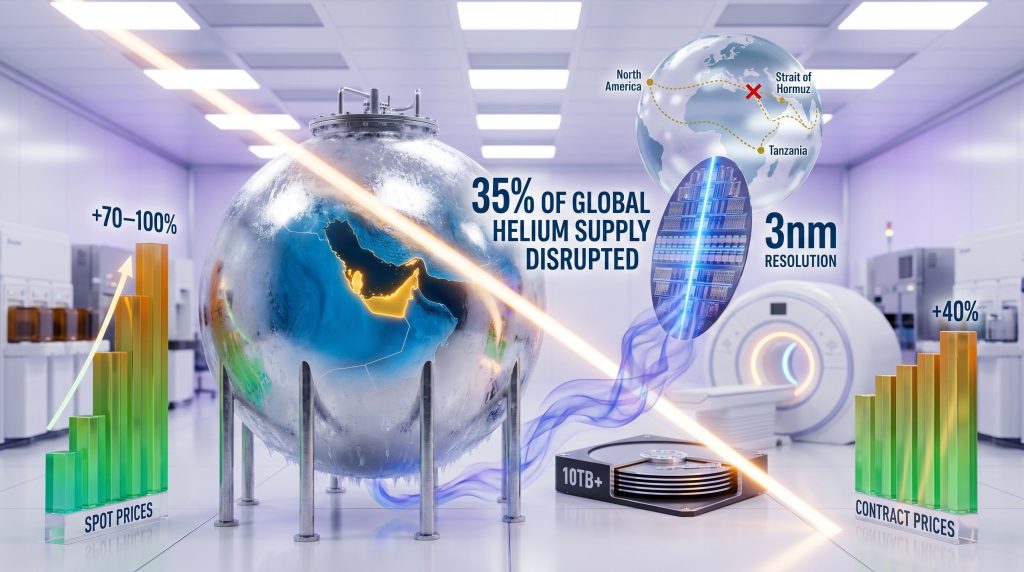
The combined effect has disrupted up to 35% of global helium supply simultaneously across both the production and logistics dimensions, as reported by OilPrice.com, creating a supply gap with no short-term mechanism for replacement. The helium supply crisis unfolding in 2025 has consequently exposed just how thin the buffers in this market truly are.
What a 35% Supply Disruption Actually Does to a Semiconductor Fab
The Inventory Runway Problem
The semiconductor industry operates on lean inventory principles across most consumable inputs, and helium is no exception. According to OilPrice.com, most semiconductor fabs maintain approximately one week of working inventory on-site. Strategic reserves extend this runway, but the threshold at which yield degradation and production rationing become unavoidable is estimated at approximately 60 days from the onset of disruption.
| Buffer Type | Estimated Duration |
|---|---|
| On-site working inventory | Approximately 1 week |
| Extended buffer with strategic reserves | 45 to 90 days |
| Rationing and yield degradation threshold | Approximately 60 days post-disruption |
| Asian chipmaker reserve depth | Approximately 3 months |
Major fabricators including TSMC, Samsung, and SK Hynix source more than 60% of their helium requirements from the disrupted region. U.S. supplier Airgas has declared force majeure, with American deliveries reduced by up to 50%. These are not warning signals about a potential future problem. They are active supply constraints affecting production planning in real time.
The Price Transmission Pathway
Spot helium prices have surged between 70% and 100% above pre-disruption levels, while contract prices have increased by up to 40%. The transmission pathway from that price shock to end consumers of AI hardware and smartphones follows a predictable but damaging sequence:
- Spot and contract helium prices surge at the industrial gas level
- Fabricators (TSMC, Samsung, SK Hynix) absorb initial cost pressure before adjusting wafer pricing
- Fabless chip designers including Apple and Nvidia face higher wafer costs
- End-product pricing for AI GPUs, smartphones, and data centre hardware increases
- AI infrastructure buildout costs rise, introducing supply-side friction on data centre deployment timelines that has nothing to do with chip design, demand forecasting, or financing conditions
Industry analysts specialising in industrial gas markets have flagged that the intersection of a 35% supply shock with peak AI-driven demand growth represents a compounding risk scenario without modern precedent. The broader vulnerabilities across critical minerals supply chains make this moment particularly consequential for technology sector planners.
Industries Beyond Chips Facing Critical Helium Exposure
High-Capacity Storage Drives and AI Data Infrastructure
The impact of the Iran helium shortage on chip supply extends well beyond wafer fabrication. Hard drives with capacities exceeding 10TB rely entirely on helium-filled enclosures. The physics are significant: helium has approximately one-seventh the density of air, which dramatically reduces aerodynamic drag on spinning platters. This enables manufacturers to stack 10 or more platters per drive versus a maximum of six in air-filled designs, while also reducing operating temperatures by roughly 4 to 5 degrees Celsius per drive, improving reliability and cutting power consumption per terabyte.
For AI data centres, which depend on high-density storage at scale, this is not a peripheral concern. Current shortage conditions have driven 20 to 30% price increases for high-capacity HDDs from manufacturers including Seagate and Western Digital, according to reporting by OilPrice.com. The same infrastructure buildout that drives AI GPU demand also drives demand for helium-filled storage, creating dual exposure within a single capital programme.
Medical Imaging: A Non-Deferrable Dependency
MRI machines operate through superconducting magnets that must be maintained at temperatures near absolute zero. Liquid helium is the only viable coolant for this application. There is no alternative gas, no alternative cooling technology currently deployed at clinical scale, and no timeline for one.
U.S. helium suppliers have already issued allocation letters to medical facilities, signalling that rationing protocols are active rather than precautionary. A prolonged shortage risks idling MRI scanners across hospital networks, creating downstream healthcare access constraints that cannot be resolved through procurement strategies or substitution.
Scientific Research and Pharmaceutical Development
Nuclear Magnetic Resonance spectrometers, which are essential tools in cancer drug development and molecular biology, require a continuous helium supply for superconducting magnet operation. Unlike industrial applications where equipment can sometimes be powered down safely, helium loss from NMR magnets can cause irreversible physical damage to the superconducting coils, representing millions of dollars in equipment exposure per instrument.
Research institutions have reported significant supply reductions, with some Canadian universities indicating cuts of approximately 50% to their helium allocations. Quantum computing research infrastructure faces parallel disruption. These are not inconveniences. They represent potential permanent setbacks to multi-year research programmes that cannot simply be restarted once supply resumes.
Aerospace and Launch Systems
Rocket propellant systems at commercial space operators use helium for pressurisation of fuel tanks and purging of fuel lines prior to ignition. While aerospace operators maintain deeper strategic reserves than most industrial users, a prolonged disruption creates real allocation pressure on launch scheduling, adding indirect cost and timeline risk to commercial space programmes.
Three Scenarios for How This Resolves
Mapping the Recovery Pathways
Scenario A: Short Disruption (Resolution Within 60 Days)
The Strait of Hormuz reopens and Qatari LNG and helium production resumes within weeks. Stranded cryogenic containers are recovered before full evaporation losses materialise. Spot prices normalise over several months. Semiconductor fabs experience cost pressure but avoid production rationing, and AI infrastructure timelines remain largely intact.
Scenario B: Extended Disruption (60 to 180 Days)
Shipping lane closure persists and Ras Laffan infrastructure requires several months of repair. Fab inventories are depleted and major fabricators implement wafer start rationing. Yield reductions emerge at advanced nodes. Apple, Nvidia, and other fabless designers face supply allocation pressures. Medical imaging facilities escalate to formal rationing protocols globally.
Scenario C: Structural Disruption (Beyond 180 Days)
Prolonged conflict prevents Qatar from resuming normal operations. U.S. domestic production capacity cannot bridge a 33% global supply gap. Helium recycling systems, which are capable of recovering up to 80% of consumed helium in closed-loop fab environments, become a genuine competitive differentiator for fabricators that invested in them ahead of the crisis. New helium exploration projects in North America, Russia, and Tanzania's Rukwa Valley deposits accelerate, but all carry multi-year development lead times before they contribute meaningful supply.
| Alternative Helium Source | Current Status | Scalability Timeline |
|---|---|---|
| United States (Federal Helium Reserve) | Active; prioritising domestic allocation | Limited incremental capacity |
| Russia (West Siberian fields) | Large reserves; geopolitically constrained | Multi-year; access complexities persist |
| Tanzania (Rukwa Valley deposits) | Significant undeveloped reserves identified | 3 to 5 year development horizon |
| Canada and Australia | Exploration-stage projects | 5 or more years to commercial output |
The next major ASX story will hit our subscribers first
The AI Boom Made This Crisis Far Worse Than It Needed to Be
Demand Amplification at the Worst Possible Moment
The helium shortage crisis has arrived at a moment when semiconductor demand is running at historically elevated levels, driven almost entirely by AI infrastructure investment. Advanced AI chip fabrication at 3nm and 2nm process nodes is measurably more helium-intensive per wafer than previous generations, due to tighter process tolerances that require more precise thermal management and purer chemical environments at every stage.
TSMC's 2026 capital expenditure programme, projected at up to $56 billion according to OilPrice.com, is heavily weighted toward advanced node and packaging capacity. Every dollar of that investment assumes helium availability at volumes that the current disruption cannot support. The company has projected more than 30% revenue growth for 2026 driven by AI-related demand, yet that growth narrative now carries embedded supply risk that was entirely absent from consensus forecasting three months ago.
The AI data centre buildout creates a particularly concentrated dual exposure. Building an AI data centre requires advanced GPUs fabricated at helium-intensive process nodes and high-capacity helium-filled hard drives for storage. These are not independent procurement decisions. They are coupled infrastructure requirements, meaning that helium constraints tighten both simultaneously. The broader geopolitical supply risk environment has, in addition, created compounding pressures across multiple input categories that technology sector planners are only beginning to quantify.
Semiconductor stocks have priced in extraordinary AI-driven optimism. TSMC has returned 140% over the prior 52-week period, Samsung 260%, Western Digital an extraordinary 860%, and Seagate 610%, according to OilPrice.com. Valuations at those levels carry very little margin of safety for a supply-side shock that compresses margins, slows production volumes, and extends delivery timelines in parallel.
The Structural Policy Gap This Crisis Has Exposed
Why No Strategic Reserve Exists for Helium
The most troubling long-term insight from this crisis is not the disruption itself but the absence of any coordinated international mechanism for managing it. The International Energy Agency coordinates strategic petroleum reserves across member nations. No equivalent framework exists for helium.
Most national strategic reserves that include helium were designed for military and government applications, not commercial semiconductor supply chains. The scale of modern chip manufacturing's dependency on a gas that has historically been treated as a cheap industrial byproduct has never been formally stress-tested against a geopolitical disruption scenario of this magnitude. Furthermore, the convergence of minerals and semiconductors in national security planning has begun to shift policy conversations, though helium has remained conspicuously absent from those frameworks.
Investment in closed-loop helium recycling systems, which can recover up to 80% of consumed helium within a fab environment, has historically been deprioritised precisely because helium was inexpensive and assumed to be abundant. The current price shock is accelerating adoption, but retrofitting existing fabs requires capital expenditure and several months of installation time. It is a medium-term solution being mobilised in response to an immediate crisis.
The Iran helium shortage affecting chip supply has made visible a structural policy gap that existed long before any missile struck a Qatari LNG facility. The world's most advanced technology supply chains were quietly dependent on a single-element gas produced at fewer than six major global facilities, with no coordinated reserve framework, no substitution pathway, and a 45-day evaporation clock on any stranded inventory.
The long-term resolution framework requires three parallel tracks: investment in helium recycling at the fab level, geographic diversification of sourcing toward emerging production regions, and development of internationally coordinated helium reserve protocols analogous to the oil reserve frameworks that were built after the energy crises of the 1970s. None of these tracks are fast. All of them are now urgent. As The Conversation notes, the world's helium supply has been quietly threatened by the Iran conflict in ways that most policymakers and technology executives were wholly unprepared to address.
This article is intended for informational purposes only and does not constitute investment advice. Forward-looking statements regarding supply scenarios, price trajectories, production timelines, and market impacts involve inherent uncertainty and should not be relied upon as predictions of future outcomes. Readers should conduct their own research and consult qualified financial and industry advisers before making investment decisions.
Want to Capitalise on Resource Discoveries Reshaping Critical Supply Chains?
As helium supply disruptions expose deep vulnerabilities across semiconductor and minerals markets, Discovery Alert's proprietary Discovery IQ model instantly notifies subscribers of significant ASX mineral discoveries — turning complex resource data into actionable investment opportunities the moment they hit the market. Explore historic returns from major mineral discoveries and begin your 14-day free trial today to position yourself ahead of the next market-moving event.