July 15, 2026
The Architecture of Control: How Iran's PGSA Permit System Is Rewriting the Rules of Hormuz Navigation
The global energy system has long operated on the assumption that maritime chokepoints function under a shared legal order — one where international conventions, not unilateral state decisions, govern the movement of commercial vessels through strategically critical passages. That assumption is now being stress-tested in real time at the Strait of Hormuz, where Iran Hormuz permits for ships have introduced a permitting architecture that challenges the foundational principles of freedom of navigation enshrined in the United Nations Convention on the Law of the Sea (UNCLOS).
What makes this moment structurally significant is not simply the conflict that triggered it, but the institutional apparatus Iran has constructed in response. The Persian Gulf Strait Authority (PGSA) is not a temporary emergency measure. It is a functioning bureaucratic regime with its own data collection systems, insurance requirements, designated transit corridors, and enforcement capacity backed by the Islamic Revolutionary Guard Corps (IRGC) Navy. Understanding how it works — and what it reveals — matters far beyond the immediate crisis.
When big ASX news breaks, our subscribers know first
Why the Strait of Hormuz Cannot Be Replaced
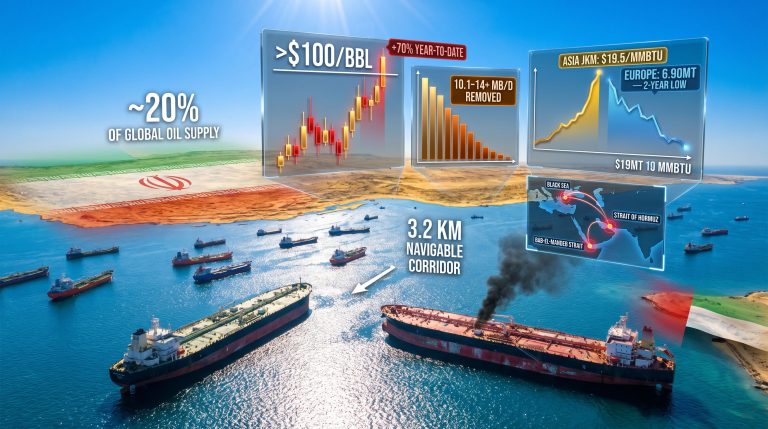
To appreciate the stakes, it helps to understand just how irreplaceable this passage is within global commodity logistics. The Strait of Hormuz channels roughly 20% of the world's seaborne oil supply annually, along with a substantial share of liquefied natural gas exports from Qatar and the UAE. No other waterway comes close to matching this concentration of energy throughput relative to its physical dimensions.
Furthermore, unlike the Suez Canal, which has experienced high-profile blockages, or the Strait of Malacca, which handles significant cargo diversions during disruption, the Strait of Hormuz has no commercially scalable bypass route capable of absorbing its full volume. The Saudi Petroline (East-West Pipeline) can move approximately 5 million barrels per day to Red Sea terminals, and the UAE's Habshan-Fujairah pipeline adds additional capacity — but together these alternatives cover only a fraction of normal Hormuz throughput, and neither addresses the LNG supply outlook or bulk commodity flows at all.
This structural irreplaceability is precisely what gives the permitting regime its leverage.
What the PGSA Actually Is and How It Operates
The PGSA was established as part of Iran's strategic response following the escalation of the US-Israel conflict with Iran, which began in late February of the current year. The authority operates under dual oversight from the IRGC Navy and the Supreme National Security Council — giving it simultaneous military enforcement capacity and the highest level of executive political authority within the Iranian state.
The core function of the PGSA is to require all non-Iranian commercial vessels to obtain a valid transit permit before entering the strait. According to Baird Maritime's detailed analysis, this pre-clearance requirement has no modern historical precedent at any comparable global energy chokepoint.
Step-by-Step: The Iran Hormuz Permit Application Process for Ships
The procedure for obtaining Iran Hormuz permits for ships follows a structured sequence:
-
Vessel Information Declaration — Operators must complete a 42-field submission covering vessel ownership structure, IMO registration number, crew manifests, cargo classification, intended route, and the nationalities of both operators and owners.
-
Submission via designated channel — Applications are lodged by email to the PGSA's official address in Excel format.
-
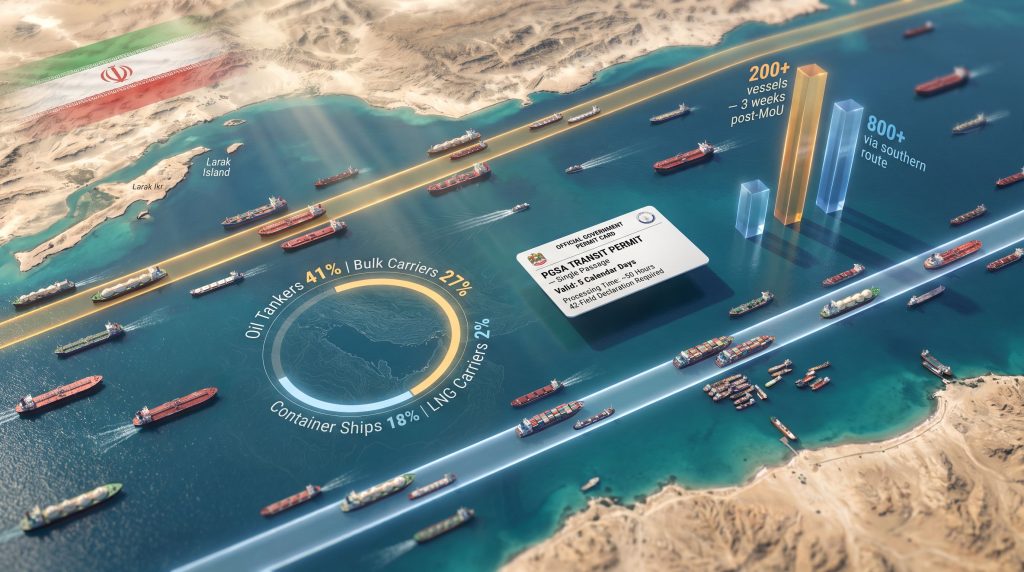
Processing window — The standard review period runs approximately 48 hours, though commercial vessels may qualify for expedited processing. The PGSA has reported an average issuance time of 50 hours across all permit applications.
-
Permit issuance or denial — A valid permit covers a single transit passage only and expires after 5 calendar days from the date of issue.
-
Route compliance — Approved vessels must transit via the PGSA-designated corridor near Larak Island, which follows the Iranian coastline side of the strait. Any deviation constitutes a violation.
-
Insurance compliance — Mandatory insurance coverage sourced from a PGSA-approved insurer is required, although this requirement was temporarily waived during a 60-day period under the terms of the US-Iran Memorandum of Understanding signed on 18 June.
Permit Requirements at a Glance
| Requirement | Operational Detail |
|---|---|
| Permit Scope | Single-passage only |
| Validity Window | Up to 5 calendar days from issuance |
| Average Processing Time | ~50 hours |
| Standard Review Period | ~48 hours |
| Application Format | 42-field Excel declaration via email |
| Required Information | Ownership, IMO number, crew, cargo, route, nationalities |
| Designated Transit Corridor | Near Larak Island (Iranian coastline side) |
| Insurance Requirement | Mandatory; PGSA-approved provider |
| Fee Status | Waived for 60 days under June MoU |
Who Gets Access and Who Does Not
The PGSA vetting process incorporates an explicit nationality and affiliation screening mechanism. Vessels with ownership, operational, or flag connections to either the United States or Israel are categorically prohibited from receiving permits. This transforms the system from a neutral administrative tool into a geopolitically discriminatory access control regime, contributing directly to broader oil market disruption across key trading routes.
Nations whose vessels have successfully received PGSA clearance include India, China, Pakistan, Turkey, France, and Malaysia — reflecting Iran's deliberate preference for maintaining commercial relationships with non-aligned states and key trading partners.
Key Insight: The PGSA's nationality screening function means that Iran Hormuz permits for ships are not universally available. The system encodes geopolitical alignment directly into maritime access rights — a novel and legally contested approach to strait governance.
The Fee Question: What Shipping Operators Are Actually Paying
The 60-day fee waiver negotiated as part of the June MoU temporarily removed one of the most opaque cost elements from the permit process. Prior to and outside that waiver period, reported transit clearance costs have ranged from over $150,000 to several million dollars, varying by vessel type, cargo sensitivity, and geopolitical context.
The potential reintroduction of formalised fees after the waiver period expires represents a significant unquantified risk for shipping companies and commodity traders with Gulf exposure. No publicly established fee schedule exists, meaning post-waiver transit costs remain structurally unpredictable.
Warning for Operators: Shipping companies should treat post-waiver PGSA transit costs as an unquantified risk exposure in voyage planning and freight pricing models. The absence of a published fee schedule means this cost variable cannot be hedged or forecasted with conventional tools.
What the PGSA's Own Data Reveals About Hormuz Traffic
In the approximately three-week window following the signing of the June MoU, more than 200 non-Iranian commercial vessels coordinated with the PGSA to transit the strait. This figure provides the first quantitative baseline for the operational scale of the permitting regime under quasi-normalised conditions.
Notably, 14% of vessels that had applied were still awaiting permit decisions at the time of reporting — indicating processing backlogs even during a period of reduced geopolitical tension. This pending-application rate is a material operational signal for route planning purposes.
Vessel Type Breakdown
| Vessel Category | Share of Permit Applications |
|---|---|
| Oil Tankers | 41% |
| Bulk Carriers | 27% |
| Container Ships | 18% |
| LNG Carriers | 2% |
| Other / Unclassified | ~12% |
The dominance of oil tankers at 41% confirms that crude and petroleum product flows remain the primary commercial driver of Hormuz transit demand. The 2% share for LNG carriers significantly understates the economic importance of that segment, given the disproportionately high cargo values per transit and the lack of any viable rerouting alternative for Gulf-origin LNG.
Directional Flow Analysis
The PGSA data reveals a near-symmetrical split between traffic entering and exiting the Mideast Gulf:
Eastbound Vessels (Exiting the Gulf — 53% of total):
- 21% destined for China
- 20% destined for India
- 29% bound for other Asia-Pacific destinations
- 22% heading to regional ports including Oman, Saudi Red Sea facilities, and the UAE's Fujairah terminal
Westbound Vessels (Entering the Gulf — 47% of total):
- 21% originated from India
- 19% originated from China
- 20% from other Asian nations
- 24% originated from ports within the broader Middle East region
Analytical Takeaway: The near-symmetrical 53/47 split between outbound and inbound traffic confirms that the Strait of Hormuz functions as a bidirectional arterial corridor. Disruption affects inbound supply chains — raw materials, manufactured goods, agricultural inputs — as much as it affects outbound energy flows. This bidirectional exposure is frequently underappreciated in market risk assessments.
Additionally, 79% of vessels that coordinated with the PGSA also took out PGSA-approved insurance coverage, suggesting high compliance with the dual permit-plus-insurance requirement among operators who engaged with the system. The remaining 21% either carried alternative coverage or remained in a pending compliance state.
The Route Sovereignty Dispute at the Core of the Crisis
Two Incompatible Interpretations of the June MoU
The memorandum of understanding signed on 18 June was deliberately worded broadly, calling on Iran to make arrangements for the safe passage of commercial vessels through the strait. Within weeks, that broad language became the source of a fundamental and irreconcilable disagreement.
Iran's position holds that the MoU confers total administrative authority over which vessels may use the waterway and which designated route they must follow — specifically the northern corridor running along the Iranian coastline near Larak Island.
The US position rejects this interpretation entirely, asserting that commercial vessels retain the right to use the southern route along the Omani coastline without Iranian pre-clearance, consistent with UNCLOS transit passage rights.
Tehran has justified the northern route mandate on safety grounds, arguing that the southern corridor remains hazardous due to uncleared naval mines left over from the conflict. Washington, however, has not accepted this framing.
Comparative Route Framework
| Dimension | Iranian Northern Route | US-Backed Southern Route |
|---|---|---|
| Coastline Proximity | Iranian territorial waters | Omani coastline |
| Permit Required | Yes (PGSA) | No (US position) |
| Iran's Stated Rationale | Mine clearance safety | N/A |
| US Legal Position | Rejects Iranian authority | UNCLOS transit passage rights apply |
| Vessels Using Route (18 Jun–10 Jul) | ~200+ (PGSA data) | 800+ (US data) |
| Crude Volume Moved | Not disclosed | ~380 million barrels |
The US reported that more than 800 ships transited via the southern route and approximately 380 million barrels of crude oil exited the Mideast Gulf through this corridor between 18 June and approximately 10 July. This implies that the substantial majority of commercial traffic was operating outside the PGSA system entirely during the stabilisation window, creating a dual-track transit reality with competing legal frameworks.
The next major ASX story will hit our subscribers first
The Sequence of Escalation and Market Consequences
The June MoU was designed as a transitional framework intended to facilitate the gradual normalisation of commercial shipping, create the conditions for a ceasefire, and establish a diplomatic basis for longer-term negotiations. Within weeks, the foundational disagreement over route authority and permit legitimacy generated renewed naval friction.
By the weekend of 11–12 July, Iran formally declared the strait closed to commercial traffic. US President Donald Trump subsequently announced the reimposition of a naval blockade on Iran, effectively ending the MoU's operational phase. Consequently, ship transits through the strait collapsed to levels not recorded since the earliest phase of the conflict.
Commodity Flows at Immediate Risk
The categories most directly exposed to sustained Hormuz disruption include:
- Crude oil and refined petroleum products — particularly flows to Asian importers, with China, India, and broader Asia-Pacific accounting for roughly 70% of eastbound permit traffic
- LNG — disproportionately impactful given cargo values and the complete absence of viable large-scale alternative routing for Gulf-origin LNG exports
- Bulk commodities — fertilisers, grain, and industrial materials carried by bulk vessels, which represented 27% of PGSA permit applicants
Freight Market and Insurance Dynamics
The permit regime introduces a category of non-market freight risk that cannot be managed through conventional freight derivatives. War risk insurance premiums for Gulf-transiting vessels have spiked materially during conflict escalation phases, contributing to wider commodity market volatility across interconnected global markets. The potential formalisation of PGSA fees post-waiver adds a structural cost layer to Gulf freight with no historical precedent in modern shipping markets.
Scenario Alert: A sustained closure of the Strait of Hormuz measured in weeks rather than days would generate supply dislocations in Asian crude markets, spike spot LNG prices across East Asia, and place significant upward pressure on freight rates across multiple vessel classes globally. The sulphur market has already demonstrated this dynamic, with spot export prices from US Gulf refineries reaching $1,100-$1,150 per tonne FOB in early July as Middle East export flows collapsed — a direct downstream consequence of Hormuz disruption cascading through interconnected commodity markets.
FAQs: Iran Hormuz Permits for Ships
What is the PGSA and why was it created?
The Persian Gulf Strait Authority is an Iranian regulatory body established to administer a transit permit system for commercial vessels seeking to pass through the Strait of Hormuz. It was created as part of Iran's strategic response following the escalation of the US-Israel conflict with Iran and represents Tehran's assertion of administrative control over the strait's navigational framework under IRGC Navy and Supreme National Security Council oversight.
Do ships legally need Iran's permission to transit the Strait of Hormuz?
Under established international maritime law — specifically UNCLOS transit passage provisions — vessels transiting an international strait connecting two areas of high seas do not require the approval of bordering states. Iran's PGSA permit system is a unilateral imposition that the United States and several other nations have declined to recognise as legally binding.
How long does it take to get a Hormuz transit permit?
The PGSA has reported an average permit issuance time of approximately 50 hours, with a standard processing window of 48 hours. Commercial vessels may qualify for expedited treatment. Permits are valid for a single transit only and expire within 5 calendar days of issuance.
Which ships are prohibited from receiving a PGSA permit?
Vessels with ownership, operational, or flag connections to the United States or Israel are explicitly excluded from the PGSA permit system under the current framework.
How much does a Hormuz transit permit cost?
During the 60-day waiver period under the June MoU, fees were suspended. Outside that window, reported costs have ranged from over $150,000 to several million dollars depending on vessel type and circumstances. No formalised fee schedule has been publicly established.
What percentage of Hormuz traffic uses the PGSA system?
Based on available data, approximately 200+ vessels coordinated with the PGSA in the three weeks following the June MoU, while US sources reported 800+ vessels transiting via the southern route over roughly the same period. This suggests the majority of commercial traffic was operating outside the PGSA framework during that window.
The Broader Precedent: Chokepoint Statecraft as a Policy Instrument
Whether or not the PGSA system survives the current conflict in its present form, its establishment signals something strategically significant for global shipping governance. Resource-rich states bordering critical maritime passages now have a visible institutional template for leveraging chokepoint geography as both a regulatory instrument and a geopolitical tool. In addition, the wider geopolitical risk landscape suggests this approach may increasingly influence how contested waterways are governed globally.
The PGSA experiment demonstrates that a sufficiently motivated state actor can construct a functioning permit regime, collect detailed vessel and cargo intelligence from compliant operators, impose route discipline on a significant share of commercial traffic, and generate fee revenue — all while operating in direct tension with the prevailing international legal framework.
For shipping operators, commodity traders, energy importers, and insurers, the core lesson is that Hormuz is no longer simply a physical chokepoint. It has become a regulatory chokepoint as well — one where the rules of access are contested, the costs are variable and unpredictable, and the legal basis for transit is actively disputed between major powers. Furthermore, the oil price rally dynamics already evident in 2025 may be further amplified should Iran Hormuz permits for ships evolve into a permanent feature of global shipping governance. That combination of physical irreplaceability and institutional uncertainty is, for global energy markets, an entirely new category of risk.
Disclaimer: This article contains forward-looking analysis and scenario projections based on publicly available data and reporting. It does not constitute financial, legal, or operational advice. Shipping operators and market participants should consult qualified legal and commercial advisors before making decisions based on the evolving Hormuz regulatory environment.
Want to Stay Ahead of Commodity Market Disruptions Driven by Geopolitical Shocks Like Hormuz?
Discovery Alert's proprietary Discovery IQ model scans ASX announcements in real time, instantly identifying significant mineral discoveries and actionable opportunities across the commodities most exposed to global supply chain volatility — explore historic discovery returns on Discovery Alert's discoveries page to see what early positioning can deliver, and begin your 14-day free trial at Discovery Alert to ensure you're never behind the market when the next major disruption reshapes commodity flows.