August 6, 2026
When Export Infrastructure Becomes the Battlefield
Oil markets are shaped not just by production volumes and political headlines, but by the physical plumbing that connects crude in the ground to buyers around the world. Terminal storage, pipeline throughput, and tanker availability form a silent architecture beneath every barrel exported. When that architecture comes under pressure, the consequences cascade upstream with remarkable speed, threatening fields, revenues, and geopolitical leverage simultaneously. The situation now unfolding around the Iran Kharg Island oil storage limit is a textbook example of how infrastructure constraints can become more consequential than any single diplomatic event or sanction announcement.
When big ASX news breaks, our subscribers know first
What Makes the Iran Kharg Island Oil Storage Limit So Strategically Significant?
The Terminal That Holds Iran's Export Economy Together
Kharg Island sits at the centre of Iran's petroleum export architecture in a way that has no meaningful parallel elsewhere in the country's energy system. Widely reported market estimates suggest the terminal processes approximately 90% of Iran's energy exports, a concentration that transforms any storage disruption at the site into a national economic emergency rather than a localised logistics problem.
Storage capacity at an export terminal like Kharg functions as a buffer between upstream field production and outbound tanker movements. When that buffer is functioning normally, operators enjoy flexibility to manage production rates, schedule loading windows, and respond to short-term export disruptions without throttling upstream flows. When storage compresses toward its ceiling, however, every one of those flexibilities disappears simultaneously.
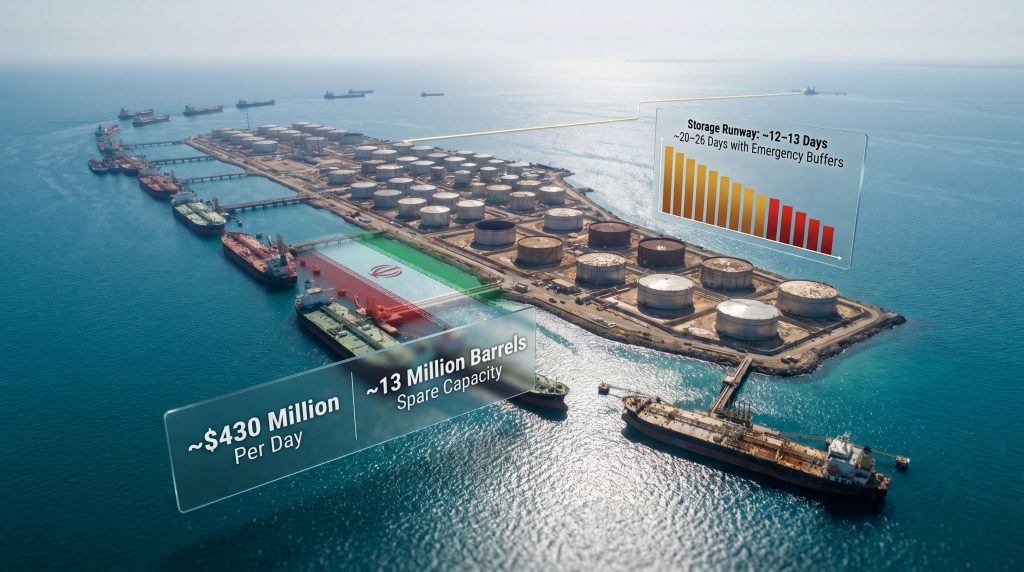
According to reporting by ZeroHedge via Oilprice.com (April 28, 2026), Kharg Island currently has roughly 13 million barrels of spare onshore storage remaining, while net inflows are running at approximately 1.0 to 1.1 million barrels per day. That arithmetic produces a saturation window of approximately 12 to 13 days under unchanged operating conditions, placing the potential fill point in late April to early May 2026.
Why This Is a Systems Problem, Not a Tanker Headline
It would be a mistake to read the situation as a shipping story about one vessel or one terminal. The Iran Kharg Island oil storage limit is fundamentally a systems constraint, connecting several layers of operational reality. Furthermore, understanding the oil logistics risk involved helps clarify why this extends far beyond a simple export delay:
- Upstream production stability: fields continue producing even as export capacity tightens
- Export logistics: loading rates, tanker queue management, and departure scheduling become increasingly strained
- Sanctions resilience: the ability to absorb disruptions depends entirely on buffer capacity
- Crude marketing flexibility: buyers need reliable loading windows to commit to purchases
- State revenue continuity: without exports moving, revenue generation halts regardless of production rates
When storage fills, the entire chain tightens simultaneously, leaving operators with no comfortable intermediate option.
How Close Is Kharg Island to Its Storage Ceiling?
Storage Math Readers Can Verify
The calculation underpinning current analyst concern is straightforward enough that any reader can replicate it independently:
- Spare onshore storage capacity: approximately 13 million barrels
- Estimated net daily inflow: 1.0 to 1.1 million barrels per day
- Division: 13 million barrels divided by 1.0 to 1.1 million bpd
- Result: saturation in roughly 11.8 to 13 days under current conditions
| Input Variable | Low Case | High Case | Key Implication |
|---|---|---|---|
| Spare Onshore Capacity (million bbl) | 12.5 | 13.5 | Uncertainty range of roughly ±4% |
| Net Daily Inflow (million bpd) | 1.0 | 1.1 | Higher inflows accelerate saturation |
| Onshore-Only Saturation (days) | 11.8 | 13.5 | Core 12-13 day estimate |
| With Floating Storage Addition (+2M bbl) | 13.6 | 15.5 | Extends runway by under 2 days |
| JP Morgan Total Capacity Estimate (days) | 20 | 26 | Includes all emergency measures |
JP Morgan's published assessment, as referenced in Oilprice.com's coverage, places the total available runway at 20 to 26 days when emergency measures including floating storage and alternative terminal utilisation are incorporated. The divergence between the 12-13 day onshore-only estimate and the 20-26 day total-capacity figure illustrates how methodological assumptions about what counts as accessible storage drive meaningfully different conclusions.
Why Days Remaining Is an Estimate, Not a Deadline
Several operational variables can shift the timeline in either direction, and readers should treat any specific figure as a conditional scenario rather than a deterministic forecast:
- Loading delays: berth congestion, maintenance windows, and regulatory inspections can reduce effective export throughput
- Weather disruptions: Persian Gulf seasonal conditions periodically reduce operational availability
- Export interruptions: geopolitical incidents, insurance complications, or strait access constraints can cause multi-day export halts
- Temporary diversions: partial rerouting through the Goreh-Jask pipeline could reduce Kharg inflows
- Floating storage deployment speed: reactivating idle tankers is not instantaneous and may not provide relief quickly enough
- Production curtailment: upstream field slowdowns can reduce inflows, but typically over days to weeks rather than immediately
Methodology note: Storage-crunch estimates are typically inferred from satellite imagery analysis, AIS vessel tracking, observed tanker draft changes, and export flow modelling rather than official disclosure from Iranian authorities. Readers should distinguish between reported figures, analyst assumptions, and independently verifiable shipping movements when assessing confidence intervals.
Onshore Storage vs. Floating Storage: A Meaningful Distinction
Onshore tank capacity and floating storage are not equivalent tools. They differ substantially across several dimensions:
| Characteristic | Onshore Storage | Floating Storage |
|---|---|---|
| Operating cost | Lower, infrastructure already amortised | Higher, ongoing demurrage and mooring costs |
| Loading/offloading efficiency | Faster, pipeline-connected | Slower, ship-to-ship or lighter transfer required |
| Weather sensitivity | Minimal | Higher, exposed to swell and wind |
| Deployment speed | Immediate (if capacity exists) | Days to weeks to reposition and connect |
| Scalability | Fixed by tank farm infrastructure | Can add vessels incrementally |
| Reliability risk | Lower with maintained infrastructure | Higher with aging or decommissioned tonnage |
Floating storage serves as a pressure valve in genuine emergencies, but its economics and logistics make it a stopgap rather than a structural substitute for onshore capacity. The current crude oil market provides important context for understanding why these distinctions carry significant commercial weight.
Why a Storage Crunch Threatens Oil Fields, Not Just Exports
The Chain Reaction When Tanks Stop Absorbing Crude
Storage saturation does not simply freeze exports in place. It triggers a cascading operational failure that works backwards through the system:
- Crude arriving at the terminal exceeds outbound loading rates
- Tank inventory builds toward operational maximum levels
- Storage buffer disappears, eliminating scheduling flexibility
- Operators face pressure to reduce field output to match what the terminal can absorb
- Controlled curtailments give way to emergency shut-in decisions if the problem is not resolved
Each step in that sequence reduces Iran's export revenue and increases the technical risk profile of its upstream assets simultaneously.
The Underappreciated Risk of Forced Well Shut-Ins
The technical dimension of forced shut-ins is less visible in mainstream coverage but arguably more consequential than the short-term revenue loss. Petroleum engineering literature, including resources published through the Society of Petroleum Engineers, documents several well-established risks associated with abrupt well stoppages:
- Reservoir pressure disruption: wells that are shut in without managed pressure reduction can experience uncontrolled pressure buildups or drops depending on reservoir conditions
- Difficult restart dynamics: re-establishing production after an unplanned shut-in requires careful pressure management and may take significantly longer than the original shutdown period
- Potential irreversible damage: in mature or naturally fractured reservoirs, sudden pressure changes can alter formation permeability in ways that permanently reduce productive capacity
- Scale and deposition risk: pausing flow allows paraffin wax, asphaltene, and mineral scale to deposit in wellbores and surface equipment, requiring costly remediation
The Oilprice.com report notes that if wells are forced to shut down due to lack of storage, this could cause permanent damage, with recovery described as both expensive and difficult. This is precisely why the threat of storage saturation carries strategic weight well beyond the immediate revenue impact. According to Fortune's analysis of Iran's oil production, the combination of a tightening naval blockade and storage constraints creates compounding operational pressures that could accelerate the timeline toward forced upstream curtailments.
Flaring as a Symptom of System Stress
Reports of increased flaring at Iranian production sites provide a visible indicator of system strain. Operators use flaring to manage associated gas that co-produces with crude oil, maintaining safer operating pressures at the wellhead without requiring full production stoppages. While flaring can buy time by reducing surface pressure, it does not address the underlying crude storage imbalance. It represents an operational workaround that generates emissions, wastes economically valuable hydrocarbons, and signals to satellite monitoring services and market analysts that the production system is operating outside normal parameters.
Is Reactivating Old Tankers a Meaningful Fix or Just an Emergency Patch?
What the M/T Nasha Actually Adds to the Equation
Iran's response to the approaching Iran Kharg Island oil storage limit includes reactivating the M/T Nasha, a roughly 30-year-old very large crude carrier (VLCC) that had been anchored and idle for several years. Maritime analysts, including vessel tracking service TankerTrackers.com, noted via social media on April 23, 2026 that the vessel was being repositioned as floating storage to absorb crude that needs to move through the system.
The M/T Nasha is estimated to provide approximately 2 million barrels of additional storage capacity. Against a daily inflow rate of 1.0 to 1.1 million barrels per day, the arithmetic reveals the limitation immediately.
How Much Extra Time Could 2 Million Barrels Actually Buy?
At net inflows of 1.0 to 1.1 million barrels per day, an additional 2 million barrels of floating storage capacity extends the total runway by approximately 1.8 to 2 days. This is not a solution; it is a brief delay.
When considered against the 12-13 day onshore saturation estimate, a 2-day extension is operationally marginal. It may allow slightly more time for diplomatic or logistical developments, but it does not materially change the fundamental constraint.
Operational Red Flags With Aging Tanker Reactivation
Beyond the limited capacity contribution, the M/T Nasha reactivation raises additional concerns observable through publicly available maritime tracking data:
- The vessel's repositioning journey reportedly took approximately 4 days, compared to a typical transit of 1.5 to 2 days for that route, suggesting mechanical limitations, slow steaming, or route modifications
- A 30-year-old VLCC carries elevated uncertainty around hull integrity, pump reliability, valve condition, and mooring system performance
- Insurance and certification status for an idle vessel of this age may limit its operational options, particularly under current sanctions conditions
- Repositioning speed constraints mean the vessel cannot be redeployed quickly if conditions change
Shipping intelligence platforms tracking AIS signals and vessel draft changes represent the most reliable source for independent verification of the vessel's condition, location, and loading status.
What Alternatives Does Iran Have If Kharg Nears Saturation?
The Goreh-Jask Pipeline and Jask Terminal as Relief Valve
Iran's secondary export pathway runs through the Goreh-Jask pipeline connecting inland production areas to the Jask Oil Terminal at Kooh Mobarak on the Gulf of Oman coast, bypassing the Strait of Hormuz entirely. In principle, diverting crude flows away from Kharg Island toward Jask could reduce inflow pressure at the primary terminal and extend the storage runway.
In practice, the utility of this diversion depends on factors that are difficult to verify externally: available storage capacity at Jask, the pipeline's current throughput utilisation, and whether the alternative terminal's storage is already substantially committed. As reported by Oilprice.com, Jask storage is described as limited and potentially already at or near capacity, which would substantially reduce its value as a relief mechanism.
Emergency Response Options and Their Trade-offs
| Option | Deployment Speed | Capacity Relief | Key Risk | Sustainability |
|---|---|---|---|---|
| Additional floating storage | Days to weeks | Moderate (2-3M bbl per vessel) | Cost, vessel condition, sanctions compliance | Short-term only |
| Upstream production cuts | Days to weeks | High if deep cuts implemented | Reservoir damage risk, revenue loss | Moderate-term |
| Goreh-Jask pipeline diversion | Immediate if capacity exists | Moderate if Jask has space | Uncertain capacity availability | Medium-term |
| Accelerated export loading | Immediate if ships available | High if tanker queue clears | Sanctions exposure for buyers | Dependent on access |
| Diplomatic resolution | Unpredictable | High if sanctions ease | Political and strategic concessions required | Long-term solution |
Scenario Modelling: Three Pathways Forward
Best case: Export flows partially normalise through diplomatic engagement or shipping lane adjustment, floating storage bridges the remaining gap, and upstream fields avoid material damage. Revenue impact is temporary and contained.
Base case: Storage remains critically tight, selective upstream curtailments begin at the most accessible fields, and economic strain intensifies. Iran continues deploying emergency measures while negotiating under increased pressure. Some reservoir stress occurs but permanent damage is avoided through managed reductions.
Stress case: Terminal saturation forces broad, unmanaged shut-ins across multiple fields. Reservoir pressure management fails at several sites, creating irreversible productive capacity loss. Export revenue collapses and the economic damage extends well beyond the immediate crisis period.
The next major ASX story will hit our subscribers first
How Large Is the Economic Risk If Storage Runs Out?
Daily Revenue Exposure From Trapped Barrels
Oilprice.com's coverage cites an estimated $430 million per day in export revenue exposure if Iranian crude cannot move out of the system. This figure is substantial, but its realised magnitude depends on several interconnected variables:
- The actual volume of crude successfully exported on any given day
- The sanctions discount applied to Iranian crude by purchasing counterparties
- Realised crude prices in global markets, which fluctuate with broader supply-demand dynamics
- Payment settlement channels and the ability to convert oil revenues into usable foreign exchange
- Crude already stored offshore in transit tankers, which may provide short-term revenue cushion
When Terminal Stress Becomes a Macroeconomic Problem
A storage bottleneck at an export terminal is not merely an oil logistics challenge. Consequently, when the terminal in question handles the majority of a nation's hydrocarbon revenues, the constraint propagates through the entire national economic architecture:
- Fiscal receipts decline as export volumes fall, reducing government revenue available for public spending
- Foreign exchange availability tightens as oil revenues represent the primary source of hard currency inflows
- Refinery feedstock planning becomes complicated if domestic refineries depend on Kharg throughput flows
- Energy-sector employment faces risk if upstream field curtailments persist beyond short durations
- Shipping insurance and freight costs escalate as counterparties price political and sanctions risk into every transaction
The result is that a storage-capacity problem at one terminal can metastasise into a balance-of-payments crisis with medium-term sovereign implications. The broader trade war impact on oil markets adds another layer of complexity to this already pressured environment.
How Market Participants May Interpret the Pressure
Traders and investors navigating this situation face a dual signal problem. Physical oil markets respond to actual supply disruptions with tightening spot prices and premium forward curves. Futures markets simultaneously price in the probability of diplomatic resolution that could restore flows. The two price signals can move in opposite directions over short timeframes, creating significant volatility and making hedging decisions genuinely complex.
Headline risk compounds this uncertainty. Analyst estimates spanning 12 days to 26 days represent a meaningful range, and each new data point, whether from satellite imagery, shipping trackers, or diplomatic channels, can trigger sharp reassessments in both directions. Understanding the broader oil price movements driven by geopolitical events helps contextualise these market reactions.
What Analysts Mean When They Say Iran Has Only Weeks Left
Reconciling Competing Estimates
The apparent contradiction between a 12-13 day saturation estimate and a 20-26 day total capacity estimate reflects genuinely different methodological choices rather than analytical error:
| Estimate | Timeline | What It Includes | What It Excludes |
|---|---|---|---|
| Onshore-only saturation | 12-13 days | Current spare tank capacity at Kharg | Floating storage, Jask capacity, emergency measures |
| JP Morgan total capacity | 20-26 days | Emergency floating storage, alternative terminals | Assumes successful rapid deployment of all options |
The gap between these figures represents the contested territory of emergency capacity: how quickly can floating storage be deployed, how much space exists at Jask, and how much crude is already stored offshore in transit tankers that have not yet been reported as delivered.
How Storage-Capacity Estimates Are Built
For readers unfamiliar with how energy analysts construct these estimates, the typical methodology involves:
- Satellite imagery analysis: commercial satellite providers can infer tank fill levels from roof position (floating-roof tanks), shadow analysis, and thermal signatures
- AIS vessel tracking: automatic identification system data reveals tanker positions, loading status, transit times, and queue formations at export terminals
- Draft-change analysis: comparing a vessel's waterline before and after port calls allows analysts to calculate approximate cargo volumes loaded or discharged
- Terminal throughput modelling: combining known tank farm capacity with observed export cadence generates inventory change estimates
- Production flow inference: upstream production estimates from field-level data and satellite monitoring are compared against export volumes to estimate net storage accumulation
None of these methods provides direct access to Iran's actual storage utilisation figures, which are not publicly disclosed. All estimates carry uncertainty bands that widen as the data becomes more inferential. Al Jazeera's reporting on Iran's storage capacity offers additional perspective on how these estimates have been interpreted across different analytical frameworks.
How Negotiations and Strategic Leverage Connect to Storage Pressure
Why Infrastructure Constraints Shift Bargaining Dynamics
When export infrastructure approaches saturation, the time horizon for decision-making compresses dramatically. A nation with months of storage buffer can negotiate from patience; a nation facing days of remaining capacity must make decisions under acute pressure. The Oilprice.com analysis observes that the threat of overcapacity is likely to push Iran toward the negotiating table in the near term, a point that reflects a broader principle in resource economics: physical constraints create a forcing function that political rhetoric cannot override indefinitely.
Counterparties who understand an adversary's storage position gain significant informational leverage. If external analysts can estimate within a few days when upstream curtailments become unavoidable, those running the blockade can calibrate their position accordingly. The geopolitical oil market dynamics at play here demonstrate how physical infrastructure and political strategy become deeply intertwined.
What Policy Analysts Would Want to Verify
Balanced analysis of this situation requires verification across multiple data streams before firm conclusions are drawn:
- Confirmed export departure records from tanker-tracking services to validate net inflow assumptions
- Independent satellite assessments of Kharg Island tank utilisation levels
- Goreh-Jask pipeline flow data or terminal utilisation estimates for Jask
- Field-level production reports where available through third-party monitoring
- Observed flaring frequency and intensity from satellite-based emissions detection services
Political statements about infrastructure timelines, from any party to a conflict, carry inherent incentive distortions and should be weighted accordingly against observable physical evidence.
Maritime and Regulatory Risk Factors in the Current Environment
Several additional risk dimensions compound the storage problem:
- Marine insurance: Protection and Indemnity clubs may limit or refuse coverage for tankers operating in contested waters, restricting the universe of vessels available for floating storage or export
- Sanctions compliance: buyers and their banks face secondary sanctions exposure, limiting the number of counterparties willing to load Iranian crude regardless of storage conditions
- Ship-to-ship transfer monitoring: evasive transfer practices to obscure crude origins attract regulatory scrutiny and create legal exposure for vessel owners
- Flagging and classification concerns: aging vessels reactivated from idle status may face challenges maintaining classification society certification
The Likely Operational Path If the Storage Ceiling Is Reached
Stage 1: Inventory Compression at the Terminal
The earliest visible signs of saturation include tanks approaching their operational maximum fill levels, a reduction in loading scheduling flexibility as berth windows tighten, and rising inefficiencies in the crude nomination and scheduling process. Buyers begin experiencing more frequent loading delays and cargo rescheduling.
Stage 2: Expensive Stopgaps and Rerouting Attempts
As onshore capacity fills, operators activate every available emergency measure: additional floating storage vessels are sourced and repositioned, Jask terminal receives diverted volumes where capacity permits, and vessel queues at Kharg lengthen as tanker arrival rates exceed departure rates. The logistics system becomes progressively less efficient and more expensive to operate.
Stage 3: Upstream Curtailment Risk
If emergency measures prove insufficient, selective field slowdowns begin. Fields with the simplest pressure management profiles are curtailed first. Associated gas handling stress increases, driving more flaring. The window for preventing reservoir damage narrows significantly at this stage.
Stage 4: Long-Tail Impact Beyond the Immediate Crisis
The consequences that persist beyond storage saturation include harder field restarts, higher well remediation costs, sustained export impairment even after any diplomatic resolution, and a longer economic drag that extends well past the original crisis duration. Permanent productive capacity loss at some fields would represent a generational setback for Iran's oil industry, making the decision calculus around negotiations genuinely existential in character.
FAQ: Iran Kharg Island Oil Storage Limit
What Is Kharg Island's Role in Iran's Oil Export System?
Kharg Island functions as Iran's primary crude export hub, with widely cited market reports suggesting the terminal processes approximately 90% of the country's energy exports. Its combination of onshore tank farm capacity, multiple loading berths, and pipeline connections to upstream producing regions makes it operationally irreplaceable in the near term.
How Many Days of Storage Capacity May Remain at Kharg Island?
Based on reporting via Oilprice.com (April 28, 2026), onshore-only estimates suggest approximately 12 to 13 days of remaining capacity at current inflow rates. JP Morgan's broader estimate, incorporating emergency measures, places the total runway at 20 to 26 days. The difference reflects methodological choices about which emergency storage options can realistically be deployed in time.
How Much Extra Capacity Does Floating Storage Add?
The M/T Nasha reactivation adds approximately 2 million barrels of floating storage capacity. At inflows of 1.0 to 1.1 million barrels per day, this translates to roughly 1.8 to 2 additional days of runway. Analysts characterise this contribution as operationally minor relative to the scale of the problem.
Why Are Forced Well Shut-Ins Considered Dangerous?
Abrupt well stoppages disrupt reservoir pressure management, create deposition risks in wellbores and surface equipment, and can alter formation permeability in ways that are difficult or impossible to reverse. Restarting production after an unplanned shut-in is technically demanding and costly, with some damage at mature fields potentially permanent depending on reservoir geology and shut-in duration.
Could the Jask Terminal Materially Reduce Pressure on Kharg Island?
Partial relief is theoretically possible if the Goreh-Jask pipeline has available throughput capacity and the Jask terminal has meaningful spare storage. However, as reported by Oilprice.com, Jask storage is described as limited and potentially already at high utilisation, which would substantially reduce its effectiveness as a pressure release mechanism.
What Is the Estimated Daily Economic Exposure?
Oilprice.com's coverage cites an estimated $430 million per day in export revenue exposure. This figure represents a reported estimate and realised losses would depend on actual export volumes achieved, the sanctions discount applied to Iranian crude, and the prevailing market price. The figure should be treated as an order-of-magnitude indicator rather than a precise forecast.
This Is a Network-Capacity Story, Not Just a Sanctions Headline
The Iran Kharg Island oil storage limit debate matters because it reveals how physical infrastructure constraints can become more decisive than political calculations in determining outcomes. The fundamental question is not whether Iran wants to export crude, but whether its export infrastructure, storage buffers, and upstream field management protocols can remain synchronised under sustained blockade pressure.
The decisive indicators to watch are storage drawdown velocity at Kharg, the rate of additional floating storage deployment, evidence of Goreh-Jask pipeline diversions in tanker tracking data, and whether observable field-level production signals suggest upstream curtailment has begun. These physical data points, rather than political statements from any party, will determine when the pressure becomes genuinely unsustainable and what shape any resulting accommodation takes.
This article is based on publicly available reporting and market analysis. All figures regarding storage capacity, inflow rates, and revenue exposure are reported estimates derived from analyst assessments and satellite-based monitoring, not official Iranian government data. Readers should treat timeline projections as conditional scenarios subject to significant operational variability. Nothing in this article constitutes investment advice.
Want to Stay Ahead of Resource Market Disruptions Like This One?
When geopolitical pressures reshape commodity flows at this speed, Discovery Alert's proprietary Discovery IQ model ensures subscribers receive real-time alerts on significant ASX mineral discoveries the moment they hit the exchange — turning complex market signals into actionable opportunities before the broader market reacts. Explore how historic mineral discoveries have generated substantial returns on Discovery Alert's dedicated discoveries page, and start your 14-day free trial today to position yourself ahead of the next major move.