
August 14, 2026
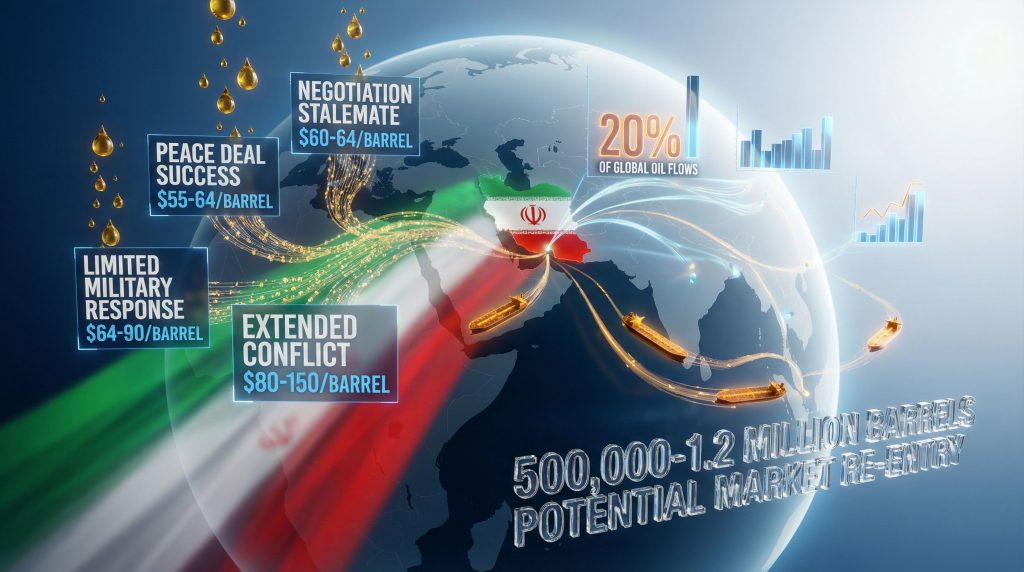
Global energy markets operate within intricate frameworks where diplomatic developments can trigger cascading price movements across commodity exchanges worldwide. Understanding these mechanisms requires examination of how negotiation cycles between major oil producers and international powers create systematic volatility patterns that extend far beyond immediate headlines.
The intersection of geopolitical diplomacy and petroleum markets represents one of the most complex risk assessment challenges facing traders, investors, and policymakers today. Iran nuclear negotiations impact on oil prices demonstrates this complexity through multiple transmission channels that convert diplomatic progress or setbacks into quantifiable market signals.
How Do Diplomatic Outcomes Create Systematic Oil Market Volatility?
The relationship between Iran nuclear negotiations and global petroleum pricing operates through several distinct mechanisms that transform political uncertainty into measurable economic outcomes. These mechanisms function across different timeframes, from immediate futures contract adjustments to longer-term supply chain recalibrations.
Recent market analysis from Skandinaviska Enskilda Banken demonstrates this dynamic in real-time conditions. During late February 2026 negotiation cycles, Brent crude exhibited trading ranges spanning $69.16 to $72.61 per barrel, reflecting what commodities analysts characterised as oscillation between diplomatic optimism and escalation concerns.
Key Transmission Mechanisms:
- Risk Premium Adjustments: Markets embed uncertainty premiums reflecting potential supply disruptions
- Supply Expectation Recalibration: Trader assessments of Iranian production re-entry possibilities
- Regional Contagion Pricing: Valuation of broader Middle East stability implications
- Strategic Reserve Positioning: Government and commercial inventory management responses
Understanding Market Psychology During Negotiation Periods
Oil market participants develop sophisticated probability assessments for different diplomatic outcomes, with these calculations directly influencing futures positioning and options market activity. The psychological component of these markets becomes particularly pronounced during weekend periods when negotiations continue but trading volumes decrease.
According to commodity market analysis, participants exhibit heightened nervousness before negotiation resumptions, leading to increased hedging activity and position adjustments. Furthermore, this behaviour pattern creates observable volatility spikes that can persist for 48-72 hour windows around key diplomatic events.
The Strait of Hormuz transit vulnerability adds another layer of complexity to these psychological dynamics. Approximately 20-21% of globally traded petroleum transits through this chokepoint, making any Iranian military posturing toward shipping lanes an immediate market concern regardless of actual implementation probability.
When big ASX news breaks, our subscribers know first
Strategic Scenario Framework for Price Modeling
Professional commodity analysts employ structured scenario analysis to model potential Iran nuclear negotiations impact on oil prices across different diplomatic outcomes. This framework approach enables systematic evaluation of probability-weighted price ranges rather than single-point forecasts.
Comprehensive Scenario Matrix:
| Diplomatic Outcome | Price Range ($/barrel) | Duration | Primary Drivers |
|---|---|---|---|
| Successful Nuclear Agreement | $55-64 | 6-12 months | Iranian supply restoration, risk premium unwinding |
| Negotiation Stalemate | $60-64 | 3-6 months | Status quo maintenance, moderate uncertainty |
| Limited Military Action | $64-90 | 2-4 weeks | Temporary risk premium spike, contained retaliation |
| Extended Regional Conflict | $80-150 | 3-12 months | Supply disruption, sustained geopolitical premium |
Scenario 1: Comprehensive Diplomatic Success
Under successful negotiation conditions, market analysts project rapid structural changes in global oil supply dynamics. Iranian crude re-entry would occur through phased sanction removal, enabling approximately 500,000 to 1.2 million barrels per day of additional market supply depending on infrastructure readiness and OPEC+ coordination responses.
Expected Market Sequence:
- Immediate Phase (Weeks 1-4): Risk premium unwinding drives $8-12 per barrel price decline
- Integration Phase (Months 2-6): Iranian crude gradually enters European and Asian markets
- Equilibrium Phase (Months 6-12): OPEC+ production adjustments accommodate new supply volumes
European refiners would gain particular benefit from Iranian crude availability as an alternative to higher-cost or politically sensitive supply sources. In addition, Asian buyers, especially China and India, would obtain additional negotiating leverage through expanded supplier optionality.
Scenario 4: Extended Regional Confrontation
The most severe scenario involves sustained military engagement with strategic Iranian focus on oil supply disruption through Strait of Hormuz interference. Analysis suggests this represents Iran's most effective economic leverage against Western powers due to the direct transmission from energy costs to consumer gasoline prices.
Strategic considerations under this scenario include:
- Supply Disruption Strategy: Partial rather than complete Strait closure maximises duration while limiting military escalation risks
- Economic Timing: Extended confrontation through electoral periods amplifies political pressure via consumer energy costs
- Market Response: Panic buying and strategic reserve releases create additional volatility beyond fundamental supply impacts
Professional market assessment indicates this scenario could generate sustained average prices of $80-100 per barrel over multiple months, with initial spikes reaching $100-150 per barrel during acute disruption periods.
Market Mechanism Analysis Behind Price Movements
The technical infrastructure connecting diplomatic developments to commodity price changes operates through several parallel channels that function at different speeds and scales. However, understanding these mechanisms enables better interpretation of market signals and volatility patterns.
Financial Market Response Systems
Immediate Response (Minutes to Hours):
- Algorithmic trading systems scan news feeds for diplomatic keywords
- Futures contract positioning adjusts based on probability recalculations
- Options market implied volatility shifts reflect changing uncertainty levels
- Currency markets respond through petrodollar flow expectations
Intermediate Response (Days to Weeks):
- Physical crude oil trading spreads adjust for potential supply changes
- Refined product futures incorporate transportation cost variations
- Regional price differentials shift based on alternative supply route assessments
- Commercial inventory strategies change reflecting new risk profiles
Supply Chain Vulnerability Mapping
Beyond the Strait of Hormuz chokepoint, Iran nuclear negotiations impact on oil prices through broader regional supply vulnerability assessments. Saudi Arabian, UAE, and Kuwaiti production facilities become elevated risk factors during escalation scenarios due to geographic proximity and historical targeting patterns.
Critical Infrastructure Assessment:
- Processing Facilities: Major refineries and export terminals within missile range
- Pipeline Networks: Cross-border and domestic distribution systems
- Storage Capacity: Strategic and commercial petroleum reserves
- Shipping Routes: Alternative pathways around potential Strait disruption
Regional producers maintain spare capacity management strategies specifically for crisis scenarios, though this capacity faces limitations during sustained disruption periods. Current spare capacity estimates suggest 3-5 million barrels per day of potential emergency production increases, though activation timelines vary significantly.
OPEC+ Strategic Positioning During Negotiation Cycles
The Organization of the Petroleum Exporting Countries and its allies face complex balancing requirements during Iran nuclear negotiation periods. These requirements involve managing current market stability while positioning for potential Iranian re-entry or extended regional disruption scenarios.
Production Coordination Challenges
Pre-emptive Capacity Management:
OPEC+ members must maintain sufficient spare production capacity to respond to potential supply disruptions while avoiding market oversupply during stable periods. Consequently, this balancing act becomes particularly challenging when Iranian negotiation outcomes remain uncertain for extended periods.
Market Share Considerations:
Saudi Arabia and UAE, as the largest OPEC+ producers, face strategic decisions about market positioning relative to potential Iranian supply restoration. Historical analysis shows these producers typically reduce output gradually to accommodate Iranian re-entry rather than defending market share through sustained production.
Revenue Optimisation Framework:
Higher oil prices during negotiation uncertainty periods benefit OPEC+ member revenues, creating incentives for measured response to supply disruption risks. However, prices above $100 per barrel historically trigger demand destruction and accelerated alternative energy adoption.
Strategic Reserve Utilisation Protocols
Government strategic petroleum reserves represent the primary mechanism for managing acute supply disruptions during Iran-related crises. The International Energy Agency coordinates release protocols among member nations, with capacity for 60-240 million barrel emergency releases depending on crisis severity and duration.
Coordinated Response Mechanisms:
- Phase 1: Announcement of reserve availability to moderate initial price spikes
- Phase 2: Actual reserve releases calibrated to disruption scale
- Phase 3: Commercial inventory mobilisation and alternative supply activation
Bilateral agreements between major consuming nations, particularly US-China-India coordination protocols, provide additional market stabilisation capacity beyond formal IEA frameworks.
Financial Market Intelligence Through Options Analysis
Oil options markets provide sophisticated insight into trader expectations regarding Iran nuclear negotiations impact on oil prices. These derivative instruments reveal probability-weighted assessments of different price outcome scenarios through premium structures and trading volumes.
Options Market Signal Analysis
Call Option Activity Patterns:
During negotiation tension periods, call option purchasing increases significantly at $80-100 strike prices, indicating trader preparation for upside price movements. Volume analysis shows institutional buyers typically dominate this activity, suggesting professional rather than speculative positioning.
Put Option Hedging Strategies:
Refinery operators and other oil consumers increase put option purchases to protect against sudden price declines from successful negotiations. For instance, this hedging creates observable premium patterns that reveal market consensus regarding negotiation success probabilities.
Volatility Premium Evolution:
Implied volatility metrics increase 40-60% during active negotiation periods compared to baseline levels. This premium expansion reflects uncertainty value rather than directional price bias, providing insight into market confidence levels.
Multi-Asset Correlation Effects
Iran nuclear negotiations impact extends beyond petroleum markets through currency, bond, and equity market correlations. These relationships create additional analytical frameworks for assessing negotiation outcome probabilities and economic implications, which helps understand the broader global trade impact of diplomatic developments.
Currency Market Relationships:
- US Dollar Strength: Typically accompanies oil price declines from successful negotiations
- Emerging Market Currencies: Iranian deal success supports oil-importing developing nations
- Commodity Currencies: Canadian dollar, Norwegian krone correlations with energy price movements
Government Bond Market Signals:
- Inflation Expectations: Energy price volatility influences interest rate policy expectations
- Safe Haven Demand: Government bond flows during geopolitical uncertainty periods
- Real Interest Rates: Commodity price impacts on monetary policy assessment
Long-Term Strategic Energy Security Implications
Successful Iran nuclear negotiations would accelerate several structural changes in global energy security architecture beyond immediate price effects. These changes involve supply diversification, investment flow redirection, and geopolitical relationship realignments with multi-decade implications.
Supply Diversification Acceleration
Iranian oil re-entry into global markets would provide consuming nations with enhanced supply security through reduced dependency concentration. European nations would gain particular benefit through alternatives to Russian energy supplies, while Asian consumers would obtain additional negotiating leverage with existing suppliers.
This situation differs significantly from current oil price stagnation dynamics where supply constraints create sustained pricing pressure. Furthermore, the US oil production decline makes alternative supply sources increasingly valuable for market stability.
Regional Impact Assessment:
- European Energy Independence: Iranian alternatives reduce Russian dependency vulnerability
- Asian Supply Security: Additional non-OPEC Gulf source for China, India, Japan energy needs
- Global Price Stability: Increased spare capacity reduces market manipulation potential
Investment Capital Redirection Patterns
Successful Iranian integration into global energy markets would trigger significant capital allocation shifts across the petroleum industry. These movements would affect competing producers, alternative energy development, and regional infrastructure requirements.
Capital Flow Analysis:
- Iranian Infrastructure: $50-100 billion potential investment influx for production expansion
- Competing Producers: Reduced investment attractiveness in higher-cost production regions
- Renewable Acceleration: Price volatility experiences historically drive clean energy investment increases
Geological assessments indicate Iran possesses substantial underdeveloped petroleum reserves that could support sustained production increases with appropriate technology and capital investment. These resources include both conventional fields and enhanced recovery opportunities from existing infrastructure.
Geopolitical Realignment Effects
Long-term Iran nuclear negotiations impact would operate through fundamental changes in Middle Eastern geopolitical balance and global energy diplomacy patterns. These changes would affect military positioning, economic partnerships, and regional influence distribution, similar to how trade war oil impact has reshaped global supply chains.
Strategic Relationship Evolution:
- Middle East Balance: Iranian economic integration versus Saudi regional influence
- US Military Positioning: Reduced Gulf military presence requirements with stable energy supplies
- China-Iran Relations: Economic partnership expansion opportunities through energy cooperation
Regional producers would face intensified competition for Asian market share, potentially accelerating economic diversification efforts and alternative revenue development strategies. This competition contrasts with recent patterns seen in oil price rally analysis where supply constraints supported higher prices.
The next major ASX story will hit our subscribers first
Understanding Iran Negotiation Market Impact: Essential Questions
How quickly do markets respond to diplomatic developments?
Oil futures contracts typically exhibit price movements within minutes of major diplomatic announcements during active negotiation periods. Professional trading systems monitor news feeds continuously, creating immediate responses to substantive developments.
What price levels indicate market confidence in negotiation success?
Sustained Brent crude prices below $65 per barrel typically signal market confidence in diplomatic progress, while movements above $80 per barrel suggest escalation concerns. The $65-80 range often reflects uncertainty and mixed probability assessments.
How do negotiation developments affect retail gasoline prices?
Consumer gasoline prices typically lag crude oil movements by 2-4 weeks due to refinery processing and distribution system delays. Successful negotiations could reduce pump prices by $0.20-0.40 per gallon over 2-3 month periods.
Which nations benefit most from successful Iranian negotiations?
Major petroleum importing countries including China, India, Japan, and European Union members benefit through increased supply options and reduced prices. Oil exporting nations face market share competition but may benefit from overall demand growth.
What duration do negotiation-related price effects typically maintain?
Immediate volatility from diplomatic announcements subsides within 1-2 weeks, but structural price changes from actual supply modifications can persist 6-18 months. The persistence depends on OPEC+ response strategies and actual Iranian production integration rates.
Investment Disclaimer: This analysis contains forward-looking assessments and scenario projections that involve substantial uncertainty. Oil price movements depend on numerous factors beyond diplomatic outcomes, including global economic conditions, weather patterns, and technological developments. Commodity investments carry significant risk and may not be suitable for all investors.
Ready to Capitalise on Commodity Market Volatility?
Discovery Alert's proprietary Discovery IQ model provides instant notifications on significant ASX mineral discoveries, helping investors navigate market volatility across multiple commodity sectors with real-time intelligence. Stay ahead of market movements by exploring Discovery Alert's proven track record of identifying major discoveries, or begin your 14-day free trial today to gain an immediate market advantage.