August 14, 2026
The Machinery of Modern Economic Statecraft: How the U.S. Targets Iran's Oil Revenues
For decades, broad trade embargoes were the dominant weapon in the sanctions arsenal. A country would be cut off from global commerce in sweeping, often blunt terms. The effectiveness of this approach was always limited by the same problem: where there is commercial demand, traders find supply. What has changed fundamentally in recent years is not the political will to apply pressure, but the precision of the tools used to do so. The evolution of how the U.S. sanctions Iranian oil export vessels illustrates this shift in vivid detail, moving from economy-wide restrictions toward the surgical dismantling of specific vessels, exchange networks, and corporate structures that keep sanctioned oil flowing.
When big ASX news breaks, our subscribers know first
From Sector-Wide Restrictions to Vessel-Level Designations
The transformation in how Washington applies financial pressure on Tehran represents one of the most significant doctrinal shifts in U.S. foreign economic policy of the past two decades. Early sanctions regimes targeting Iran focused on banking exclusions and technology transfer bans. The logic was simple: cut off access to capital and technology, and the energy sector would wither.
What policymakers did not fully anticipate was the adaptability of the Iranian export ecosystem. Over time, Tehran constructed an elaborate parallel infrastructure, combining opaque shipping arrangements, offshore corporate layering, and alternative currency exchange mechanisms to keep oil revenues flowing. The response from the U.S. Treasury Department's Office of Foreign Assets Control (OFAC) has been to match that complexity with equally granular enforcement actions.
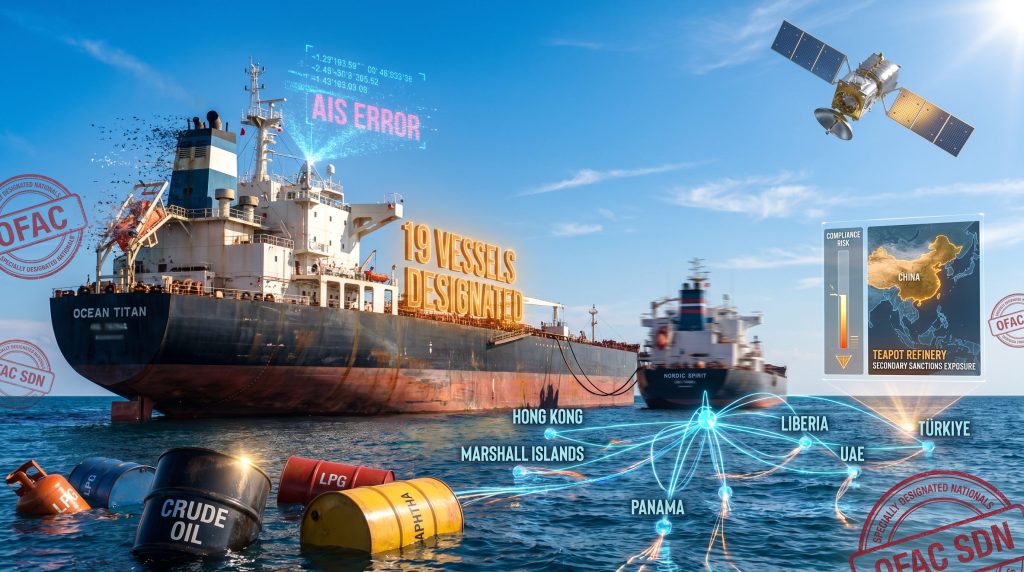
The designation of 19 vessels in May 2026, announced as part of the administration's stated "Economic Fury" campaign, is a clear expression of this matured doctrine. Rather than restricting an entire industry or financial sector, OFAC identified discrete nodes within Iran's export logistics chain and placed them on the Specially Designated Nationals (SDN) list simultaneously across shipping, financial intermediary, and trading company categories. Furthermore, the broader geopolitical landscape surrounding energy markets has made these enforcement tools increasingly consequential.
What Is Iran's Shadow Fleet and How Does It Operate?
The term "shadow fleet" has gained wide usage in energy policy circles, but its operational mechanics are less well understood outside specialist communities. These are not simply old or poorly maintained tankers. They are vessels deliberately configured for plausible deniability, operated through ownership structures designed to frustrate identification and enforcement.
Four core techniques define shadow fleet operations:
- AIS signal manipulation: Vessels disable or falsify Automatic Identification System transponders, the maritime equivalent of turning off a GPS tracker, to obscure their real-time position and port calls.
- Ship-to-ship (STS) transfers: Cargo is transferred between vessels in international waters, breaking the documentary chain of custody that would otherwise connect the cargo to its Iranian origin port.
- Flag-hopping: Vessels rapidly re-register under different national flags, exploiting permissive registries that conduct minimal due diligence on vessel histories or ownership structures.
- Layered corporate ownership: Beneficial ownership is concealed through cascading shell company arrangements spanning multiple offshore jurisdictions, making enforcement legally and logistically complex.
The jurisdictional spread of shadow fleet infrastructure is deliberately diverse. Corporate ownership layering and financial routing tend to concentrate in Hong Kong, while flag-of-convenience registrations cluster in Marshall Islands, Panama, and Liberia. Front company operations and financial facilitation have been identified in the UAE and Türkiye, with each jurisdiction playing a distinct role in the overall evasion architecture.
The Exchange House Problem: Shadow Banking Fills the Gaps
Equally important, and often underappreciated, is the role of alternative financial infrastructure in sustaining these operations. When sanctioned Iranian banks cannot access SWIFT or correspondent banking networks, currency exchange houses step in to perform the same functions through less regulated channels.
OFAC's May 2026 action specifically targeted Amin Exchange, an Iran-based foreign currency network that officials identified as a major financial conduit for sanctioned Iranian banks, petrochemical exporters, and the National Iranian Oil Company. According to OFAC, this entity operated front companies across the UAE, Türkiye, and Hong Kong to support cross-border financial flows tied to Iranian oil and petrochemical trade, functioning as a financial bridge that exists entirely outside conventional banking channels. The full scope of sanctions on oil trading reflects how these mechanisms have become a consistent feature of sanctioned-state export strategies.
Commodity Categories and Strategic Significance
The May 2026 designations covered a wider range of commodities than many previous actions, reflecting Iran's increasingly diversified export base. The following table illustrates why each commodity carries strategic weight:
| Commodity | Strategic Significance to Iran | Typical Buyer Profile |
|---|---|---|
| Crude Oil | Primary revenue generator | Asian independent refiners |
| LPG | Residential and industrial fuel exports | Regional Asian markets |
| Methanol | Petrochemical feedstock | Industrial buyers globally |
| Naphtha | Refinery feedstock and petrochemical input | East Asian processors |
| Petrochemicals | High-value derivative exports | Diversified global buyers |
The inclusion of methanol, naphtha, and petrochemicals alongside crude oil and LPG signals that U.S. enforcement attention has expanded well beyond raw crude exports. Iran has invested heavily in downstream processing capacity precisely to diversify revenue streams and reduce dependence on crude oil pricing cycles. Targeting these derivative commodity flows represents a meaningful tightening of the compliance perimeter.
Secondary Sanctions and the Exposure of Third-Party Buyers
Perhaps the most consequential dimension of the latest enforcement round is not the vessel designations themselves, but the explicit warning directed at third-party buyers. Secondary sanctions extend the jurisdictional reach of U.S. financial law to non-American entities that continue transacting with designated parties, even if those transactions occur entirely outside U.S. territory and involve no U.S. persons.
The Treasury Department's public statements specifically referenced Chinese independent refineries, colloquially known as "teapot" refineries, as entities at risk of secondary sanctions exposure. These smaller, privately owned processing facilities have historically operated with limited integration into Western financial systems, which made them attractive buyers of discounted sanctioned crude. Their relative insulation from U.S. banking infrastructure was long viewed as a form of protection. The explicit naming of this buyer category as a secondary sanctions target represents a direct escalation of enforcement pressure. For context, sanctions on oil trading administered through OFAC outline the precise legal framework underpinning these designations.
Financial institutions operating in any jurisdiction with exposure to Iranian energy trade must conduct enhanced due diligence on vessel ownership chains, screen counterparties against updated SDN lists, monitor for AIS anomalies and STS transfer indicators, and carefully assess correspondent banking relationships touching high-risk jurisdictions.
Geopolitical Context: The Strait of Hormuz and Regional Conflict Dynamics
Sanctions enforcement against Iranian oil infrastructure is not occurring in a vacuum. The announcement of the May 2026 designations coincided with continued disruption tied to the Strait of Hormuz crisis, a chokepoint through which approximately 20% of global oil supply transits. Regional conflict dynamics have compounded pre-existing logistical pressures on global crude and LNG markets, with NATO reportedly weighing operational options to address deepening shipping disruptions.
This intersection of sanctions policy and active geopolitical conflict creates a feedback loop that amplifies market sensitivity. When enforcement actions effectively remove Iranian barrels from accessible supply pools at the same time that Strait of Hormuz transit risk is elevated, the combined effect on freight rates, route diversions, and spot market pricing can be significantly larger than either factor would produce in isolation. In addition, the trade war oil markets dynamic has further complicated the broader picture for energy traders navigating these overlapping pressures.
The next major ASX story will hit our subscribers first
Comparing Shadow Fleet Operations Across Sanctioned Exporters
Iran's shadow fleet does not operate in isolation as a case study. The mechanics developed for Iranian crude evasion have been adapted and deployed by other sanctioned exporters, creating what analysts increasingly describe as a globalised grey-market tanker ecosystem.
| Sanctioned Country | Primary Commodity | Key Shadow Fleet Tactics | Main Buyer Regions |
|---|---|---|---|
| Iran | Crude oil, LPG, petrochemicals | AIS spoofing, STS transfers, flag-hopping | China, East Asia |
| Russia | Crude oil, refined products | Flag-hopping, opaque ownership structures | India, China, Middle East |
| Venezuela | Crude oil | Ship-to-ship transfers, front companies | China, Caribbean |
The cross-pollination of evasion techniques between these three supply ecosystems has created enforcement challenges that no single designation round can fully resolve. Shadow fleet operators in all three contexts have demonstrated the ability to source replacement vessels, reconstitute ownership structures, and adapt registry arrangements in timeframes that outpace the cadence of OFAC designations. However, the Venezuela oil policy shift illustrates how geopolitical recalibration can fundamentally alter the dynamics of any one sanctioned exporter's market position.
Maritime Compliance: Insurance, Port Access, and Surveillance Technology
When a vessel receives an SDN designation, the practical consequences extend well beyond the legal prohibition on U.S.-person transactions. Designated vessels lose access to Protection and Indemnity (P&I) club coverage from Western marine insurance markets, which is a prerequisite for calling at most major international ports. They face exclusion from bunkering services, inability to arrange crew payments through conventional banking channels, and risk of physical seizure in jurisdictions cooperating with U.S. enforcement requests.
The growing scale of shadow fleet operations has placed the traditional marine insurance market under structural pressure. Underwriters are being asked to conduct increasingly granular due diligence on vessel ownership chains that may span five or six corporate layers across as many jurisdictions. Furthermore, the oil price shock experienced across energy markets has heightened the urgency of accurate compliance assessments for insurers and port operators alike.
Simultaneously, enforcement technology is advancing. Satellite-based AIS monitoring, cross-referenced with optical satellite imagery, has significantly improved the ability to detect STS transfers in international waters that were previously invisible to port state authorities. Emerging applications of machine learning to vessel behaviour analysis, including anomaly detection in speed, heading, and transponder activity patterns, are beginning to narrow the technical advantage that shadow fleet operators have long exploited. For instance, the SHIP Act framework provides a detailed legislative basis for how satellite-enabled tracking is being formally integrated into enforcement mechanisms.
Frequently Asked Questions: U.S. Sanctions on Iranian Oil Export Vessels
What Does OFAC Designation Mean for a Vessel in Practice?
An SDN-listed vessel is effectively locked out of Western financial infrastructure. Insurers, port operators, bunkering companies, and financial institutions in cooperating jurisdictions will not service it, and any non-U.S. entity that continues to engage with it faces secondary sanctions exposure.
What Are Teapot Refineries and Why Are They Specifically Targeted?
Chinese independent refineries, known informally as teapot refineries, are privately owned processing facilities that have historically purchased discounted Iranian crude because their limited Western banking exposure reduced their perceived sanctions risk. U.S. Treasury's explicit identification of this buyer category signals a significant expansion of secondary enforcement pressure.
How Does the Shadow Fleet Differ from Standard Commercial Shipping?
Legitimate commercial vessels maintain consistent AIS transmission, stable ownership registrations, and transparent documentation. Shadow fleet vessels are characterised by frequent name and flag changes, deliberate AIS manipulation, mid-ocean STS transfers, and multi-layered offshore ownership designed to resist identification.
Do These Designations Affect Global Oil Prices?
Effective enforcement that removes meaningful Iranian supply volumes from accessible markets can contribute to tighter supply conditions. The actual price impact depends on enforcement effectiveness, OPEC+ production decisions, and the availability of alternative supply. This analysis reflects observable market dynamics and should not be interpreted as a price forecast.
Key Dimensions of the May 2026 Enforcement Action
| Dimension | Key Finding |
|---|---|
| Vessels designated | 19 across crude tanker, LPG carrier, and chemical tanker categories |
| Commodities covered | Crude oil, LPG, methanol, petrochemicals, naphtha |
| Financial network targeted | Amin Exchange, operating front companies in UAE, Türkiye, and Hong Kong |
| Secondary sanctions focus | Chinese independent teapot refineries explicitly identified |
| Broader enforcement trend | Vessel-level and entity-level precision targeting replacing sector-wide restrictions |
| Market context | Strait of Hormuz disruptions compounding global crude and LNG supply pressure |
Probable Enforcement Trajectories: Three Scenarios
The trajectory of how the U.S. sanctions Iranian oil export vessels is unlikely to remain static. Three plausible paths forward carry meaningfully different implications for energy markets and compliance risk:
- Escalation continuation: Further OFAC designation rounds expand to cover additional vessel operators, flag registries, and Asian financial intermediaries, steadily tightening the compliance perimeter and reducing the pool of vessels willing to carry Iranian cargoes.
- Diplomatic adjustment: Temporary licensing exemptions or waivers are issued for specific cargoes already in transit, moderating immediate market disruption while preserving the underlying enforcement architecture for future application.
- Evasion technique adaptation: Shadow fleet operators accelerate adoption of newer countermeasures, including decentralised payment systems and AI-assisted AIS manipulation, requiring a corresponding evolution in satellite surveillance and behavioural analytics capabilities on the enforcement side.
Each scenario carries distinct implications for freight markets, Asian refinery margins, and the long-term viability of Iran's parallel export infrastructure. Market participants, compliance officers, and policymakers will each weigh these trajectories differently depending on their exposure and objectives.
This article is intended for informational purposes only and does not constitute legal, financial, or compliance advice. Readers should consult qualified advisors regarding specific sanctions exposure and regulatory obligations. Further coverage of upstream energy regulatory developments and maritime trade disruptions is available from World Oil at worldoil.com.
Want To Know Which ASX Mineral Discoveries Are Emerging Amid Shifting Commodity Markets?
As geopolitical disruptions reshape global energy and commodity supply chains, identifying significant ASX mineral discoveries ahead of the broader market has never been more critical. Discovery Alert's proprietary Discovery IQ model delivers real-time alerts on major ASX mineral discoveries — explore the historic returns major discoveries have generated and begin a 14-day free trial to position yourself at the forefront of the next significant find.