July 9, 2026
The Architecture of Conditional Diplomacy: How Performance-Based Sanctions Relief Unravels
Few instruments in U.S. foreign policy are as structurally fragile as the conditional sanctions waiver. Unlike formal sanctions rollbacks, which require legislative or executive order-level action, a general license issued by the Treasury Department's Office of Foreign Assets Control (OFAC) can be revoked within hours. That reversibility is, by design, the point. Washington uses it as a behavioural compliance lever. When the lever stops working, the licence disappears. What happened in the Strait of Hormuz on 7 July 2026 demonstrated precisely how quickly that architecture can collapse under geopolitical pressure.
The Iran oil sanctions revocation after Strait of Hormuz tanker attacks represents one of the most compressed policy cycles in recent U.S. sanctions history: a 60-day waiver framework dismantled in just 16 days. Understanding why it collapsed, how the mechanics operated, and what the market consequences are requires examining each layer of the story separately.
When big ASX news breaks, our subscribers know first
General License X: What Was Actually Authorised and Why
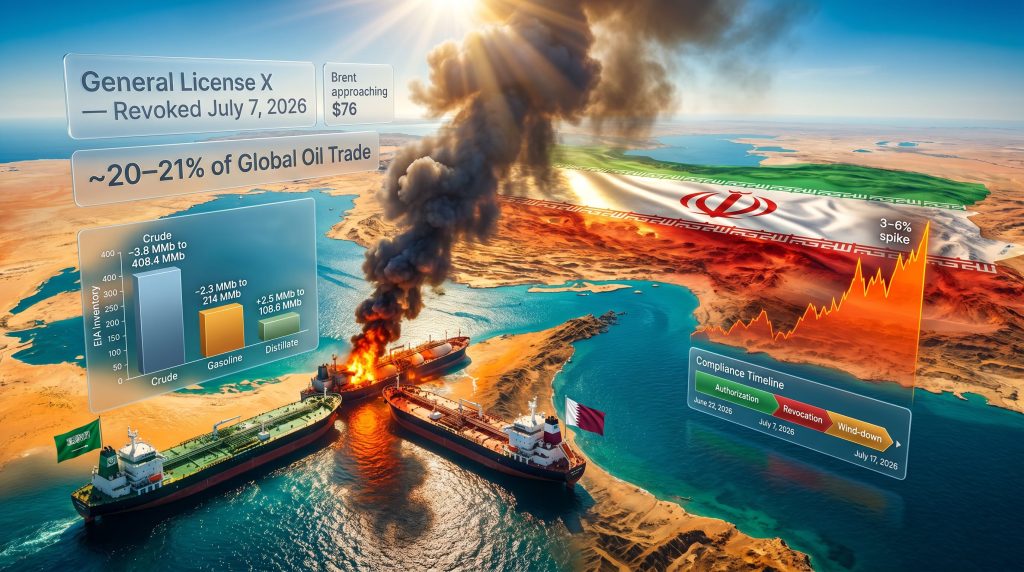
On 22 June 2026, OFAC issued General License X under the authority of the International Emergency Economic Powers Act (IEEPA), providing temporary authorisation for the production, sale, and transportation of Iranian-origin crude oil, petrochemical products, and petroleum products. The licence was embedded within a broader U.S.-Iran interim agreement framework that had been quietly constructed over preceding months.
The authorisation was never intended as a permanent sanctions rollback. It was structured as a performance-based instrument: Iran would receive access to oil export revenues in exchange for demonstrable behavioural compliance, most critically the maintenance of safe commercial navigation through the Strait of Hormuz.
The strategic logic behind this design was deliberate:
- A temporary, revocable waiver preserves Washington's ability to rapidly reimpose maximum economic pressure without requiring new legislative action.
- It creates asymmetric leverage: Iran gains tangible economic relief immediately, while the U.S. retains the switch to reverse that relief within hours.
- The 60-day operational window through 21 August 2026 was calibrated to provide sufficient time to assess Iranian behavioural compliance before committing to longer-term relief.
- Crucially, the waiver did not constitute a formal recognition of Iran's oil sector legality under U.S. law.
This distinction between a general licence and a formal sanctions rollback is widely misunderstood in public discourse. A general licence is an OFAC administrative authorisation, revocable without Congressional approval or new executive orders. A formal sanctions rollback would require unwinding the underlying executive orders or statutory frameworks that impose the sanctions themselves. General License X was never the latter.
The July 7 Incident: What Happened in the Strait of Hormuz
The Tanker Attacks That Triggered Revocation
On 7 July 2026, three commercial vessels were struck by drones and projectiles in and near the Strait of Hormuz. The attacks targeted a Saudi-flagged vessel called the Wedyan, the Qatari LNG tanker Al Rekayyat, and a third commercial ship. Qatar attributed the strike on the Al Rekayyat directly to an Iranian drone, which ignited an engine-room fire aboard the vessel. Saudi Arabia formally condemned the Iranian strike on its tanker as it transited the strait.
The Joint Maritime Information Center (JMIC) responded by elevating the maritime threat level in the Strait of Hormuz to severe, signalling that continued hostile action by Iranian forces against commercial shipping was assessed as a likely ongoing risk rather than an isolated incident.
The U.S. characterised the strikes as an unjustified and hazardous breach of the ceasefire terms that had underpinned General License X. The Treasury's response was almost instantaneous.
The speed of the JMIC threat-level elevation to "severe" is significant beyond the immediate insurance implications. It signals that Western maritime intelligence assessed Iranian action as systematic rather than opportunistic, which directly influenced the speed and permanence of the Treasury's revocation decision.
Why the Framework Collapsed So Quickly
Within hours of the attacks being confirmed, the U.S. Treasury revoked General License X effective 7 July 2026. The 16-day window between issuance on 22 June and revocation on 7 July exposed a structural vulnerability in performance-based diplomacy: it presupposes that the party receiving relief has both the intention and capacity to control actors operating under its broader strategic umbrella.
Furthermore, when proxy dynamics or factional actors within Iran's security apparatus can independently trigger ceasefire violations, bilateral compliance frameworks become extremely difficult to enforce. The broader geopolitical trade tensions at play in the region had, in many respects, made this outcome foreseeable.
From General License X to General License X1: The Wind-Down Mechanics
The revocation of General License X did not create a legal vacuum. It was replaced immediately by General License X1, a wind-down instrument rather than a continuation of oil trade authorisation. The mechanics of this transition carry significant compliance implications for market participants.
| Provision | Detail |
|---|---|
| Revocation Date | 7 July 2026 |
| Wind-Down Deadline | 17 July 2026 |
| New Transactions | Prohibited from 7 July |
| Existing Transactions | Permitted to conclude before 17 July |
| Payments Involving Blocked Persons | Must be deposited into blocked, interest-bearing U.S. accounts |
| Scope of Prohibition | Iranian crude oil, petrochemicals, and petroleum products |
The 10-day wind-down window from 7 July through 17 July is a standard OFAC mechanism designed to prevent immediate contractual defaults and allow supply chains to disentangle without catastrophic legal exposure. However, the prohibition on new purchases and cargo loading effective 7 July is absolute.
Any vessel that loaded Iranian-origin crude after that date, regardless of pre-existing commercial arrangements, would be operating outside the authorised framework and subject to full OFAC enforcement. For shipping operators, cargo insurers, and commodity traders, 17 July 2026 represents a hard compliance cliff.
EIA Inventory Data and the Market Divergence That Preceded the Shock
What the Numbers Revealed
Before geopolitical risk overwhelmed market fundamentals, the EIA's weekly inventory report released on 1 July 2026 had already generated complex mixed signals for crude traders. For broader context on how these figures fit into the current landscape, the crude oil market overview highlights the volatility that preceded this period.
| Product | EIA Inventory Change | Analyst Forecast | Market Reaction |
|---|---|---|---|
| Crude Oil | -3.8 MMb (to 408.4 MMb) | -4.5 MMb | Brent -1.6%, WTI -1.0% |
| Gasoline | -2.3 MMb (to 214 MMb) | -1.0 MMb | Gasoline futures +1.1% |
| Distillates | +2.5 MMb (to 108.6 MMb) | -0.5 MMb | Diesel futures +0.4% |
| Refinery Throughput | +85 Mb/d | N/A | Supported refinery margins |
| Refinery Utilisation | 96.6% (+0.5 pp) | N/A | Supported refinery margins |
The crude draw came in smaller than analyst projections, which Brent markets interpreted as mildly bearish, contributing to a 1.6% decline in Brent futures and approximately a 1.0% fall in WTI. Meanwhile, the larger-than-expected gasoline draw, reflecting strong domestic refinery demand at 96.6% utilisation, drove gasoline futures up 1.1%.
The distillate build of 2.5 million barrels against an expected decline of 0.5 million barrels is the more analytically interesting data point. Rising distillate inventories alongside high refinery utilisation suggest that gasoline and diesel production are running at divergent rates relative to seasonal demand.
Crude stocks at the Cushing, Oklahoma delivery hub rose by 709,000 barrels over the same period, adding to the bearish crude signal even as gasoline fundamentals tightened. However, all of these nuances were rendered largely irrelevant to price formation within days, as the Hormuz attacks and the Iran oil sanctions revocation imposed a geopolitical risk premium that displaced inventory fundamentals as the dominant market driver.
The Hormuz Chokepoint: Why Disruption Risk Is Uniquely Severe Here
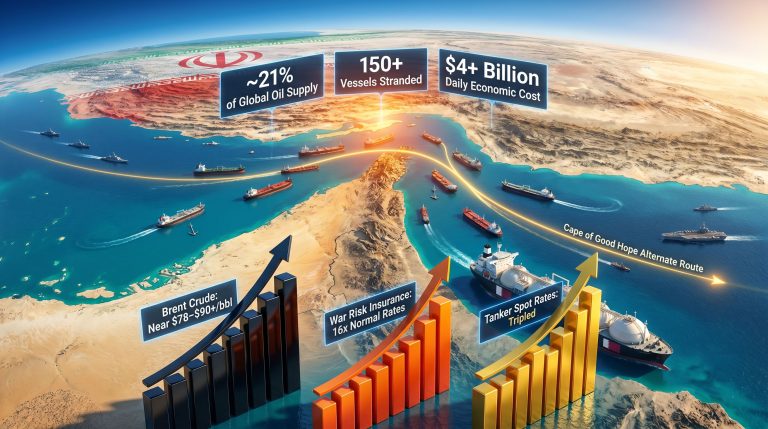
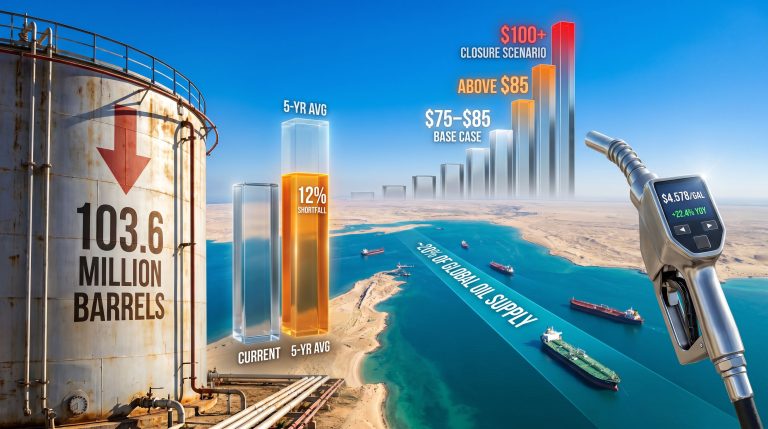
The Strait of Hormuz is approximately 33 kilometres wide at its narrowest navigable point, with two shipping lanes of just three kilometres each separated by a buffer zone. Approximately 20 to 21 percent of global oil trade transits this strait annually, including the bulk of export volumes from Saudi Arabia, the UAE, Kuwait, Iraq, and Bahrain.
Qatar's LNG exports, representing roughly 30 percent of global LNG trade, also transit exclusively through Hormuz before reaching the Gulf of Oman. There is no viable alternative routing for the volumes currently moving through the strait at scale.
Iran holds what analysts sometimes call the chokepoint leverage paradox: its ability to threaten global oil supply is vastly disproportionate to its own share of that supply. Consequently, this gives Iran negotiating power that persists even under severe sanctions pressure. The OPEC market influence over spare capacity decisions will be critical in determining how quickly any supply gap can be addressed.
The next major ASX story will hit our subscribers first
Scenario Analysis: Where Oil Markets Go From Here
Following the Iran oil sanctions revocation after Strait of Hormuz tanker attacks, oil price trajectories over the coming weeks depend on which of three broad scenarios materialises:
- Rapid Diplomatic Re-engagement: Iran and the U.S. return to back-channel negotiations, the wind-down under General License X1 proceeds without further incidents, and market focus shifts back to inventory fundamentals. Brent stabilises in the $72 to $78 per barrel range.
- Prolonged Sanctions Standoff: No successor licence is issued, Iranian oil exports decline materially as buyers return to compliance mode, and OPEC+ spare capacity partially absorbs the supply gap. Brent holds above $80 with elevated volatility.
- Full Strait Disruption: Sustained Iranian interdiction of commercial shipping triggers a supply shock. Brent prices spike toward the $90 to $100+ range, LNG spot markets experience severe dislocation, and war risk insurance premiums make Gulf transits commercially unviable for many operators.
The JMIC's elevation of the Hormuz maritime threat level to "severe" positions Scenario 2 as the near-term base case in most risk frameworks, with Scenario 3 representing a tail risk that insurance and derivatives markets are actively repricing through elevated war risk premiums and option skew.
Brent crude prices spiked approximately 3 to 6 percent in the immediate aftermath of the 7 July revocation, with Brent approaching $76 per barrel before settling as markets assessed the pace of diplomatic response. The broader trade war oil impact on global supply chains added a further layer of complexity to an already volatile pricing environment.
The Structural Limitations of Compliance-Based Sanctions Relief
The 16-day collapse of General License X is not merely a diplomatic failure. It is a case study in the structural limitations of using reversible sanctions relief as a behavioural compliance mechanism during active hostilities involving multiple armed actors.
Performance-based sanctions relief assumes a bilateral relationship where both parties control the variables being measured. In practice, Iran's Revolutionary Guard Corps (IRGC) and affiliated naval forces operate with varying degrees of independence from diplomatic channels. A ceasefire commitment made at the negotiating table may not bind the operational commanders who execute maritime interdiction missions.
Historical precedent reinforces this concern. Since the reimposition of maximum pressure sanctions in 2018 following U.S. withdrawal from the Joint Comprehensive Plan of Action (JCPOA), multiple rounds of attempted sanctions relief and partial waivers have consistently encountered the same problem. The trade war economic impact on global supply relationships has, moreover, made these compliance frameworks even more difficult to sustain.
For any future General License X2 or successor instrument to be viable, it would likely need to incorporate more granular compliance verification mechanisms, potentially involving third-party maritime monitoring, pre-agreed response protocols for incident attribution, and involvement of Gulf state mediators.
Frequently Asked Questions: Iran Oil Sanctions and the Strait of Hormuz Crisis
Were Iran's oil sanctions revoked or reimposed in July 2026?
Sanctions were reimposed, not revoked. The U.S. Treasury cancelled a temporary 60-day waiver (General License X) that had briefly authorised Iranian oil sales, effectively reinstating the full sanctions framework as of 7 July 2026. The public confusion on this point stems from imprecise use of the word "revoked," which describes the cancellation of the waiver rather than the underlying sanctions.
What is General License X1 and what does it authorise?
General License X1 is a wind-down instrument that replaced General License X upon its revocation. It does not authorise new Iranian oil transactions. It provides a 10-day window through 17 July 2026 for the conclusion of transactions that were previously authorised, with strict conditions on payments involving blocked persons.
How did oil prices respond to the sanctions reimposition?
Brent crude spiked approximately 3 to 6 percent following the 7 July revocation, approaching $76 per barrel, driven by both the direct supply disruption risk from reduced Iranian exports and the broader Hormuz escalation premium being priced into Gulf crude and LNG markets.
What does the JMIC "severe" threat level mean practically?
The Joint Maritime Information Center's severe classification signals that hostile Iranian action against commercial vessels is assessed as a likely ongoing risk rather than an isolated event. For shipping operators, this translates directly into higher war risk insurance premiums, potential routing changes, and in some cases commercial decisions to suspend Gulf transits entirely until the threat environment de-escalates.
Could a successor licence be issued?
A General License X2 or equivalent instrument is legally feasible under OFAC's administrative powers. Whether it is politically feasible depends on the pace of back-channel diplomatic engagement, the scale of further Iranian actions in the strait, and congressional dynamics in Washington. The precedent set by the 16-day collapse of General License X significantly raises the bar for any administration seeking to justify a repeat waiver to domestic and allied audiences.
Disclaimer: This article contains forward-looking scenario analysis and market projections that reflect conditions as of July 2026. Oil price forecasts and geopolitical scenario assessments are inherently speculative and should not be construed as investment advice. Readers should consult current market data and qualified financial advisors before making decisions based on the information contained herein.
Want to Stay Ahead of Commodity Market Shifts Driven by Geopolitical Events Like This?
Discovery Alert's proprietary Discovery IQ model delivers real-time alerts on significant ASX mineral discoveries, instantly translating complex market data into actionable investment insights — so subscribers can identify opportunities before the broader market reacts. Explore Discovery Alert's discoveries page to understand how major resource discoveries have historically generated substantial returns, and begin your 14-day free trial today to secure a market-leading edge.