July 9, 2026
The Thin Margins of Global Energy Security: What the Persian Gulf Tells Us About Systemic Fragility
Energy markets habitually price in geopolitical risk as a theoretical premium. But when physical infrastructure collides with active military conflict, the theoretical becomes operational with extraordinary speed. The current confrontation unfolding across the Persian Gulf is doing exactly that, with US Iran airstrikes Strait of Hormuz shipping disruptions stripping away the comfortable assumption that modern supply chains can absorb acute disruption at the world's most critical maritime chokepoint.
The Strait of Hormuz has long existed in strategic planning documents as the single-point failure risk that no alternative architecture can fully mitigate. What is now unfolding between US military forces and Iranian defence infrastructure is converting that planning-document risk into a live market reality, with consequences that extend far beyond crude oil benchmarks.
When big ASX news breaks, our subscribers know first
The Strait of Hormuz: Anatomy of a Chokepoint
To understand why the current disruptions are registering across every major energy market simultaneously, it is necessary to understand the physical and commercial architecture of the waterway itself. The oil market disruption caused by this conflict has caught many analysts off guard with its speed and severity.
The strait spans approximately 33 kilometres at its narrowest navigable point, connecting the Persian Gulf to the Gulf of Oman and from there to the broader Arabian Sea. Despite its compact geography, the volume of energy flowing through this passage on any given day is structurally irreplaceable in the short term.
Key Transit Statistics That Define the Strait's Strategic Weight
| Metric | Estimated Figure |
|---|---|
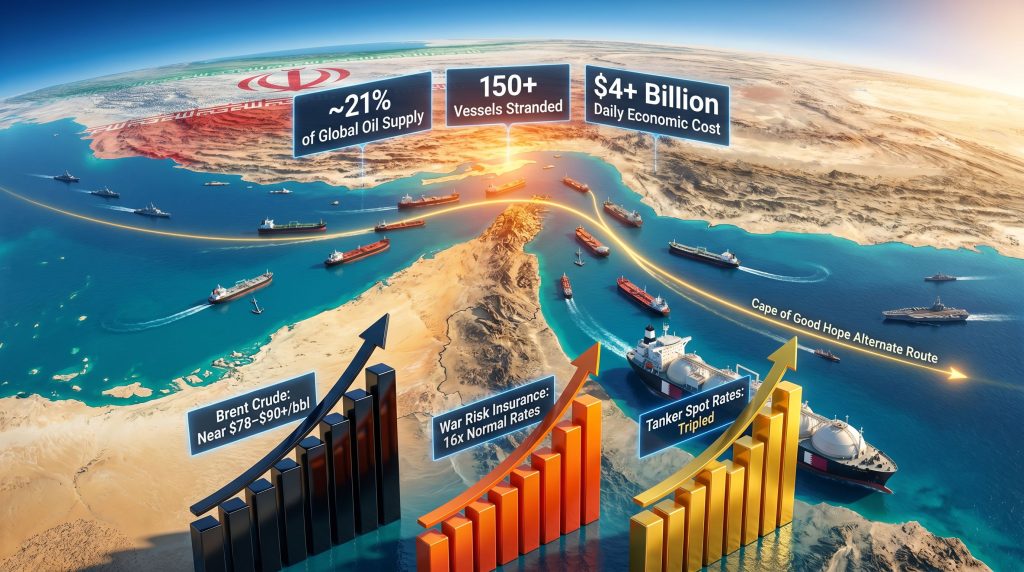
| Share of global oil supply transiting daily | ~21% |
| Share of global LNG trade at risk | ~25% |
| Normal daily vessel transits | ~60 ships per day |
| Estimated traffic decline during current conflict | 70–90% |
| Vessels stranded in Gulf of Oman/Arabian Gulf | 150+ ships |
| Daily economic cost of disruption | $4+ billion |
These figures illustrate why the strait functions less like a trade route and more like a circulatory valve for the global energy system. No other single maritime passage concentrates this density of critical commodity flow.
Which Economies Face the Greatest Exposure?
The geographic distribution of vulnerability is highly uneven:
- East Asia: Japan, South Korea, and China collectively represent the largest bloc of Persian Gulf crude importers. Gulf supply is not supplementary for these economies — it is foundational.
- South Asia: India's expanding refining sector maintains deep exposure to Gulf crude supply chains, with limited short-term alternatives for comparable grade volumes.
- European Union: Secondary exposure operates through LNG spot market repricing. European buyers have been aggressively expanding LNG import infrastructure since 2022, creating a direct transmission channel from Gulf LNG disruption to European energy costs.
- Emerging markets: Nations carrying limited strategic reserves and thin current account buffers face the most acute import cost shocks when Gulf supply contracts and freight rates surge simultaneously.
How the Diplomatic Framework Collapsed Into Open Conflict
The escalation did not emerge from a vacuum. An interim ceasefire arrangement had temporarily stabilised Persian Gulf shipping lanes following earlier tensions, providing a window for commercial vessel transit to partially resume. That framework broke down when Iranian forces attacked commercial shipping vessels operating within the strait corridor. Furthermore, the broader geopolitical risk landscape across the region had been deteriorating for months before the first shots were fired.
The Sequential Escalation That Drove the Crisis
- Iranian attacks on commercial shipping operating within Strait of Hormuz transit lanes triggered the initial breakdown.
- US CENTCOM launched retaliatory strikes targeting Iranian military infrastructure across approximately 80 designated sites on the first day of operations.
- A second strike package targeting roughly 90 additional Iranian military sites followed the subsequent night, focused specifically on degrading Tehran's capacity to threaten commercial maritime traffic.
- Iranian counter-strikes targeted US military installations in Bahrain, Kuwait, and Qatar, widening the geographic footprint of the conflict.
- Jordan intercepted eight Iranian missiles during the exchange, demonstrating active regional air defence engagement.
- The US revoked an existing sanctions waiver that had permitted Iranian crude oil to reach global markets, removing a key economic incentive for Iranian restraint.
- Iran's Islamic Revolutionary Guard Corps formally declared the Strait closed to commercial shipping, formalising what ship-tracking data was already showing.
What US Airstrikes Were Specifically Targeting
Understanding the operational logic of the US strike packages clarifies both the military strategy and its limitations:
- Iranian air defence systems and radar networks covering the strait's transit lanes
- Anti-ship missile launch sites capable of targeting commercial and military vessels
- More than 60 IRGC-operated small patrol and fast-attack boats
- Strategic military installations across multiple sites in the first two rounds of strikes
The strategic objective is degradation rather than elimination. Removing the physical infrastructure underpinning Iran's maritime interdiction capability is designed to restore conditions under which commercial operators can reasonably assess transit risk. According to the Council on Foreign Relations, the Strait of Hormuz has historically represented the most consequential maritime flashpoint in US-Iran relations.
The Collapse of Commercial Shipping Through the Strait
The US Iran airstrikes Strait of Hormuz shipping disruptions have produced a near-complete withdrawal of voluntary commercial transit. Ship-tracking data tells a striking operational story.
The Two-Corridor Problem
Commercial shipping has been effectively split between two incompatible operational frameworks:
| Corridor | Status | Controlling Authority | Risk Profile |
|---|---|---|---|
| Iran-approved northern route | Partially operational | IRGC | Subject to Iranian conditions and selective enforcement |
| US-supported Omani lane | Largely inactive | US/Omani coordination | Exposed to Iranian interdiction risk |
| Cape of Good Hope reroute | Active alternative | Major carriers | Adds up to 14 days transit time |
This dual-corridor problem is not merely logistical. It reflects an underlying contest over who controls the commercial rules of passage through internationally recognised waters, a contest that cannot be resolved by shipping operators acting independently.
How Major Carriers Are Adapting
The commercial response has been swift and largely uniform:
- Maersk, Hapag-Lloyd, and MSC have suspended Persian Gulf transit operations entirely pending a security reassessment.
- Vessels are being rerouted via the Cape of Good Hope, a diversion that adds up to 14 additional transit days per voyage and significantly increases per-journey fuel and operating costs.
- War risk insurance premiums have surged to more than 16 times their standard rates, effectively functioning as a market-imposed transit ban for many commercial operators whose voyage economics cannot absorb that cost escalation.
- Tanker spot rates on Gulf-to-Asia routes have tripled relative to pre-conflict levels, reflecting acute supply scarcity in the freight market.
"When war risk premiums reach multiples this extreme, the insurance market effectively becomes a second enforcement mechanism for the corridor closure, operating independently of any military or political authority. Carriers do not need to be directly threatened to withdraw from a route when the cost of insuring the voyage becomes commercially prohibitive."
Oil Price Volatility and the LNG Compounding Effect
Brent crude climbed more than 5% in a single trading session as the second round of US-Iran strikes was confirmed, trading near $78 per barrel. Earlier phases of the conflict produced initial price spikes of up to 25%, reflecting the market's acute sensitivity to Hormuz transit risk. In addition, these oil price movements are creating knock-on effects across a broad range of commodity and currency markets.
Oil and Energy Market Snapshot
| Market Variable | Pre-Conflict Baseline | Crisis-Period Reading |
|---|---|---|
| Brent crude price | Below $75/bbl | Near $78–$90+ range |
| Initial conflict-phase price spike | Baseline | Up to 25% |
| Tanker spot rates (Gulf to Asia) | Standard market rates | Tripled |
| War risk insurance premiums | Standard rates | 16x normal |
Why LNG Markets Face a Distinct Compounding Risk
The crude oil disruption is the headline story, however the LNG dimension introduces a structurally separate and potentially more persistent market shock. Consequently, understanding global LNG supply dynamics has become essential for any assessment of the conflict's long-term energy market implications.
Qatar operates the world's largest LNG production complex and supplies approximately 25% of all globally traded LNG. The attack on one of its LNG carriers within the strait has caused Qatar to pause efforts to restore full production output. This single event creates a simultaneous supply shock across both European and Asian LNG spot markets, where Qatar-sourced volumes carry significant weight in pricing dynamics.
The interaction between disrupted crude flows and paused LNG production creates a compounding pressure structure:
- Crude oil prices rise, increasing energy costs across all consumption categories
- LNG spot prices rise independently, driven by Qatari production uncertainty
- European buyers who converted from pipeline gas dependency to LNG dependency face elevated costs across both primary supply channels
- Asian utilities operating with limited reserve inventory face emergency procurement at distorted spot rates
The Strategic Petroleum Reserve Limitation
The US Strategic Petroleum Reserve provides a meaningful short-term demand buffer. However, its structural limitations in a prolonged conflict scenario are significant:
- The reserve was designed to offset disruptions measured in weeks, not multi-month closures
- A sustained Hormuz closure lasting beyond four to six weeks would require coordinated International Energy Agency reserve releases to prevent systemic supply gaps
- Consumer price inflation in energy-importing economies would accelerate in parallel with rising upstream costs
- Fertiliser production — heavily dependent on natural gas as a feedstock — would see cost escalation flowing through to global agricultural commodity prices, creating a food security transmission channel well beyond the energy sector
Geopolitical Scenarios: Three Trajectories for the Hormuz Crisis
Given that negotiations remain suspended and the diplomatic framework that underpinned the previous interim arrangement has fractured, the range of credible forward scenarios spans a wide spectrum. The crude oil geopolitical risks embedded in each scenario carry materially different implications for energy-importing economies.
Scenario A: Rapid Diplomatic Re-engagement
- Third-party mediation resumes within weeks
- A partial shipping corridor is restored under new terms
- Brent crude stabilises in the $80–$85 per barrel range
- The sanctions waiver is potentially reinstated as a negotiating incentive
Scenario B: Sustained Military Standoff
- Tit-for-tat strikes prevent commercial shipping from normalising
- Cape of Good Hope rerouting becomes the operational default for major carriers across an extended period
- Brent crude sustains above $90 per barrel as markets price in structural supply tightening
- Asian economies initiate emergency energy procurement at elevated spot costs
Scenario C: Regional Escalation
- Additional Gulf state actors are drawn into the conflict
- The Strait of Hormuz remains physically or effectively closed for multiple months
- Global recession risk rises materially as energy cost inflation feeds through supply chains
- Emergency IEA coordinated reserve releases are triggered across member nations
The Sanctions Dimension: A Tool That Cuts Both Ways
The revocation of the Iranian oil sales sanctions waiver merits specific analytical attention because it simultaneously tightens global supply and reduces Iran's economic calculus for negotiation. Three structural implications stand out:
- It removes Iranian crude from global supply at precisely the moment physical disruption is already constraining available volumes
- It reduces the economic leverage available to negotiators, since there is less sanctions relief to offer as an inducement
- It signals that the current US administration is prepared to absorb higher domestic energy costs as an acceptable strategic price
The next major ASX story will hit our subscribers first
The IRGC's Maritime Strategy and Its Military Logic
Iran's interdiction approach in the strait is not improvised. The IRGC has developed and refined a layered maritime denial capability over decades, combining several complementary elements:
- Fast-attack boat swarms capable of harassing and boarding commercial vessels with limited warning time
- Anti-ship missile batteries covering the primary transit lanes from multiple firing positions
- Formal corridor designation that forces commercial operators to choose between Iranian-monitored routes or full exposure to interdiction risk
- Selective enforcement that creates deliberate unpredictability, deterring voluntary transit even when active interdiction is not occurring
This last element — selective enforcement — is strategically underappreciated by markets. Iran does not need to physically stop every vessel to effectively close the strait commercially. The unpredictability alone is sufficient to drive insurance premiums to prohibitive levels and trigger voluntary carrier withdrawal. The AP News coverage of these developments highlights the accelerating pace at which market conditions have deteriorated.
Gulf State Allies and the Widening Conflict Geography
- Bahrain and Kuwait absorbed Iranian retaliatory missile and drone strikes against US military installations, widening the active conflict zone
- Jordan demonstrated operational air defence capability by intercepting eight Iranian missiles during the exchange
- Qatar occupies a uniquely complex position, simultaneously hosting US military assets and operating the world's largest LNG facility, making it both a military target and a critical energy infrastructure node
- Oman has been positioned as a potential neutral corridor facilitator, though its shipping lane has remained largely inactive throughout the current escalation
What This Crisis Reveals About Global Energy Architecture
| Structural Vulnerability | Market and Policy Implication |
|---|---|
| Single-chokepoint oil dependency | No viable short-term alternative maritime route for Gulf crude |
| LNG concentration risk in Qatar | Qatar's dominance creates systemic fragility across two major import markets |
| Insurance market sensitivity | Rapid premium escalation functions as a de facto shipping ban |
| Diplomatic leverage asymmetry | Sanctions tools lose effectiveness when conflict becomes kinetic |
| Reserve capacity limitations | Short-term buffers inadequate for multi-month closure scenarios |
Long-Term Policy Responses Energy-Importing Nations Should Consider
- Strategic reserve expansion to extend buffer capacity beyond current drawdown timelines
- Supplier diversification reducing single-corridor dependency across both crude and LNG procurement
- Non-Gulf LNG terminal development in producing regions across Africa, the Americas, and the Asia-Pacific
- Bilateral energy security frameworks with alternative suppliers capable of absorbing demand redirection
- Insurance market reform to prevent war risk premium spirals from becoming a structural transit barrier during periods of elevated but non-prohibitive risk
"The speed at which vessel traffic collapsed, insurance markets repriced, and LNG production paused during this conflict demonstrates how thin the operational margins of the global energy system truly are. The Hormuz crisis is not primarily a story about oil prices. It is a stress test of the structural assumptions that energy-importing economies have built decades of industrial policy around — and those assumptions are not holding."
Frequently Asked Questions: US-Iran Airstrikes and Strait of Hormuz Shipping
What is the Strait of Hormuz and why does it matter for oil prices?
The Strait of Hormuz is the narrow maritime passage between Iran and Oman that connects the Persian Gulf to the broader Arabian Sea. Roughly 21% of the world's oil supply and 25% of globally traded LNG passes through this waterway, making it the single most strategically significant energy chokepoint on the planet. Any sustained disruption to transit directly affects global crude benchmarks and energy security for dozens of nations simultaneously.
How many ships have been affected by the current disruptions?
More than 150 vessels, including oil tankers and bulk carriers, are reported stranded in the Gulf of Oman or Arabian Gulf awaiting operational clearance. Normal daily transit volumes of approximately 60 ships have contracted by an estimated 70–90%.
What has happened to tanker freight rates?
Tanker spot rates on Gulf-to-Asia shipping routes have tripled relative to pre-conflict levels. Simultaneously, war risk insurance premiums have surged to more than 16 times their standard rates, making voluntary commercial transit economically unviable for many operators regardless of their appetite for physical risk.
How are major shipping companies responding?
Maersk, Hapag-Lloyd, and MSC have each suspended Persian Gulf transit operations and are rerouting vessels via the Cape of Good Hope, a diversion adding up to 14 additional transit days and substantially increasing per-voyage operating costs.
What is the estimated daily economic cost of the disruption?
Independent estimates place the daily economic cost of the US Iran airstrikes Strait of Hormuz shipping disruptions at more than $4 billion, encompassing energy supply impacts, freight cost escalation, insurance premium surges, and downstream effects on fertiliser production and food supply chain economics.
Can the US Strategic Petroleum Reserve offset a prolonged Hormuz closure?
The reserve provides a meaningful short-term buffer but was not designed to absorb closures extending beyond several weeks. A multi-month disruption would require coordinated International Energy Agency reserve releases alongside emergency procurement from alternative suppliers, and would likely still produce sustained consumer price inflation in energy-dependent economies.
This article contains forward-looking analysis and scenario modelling based on current available information. Energy market conditions, geopolitical developments, and military situations can change rapidly. Nothing in this article constitutes financial or investment advice. Readers should consult independent professional advisors before making decisions based on energy market analysis. For ongoing upstream energy analysis and regional Middle East coverage, World Oil provides continuous industry reporting at worldoil.com.
Want to Know Which ASX Miners Could Benefit From Rising Commodity Prices?
When energy market disruptions drive commodity repricing across global markets, the real opportunity often lies in identifying significant mineral discoveries before the broader market catches on. Discovery Alert's proprietary Discovery IQ model delivers real-time alerts on significant ASX mineral discoveries — explore Discovery Alert's discoveries page to understand how historic finds have generated substantial returns, and begin your 14-day free trial to position yourself ahead of the market.