June 24, 2026
The 60-Day Clock That Could Reshape Global Oil Markets
Every major commodity market carries within it a hidden architecture of choke points, legal instruments, and diplomatic deadlines that most participants never examine until a crisis forces the issue. The Iran oil sanctions waiver and Hormuz Strait oil flow situation illustrates precisely this dynamic. The Strait of Hormuz has always been the most consequential of these structural vulnerabilities, a 33-kilometre-wide passage between Oman and Iran through which the economic lifeblood of industrial civilisation flows daily.
Understanding how a single regulatory instrument published by a US Treasury bureau on a Monday in late June 2026 can simultaneously move crude benchmarks, restructure Asian refining supply chains, and reset a geopolitical standoff requires looking beneath the headlines at the mechanics that actually drive global energy pricing.
When big ASX news breaks, our subscribers know first
Why Hormuz Has No Real Substitute
The geography of the Persian Gulf is almost uniquely hostile to alternative routing. Saudi Arabia, Iraq, Kuwait, the UAE, and Iran share one thing beyond their hydrocarbon reserves: they are all, to varying degrees, dependent on a single maritime exit point. The Strait of Hormuz is not merely important — it is functionally irreplaceable at scale.
Under normal operating conditions, somewhere between 17 and 21 million barrels of crude oil transit the strait every single day, representing approximately one-fifth of total global petroleum consumption. No other maritime chokepoint comes close to this concentration of energy value per square kilometre of water.
The alternatives that do exist are instructive precisely because of their limitations:
- Saudi Arabia's East-West Petroline carries a maximum of roughly 5 million barrels per day
- The UAE's Abu Dhabi Crude Oil Pipeline (ADCO pipeline) can handle approximately 1.5 million barrels per day
- Combined, these bypass routes can absorb fewer than 7 million barrels daily, less than one-third of normal Hormuz throughput
- Neither route serves Iraqi, Kuwaiti, or Iranian export volumes at all
Any scenario requiring sustained rerouting would impose severe freight cost inflation across Asian refining margins and structurally elevate war-risk insurance premiums across the entire Persian Gulf basin, not just for Iranian-flagged vessels.
Structural Reality: The economic leverage embedded in Hormuz is not purely physical. The credibility of a closure threat carries measurable pricing power even when tanker traffic continues unimpeded, because insurers, schedulers, and sovereign buyers must price uncertainty itself.
When Closure Threats Have Previously Moved Markets
Iran has tested the credibility of Hormuz closure threats on multiple prior occasions. The 2011–2012 episode, when Tehran explicitly threatened to block the strait in response to Western sanctions over its nuclear programme, triggered a measurable spike in Brent crude despite no physical disruption occurring. A similar dynamic played out in 2019 following attacks on tankers in the Gulf of Oman. Furthermore, the geopolitical oil price drivers at play in both episodes continue to shape how markets interpret Iranian posturing today.
What made the June 2026 episode structurally distinct was the simultaneous existence of contradictory official narratives from two sovereign governments describing the same waterway in incompatible terms. Iran declared the strait closed. US Central Command reported 55 merchant vessels actively transiting, collectively carrying in excess of 17 million barrels of oil, with independent ship-tracking services confirming continued vessel movement and detecting no diversions or U-turns.
This informational asymmetry functions as its own market-moving mechanism. Energy traders, shipping insurers, and sovereign procurement teams operating under conditions of dual-reality official communication cannot rely on confirmed facts. They must price the uncertainty itself, which structurally elevates risk premiums even when physical flows are uninterrupted.
Decoding General License X: What the Waiver Actually Does and Doesn't Do
On June 23, 2026, the US Office of Foreign Assets Control (OFAC) published General License X, a formal regulatory instrument that sits at the intersection of US foreign policy, energy markets, and international commercial law. Understanding its precise architecture is essential for any market participant trying to assess what has actually changed. The trade war impact on oil pricing dynamics are also deeply relevant here, as US foreign policy decisions ripple through commodity markets in ways that extend well beyond diplomatic announcements.
The Legal Structure of the 60-Day Authorisation
General License X authorises a broad category of transactions involving Iranian crude oil, petroleum products, and petrochemical shipments. Critically, the instrument operates on the buyer side of transactions, not the seller side. Iranian sellers remain under sanctions. What OFAC has done is suspend enforcement against entities purchasing Iranian crude, conducting related freight and insurance payments in US dollars, or engaging with vessels that were previously designated under sanctions programmes.
| Transaction Type | Permitted Under General License X |
|---|---|
| Purchase of Iranian crude oil | Yes |
| Purchase of Iranian petroleum products | Yes |
| Purchase of Iranian petrochemicals | Yes |
| USD-denominated freight and insurance payments | Yes |
| Transactions involving previously sanctioned vessels | Yes |
| Removal of sanctions from Iranian sellers | No |
The waiver window extends through August 21, 2026, a 60-day operational period aligned with a US-Iran Memorandum of Understanding signed on June 18, 2026. This MoU established the foundational diplomatic framework that preceded OFAC's publication of the licence.
Regulatory Distinction: General License X represents a waiver of enforcement, not a legislative or executive order permanently lifting sanctions. Its hard expiry date on August 21 creates a binary outcome point with significant market implications.
Why the Buyer-Side Structure Is Diplomatically Sophisticated
The asymmetric legal design of General License X — waiving buyer-side exposure while preserving seller-side sanctions — is not an oversight. It is a deliberate policy tool that achieves several objectives simultaneously. According to analysis from the Council on Foreign Relations, easing sanctions on both Iran and Russia simultaneously represents a significant strategic gamble with far-reaching consequences for global energy markets.
- It enables commercial flows without requiring the political cost of formally lifting sanctions on Iran
- It preserves US leverage by keeping the formal sanctions architecture intact and reversible
- It creates a structured diplomatic clock, after which OFAC enforcement can resume without new legislative action
- It mirrors historical snapback frameworks used in prior nuclear-adjacent diplomatic arrangements, offering Washington a tested exit mechanism
This structure also means that European buyers face a more complex compliance environment. EU sanctions frameworks are not synchronised with General License X, meaning European purchasers cannot simply rely on the OFAC instrument for protection under their own regulatory jurisdictions. In addition, the broader question of sanctions and oil trading behaviour across multiple jurisdictions adds further complexity for international buyers navigating this landscape.
The 19 Million Barrel Claim: Record Transit and Its Market Significance
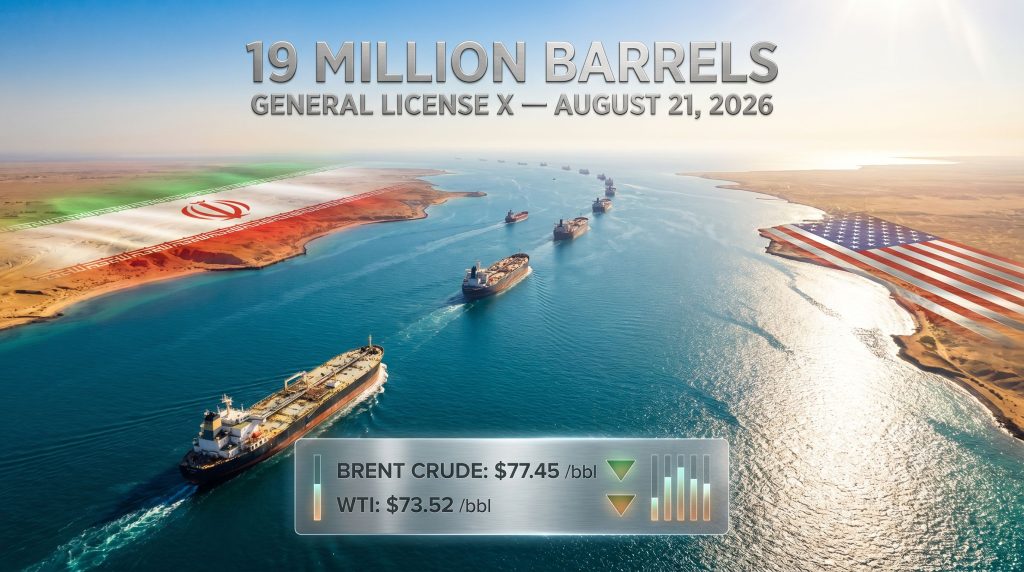
On June 24, 2026, US President Donald Trump stated that 19 million barrels of oil had transited the Hormuz Strait on Monday June 23, characterising it as an all-time record. The claim carried dual significance: as a policy communication and as a direct market signal.
If independently verified, a single-day transit figure of 19 million barrels would represent a meaningful surge above the 17 million barrel baseline that US Central Command had reported for June 20. The jump is significant enough to warrant scrutiny through independent ship-tracking databases such as Kpler and Vortexa, which aggregate vessel position data in near real-time.
Trump also stated that oil prices were declining and that the world had become considerably safer, framing continued Hormuz flows as a direct consequence of US diplomatic and military posture. The president also acknowledged, implicitly, that pursuing continued conflict with Iran would have risked economic catastrophe — a statement that functions as an explicit recognition of the economic leverage Tehran holds through its capacity to threaten the strait.
This acknowledgment matters analytically. It confirms that the negotiating architecture of the US-Iran framework is not structured around conventional military deterrence alone. The economic continuity of global energy markets is itself a structural dependency that constrains US policy options.
How Crude Benchmarks Responded to the Waiver and Transit Data
The market response on June 24 reflected a careful weighing of the available evidence. Consequently, understanding the broader context of crude oil volatility trends is essential to interpreting why the price movement was more measured than many analysts expected.
| Benchmark | Approximate Pre-Waiver Level | June 24 Level | Change |
|---|---|---|---|
| Brent Crude Futures | ~$77.90/bbl | $77.45/bbl | -$0.45 |
| West Texas Intermediate (WTI) | ~$73.86/bbl | $73.52/bbl | -$0.34 |
The modest decline, rather than a sharp drop, tells a nuanced story. Markets had already partially priced in the possibility of diplomatic de-escalation before the formal publication of General License X. The residual uncertainty surrounding the August 21 expiry date and the durability of the MoU framework constrained any more aggressive downward repricing.
Why Full Normalisation Takes Months, Not Days
Several structural factors explain why oil market normalisation following a Gulf tension episode extends well beyond the initial diplomatic announcement:
- Tanker scheduling backlogs: vessels already rerouted or held in waiting patterns require weeks to reintegrate into normal scheduling cycles
- War-risk insurance premiums: rates embedded in Persian Gulf transit insurance do not reset immediately upon diplomatic announcements; Lloyd's of London market data typically shows these premiums persisting for 60–90 days after perceived threat cessation
- Sovereign buyer behaviour: large Asian refiners, particularly in China, India, South Korea, and Japan, tend to maintain diversified supply hedges for several months before reverting to pre-conflict procurement patterns
- Cargo financing: letters of credit and trade financing for Iranian crude involve additional compliance review periods that slow commercial velocity even after legal authorisation is in place
Historical analogues from prior Gulf tension episodes consistently indicate that full market normalisation requires 3–6 months following the cessation of active hostilities or credible threat environments. The June 2026 waiver initiates this process but does not accelerate it past its structural minimum.
Who Benefits From General License X, and Who Faces Complications
The geographically uneven distribution of benefit from the Iran oil sanctions waiver and Hormuz Strait oil flow developments reflects the complex architecture of existing sanctions frameworks and regional trade dependencies.
Primary beneficiaries:
- Asian refining economies (China, India, South Korea, Japan) gain access to Iranian crude at potentially discounted prices relative to alternative suppliers, as Iranian sellers typically apply a discount to move volumes under constrained market conditions
- Independent tanker operators previously excluded from Persian Gulf trade due to vessel designation risks gain a 60-day window of compliance clarity
- Commodity trading houses with established Iranian crude relationships can resume commercial activity without immediate legal exposure
Parties facing complications:
- European buyers must navigate the gap between OFAC's General License X and EU sanctions regulations, which are not automatically synchronised with US waivers
- OPEC+ producers, particularly Saudi Arabia and the UAE, face competitive pressure as Iranian volumes re-enter global markets at discounted rates. OPEC's market influence is therefore directly tested by this waiver, as Iranian re-entry at discount pricing potentially undermines production quota discipline within the bloc
- Shipping insurance underwriters must reassess their war-risk pricing models for Persian Gulf routes under conditions of diplomatic uncertainty
The next major ASX story will hit our subscribers first
Three Scenarios Beyond August 21: A Framework for Energy Market Positioning
The August 21, 2026 expiry of General License X functions as a forcing mechanism for both diplomatic resolution and market positioning. Energy participants operating in the 60-day window must account for three structurally distinct outcome pathways. The Atlantic Council's energy sanctions dashboard provides a useful real-time reference for tracking how these regulatory instruments evolve across jurisdictions.
Scenario 1: Diplomatic Resolution and Waiver Extension
US and Iranian negotiators formalise a broader agreement before August 21, triggering either an extension of General License X or its replacement with a more durable instrument. Iranian crude volumes integrate progressively into global supply chains, Brent crude faces sustained downward pressure toward the $70–$74/bbl range, and war-risk insurance rates normalise over 60–90 days. This scenario is the working base case for most market participants given both parties' demonstrated interest in commercial normalisation.
Scenario 2: Waiver Expiry Without Renewal (Sanctions Snapback)
OFAC enforcement resumes on August 22 without replacement authorisation. Buyers who entered transactions under General License X face renewed compliance exposure and legal uncertainty. Iranian crude volumes contract as buyers retreat to alternative suppliers. Brent crude recovers toward the $80–$85/bbl range as supply uncertainty re-emerges. Asian buyers accelerate diversification toward Gulf Cooperation Council and African suppliers.
Scenario 3: Escalation and Physical Hormuz Disruption
A negotiation breakdown triggers Iranian enforcement of a genuine, verified Hormuz closure. Even a 5–10 day confirmed closure could spike Brent crude by an estimated $15–$25/bbl based on historical disruption modelling. IEA member nations would activate strategic petroleum reserve releases. Global recession risk assessments would be revised upward across major investment banks and sovereign wealth funds.
Analytical Note: Scenario 3 remains a tail risk rather than a base case, given both parties' demonstrated commercial interests in normalisation. However, the August 21 hard deadline creates a binary outcome structure that energy markets will increasingly price as the date approaches, particularly if diplomatic progress stalls.
What to Watch Between Now and August 21
For energy market participants, policy analysts, and sovereign buyers, the following indicators provide the most reliable real-time signal set for tracking how the Iran oil sanctions waiver and Hormuz Strait oil flow situation is evolving:
| Indicator | Relevance | Data Source |
|---|---|---|
| Daily Hormuz vessel transit counts | Physical flow confirmation | US Centcom, Lloyd's List |
| War-risk insurance premium rates (Persian Gulf) | Risk sentiment proxy | Lloyd's of London market data |
| Iranian crude export volumes (weekly) | Sanctions waiver uptake | Kpler, Vortexa ship-tracking |
| Brent/WTI futures curve shape | Market forward pricing | ICE, CME Group |
| OFAC regulatory updates | Waiver status changes | US Treasury OFAC portal |
| US-Iran diplomatic communiqués | MoU durability signals | US State Department, Iranian Ministry of Foreign Affairs |
Particular attention should be paid to the shape of the Brent futures curve between now and late August. A curve that shifts progressively toward backwardation as August 21 approaches would signal that markets are pricing in supply tightening from a potential snapback. Conversely, a flattening or contango structure in the August–November contract window would indicate confidence in diplomatic resolution or waiver renewal.
Frequently Asked Questions: Iran Oil Sanctions Waiver and Hormuz Strait Oil Flow
What is General License X and what does it permit?
General License X is a formal regulatory instrument published by the US Office of Foreign Assets Control on June 23, 2026. It authorises buyers to purchase Iranian crude oil, petroleum products, and petrochemicals and to conduct related financial transactions in US dollars through August 21, 2026. It does not remove sanctions from Iranian sellers but suspends their enforcement against qualifying buyers during the 60-day window.
Is the Strait of Hormuz currently open to tanker traffic?
As of late June 2026, independent ship-tracking data and US Central Command reporting confirm that vessel traffic through the Strait of Hormuz is continuing without physical disruption, despite Iranian government statements characterising the waterway as closed. No vessel diversions or confirmed U-turns have been detected by tracking services.
Why did oil prices fall only modestly after the waiver announcement?
Markets had partially priced in diplomatic de-escalation before General License X was formally published. Residual uncertainty around the August 21 expiry date, the durability of the underlying MoU, and structural backlogs in tanker scheduling and insurance underwriting all constrained a more aggressive downward price move. Brent fell approximately $0.45 to $77.45/bbl and WTI declined $0.34 to $73.52/bbl on June 24, 2026.
What happens if the waiver is not renewed after August 21?
If General License X expires without a replacement instrument, OFAC enforcement mechanisms would resume. Buyers holding Iranian crude transactions entered under the waiver would face renewed compliance exposure. This scenario would likely tighten global supply perceptions and apply upward pressure on Brent and WTI benchmarks, with the scale of repricing depending on how much Iranian volume had re-entered the market during the 60-day window.
How long does it typically take for oil markets to fully normalise after Gulf tension?
Historical precedent from prior Gulf tension episodes indicates that full normalisation of supply chains, insurance rates, and crude pricing typically requires 3–6 months after the cessation of active hostilities or credible threat environments, even when physical flows are restored more rapidly.
The Negotiated Pause and What Comes Next
The publication of General License X and the confirmed continuation of Hormuz vessel traffic represent a meaningful de-escalation inflection point in a situation that carried genuine risk of severe global economic disruption. However, framing this development as a resolution would be analytically premature.
What exists as of late June 2026 is a negotiated pause with a hard expiry date. The 60-day window created by General License X and the underlying MoU provides both sides with the commercial breathing room to pursue a more durable framework, while simultaneously creating the conditions under which failure to agree will carry immediate and automatic market consequences.
The record transit volumes cited for June 23, if independently verified through ship-tracking data, would signal that commercial normalisation is genuinely underway. However, the regulatory architecture supporting those flows remains fragile until the August 21 deadline is resolved through diplomatic progress rather than simply elapsed time.
Energy markets are rarely moved by certainty. They are moved by the distribution of possible futures and the shifting probability weights assigned to each. The Iran oil sanctions waiver and Hormuz Strait oil flow developments of June 2026 have not resolved that distribution — they have temporarily compressed it, with a defined date on which compression either holds or violently releases.
This article contains forward-looking analysis and scenario projections based on publicly available information as of June 2026. Energy market conditions, diplomatic developments, and regulatory frameworks are subject to rapid change. Nothing in this article constitutes financial or investment advice. Readers should conduct independent research and consult qualified advisers before making any decisions based on the information presented.
Want to Stay Ahead of the Next Major Resource Discovery Driving Global Commodity Markets?
While geopolitical forces reshape oil supply chains and energy pricing, Discovery Alert's proprietary Discovery IQ model delivers real-time alerts on significant ASX mineral discoveries — instantly translating complex resource data into actionable investment insights for traders and long-term investors alike. Explore how historic discoveries have generated substantial market returns on Discovery Alert's dedicated discoveries page, and start your 14-day free trial today to position yourself ahead of the broader market.