June 24, 2026
The Fragility Built Into Global LNG Markets
Every energy system contains hidden assumptions about stability. For decades, the global LNG trade operated on one foundational assumption: that the Gulf's export infrastructure would remain functional, and that the narrow maritime passage connecting it to world markets would remain open. The events now unfolding around Qatar's production network have exposed how quickly that assumption can unravel, and what the consequences look like when it does.
Qatar LNG production recovery has become one of the most watched subjects in global energy markets, not because of its regional significance alone, but because of what it reveals about the structural vulnerabilities embedded in a supply chain that serves roughly one-fifth of the world's LNG demand. Understanding the recovery trajectory requires moving well beyond the initial disruption narrative and into the technical, diplomatic, and financial layers that will ultimately determine when, and whether, normal output resumes.
When big ASX news breaks, our subscribers know first
Qatar's Structural Position in the Global LNG Supply Chain
Qatar has long occupied a position in global LNG markets that no other single nation can replicate at scale. Supplying approximately 20% of global LNG volumes, the country's production infrastructure is concentrated almost entirely within two industrial complexes: Ras Laffan Industrial City and Mesaieed. This geographic concentration has historically been viewed as an operational strength, enabling dense logistical efficiency and shared utility infrastructure across a vast network of liquefaction trains.
That same concentration, however, creates a single-point-of-failure dynamic that no diversification strategy can easily offset. When both the production infrastructure and the maritime export route face simultaneous disruption, the compounding effect is categorically different from any prior interruption the market has experienced. Furthermore, the LNG supply outlook for 2025 already pointed to tightening conditions before this disruption materialised.
The Strait of Hormuz: Where Transit Becomes a Chokepoint
The Strait of Hormuz is the world's most consequential maritime energy corridor. Under normal operating conditions, it channels an extraordinary volume of hydrocarbons toward Asian, European, and South Asian buyers. For Qatar specifically, it is not merely an important route. It is the only route.
This matters enormously for understanding the recovery timeline. LNG liquefaction is a continuous cryogenic industrial process. Supercooled natural gas is maintained at approximately -162°C throughout loading and transit. Without operational export shipping, liquefaction cannot continue indefinitely. Storage capacity at export terminals is finite, and the engineering systems cannot simply be paused and restarted at will. A blockade at the Strait therefore forces upstream production to halt independently of whether any physical damage has occurred to onshore infrastructure.
Technical Reality: Unlike pipeline gas, which can be redirected or stored within the network, LNG requires an unbroken operational chain from wellhead through liquefaction, loading, and maritime transit. Interrupting any single link forces a shutdown of the entire system.
What Caused the Production Suspension: A Multi-Layer Disruption
The production halt at QatarEnergy followed a sequence of events linked to the broader US-Israel conflict with Iran. Military strikes targeted facilities within the Ras Laffan LNG complex, including attacks on power and water infrastructure that support liquefaction operations. Separately, Iranian drone operations formed part of a broader pattern of targeting energy installations.
QatarEnergy subsequently declared force majeure on gas export obligations. In commercial terms, this is not merely an administrative notification. Force majeure suspends legal liability under long-term supply contracts when performance becomes impossible due to extraordinary events beyond the operator's control. For European and Asian buyers holding long-term contracted volumes, this declaration means their supply obligations are suspended for the declared duration, with significant secondary effects on pricing, storage drawdown strategies, and spot market behaviour.
Two distinct disruption vectors operated simultaneously:
- Direct infrastructure damage to production and utility systems within the Ras Laffan complex
- Maritime export obstruction through the Strait of Hormuz, which independently rendered ongoing liquefaction non-viable
This dual-vector disruption is what makes the current situation structurally different from historical interruptions. Even if infrastructure repairs were instantaneous, production could not resume until the export corridor reopened. Indeed, this episode adds a significant new dimension to an already complex geopolitical risk landscape that has been reshaping commodity markets throughout 2025.
Quantifying the Damage: What the Numbers Reveal
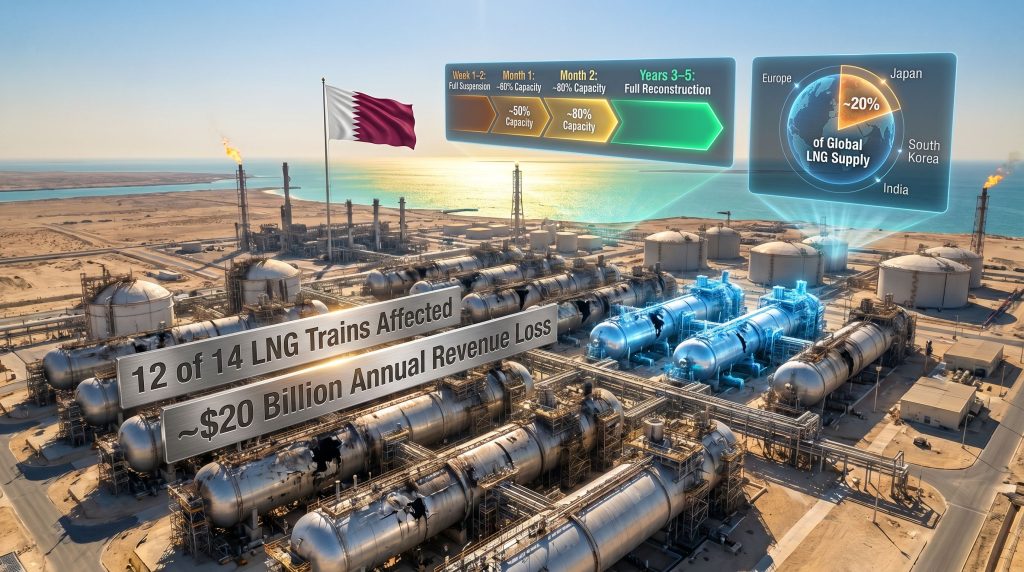
The scale of infrastructure damage is significant, though not total. Approximately 12 of 14 LNG trains were affected to varying degrees, with the damage collectively representing roughly 17% of Qatar's total LNG output capacity. According to Reuters, this damage could take three to five years to fully repair.
| Infrastructure Component | Estimated Impact | Recovery Complexity |
|---|---|---|
| LNG Trains Affected | 12 of 14 | High — sequential restart required |
| Annual LNG Production Lost | ~12.8 million tonnes | Severe |
| Condensate Export Reduction | ~24% decline | Moderate |
| LPG Output Reduction | ~13% decline | Moderate |
| Helium Export Reduction | ~14% decline | Moderate |
| Naphtha and Sulfur Output | ~6% reduction | Low |
The financial consequences are equally striking. Annualised revenue losses are estimated at approximately $20 billion, a figure that encompasses not only LNG sales but also the condensate, LPG, helium, and petrochemical streams that are co-produced alongside natural gas. These secondary revenue streams are often overlooked in headline analysis but represent a material share of QatarEnergy's total income.
The Turbine Problem Nobody Is Talking About
One of the least-discussed constraints on Qatar LNG production recovery is the global scarcity of large-frame industrial gas turbines. LNG liquefaction trains rely on purpose-built turbomachinery that cannot be sourced from general industrial markets. Lead times for replacement units, when available at all, typically extend 12 to 24 months under normal commercial conditions.
In a post-disruption environment where multiple operators may be competing for the same limited pool of equipment, those timelines extend further. This means the bottleneck is not primarily structural reconstruction — it is equipment procurement. Even if diplomatic resolution occurs rapidly and maritime access is restored, the physical restoration of the damaged 17% of capacity is constrained by turbine availability in ways that geopolitical agreements cannot accelerate. Consequently, full infrastructure restoration carries a realistic horizon of three to five years, regardless of how quickly the conflict environment stabilises.
The Four-Phase Recovery Model
Qatar's Prime Minister Sheikh Mohammed bin Abdulrahman al-Thani has communicated that normal LNG production is expected to return within weeks, a statement that must be understood within a staged recovery framework rather than as a promise of immediate full restoration.
Phase 1: Immediate Suspension Window (Weeks 1–2)
Following the production halt, a minimum two-week period is required before any restart can be safely initiated. The technical reason is thermal management. Cryogenic systems that have been shut down must be incrementally recooled to operating temperatures. Attempting to restart too quickly creates the risk of thermal shock damage to the metallic components of liquefaction trains, which would transform a recoverable disruption into a far more severe one.
Phase 2: First Restart Milestone (Month 1 Post-Strait Reopening)
The primary precondition for any restart is the restoration of safe maritime passage through the Strait of Hormuz. Once that condition is met, QatarEnergy has indicated readiness to resume output with a target of reaching approximately 50% of pre-disruption capacity within one month. The sequencing of which LNG trains restart first will be determined by the condition of their turbomachinery and utility systems.
Phase 3: Accelerated Ramp-Up (Month 2 Post-Strait Reopening)
Assuming sustained stability in the diplomatic and maritime environment, output could reach approximately 80% of pre-disruption capacity within two months of Strait reopening. Factors that could compress or extend this timeline include the speed of US-Iran diplomatic progress, availability of specialist engineering crews, and the operational status of undamaged trains and shared utility infrastructure.
Phase 4: Long-Term Infrastructure Restoration (Years 1–5)
The final 17% of damaged capacity enters a multi-year reconstruction programme governed primarily by equipment procurement timelines rather than engineering complexity. International energy majors with stakes in Qatari LNG assets will likely play a significant role in mobilising resources for this phase.
Scenario Warning: Under the most optimistic conditions combining rapid diplomatic resolution, smooth equipment procurement, and operational sequencing without setbacks, full production restoration to pre-disruption levels is unlikely before 2029–2030 at the earliest.
The Diplomatic Architecture of Recovery
Qatar's Prime Minister has been explicit: establishing a direct US-Iran communication channel is the essential first step toward reopening the Strait of Hormuz. This positions the recovery timeline as fundamentally dependent on geopolitical negotiation rather than engineering capacity alone.
Oman has emerged as a significant diplomatic intermediary in this process. Its geographic position at the mouth of the Strait, combined with longstanding channels of communication with Tehran, gives Muscat a unique facilitation role. Recent Oman-Iran coordination efforts on Hormuz transit arrangements represent one of the few active diplomatic tracks capable of producing near-term progress.
Separately, Oman's Duqm Port, located outside the Strait on the Arabian Sea coast, has attracted attention as a potential logistics node that could partially reduce dependence on Hormuz routing for certain cargo types. However, its current capacity and infrastructure are not calibrated for large-scale LNG operations.
| Recovery Milestone | Key Precondition | Estimated Timeframe |
|---|---|---|
| Strait reopening | US-Iran de-escalation | Weeks to months |
| LNG tanker transit resumption | Safe passage guarantees | Concurrent with above |
| 50% capacity restoration | Stable ceasefire conditions | ~1 month post-reopening |
| 80% capacity restoration | Sustained diplomatic stability | ~2 months post-reopening |
| Full infrastructure repair | Long-term regional stability | 3–5 years |
The next major ASX story will hit our subscribers first
Global Market Consequences: Who Bears the Exposure?
With Qatar accounting for roughly one-fifth of global LNG supply, even a short-duration disruption generates measurable tightening in spot markets. The buyers most exposed to near-term supply risk are those with high Qatari contract concentration and limited alternative supply access. In addition, the broader energy market turmoil of 2025 has already stretched many buyers' contingency planning resources thin.
- Europe has increased its dependence on Qatari LNG significantly since 2022, following the structural reduction in Russian pipeline gas flows. Storage levels and seasonal demand timing will determine how much buffer European buyers have before spot procurement becomes urgent.
- Japan and South Korea hold substantial long-term contracted volumes with QatarEnergy, meaning force majeure declarations directly interrupt their contracted supply, not merely spot availability.
- India has been expanding its LNG import capacity and holds a growing contractual relationship with Qatar, making it similarly exposed.
Can Alternative Suppliers Fill the Gap?
The honest answer is: not in the near term, and not at the required scale.
| Supplier | Annual Export Capacity (approx.) | Spot Flexibility | Key Constraints |
|---|---|---|---|
| United States | ~90 MTPA | High | Infrastructure near peak utilisation |
| Australia | ~80 MTPA | Low | Majority under long-term contracts |
| Russia (Yamal/Arctic LNG) | ~30 MTPA | Very Low | Sanctions and buyer restrictions |
| Nigeria | ~22 MTPA | Moderate | Operational reliability concerns |
| Mozambique | ~3-4 MTPA | Low | Early-stage ramp-up |
The United States holds the greatest theoretical flexibility to redirect spot cargoes, but utilisation rates across US LNG export terminals are already running near capacity. Australia's volumes are overwhelmingly committed under long-term agreements. Russian LNG remains inaccessible to most Western buyers. The combined spot capacity of Nigeria and Mozambique represents a fraction of the shortfall.
This supply gap creates sustained upward pressure on global LNG spot prices, which in turn affects electricity generation costs, industrial input pricing, and inflation dynamics in import-dependent economies. These natural gas price trends were already showing volatility heading into this disruption.
Long-Term Strategic Implications for Qatar's Energy Position
The North Field Expansion at Risk
Qatar's multi-decade strategy for maintaining LNG dominance has centred on the North Field Expansion programme, one of the largest LNG capacity additions ever undertaken. Infrastructure damage at Ras Laffan and the capital reallocation required for repairs could push expansion milestones to the right, potentially by years.
International partners evaluating their participation in expansion phases will be reassessing their risk models in light of the demonstrated vulnerability of concentrated production infrastructure to geopolitical disruption. The commodity price impacts flowing from extended outages will furthermore complicate investment case modelling across the entire project portfolio.
Sovereign Wealth as the Fiscal Shock Absorber
The Qatar Investment Authority (QIA) holds assets estimated at over $475 billion, providing a substantial buffer against the approximately $20 billion annual revenue shortfall created by the production halt. Qatar can sustain this revenue gap without immediate fiscal stress, but prolonged disruption would begin to affect capital expenditure commitments, both within the energy sector and across the broader national development programme.
Buyer Diversification: A Strategic Reassessment
Perhaps the most consequential long-term effect of this disruption is the signal it sends to LNG buyers about concentration risk. European, Japanese, and South Korean energy companies negotiating contract renewals over the next several years will have a compelling commercial rationale to diversify their supply portfolios, reducing their exposure to any single producer.
This does not mean Qatar loses its dominant position, but it does mean the premium it can command for long-term contracted volumes may compress as buyers structure their portfolios with explicit geographic diversification requirements. Reports from Anadolu Agency indicate that the damaged facility may take up to five years to recover, a timeline that will factor heavily into buyer contract strategies.
Frequently Asked Questions: Qatar LNG Production Recovery
What caused QatarEnergy to suspend LNG production?
Military strikes targeting infrastructure within the Ras Laffan complex, combined with the effective obstruction of the Strait of Hormuz, made continued liquefaction and export operations non-viable. Both factors operated simultaneously, creating a compounding disruption that neither alone would have caused at the same scale.
When will Qatar LNG production return to normal?
A phased recovery is underway. The earliest realistic milestone is approximately 50% of capacity within one month of the Strait reopening, rising to around 80% within two months. Full restoration of damaged infrastructure carries a horizon of three to five years due to turbine procurement constraints.
How much of Qatar's LNG capacity was affected?
Roughly 17% of total production capacity was directly impacted, with 12 of the 14 LNG trains sustaining damage to varying degrees. The undamaged trains are central to the near-term recovery plan.
What does force majeure mean for buyers?
It suspends QatarEnergy's contractual delivery obligations for the duration of the declared period, shifting the burden of finding replacement supply onto buyers. It also has pricing implications in markets where contract indexation is linked to delivery performance.
Why is the Strait of Hormuz so critical to the recovery?
It is the sole maritime export corridor for Qatari LNG. Without safe passage through the Strait, completed LNG cargoes cannot reach buyers, which in turn makes continued liquefaction operations economically and technically unviable.
Three Variables That Will Determine Recovery Speed
The Qatar LNG production recovery trajectory ultimately resolves into three interdependent variables, each capable of either accelerating or derailing progress:
- Diplomatic resolution between the United States and Iran, specifically the establishment of direct communication channels and a de-escalation framework sufficient to reopen the Strait of Hormuz to commercial shipping.
- Technical sequencing of LNG train restarts, which must proceed incrementally to avoid thermal damage to cryogenic systems that have been fully cooled down.
- Equipment availability, particularly for large industrial turbines, where global supply constraints impose timelines that operate independently of geopolitical developments.
A rapid diplomatic breakthrough could unlock the first two variables within weeks. The third, however, will take years. That asymmetry is the defining feature of Qatar's recovery challenge: the short-term disruption is manageable, but the structural restoration of full capacity belongs to a fundamentally different timeframe.
This article contains forward-looking analysis, scenario modelling, and financial estimates that are inherently uncertain. Figures cited reflect reported assessments and publicly available analysis at the time of writing. Readers should conduct independent research before making any decisions based on the information presented. Ongoing developments in the geopolitical environment may materially alter the scenarios described.
For ongoing regional energy coverage and GCC economic developments, Zawya's energy section provides regular reporting on Gulf energy affairs at zawya.com/en/business/energy.
Want To Stay Ahead Of The Next Major Energy Or Commodity Market Shift?
Discovery Alert's proprietary Discovery IQ model delivers real-time alerts on significant ASX mineral discoveries, instantly translating complex data across 30+ commodities into actionable investment insights — so subscribers can identify opportunities before the broader market reacts. Start your 14-day free trial today and explore Discovery Alert's discoveries page to see how historic mineral discoveries have generated exceptional returns for well-positioned investors.