July 16, 2026
The Floating Inventory Problem No One Anticipated
Global oil markets have spent decades obsessing over onshore storage capacity as the defining constraint on crude oversupply. Cushing, Oklahoma. Fujairah. The SPR. Yet the more subtle and strategically significant pressure valve in today's market is not a tank farm on land — it is the open ocean itself. When geopolitical shocks collide with sanctions architecture and buyer hesitancy, crude oil does not simply disappear from supply chains. It parks itself at sea, accumulating carrying costs and counterparty risk with every passing day.
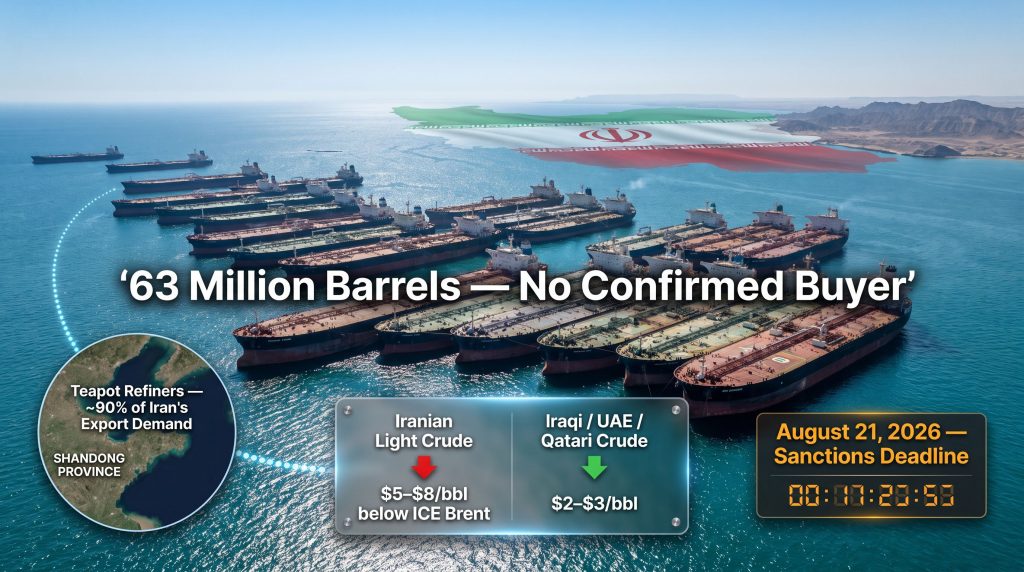
That is precisely the dynamic now unfolding across Asian waters, where Iran oil stuck at sea China teapots Middle East supplies has become one of the most consequential stories in global energy markets. An estimated 63 million barrels of Iranian crude are currently afloat with no confirmed buyer or delivery destination, according to analysis from United Against Nuclear Iran (UANI). The volume is staggering — and the commercial clock is ticking.
When big ASX news breaks, our subscribers know first
How the Ceasefire Window Became a Supply Trap
Iran's Export Surge During the June 14 Truce
The June 14, 2026 ceasefire agreement between the United States and Iran created a narrow but significant commercial opening. Tehran, anticipating a return to sanctions enforcement, moved aggressively to monetise its crude inventory. The results were dramatic on paper: UANI analysis shows that February 2026 exports reached approximately 60.7 million barrels, averaging 2.17 million barrels per day, a 20% increase from January 2026. That pace was unsustainable — March exports fell sharply to around 35.7 million barrels, averaging 1.136 million bpd.
Following the ceasefire announcement, the pace accelerated again. UANI tracked 52 tankers carrying Iranian oil and petrochemical products — roughly 62 million barrels — departing since June 14. Tanker tracking firm TankerTrackers.com reported that Tehran shipped out no fewer than 10 million barrels of crude and fuel oil overnight in a single push, apparently anticipating an imminent resumption of US naval enforcement.
The strategy made commercial sense in isolation: front-load exports before the window closes. However, it did not account for what buyers on the other end of those shipments were doing at exactly the same moment.
The Tracking Data in Detail
Multiple commodity intelligence firms have monitored the flow, and their findings are broadly consistent:
| Tracking Period | Volume Recorded | Source | Key Notes |
|---|---|---|---|
| June 15 – July 6, 2026 | ~30 million barrels loaded | Vortexa Analytics | Equivalent to 1.35 million bpd |
| June 14 – July 10, 2026 | ~34.5 million barrels | Kpler | Across 21 tankers via Hormuz |
| Since June 14 ceasefire | ~62 million barrels | UANI Analysis | 52 tankers; includes petrochemicals |
| February 2026 peak | ~60.7 million barrels | UANI | Avg. 2.17 million bpd; +20% vs. Jan |
| March 2026 | ~35.7 million barrels | UANI | Avg. 1.136 million bpd |
| China imports (July 2026) | ~556,000 bpd | Kpler | Lowest level since January 2023 |
China's Iranian crude import rate for July 2026 — sitting at just 556,000 barrels per day according to Kpler — represents a dramatic compression relative to recent peak volumes and marks the lowest monthly absorption rate since early 2023. Furthermore, the broader US-China trade war impacts have added a further layer of complexity to how Chinese refiners are approaching procurement decisions.
Why China's Teapot Refiners Walked Away
Understanding the Teapot Ecosystem
To understand why Iran oil stuck at sea China teapots Middle East supplies dynamics have become so important, it is essential to understand how independent Chinese refining actually works.
China's so-called teapot refineries are privately owned, independently operated crude processors concentrated predominantly in Shandong Province on China's eastern coast. Unlike state-owned entities such as Sinopec or CNOOC, teapot refiners carry limited exposure to Western financial infrastructure, which has historically made them the natural home for discounted, sanctioned crude. They have absorbed approximately 90% of Iran's total oil export volumes by some trader estimates, driven by their ability to access pricing unavailable to more compliance-conscious buyers.
Teapot refineries typically source crude on a delivered basis, meaning they pay for oil already transported to Asian waters rather than managing freight and insurance risk themselves. This structure makes them highly price-sensitive and responsive to competitive alternatives — a dynamic that has become Iran's commercial undoing in mid-2026.
The Pricing Inversion: How Iranian Crude Became the Most Expensive Option
The Strait of Hormuz reopened in late June 2026, and Gulf producers responded with remarkable commercial speed. Iraq, the UAE, and Qatar mobilised export capacity and rapidly contracted forward delivery volumes with Asian buyers at deeply competitive pricing. The discount structure that emerged was striking, and the resulting oil price movements have reshaped procurement strategies across the region:
- Rival Middle Eastern crude from Iraq, the UAE, and Qatar entered the Asian market at discounts of $5 to $8 per barrel below ICE Brent for August to September deliveries
- Iranian Light crude, by contrast, held at only $2 to $3 per barrel below ICE Brent — less than half the competing discount
- Traders active in the teapot market described Iranian sellers as slow and unwilling to adjust pricing to reflect the changed competitive landscape
- Independent refiners have indicated they will not resume Iranian purchases until discounts reach $4 to $5 per barrel below Brent
The result is a structural pricing paradox: sanctioned crude that theoretically should be the cheapest option on the market has, in the current environment, become the most expensive on a risk-adjusted basis. This represents a significant reversal that few oil market analysts had modelled in advance.
What Teapots Actually Purchased Instead
The scale of the pivot away from Iran toward alternative Middle East supplies is substantial. Traders confirmed the following transactions:
| Buyer | Volume | Origins | Distribution Channel |
|---|---|---|---|
| Shandong teapot refiners | 16–20.5 million barrels | Qatar, Iraq, UAE | Delivered basis |
| Shenghong Petrochemical | ~12 million barrels | Iraq, Abu Dhabi, Saudi Arabia | Trader-confirmed |
The non-Iranian cargoes were sold through a combination of European commodity trading houses including Mercuria and Vitol, state-linked entities such as PetroChina International and Zhenhua Oil, and directly from Gulf producer ADNOC. This represents the largest collective teapot purchase of non-sanctioned Middle Eastern crude since the US-Iran conflict commenced.
A compounding factor slowed Iran's commercial response further. The funeral and mourning period following the death of Supreme Leader Ayatollah Ali Khamenei resulted in office closures across Iran's oil export administration, delaying the pricing adjustments needed to remain competitive at exactly the moment when buyers were actively contracting alternative cargoes.
The Sanctions Architecture and the August 21 Deadline
How Washington Structured the Enforcement Window
The US approach to reimposed sanctions included a deliberate tactical carve-out designed to avoid an immediate global supply shock. A temporary enforcement waiver was issued covering an estimated 140 million barrels of Iranian crude already in transit at the time the sanctions framework was reinstated. This temporary suspension explicitly excluded new purchases, prohibiting any fresh Iranian crude transactions from the outset.
The waiver expires on August 21, 2026. That date is not merely administrative — it functions as a hard commercial cliff edge with real financial and legal consequences for any refinery or trading entity caught holding Iranian crude in active transit after that point.
Secondary Sanctions Exposure: The Compliance Barrier
The secondary sanctions dimension is what makes Iranian crude uniquely toxic for most of the global buyer pool:
- State-owned Chinese refiners have largely avoided direct Iranian crude imports since sanctions were first reimposed in 2018, precisely because of secondary sanctions exposure through dollar-clearing and Western financial institutions
- European commodity trading houses face both reputational and compliance barriers to direct involvement in Iranian transactions
- Even indirect exposure through shipping, insurance, or letters of credit can trigger enforcement actions against non-US entities
- The effective buyer pool for Iranian crude is therefore structurally limited to entities with minimal Western financial exposure — primarily teapot refiners and a small number of other Asian independents
Sanctions Insight: What makes the August 21 deadline particularly acute is that the 63 million barrels currently at sea are not uniformly covered by the enforcement waiver. Cargoes loaded after the ceasefire into a market where the new sanctions framework had already been signalled occupy an ambiguous legal position — one that buyers are understandably reluctant to test.
The Floating Storage Cost Spiral
Beyond sanctions, there is a purely commercial logic to Iran's narrowing window. Every day that a VLCC remains at anchor or in slow transit accumulates costs:
- Daily VLCC charter rates for floating storage purposes typically range between $30,000 and $80,000 depending on market conditions and vessel specifications
- Across 52 tankers, the carrying cost accumulation is substantial — adding an effective per-barrel premium that further erodes Iran's pricing competitiveness
- As onshore Iranian storage approaches operational capacity constraints, the pressure to offload at sea intensifies
- The convergence of rising carrying costs, the August 21 deadline, and buyer reluctance creates a narrowing commercial corridor that compresses Iran's negotiating position daily
The Hormuz Variable: Physical Chokepoint, Market Multiplier
Why the Strait Matters Beyond Headlines
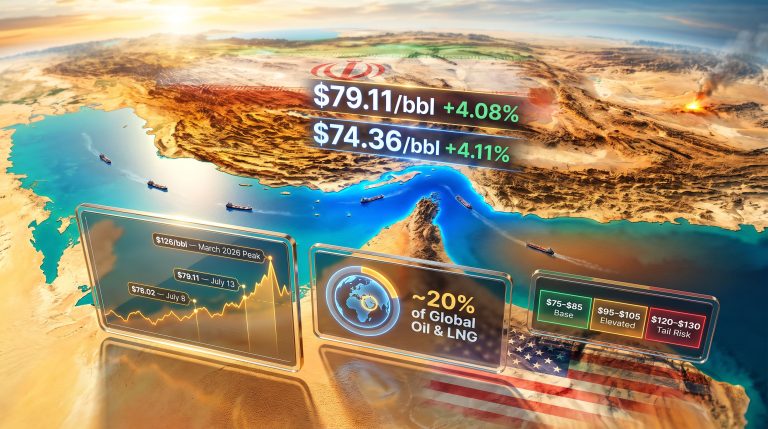
The Strait of Hormuz is approximately 33 kilometres wide at its narrowest navigable point. Through this corridor flows an estimated 20% of global oil consumption — a concentration of energy trade that makes it arguably the single most consequential maritime passage on Earth.
The Strait's reopening in late June 2026 triggered the wave of competitive Gulf crude that displaced Iranian market share. Yet tanker traffic through the Strait has decelerated again in mid-July 2026, responding to renewed tit-for-tat military exchanges between US and Iranian forces. Cargo vessels have been observed anchoring near Khor Fakkan on the UAE's eastern coast, waiting for passage clarity before committing to transit.
Of the 52 tankers tracked since the ceasefire, 15 have reached the Singapore Strait and are positioned near Malaysia's Johor anchorage zone — the Eastern Outer Port Limits, a well-known trans-shipment and ship-to-ship transfer area used extensively in sanctioned crude trade. Three Iranian-flagged VLCCs have already discharged their cargoes, confirming that some volume is reaching end buyers. However, the remaining inventory continues to accumulate.
The Freight Risk Premium Dimension
Renewed US-Iran military exchanges in mid-July 2026 have reintroduced freight risk premiums into Middle Eastern crude pricing. War risk insurance surcharges, which had partially normalised following the ceasefire, are being revisited by underwriters. This creates an additional cost layer that applies asymmetrically: it affects Iranian crude most severely, since its tankers cannot access Western insurance markets and rely on non-Western coverage that carries its own liquidity and enforceability limitations. Consequently, the trade war impact on oil pricing continues to reverberate well beyond initial market expectations.
Who Benefits: The Gulf Producer Windfall
Iraq, UAE, Qatar, and Saudi Arabia Step Into the Gap
Iran's export paralysis has produced a clear set of structural beneficiaries among Gulf producers. The speed with which they contracted Asian volumes following the Hormuz reopening demonstrates the degree of preparation — and the commercial intelligence — built into their export systems. In addition, OPEC's market influence has shaped the broader context in which these competitive dynamics are playing out.
| Gulf Producer | Key Competitive Advantage | Asian Buyer Type |
|---|---|---|
| Iraq | Established Basra crude relationships; competitive pricing | Teapots, state refiners |
| UAE (ADNOC) | Direct contracting capability; reliable delivery | Teapots, Shenghong-type independents |
| Qatar | LNG relationship leverage; surplus crude capacity | Teapots, regional buyers |
| Saudi Arabia | Scale, quality consistency, long-term supply credibility | Large independents, state refiners |
The Shenghong Petrochemical purchase — confirming Saudi barrels re-entering the Shandong supply chain — is particularly significant. It signals that even buyers who had been sourcing predominantly discounted sanctioned crude are now willing to pay closer-to-market prices for the reliability, compliance cleanliness, and delivery certainty that Gulf producers offer.
The next major ASX story will hit our subscribers first
Global Price Implications and Investor Risk Framework
Bidirectional Volatility: The Market's Dual Scenario Problem
The situation creates genuine price uncertainty in both directions, which is what makes it genuinely complex for oil market participants to position around. Furthermore, the evolving geopolitical trade tensions between major powers continue to amplify market uncertainty across energy commodities:
- If Iranian volumes flood the market at forced discount pricing, Asian crude benchmarks face downward pressure — potentially dragging Brent lower through arbitrage mechanics
- If US naval enforcement tightens and Iranian supply is effectively removed from accessible markets, Brent faces upward pressure from a real supply reduction of potentially 1 to 2 million bpd
- Oil prices jumped approximately 3% in mid-July 2026 following escalating US-Iran military strikes, illustrating the market's sensitivity to enforcement signals
Investor Note: This article discusses market dynamics and price scenarios that involve significant geopolitical uncertainty. All price forecasts, volume estimates, and scenario projections carry inherent uncertainty and should not be construed as investment advice. Past market behaviour during geopolitical disruptions does not reliably predict future outcomes.
Three Scenarios Through Q3 2026
| Scenario | Key Driver | Price Impact | Critical Variable |
|---|---|---|---|
| Forced discount clearance | Iran cuts to $4–$5 below Brent | Modest downward pressure on Asian benchmarks | Teapot appetite at revised pricing |
| Blockade tightens; volumes removed | US naval enforcement escalates | Brent spike; potential supply shock | Hormuz traffic and enforcement signals |
| Diplomatic resolution | US-Iran back-channel negotiation | Price normalisation; Iran re-enters market | Sanctions waiver extension or modification |
The OPEC+ Dimension
Iran's effective export reduction — whether voluntary or enforced — creates headroom within global supply balances that OPEC+ members with spare capacity are well positioned to absorb. Saudi Arabia, the UAE, and Iraq all maintain documented spare production capacity. While no formal quota adjustments have been announced, the alignment of Gulf producer interests with the current situation creates an implicit dynamic that market participants are increasingly pricing into forward curves.
Frequently Asked Questions
Why is Iranian oil stuck at sea right now?
Iranian crude export volumes were accelerated during the June 14 ceasefire period, but the reimposition of US sanctions — combined with China's teapot refiners pivoting to cheaper non-sanctioned Gulf crude — has left approximately 63 million barrels without confirmed buyers as of mid-July 2026.
What exactly are teapot refiners and why do they matter?
Teapot refineries are independently owned crude processors concentrated in Shandong Province, China. They have historically absorbed the overwhelming majority of Iran's export volumes because discounted sanctioned crude pricing makes economic sense for buyers with limited Western financial exposure. Their purchasing behaviour is the single most important demand variable for Iranian crude in global markets. For further context, Al Jazeera's reporting on teapot refineries provides a detailed examination of how these refineries have cushioned China from broader supply disruptions.
What is the August 21, 2026 sanctions deadline?
The United States issued a temporary enforcement waiver covering Iranian crude already in transit — estimated at up to 140 million barrels — but explicitly prohibited new purchases. The waiver expires August 21, 2026, after which all Iranian crude transactions face full secondary sanctions enforcement.
Why are teapots buying Gulf crude instead of Iranian barrels?
Following the Hormuz reopening in late June 2026, Gulf producers rapidly offered crude at discounts of $5 to $8 per barrel below ICE Brent, compared to Iranian Light's $2 to $3 discount. Combined with sanction risk, logistical uncertainty, and the August 21 deadline, the pricing differential drove the largest teapot purchases of non-sanctioned Middle Eastern crude since the conflict began.
What happens to Iranian tankers at sea after August 21?
Tankers that have not discharged their cargoes before waiver expiry expose their operators, insurers, and receiving refineries to significant legal and financial consequences. This creates strong commercial incentive for Iran and its trading intermediaries to accelerate sales in the weeks immediately preceding the deadline.
Key Takeaways
- Iran's floating crude inventory has reached crisis proportions, with approximately 63 million barrels stranded and more than 90% lacking a confirmed buyer
- China's teapot refiners — historically the backbone of Iranian crude demand — have executed their largest pivot to non-sanctioned Gulf crude since the conflict began
- The pricing architecture has inverted: Iranian crude now carries a higher effective cost than competing Gulf alternatives on a risk-adjusted basis
- A hard commercial deadline of August 21, 2026 is compressing Iran's negotiating window and accelerating pressure for price concessions
- Gulf producers, particularly Iraq, the UAE, Qatar, and Saudi Arabia, are the structural beneficiaries of Iran's export paralysis
- The Strait of Hormuz remains the defining physical variable: any further closure or traffic disruption will amplify all of the above dynamics simultaneously
For ongoing coverage of Middle East energy trade flows and the geopolitical dimensions of Iranian oil sanctions, Arab News provides detailed reporting at arabnews.com.
Want To Stay Ahead of the Next Major Commodity Discovery?
While geopolitical shocks reshape global energy flows and redirect billions in capital overnight, Discovery Alert's proprietary Discovery IQ model scans the ASX daily to deliver real-time alerts on significant mineral discoveries — instantly translating complex data across more than 30 commodities into clear, actionable insights. Explore historic discoveries and their remarkable returns, then begin your 14-day free trial to ensure you're positioned ahead of the market when the next major find is announced.