July 16, 2026
The Invisible Architecture Behind Every Aluminium Trade
Commodity markets are defined not just by price, but by time. The ability to lock in a price for a specific future date, aligned precisely with a physical shipment or procurement cycle, is what separates a functional commercial hedging market from a speculative one. For aluminium, that temporal architecture is built on a single foundation: the LME trading calendar for aluminium traders, a document that shapes every pricing decision, hedge execution, and supply contract across the global industry.
Most market participants understand that price discovery matters. Fewer appreciate that when that price is discovered matters just as much. The difference between a prompt date falling on an active trading day versus a UK banking holiday can cascade through half a dozen commercial relationships simultaneously, affecting invoice timing, trade finance costs, warehouse operations, and hedge positions in a single stroke.
When big ASX news breaks, our subscribers know first
Why Aluminium's Investment Cycle Demands a Decade-Long Calendar
Unlike agricultural commodities that reset annually with each growing season, aluminium operates on capital cycles measured in decades. The economics of the industry make this unavoidable. Furthermore, the scale of capital required to bring new capacity online means that forward price visibility is not merely useful — it is structurally essential for project financing.
Consider what it actually takes to bring new primary aluminium capacity into production:
- Bauxite mine development requires multi-year permitting, infrastructure investment, and environmental approvals before extraction begins
- Alumina refinery construction typically spans three to five years from final investment decision to first output
- Primary smelter development involves construction periods of five to seven years, with a 750,000-tonne-per-annum facility requiring capital expenditure exceeding USD 6 billion
- Power purchase agreements underpinning smelter operations routinely extend 20 to 30 years, reflecting electricity's status as approximately one-third of total production costs
Project lenders financing these assets need the ability to assess forward aluminium prices across the full debt-service period. A forward curve extending to 123 months provides the temporal scaffolding within which bankable revenue projections can be constructed. Without it, project finance structures for large-scale smelter developments become significantly harder to underwrite.
How Downstream Sectors Extend the Planning Horizon Further
The long-cycle logic does not terminate at the smelter. End-use industries consuming aluminium at scale operate on comparably extended procurement horizons:
- Automotive manufacturers negotiate multi-year aluminium supply agreements aligned to vehicle platform development timelines
- Aerospace producers require price stability and material specification guarantees across programme durations measured in decades
- Beverage can producers, operating high-volume and margin-sensitive businesses, depend on multi-year price certainty as a core input to profitability planning
- Infrastructure developers lock in material costs during project financing phases, frequently years ahead of physical delivery
Each of these commercial relationships ultimately prices against LME benchmark references. The trading calendar therefore functions as the shared temporal infrastructure connecting physical supply commitments across the entire value chain to financial market settlement. In addition, understanding the role of top aluminium producers in shaping forward supply is equally essential context for interpreting price signals.
How the LME Prompt-Date System Actually Works
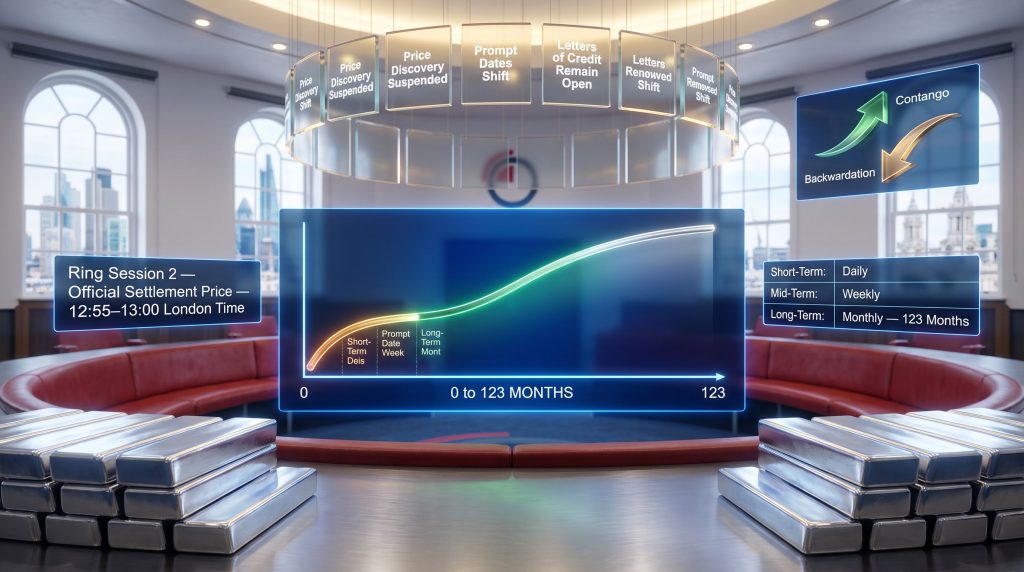
The LME trading calendar is structured around a concept that distinguishes it from virtually every other major commodity exchange: the prompt date. Rather than concentrating settlement into standardised monthly expiry cycles as the CME or SHFE do, the LME allows participants to select specific business days as settlement dates.
| Prompt Date Tier | Time Horizon | Settlement Frequency | Primary Commercial Use |
|---|---|---|---|
| Short-Term | Cash to 3 months | Daily | Spot hedging, physical cargo alignment |
| Mid-Term | 3 to 6 months | Weekly | Rolling hedges, quarterly procurement |
| Long-Term | 7 to 123 months | Monthly | Project finance, decade-long offtake agreements |
The practical logic behind this structure mirrors physical reality. Physical cargoes rarely arrive on the final day of a calendar month. Vessels encounter weather delays, port congestion, customs inspections, and geopolitical disruptions. By enabling settlement on specific business days rather than generic monthly periods, the LME allows financial contracts to align far more precisely with actual commercial activity, reducing what practitioners call timing risk: the mismatch between a financial hedge and the actual physical delivery date.
"The LME is the only major exchange simultaneously offering daily, weekly, and monthly settlement windows extending nearly a decade into the future, a design built explicitly to mirror the operational rhythms of physical metals commerce rather than the convenience of financial market standardisation."
LME Aluminium Trading Sessions: The Price Discovery Architecture
Aluminium price discovery at the LME is not a continuous process. It is concentrated within discrete five-minute Ring sessions, a structure that carries enormous operational significance for trading desks managing time-sensitive positions. The LME trading times are publicly available and should be integrated into every trading desk's operational schedule.
| Session | London Time | Function |
|---|---|---|
| LMEselect Electronic | 01:00 – 19:00 | Continuous electronic order matching |
| Ring Session 1 | 11:55 – 12:00 | Morning price reference |
| Ring Session 2 (Official Price) | 12:55 – 13:00 | Global benchmark price set here |
| Ring Session 3 | 15:15 – 15:20 | Afternoon reference |
| Ring Session 4 | 15:55 – 16:00 | Final Ring session |
| Kerb Close | 16:15 – 17:00 | Aluminium trading ceases at 17:00 |
The Official LME Settlement Price, established exclusively during Ring Session 2 between 12:55 and 13:00 London time, is the single number referenced in the majority of global aluminium supply contracts, trade finance facilities, and hedging instruments. When the exchange is closed, this mechanism does not operate. That absence is not a minor inconvenience; it is a structural event with measurable commercial consequences.
What Happens When the LME Closes: A Ten-Step Cascade
Experienced trading desks treat an LME holiday as a risk management event rather than an administrative notation. The cascade of consequences that follows a single closed trading day moves through commercial operations in a predictable but disruptive sequence:
- Official Settlement Price suspended for that business day, eliminating the benchmark reference
- Prompt dates shift to the next available trading day, affecting all contracts referencing the original date
- Forward curve recalculation required as downstream contracts referencing shifted prompt dates must be repriced
- Option expiry schedules adjust, requiring repricing or rollover of linked positions
- Warehouse release instructions pause as physical metal movements tied to settlement documentation are delayed
- Shipping documentation stalls while bills of lading and delivery orders referencing settlement dates await revision
- Letters of credit remain open as trade finance instruments cannot be closed without a confirmed settlement price
- Working capital costs increase with each additional business day a financing facility remains outstanding generating incremental interest expense
- Invoice finalisation delayed as counterparties cannot issue or accept final invoices until revised settlement prices are confirmed
- Treasury cash flow projections revised across the supply chain as intraday funding positions are updated
"Experienced aluminium trading desks treat the LME calendar as a primary risk input, not an administrative reference. Failure to account for holiday-driven prompt date shifts has historically resulted in unintended basis exposure and financing cost overruns."
A Practical Scenario: Holiday Disruption in a Five-Year Offtake Agreement
Consider a Gulf region primary aluminium producer supplying a North American automotive manufacturer under a five-year offtake agreement. Pricing is indexed to the LME Official Settlement Price across a defined quotation period, plus the US Midwest Premium reflecting regional logistics and supply dynamics. Both parties hedge their LME exposure independently. Banks, shipping companies, and treasury teams coordinate financing and cargo movements around expected settlement dates.
If the quotation period closes during a week containing a UK banking holiday, the following table illustrates the simultaneous impact across six distinct stakeholder groups:
| Stakeholder | Immediate Impact | Secondary Consequence |
|---|---|---|
| Producer | Invoice cannot be finalised | Revenue recognition delayed |
| Buyer | Accounts payable position uncertain | Cash flow projection revised |
| Hedging desk | Rollover timing shifts | Potential basis exposure if curve moves |
| Trade finance bank | Letter of credit remains open | Additional interest accrual |
| Logistics team | Cargo arrives before financial settlement | Warehouse or demurrage costs may arise |
| Treasury | Intraday funding requirement extended | Working capital facility utilisation increases |
A single day's absence from the exchange creates coordinated operational disruption across all six functions simultaneously, none of which can be resolved until trading resumes.
Understanding Market Structure Through the Calendar: Contango, Backwardation, and Basis Risk
The LME's extended prompt-date structure makes the shape of the aluminium forward curve directly observable across a near-decade horizon. The curve's structure is not merely a theoretical curiosity; it determines the economics of storage, hedging, and financing strategies in real commercial terms.
Contango conditions, where forward prices exceed spot prices, reflect the cost of storing, financing, and insuring physical metal over time. Under favourable contango conditions, traders can purchase physical aluminium, deposit it in LME-approved warehouses, and simultaneously sell forward contracts to capture the price differential between current and future settlement. This mechanism underpins the warehouse financing trade, a strategy that becomes viable or unviable depending on the steepness of the contango and prevailing financing rates.
Backwardation, where nearby prices exceed forward prices, signals near-term physical tightness or supply disruption. Backwardated markets discourage inventory accumulation, accelerate warehouse stock drawdowns, and increase urgency among consumers to secure near-term physical supply.
"Neither contango nor backwardation is a permanent market condition. The forward curve continuously evolves in response to inventory levels, macroeconomic conditions, geopolitical developments, and regional supply-demand shifts. Every hedge eventually requires rolling forward, and the cost or benefit of that rollover is determined by the curve's structure at execution."
The Multi-Dimensional Basis Risk Problem
In today's fragmented aluminium market, the LME benchmark represents only one component of the total delivered cost of metal. Sophisticated market participants must simultaneously manage exposure across multiple pricing dimensions that can move independently. Consequently, shifts in US aluminium tariffs have demonstrated precisely how sharply regional premiums can diverge from the LME benchmark during periods of trade policy disruption.
| Cost Component | Pricing Reference | Key Volatility Driver |
|---|---|---|
| LME Benchmark | Official Settlement Price | Global supply-demand balance |
| Regional Physical Premium | US Midwest, European Duty-Paid, Asian Premiums | Local logistics, tariffs, regional inventory |
| Freight Costs | Shipping indices, contract rates | Vessel availability, fuel costs |
| Carbon Costs | EU CBAM, regional carbon schemes | Regulatory evolution, emissions intensity |
| Financing Costs | SOFR, EURIBOR + credit spread | Interest rate environment |
| Insurance | Contract-specific | Geopolitical risk, cargo value |
The interaction between these components, particularly during periods of trade policy disruption, can cause delivered aluminium prices to diverge substantially from the LME benchmark alone.
When Inventory Signals and Prices Diverge: A 2026 Market Insight
One of the less commonly understood dynamics in aluminium trading is the frequent divergence between warehouse inventory levels and price movements. Standard economic intuition suggests that declining inventories should push prices higher and rising inventories should suppress them. However, the aluminium market regularly challenges this assumption.
During 2026, LME volumes surged over 25% year-on-year in Q1, driven substantially by aluminium trading activity. LME aluminium warehouse stocks declined from approximately 420,000 tonnes at the start of the year to around 289,000 tonnes by mid-July, a drawdown of roughly 31% over six months. Yet price movements did not follow a simple inverse relationship with inventory levels across this period.
The explanation lies in the simultaneous influence of macroeconomic variables, interest rate expectations, currency movements, and geopolitical risk sentiment, all of which can override inventory-driven price signals in the short to medium term. Furthermore, the broader context of aluminium and alumina markets in 2025 demonstrated how analyst downgrades and supply-side adjustments can introduce uncertainty that manifests in premium markets rather than headline LME prices.
This is precisely why sophisticated market participants monitor not only cash prices but also warehouse stocks, cancelled warrants (inventory earmarked for physical withdrawal), prompt date availability, and the full shape of the forward curve. The LME trading calendar for aluminium traders provides the temporal framework within which all these variables can be interpreted in relation to one another.
The next major ASX story will hit our subscribers first
How to Use the LME Trading Calendar in Practice
The LME publishes a comprehensive trading calendar covering the period 2025 to 2035, available as a downloadable PDF from the exchange's official website. The document specifies all UK banking holidays on which the exchange is closed, non-LME prompt dates excluded for operational reasons, Third Wednesday monthly futures reference dates, and the complete prompt-date schedule for each metal including aluminium.
Step-by-step process for verifying a specific trading date:
- Download the current LME Trading Calendar (2025–2035) from the official LME website
- Confirm the target date is not listed as a UK banking holiday or non-LME prompt date
- Cross-reference against the daily Prompt Date Calendar Report, transmitted at 00:01 UTC, for near-term dates
- Confirm relevant Ring session times if Official Price discovery is required for that specific date
- If the target date falls near a holiday, identify the next available prompt date and assess the downstream impact on linked contracts, financing instruments, and hedge positions
"Operational note for trading desks: The LME transmits a Prompt Date Calendar Report daily at 00:01 UTC. This report confirms active prompt dates for the upcoming period, accounting for any late-notified UK banking holidays or operational changes. Integrating this report into the morning workflow is a straightforward way to reduce calendar-driven basis exposure."
Frequently Overlooked Calendar Mechanics
Several structural features of the LME calendar are under-appreciated even by experienced market participants:
- The LME is closed on all UK public banking holidays, including days that may be active trading sessions in New York, Singapore, or Shanghai
- Trading in any prompt date terminates at the close of Ring Session 1 on the business day immediately preceding that prompt date
- The Third Wednesday of each month carries special significance as the primary monthly futures reference date on LMEselect electronic trading
- The forward curve extending to 123 months makes LME aluminium one of the longest forward curves available on any major commodity exchange
The Evolving Complexity Driving Calendar Importance
The aluminium market of the mid-2020s is structurally more fragmented than it was a decade ago. Several converging forces have elevated the operational significance of the LME trading calendar for aluminium traders well beyond its traditional role as a scheduling reference.
Trade policy fragmentation has reshaped commercial flows. Section 232 tariffs in the United States have created persistent premium volatility that must be managed alongside LME benchmark hedges. Sanctions affecting Russian aluminium production have altered the composition of LME-deliverable metal. Regional supply-chain diversification has multiplied the number of pricing nodes that commercial agreements must reference simultaneously.
Carbon market integration is introducing new pricing dimensions. The EU Carbon Border Adjustment Mechanism (CBAM) adds a carbon cost layer to aluminium imports that does not appear in the LME benchmark price. Emerging green metals pricing dynamics, reflecting low-carbon production credentials verified against lifecycle emissions data, are developing as a distinct pricing layer requiring separate commercial and hedging management. In addition, the global steel outlook offers useful comparative context, given that steel and aluminium share many of the same downstream industrial customers and face analogous decarbonisation pressures.
Long-term offtake agreements further amplify calendar sensitivity. When trading houses commit to purchasing a producer's future output for multiple years, every shipment delivered over the agreement's life is priced against LME reference values. Calendar-driven prompt date shifts, quotation period adjustments caused by holidays, and hedge rollover timing all affect the final realised price for every delivery across the contract's duration.
The result is a market where companies must manage a composite of LME benchmark prices, regional physical premiums, freight costs, carbon costs, financing costs, and insurance, all coordinated against a trading calendar that governs when each component can be priced and settled. In that context, treating the LME trading calendar for aluminium traders as anything less than a primary risk management tool is a structural oversight with measurable commercial consequences.
Want to Stay Ahead of the Next Major ASX Mineral Discovery?
Discovery Alert's proprietary Discovery IQ model delivers real-time alerts on significant ASX mineral discoveries, turning complex mineral data into actionable insights for both short-term traders and long-term investors — explore historic discoveries and their exceptional returns, then begin your 14-day free trial to position yourself ahead of the broader market.