June 15, 2026
When Geopolitical Fear Lifts, the Real Portfolio Opportunities Begin
Most investors instinctively focus on what conflict does to markets. Far fewer think carefully about what peace does, and the distinction matters enormously for portfolio construction. History shows that the unwinding of a geopolitical risk premium is not simply the mirror image of its build-up. The sectors that suffered most during a supply shock do not always recover fastest.
The assets that benefited from fear do not always collapse symmetrically. And the structural shifts that a crisis accelerates rarely reverse, even when the underlying trigger disappears. The Iran peace deal investment strategy, consequently, demands a far more nuanced framework than simply reversing whatever worked during the conflict period.
The Iran peace deal reached in June 2026 is a textbook case study in this dynamic. Understanding the layered investment implications, across cyclical, monetary, and structural dimensions, is what separates a reactive portfolio from a genuinely positioned one.
When big ASX news breaks, our subscribers know first
The Macro Transmission Chain: From Hormuz to Your Mortgage Rate
To understand the Iran peace deal investment strategy, it helps to trace the full economic chain of causation that the 2026 conflict set in motion, and then reverse it.
The Strait of Hormuz carries approximately 25% of the world's seaborne oil supply. When access through this chokepoint was severely disrupted, the effect was not confined to energy markets. It radiated across the entire consumer price complex. Australian petrol prices surged past $2.50 per litre at peak disruption, with diesel clearing $3.00 per litre in many regions.
Fuel prices across the economy rose 32.8% in a single quarter, a figure that immediately flowed into transport costs, manufacturing inputs, and household budgets simultaneously. Furthermore, understanding the broader oil price trends at play provides essential context for how dramatically this shift is expected to reverberate through domestic inflation.
The Reserve Bank of Australia faced an unenviable position. Confronted with inflation expectations at risk of becoming self-reinforcing, it raised the cash rate to 4.35% in May 2026, with trimmed mean inflation estimated to have peaked near 3.9% in the June quarter. This was orthodox monetary policy under extraordinary supply-side pressure.
The critical insight for investors is this: the Iran peace deal is not merely an oil story. It is a monetary policy story. Falling oil prices reduce headline inflation, which reduces pressure on the RBA to maintain a hiking bias, which re-rates every interest-rate-sensitive asset class in the economy.
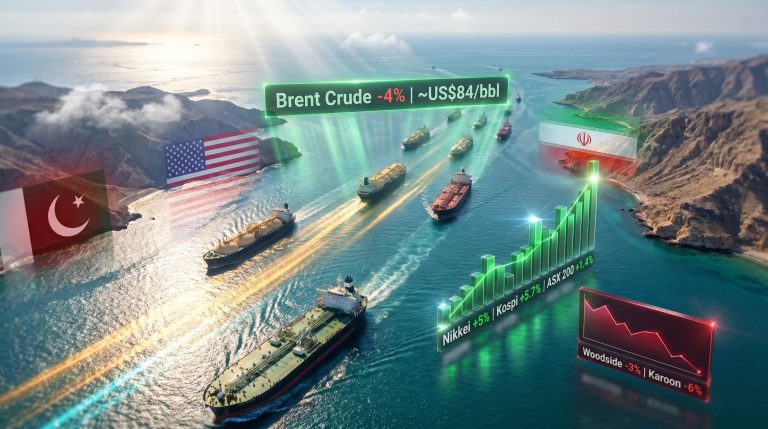
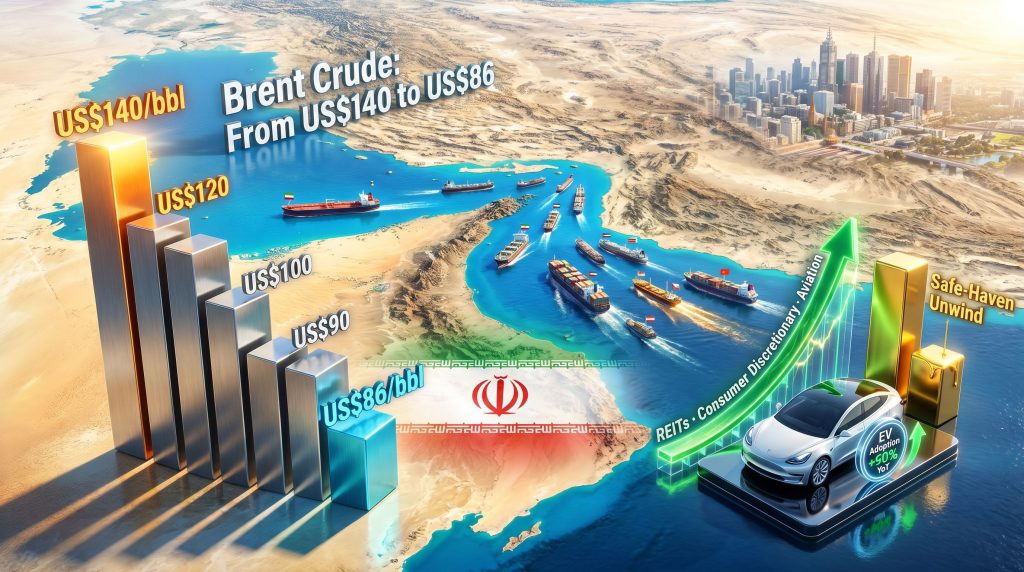
Brent crude moved from above US$140 per barrel in March 2026, its highest level since the Global Financial Crisis, toward approximately US$86 per barrel following the peace deal announcement. That trajectory, if sustained, changes the inflation calculus completely.
Three Time Horizons: Mapping the Iran Peace Deal Investment Strategy
A structured approach to positioning requires thinking in distinct timeframes, because the opportunities available now are very different from those available in twelve months, which are different again from those that compound over five years.
Horizon One: The Immediate Rotation (Zero to Three Months)
The first wave of capital reallocation is already underway. Rate-sensitive and high-beta equities respond fastest to shifting monetary expectations, because their valuations are mathematically most sensitive to changes in the discount rate.
Rate-sensitive equities and growth stocks are the most direct beneficiaries. Long-duration growth names, including ASX-listed software leaders like WiseTech Global (ASX:WTC) and Xero (ASX:XRO), saw valuations compressed during the rate-hiking cycle. As expectations shift toward rate cuts, their present-value calculations improve. The important caveat is that these names also face an independent headwind from AI-driven disruption concerns in the SaaS sector, which must resolve on its own merits.
Consumer discretionary businesses benefit from a direct household income effect. A family spending significantly more per tank fill during peak prices suddenly recovers meaningful purchasing power when fuel normalises. Retailers like JB Hi-Fi (ASX:JBH) and similar discretionary operators are natural beneficiaries of this spending power restoration.
Travel and aviation receive a dual tailwind. Jet fuel represents roughly one-third of total airline operating costs, so a sustained oil price decline is functionally equivalent to a large margin expansion event. Qantas (ASX:QAN), Flight Centre (ASX:FLT), and Web Travel Group (ASX:WEB) all benefit from both lower costs and renewed consumer appetite for discretionary travel.
REITs and property-linked sectors behave as long-duration interest rate proxies. When bond yields decline in anticipation of RBA cuts, the yield spread between REITs and risk-free rates shifts favourably. Industrial and logistics REITs such as Goodman Group (ASX:GMG) carry additional structural demand from the e-commerce supply chain, making the rate tailwind additive rather than the sole driver.
Horizon Two: The Structural Repositioning (Three to Eighteen Months)
The second phase involves trades that the consensus has only partially priced, and risks that many portfolios have not yet addressed.
| Asset Class | Conflict Period Performance | Post-Deal Direction | Primary Driver |
|---|---|---|---|
| Oil and Energy Producers | Strong (war premium) | Headwind | Brent crude decline |
| Gold | Strong (safe-haven demand) | Partial unwind | Geopolitical premium fading |
| Consumer Discretionary | Weak (cost squeeze) | Recovery | Fuel cost relief |
| REITs | Weak (rate pressure) | Recovery | RBA pivot expectations |
| Aviation and Travel | Weak (fuel and demand) | Strong recovery | Dual cost and demand tailwind |
| Marine Insurance | Strong (war-risk premiums) | Normalisation | Hormuz reopening |
| AUD-sensitive Exporters | Variable | Currency-dependent | AUD directional shift |
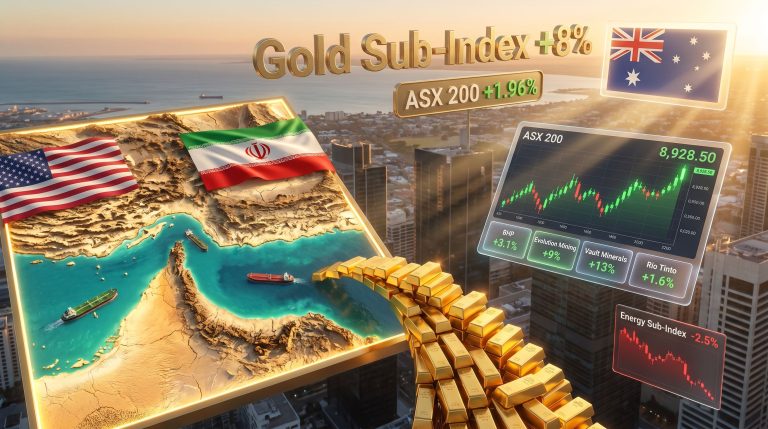
Gold requires careful recalibration. Gold performed strongly as a geopolitical risk premium asset throughout the conflict period. ASX-listed producers like Northern Star Resources (ASX:NST) and Evolution Mining (ASX:EVN) delivered significant gains. However, as the fear premium dissipates, the gold safe-haven role that elevated prices faces a structural headwind. This is not a bearish view on gold's long-term place in portfolios, but investors sitting on substantial conflict-era gains should assess how much of their position reflects durable monetary fundamentals versus transient crisis demand.
The AUD dimension is widely underestimated. Currency direction will quietly reprice the Australian-dollar value of offshore earnings across the entire market. A strengthening AUD compresses USD revenues for global healthcare and technology exporters like CSL (ASX:CSL) and ResMed (ASX:RMD), while a weakening AUD amplifies those earnings. Most retail investors never model currency sensitivity into their portfolio construction, which creates both risk and opportunity for those who do.
Marine insurance and freight costs normalise. War-risk premiums on shipping insurance surged materially during the Hormuz disruption. As the strait reopens and clearance operations conclude, these premiums retrace, reducing logistics costs across import-dependent businesses while creating a headwind for underwriters who benefited from elevated pricing.
Energy producers warrant differentiated treatment, not blanket selling. Woodside (ASX:WDS), Santos (ASX:STO), Beach Energy (ASX:BPT), and Karoon Energy (ASX:KAR) all benefited from the war premium embedded in oil prices. That premium is now draining. However, Australia's LNG producers price contracts primarily against Asian gas benchmarks rather than Brent crude directly, which creates a meaningfully different earnings dynamic. Indiscriminate selling of all energy exposure conflates distinct pricing structures.
Horizon Three: Structural Megatrends Peace Cannot Reverse (Eighteen Months to Five Years)
The most durable and arguably most important dimension of the Iran peace deal investment strategy involves the structural shifts that the conflict accelerated and that lower oil prices cannot undo.
The EV ratchet effect is perhaps the least appreciated dynamic in this entire investment landscape. Australian EV sales reached a record 14.6% of all new vehicle sales in March 2026, representing growth of more than 90% year-on-year, with some states recording near-50% monthly jumps in EV registrations at peak fuel prices. The historical precedent established during the 2022 Ukraine-driven oil shock is instructive: each major fuel crisis leaves behind a permanently elevated baseline of EV demand.
Consumers who make the transition during a crisis do not revert to combustion engines when fuel prices fall. The behavioural shift is durable, and it compounds with each subsequent disruption event. In addition, the ongoing battery storage expansion across Australia amplifies the structural demand for EV-related supply chains well beyond the conflict period.
This ratchet mechanism has profound implications for battery supply chains, grid-scale storage infrastructure, and charging networks, all of which benefit from a structurally higher EV adoption floor regardless of where oil trades in any given year.
Energy security has become a permanent policy priority for Australia. The country's dependence on imported refined fuel was starkly exposed when more than 500 fuel retail sites ran dry during peak supply disruption. The political and commercial response to that vulnerability tends to be long-lasting. Domestic fuel infrastructure operators and refiners, including Ampol (ASX:ALD) and Viva Energy (ASX:VEA), are positioned to benefit from this shift.
Rooftop solar and residential battery storage adoption also accelerates as households seek energy independence at the individual level. Longer-term, Australia's recalibration of its energy security posture may also renew momentum around uranium and nuclear growth, with multi-decade implications for domestic energy policy.
Defence expenditure is the stickiest government spending category. Military conflicts consistently trigger multi-year budget expansions that persist well beyond a conflict's resolution. Procurement cycles, capability gaps, and strategic posture reviews institutionally lock in elevated defence spending. ASX-listed defence technology companies operating across naval systems, autonomous platforms, and electro-optic technologies, including Austal (ASX:ASB), DroneShield (ASX:DRO), Boresight (ASX:BST), and Electro Optic Systems (ASX:EOS), sit within a structural growth tailwind entirely decoupled from oil price movements.
A Four-Step Portfolio Construction Framework
Translating the above analysis into action requires a structured approach rather than reactive trading.
-
Identify conflict-specific positions versus structurally justified ones. Energy producers that rallied purely on war premium should be reviewed on their underlying earnings merits. Gold positions built primarily on geopolitical fear rather than monetary fundamentals warrant partial profit-taking consideration.
-
Rotate toward rate-sensitive assets before the RBA pivot is formally announced. Markets reprice the rate cut before it occurs. Waiting for confirmation means missing the majority of the re-rating. Growth equities, REITs, and consumer discretionary names typically lead this rotation.
-
Build structural positions across the three megatrend themes. EV ecosystem investments (selectively, given near-term lithium oversupply), energy security infrastructure, and defence technology represent multi-year compounding themes that the conflict accelerated but did not create.
-
Model the AUD as a portfolio overlay variable. Determine the currency sensitivity of each significant holding, particularly for global healthcare, technology, and resource exporters. Currency direction will quietly determine a meaningful portion of total return over the next twelve months.
Key Risks to the Investment Thesis
No Iran peace deal investment strategy is complete without an honest assessment of what could invalidate it.
-
Deal fragility. Peace agreements in complex geopolitical environments carry significant implementation risk. Partial compliance, sanctions reimposition, or regional escalation can rapidly unwind the oil price recovery and re-inject fear premiums across risk assets. Bank of America analysts have highlighted this fragility as a key variable for investors monitoring asset re-pricing post-deal.
-
Inflation persistence beyond energy. Services inflation, wage growth, and housing costs are not resolved by cheaper petrol. If non-energy inflation components prove sticky, the RBA's pivot timeline may extend materially beyond market expectations, delaying the rate-sensitive asset re-rating.
-
China demand uncertainty. Australian commodity exports are substantially exposed to Chinese economic conditions. A slowdown in Chinese industrial activity can offset many of the benefits that lower oil prices would otherwise deliver to resource-sector earnings.
-
Consensus positioning is partially priced. The most obvious trades, including aviation, consumer discretionary, and REITs, may already reflect a significant portion of the expected recovery. Asymmetric opportunity is more likely in less obvious positions, such as currency overlays, marine insurance normalisation, and structural EV supply chain themes.
The next major ASX story will hit our subscribers first
Frequently Asked Questions: Iran Peace Deal Investment Strategy
Does a peace deal automatically mean oil prices will keep falling?
Not necessarily. The initial price decline reflects the removal of the war premium embedded in Brent crude. OPEC+ production decisions, the pace of Iranian supply returning to market, and global demand trajectories all influence the ultimate settlement level. The directional bias is lower, but the magnitude and timeline remain uncertain.
Should investors sell all energy stocks after the deal?
A blanket exit from energy exposure is not warranted. LNG producers with contracts priced against Asian gas benchmarks have meaningfully different earnings dynamics than pure Brent-linked oil producers. The war premium unwinds, but underlying energy demand and contract structures vary significantly across the sector.
Is gold a sell in this environment?
The conflict-specific fear premium supporting gold will likely fade. However, gold's long-term fundamentals, including central bank gold demand, monetary policy uncertainty, and currency debasement concerns, are independent of this specific conflict. Partial profit-taking on positions built primarily on crisis demand is rational. Abandoning gold entirely conflates cyclical and structural drivers.
What is the EV ratchet effect?
The ratchet effect describes the empirically observed pattern that each major fuel price crisis permanently elevates the baseline level of EV adoption. Consumers who transition to electric vehicles during a crisis do not revert to combustion engines when fuel prices subsequently fall, creating a durable upward shift in EV demand after every significant shock event.
This article is intended for general educational and informational purposes only and does not constitute personal financial advice. All statistics, figures, and company references are based on information available at the time of writing. Investment decisions should be made in consultation with a qualified financial adviser, taking into account individual circumstances, risk tolerance, and investment objectives. Past performance is not indicative of future results.
Want to Capitalise on the Next Major Market-Moving Discovery?
While geopolitical shifts reshape portfolios across commodities, energy, and rate-sensitive sectors, Discovery Alert's proprietary Discovery IQ model delivers real-time notifications on significant ASX mineral discoveries — instantly translating complex data into actionable opportunities for both short-term traders and long-term investors. Explore historic examples of exceptional discovery returns and begin your 14-day free trial at Discovery Alert to position yourself ahead of the broader market.