August 5, 2026
The Price of Threats: How Energy Markets Quantify Conflict Risk
Long before a single missile is launched or a shipping lane is physically blocked, oil markets begin adjusting. This is one of the most misunderstood dynamics in commodity investing: crude prices do not respond to reality alone, they respond to probability. When geopolitical flashpoints emerge in energy-rich regions, traders reprice risk in real time, embedding what analysts call a geopolitical risk premium into every barrel traded on global benchmarks. Understanding this mechanism is essential for anyone trying to make sense of what the Iran retaliation threat and oil prices relationship actually looks like in practice.
The current U.S.-Iran standoff, which intensified significantly through the middle of 2026, offers one of the most instructive case studies in modern commodity markets for how military rhetoric translates into measurable price movement, sometimes within hours of a statement being posted on social media.
When big ASX news breaks, our subscribers know first
What the Geopolitical Risk Premium Actually Means for Crude
At its core, the geopolitical risk premium is not a precise calculation, it is a collective market judgment about the likelihood that physical supply will be disrupted. When that probability rises, prices rise with it, even if not a single additional barrel is removed from the market. Understanding crude oil price trends helps contextualise just how significant this premium has become.
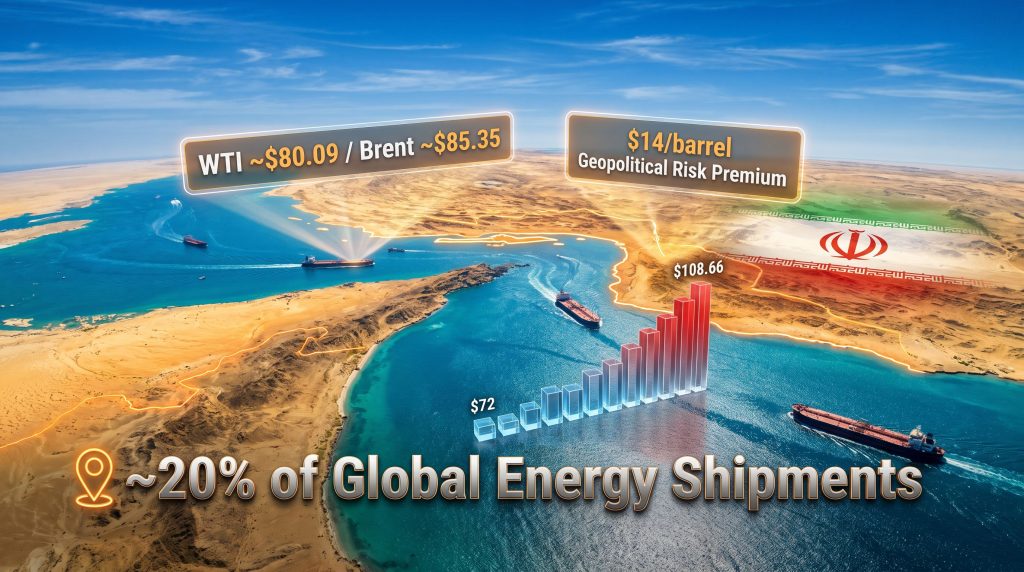
By March 2026, analysts estimated this conflict-driven premium had reached approximately $14 per barrel embedded in crude benchmarks, a significant buffer above what supply-demand fundamentals alone would justify. This figure is not static, it compresses when diplomatic signals emerge and expands when military rhetoric intensifies.
The oil market is fundamentally a forward-pricing mechanism. It discounts geopolitical risk weeks and sometimes months before any physical supply consequence materialises. This is why Iran's statements, even absent any military action, carry immediate pricing power.
This dynamic creates a unique challenge for market participants: distinguishing between noise and genuine supply risk requires deep familiarity with the geography, military capabilities, and diplomatic incentives involved in a specific conflict. Furthermore, oil geopolitics analysis reveals how interconnected these pricing signals truly are across global benchmarks.
The Strait of Hormuz: Why One Waterway Holds the Global Economy Hostage
No single geographic feature better illustrates the concentration of energy infrastructure risk than the Strait of Hormuz. This narrow passage between Iran and Oman serves as the primary exit route for roughly one-fifth of all global energy shipments, making it the most consequential maritime chokepoint on the planet. CNBC reported on how the Iran-U.S. standoff has placed renewed focus on this critical waterway.
What makes the Strait so strategically dangerous is not just volume, it is the absence of viable alternatives. Unlike some energy corridors where overland pipelines or alternative sea routes exist, Gulf producers have no cost-equivalent bypass for large-scale crude and LNG exports. The logistical constraints are structural, not temporary.
Goldman Sachs modelling has estimated that a full one-month closure of the Strait could add $10 to $15 per barrel to global benchmarks, potentially pushing Brent crude into the $120 to $130 per barrel range from current levels. Even a partial disruption, reducing Gulf Cooperation Council export volumes by 20 to 30% without a complete closure, could push prices into the $80 to $100 per barrel band.
Key supply chain vulnerabilities concentrated around the Strait include:
- Crude oil exports from Saudi Arabia, Iraq, Kuwait, the UAE, and Qatar
- Liquefied natural gas shipments from Qatar's massive North Field operations
- Petrochemical feedstocks serving downstream manufacturing across Asia and Europe
- Tanker insurance and freight pricing, which respond to threat levels independently of physical blockades
Iran's military posture includes documented capacity to threaten commercial vessel movement through mines, fast-attack craft, and anti-ship missile systems. Consequently, even without a formal closure, the credible threat of interdiction raises shipping insurance costs and introduces operational delays that create effective supply tightening. For a broader view of how global LNG supply is exposed to these chokepoint risks, the vulnerability is considerable.
A Detailed Timeline: How Prices Moved Through the 2026 Escalation Cycle
The 2026 U.S.-Iran conflict cycle has produced some of the most dramatic intraday and weekly price swings seen in crude markets since the 2022 energy shock. Mapping these moves against specific escalation events reveals a clear pattern in how markets are processing the crisis.
| Escalation Event | Brent Price Movement | Market Interpretation |
|---|---|---|
| U.S./Israel airstrikes on Iran (Feb 28, 2026) | $72 to $108.66/barrel | Acute supply disruption fears |
| Trump threatens Iranian infrastructure strikes | $110 to $107/barrel | Diplomatic signals partially offset fear |
| Iran tightens Hormuz vessel controls | ~$70 to $73-$78/barrel | Chokepoint closure probability rises |
| Iran retaliates but spares energy assets | $78 to $72/barrel (-6%) | Risk premium compresses sharply |
| Trump resumes strikes after ceasefire ends (Jul 8) | $73.89 to $78.02/barrel (+5.2%) | Risk premium reprices upward |
| Current escalation cycle (Jul 16-17, 2026) | WTI ~$80.09 / Brent ~$85.35 | Sustained bullish pressure on infrastructure threat |
As of July 17, 2026, WTI crude futures for August delivery were trading at approximately $80.09 per barrel, a gain of 1.32%, while international Brent futures advanced to $85.35 per barrel, up 1.33%, directly reflecting market repricing following Iran's formal warning that regional infrastructure would be targeted if U.S. strikes proceeded.
Decoding Tehran's Threat: What Regional Infrastructure Actually Means
The statement issued by Iran's top military command, warning that everything still intact across regional infrastructure would be destroyed in response to U.S. strikes, deserves careful analytical reading rather than surface-level interpretation.
The phrase regional infrastructure carries deliberate scope ambiguity. It does not specify military targets, it implies economic and energy assets across multiple Gulf states simultaneously. This matters for several reasons, and examining oil prices and conflict risk more broadly underscores why the language was so immediately impactful on markets.
Potential target categories encompassed by this language:
- Oil export terminals and tanker loading facilities in Saudi Arabia and the UAE
- Gas processing plants including assets adjacent to Iran's own South Pars gasfield, the world's largest natural gas field
- Desalination infrastructure that multiple Gulf states depend on for freshwater supply
- Port logistics and container handling facilities serving regional trade flows
The South Pars dimension is particularly significant. Any military action that damages shared reservoir geology in the Persian Gulf could simultaneously affect Iranian and Qatari production capacity, given that South Pars and Qatar's North Field draw from the same geological formation. This creates a scenario where infrastructure warfare produces supply losses across multiple producing nations simultaneously, generating non-linear price responses that models calibrated on single-country disruptions may significantly underestimate.
This threat architecture preceded the market move. President Trump's statement in a Fox News interview, indicating U.S. forces could target Iranian infrastructure within days absent a diplomatic breakthrough, established the escalation sequence. Iran's response followed, and markets priced the combined signal immediately.
Rystad Energy's Base Case and Why Confidence Has Weakened
Senior analysts at Rystad Energy publicly maintained through mid-July 2026 that a limited diplomatic agreement between Washington and Tehran remained the most probable near-term outcome, while acknowledging that confidence in this conclusion had materially eroded as rhetoric from both sides intensified.
The analytical foundation for expecting a negotiated resolution rests on two structural incentives that neither side has fully abandoned.
1. U.S. Political Economy Pressures
The Trump administration faces November midterm elections in an environment where gasoline prices function as a direct barometer of voter sentiment. Elevated crude benchmarks above $100 per barrel translate almost immediately into pump price increases that have historically damaged incumbent parties. This creates a powerful domestic political incentive to keep energy costs contained, making a full military escalation economically self-defeating from a U.S. political standpoint.
2. Iran's Economic Package on the Table
Tehran currently has access to a substantial set of economic concessions, including releases of previously frozen assets and export waivers that provide meaningful relief to its sanctions-constrained economy. According to analysis from Rystad Energy's Jorge León, Iran's economic calculus strongly discourages permanently forfeiting these concessions by triggering a full military confrontation that would likely result in even tighter international sanctions.
Rystad Energy's base case rests on the mutual recognition that full escalation is economically irrational for both parties, but the gap between rational incentives and actual decision-making has historically widened during periods of domestic political pressure on either side.
The next major ASX story will hit our subscribers first
Target Sensitivity: Why Iran's Retaliation Does Not Always Push Prices Higher
One of the most practically important and least widely understood features of the 2026 escalation cycle is that Iran's retaliatory actions have not produced uniformly bullish oil price outcomes. The market's response is target-sensitive, meaning price direction depends critically on what assets are struck, not merely that a strike occurred. However, the Iran retaliation threat and oil prices relationship remains highly dynamic and closely watched by analysts worldwide.
| Retaliation Type | Price Direction | Observed Magnitude |
|---|---|---|
| Military base strikes (sparing energy assets) | Bearish | -6% observed |
| Threats specifically targeting oil/gas infrastructure | Bullish | +5% to +36% range |
| Hormuz vessel interference or chokepoint action | Sharply Bullish | Insurance spike + supply premium |
| Diplomatic language / ceasefire signalling | Bearish | Risk premium compression |
When Iran's retaliatory strikes in early 2026 targeted military installations while leaving energy export infrastructure intact, Brent crude fell nearly 6% as the market concluded supply chains remained operational. This asymmetry is critical for traders and investors monitoring the situation: the absence of energy infrastructure targeting is itself a bearish signal, regardless of whether military action is occurring.
This pattern suggests that sophisticated market participants are watching what Iran targets far more closely than whether it retaliates at all. Furthermore, OPEC market influence adds another layer of complexity to how these price signals ultimately resolve across global supply balances.
Downstream Consequences: From Futures Markets to Consumer Prices
The economic consequences of a sustained Hormuz disruption extend well beyond crude futures. Analysts estimate that a meaningful, prolonged interruption to Strait traffic could raise U.S. gasoline prices by up to $1.25 per gallon, a figure that would register immediately in consumer confidence data and retail spending patterns. MarketWatch has highlighted how sluggish Strait traffic alone could reignite upward price pressure even before a formal closure occurs.
For central banks already navigating above-target inflation environments, an energy-driven price shock of this magnitude creates a compounded policy dilemma. Tightening monetary policy to contain energy-driven inflation risks slowing growth precisely when geopolitical uncertainty is already weighing on business investment. This is a scenario where standard policy tools lose effectiveness because the inflation source is supply-side and externally driven.
The broader supply chain exposure beyond crude oil includes:
- LNG shipments to European and Asian buyers transiting the same chokepoint
- Petrochemical feedstock costs affecting plastics, fertiliser, and manufacturing inputs globally
- Disproportionate fiscal exposure for energy-import-dependent emerging market economies running current account deficits
- Agricultural commodity prices, which have historically correlated with energy cost spikes through fertiliser and transportation channels
Three Scenarios for Oil Markets Through the Remainder of 2026
Given the current escalation trajectory, analysts have framed three plausible pathways for crude prices through the second half of 2026.
Scenario 1: Diplomatic Resolution (Base Case)
A limited agreement is reached between Washington and Tehran, the $14 per barrel risk premium gradually unwinds, and Brent crude drifts back toward pre-escalation levels in the $70 to $75 range. Both parties preserve their respective economic incentives. This remains the most probable outcome but is no longer highly confident.
Scenario 2: Sustained Standoff (Elevated Risk Case)
Talks stall without either side escalating to infrastructure strikes. Prices remain range-bound between $80 and $95, held elevated by persistent uncertainty but capped by the absence of actual supply disruption. This scenario could persist for months and creates a prolonged drag on energy-intensive economies.
Scenario 3: Full Escalation (Tail Risk Case)
Infrastructure strikes occur, Hormuz access is physically threatened, and Brent surges toward the $120 to $130 range. Emergency reserve releases from the International Energy Agency member nations would likely follow, but coordination lag means initial price spikes could be severe. Central banks would face simultaneous growth and inflation pressures. This scenario is not the base case, but its consequences are disproportionately large relative to its probability.
Disclaimer: The scenario projections above are based on analyst modelling and publicly available research as of July 2026. They represent probabilistic frameworks, not predictions, and actual market outcomes may differ materially based on diplomatic developments, military actions, or supply-side factors not currently visible. This article does not constitute financial advice.
Frequently Asked Questions: Iran Retaliation Threat and Oil Prices
Why did oil prices rise on July 17, 2026?
Iran's military command issued a formal warning that it would destroy regional infrastructure across the Gulf if U.S. strikes on Iranian facilities proceeded. This elevated the perceived probability of supply disruption across one of the world's most critical energy corridors, causing both WTI and Brent to advance by approximately 1.3%.
How high could oil prices go if the Strait of Hormuz is blocked?
Based on Goldman Sachs modelling, a complete one-month Strait closure could add $10 to $15 per barrel to global benchmarks, potentially pushing Brent from its current level near $85 into the $120 to $130 per barrel range.
Does Iran's retaliation always push oil prices higher?
No. When earlier 2026 retaliatory strikes targeted military assets while sparing energy infrastructure, Brent fell nearly 6%. Price direction is determined by whether energy supply chains are directly threatened, not by whether retaliation occurs at all. The Iran retaliation threat and oil prices dynamic is therefore far more nuanced than headline coverage typically suggests.
What is currently embedded in oil prices as a geopolitical premium?
As of March 2026, analysts estimated the conflict-related premium at approximately $14 per barrel above fundamental supply-demand levels. This figure has fluctuated with the intensity of military and diplomatic signalling throughout the escalation cycle.
What would cause oil prices to fall from current levels?
A credible diplomatic agreement between Washington and Tehran would compress the embedded risk premium and likely push prices back toward the $70 to $75 Brent range. Both sides retain economic incentives to negotiate, though the window for agreement appears to be narrowing as military planning timelines shorten.
Want to Stay Ahead of the Next Major Commodity Market Shift?
Discovery Alert's proprietary Discovery IQ model scans ASX announcements in real time, instantly identifying significant mineral discoveries and translating complex market signals into actionable investment opportunities — explore historic discovery returns on Discovery Alert's discoveries page to see what early positioning can mean for a portfolio, and begin your 14-day free trial at Discovery Alert to ensure you're never behind the market when the next major move unfolds.