July 21, 2026
The Hidden Architecture of Sanctions Evasion at Sea
Few mechanisms in global commodity markets are as poorly understood by outsiders as the infrastructure that keeps sanctioned oil flowing. Iran seizes sanctioned oil tanker off Oman is more than a dramatic headline. It reveals a sophisticated system involving vessel renaming, flag rotation, shell ownership, disabled transponders, and falsified destination records.
The shadow tanker ecosystem is not a fringe phenomenon run by rogue actors. Instead, it is a layered supply chain that operates in the gaps between maritime law, enforcement capacity, and geopolitics. Consequently, when Tehran moved against the vessel known as Ocean Koi on 8 May 2026, it exposed just how fragile the wider sanctions regime has become.
How Iran's Maritime Enforcement Fits Into a Wider Sanctions Conflict
The mechanics behind U.S. secondary sanctions on oil tankers
The U.S. Treasury’s Office of Foreign Assets Control, or OFAC, uses the Specially Designated Nationals (SDN) list as a core enforcement tool. Once a vessel is listed, U.S. persons and institutions are barred from dealing with it directly.
More importantly, secondary sanctions extend that risk to foreign parties. As a result, banks, insurers, traders, and port operators in Europe and Asia often avoid any exposure. This ripple effect is central to broader sanctions on oil trading.
The architecture works on several levels:
- Primary designations freeze U.S.-linked assets and block domestic dealings
- Secondary sanctions penalise foreign entities engaging with listed vessels
- Vessel-level enforcement tracks aliases, ownership links, and prior names
- Cargo-level enforcement targets financial flows tied to the oil itself
Since the U.S. withdrew from the JCPOA in 2018, this framework has tightened considerably. However, enforcement on paper and enforcement at sea are often very different things.
Why sanctioned vessels keep sailing
Despite their formal reach, sanctions have not stopped the growth of the shadow fleet. Instead, operators have adapted faster than regulators in many cases.
For instance, vessels may legally change names or flags in isolation. Yet when these steps are combined, they can obscure a tanker’s true identity. In addition, AIS transponder disabling has become routine, making live tracking unreliable.
Other common tactics include:
- Routing ownership through opaque offshore jurisdictions
- Falsifying destination records
- Conducting ship-to-ship transfers
- Blending cargo chains to mask origin
Therefore, Iran seizes sanctioned oil tanker off Oman should also be viewed through the lens of an enforcement gap, not just a naval incident.
What Is the Ocean Koi, and Why Does Its Seizure Matter?
From Jin Li to Ocean Koi
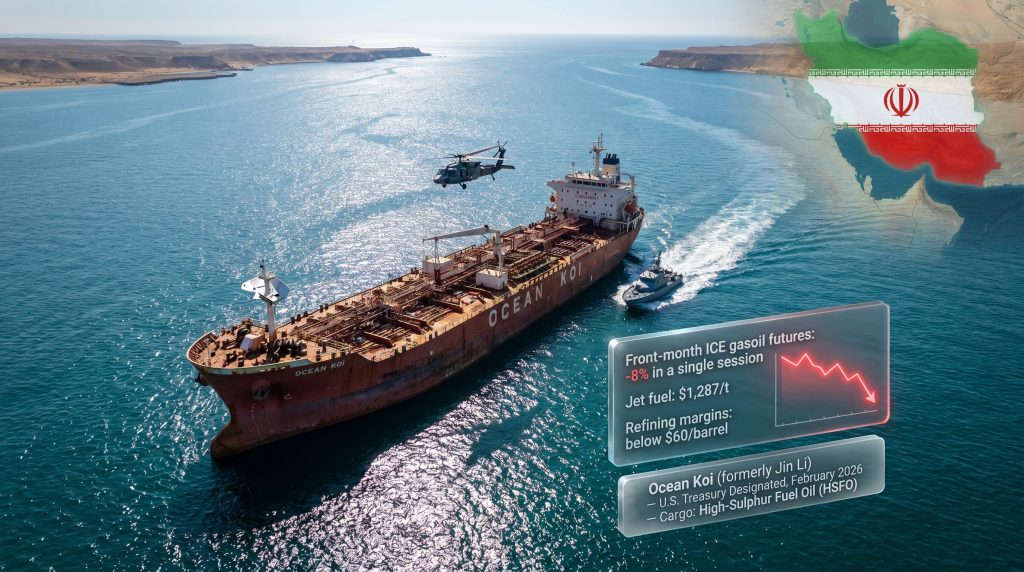
The vessel at the centre of the case previously operated as Jin Li before appearing in tracking data as Ocean Koi. That change was not incidental. Rather, it reflects a standard rebranding tactic used within the shadow fleet.
Vessel analytics firm Vortexa tracked the tanker loading High-Sulphur Fuel Oil (HSFO) off Oman on 7 May 2026. Its declared destination was Khor Fakkan in the UAE, although such declarations can be deeply misleading.
The February 2026 designation
The U.S. Treasury added Ocean Koi to the SDN list in February 2026 over its alleged role in Iranian oil trade. That action followed a broader pattern of targeting vessels and intermediaries linked to Tehran’s export networks.
According to Reuters reporting on the seizure, Iranian state media said the tanker was redirected towards Iranian shores. That framing adds another layer to an already complex incident.
Cargo details and why HSFO matters
HSFO is a residual petroleum product used mainly as marine bunker fuel. Its significance here goes beyond the cargo itself. The fact that it was loaded off Oman, rather than directly from an Iranian port, strongly suggests the use of intermediary transfer arrangements.
This kind of structure is common in shadow shipping. Furthermore, it reflects the wider geopolitical landscape for commodities, where energy and raw materials increasingly move through politically contested channels.
Key facts include:
- Vessel: Ocean Koi, formerly Jin Li
- Cargo: HSFO
- Loading point: Off the coast of Oman, 7 May 2026
- Declared destination: Khor Fakkan, UAE
- Sanctions date: February 2026
- Seizing force: Iranian Navy
Is Iran Seizing Its Own Oil? The Enforcement Paradox
A supply chain control dispute
Iranian state media claimed the vessel was carrying oil belonging to the Islamic Republic and was seized for acting against the interests of Iranian exports. On the surface, that sounds contradictory.
However, the more coherent explanation is an internal control dispute. Iran’s export system is not a single chain of command. Instead, it includes state entities, private traders, and networks linked to the IRGC, which do not always share the same incentives.
If cargo was diverted without authorisation, intervention would make sense from Tehran’s perspective. In that light, Iran seizes sanctioned oil tanker off Oman may indicate internal discipline as much as foreign confrontation.
Domestic political signalling
The seizure also plays well domestically. By presenting the action as a defence of national resources, Iranian authorities can project control during a period of heightened regional pressure.
That matters because energy disputes are never purely commercial. They are also political theatre, especially in contested chokepoints like the Strait of Hormuz.
The Strait of Hormuz Crisis: A Compressed Timeline
The Ocean Koi seizure unfolded during an exceptionally volatile 30-day period. In other words, it was part of a broader escalation, not an isolated event.
Notable developments included:
- 7 April 2026: U.S.-Iran ceasefire agreement reached
- 13 April 2026: U.S. enforces blockade of Iranian trade
- 4 May 2026: Project Freedom naval escort mission launched
- 5 May 2026: CMA CGM San Antonio struck by Iranian projectile
- 7 May 2026: Ocean Koi loads HSFO off Oman
- 8 May 2026: Iran seizes the tanker
What Project Freedom revealed
Project Freedom lasted less than 24 hours before being suspended. Iranian missiles, drones, and small boats challenged U.S. naval operations in a confined waterway where geography heavily favours shore-based systems.
According to Argus Media reporting cited in the original analysis, front-month ICE gasoil futures fell more than 8% in a single session on 6 May 2026 after talk of a possible Hormuz deal. That speed highlights how nervous the market remains.
This is where the wider oil price shock theme becomes relevant. Even short-lived disruption in Hormuz can trigger outsized reactions across freight, refining, and aviation.
Global Energy Markets and the Hormuz Sensitivity Premium
Jet fuel, crude and risk pricing
The market response has been severe and highly reactive. On 6-7 May 2026, several pricing indicators reflected intense volatility:
- European jet fuel premiums were assessed at $99.50 per tonne
- Refining margins fell below $60 per barrel
- Outright jet fuel prices dropped to $1,287 per tonne
- Yet prices still remained more than 50% above pre-war levels
Therefore, Iran seizes sanctioned oil tanker off Oman is not simply a shipping story. It also reinforces a broader pricing premium attached to Hormuz risk.
Why the global spillover matters
About 20% of global petroleum liquids pass through the Strait of Hormuz each day. Consequently, any disruption quickly affects crude benchmarks, refined products, freight rates, and industrial costs.
In addition, tensions around shipping lanes often overlap with the trade war impact on oil, further complicating market sentiment. Energy traders must now price in both military and policy shocks at once.
Gas markets are also sensitive. Although this incident centres on oil, any sustained Hormuz disruption would inevitably shape the wider LNG supply outlook across Asia and Europe.
How Iran's Seizure Pattern Has Developed
Iran’s interception of Ocean Koi is not an anomaly. Instead, it fits an established pattern of maritime seizures in the Gulf of Oman and nearby waters.
Recent examples include:
- November 2025: The Talara, a Marshall Islands-flagged crude tanker, was diverted to Iranian waters
- December 2025: A foreign tanker near Jask was seized with 18 crew members detained
- May 2026: Ocean Koi was intercepted after loading HSFO
A recognisable operating method
Across multiple cases, the methodology appears consistent:
- Helicopter or rapid-force boarding
- Navigation system control or AIS scrutiny
- Diversion to Iranian coastal waters
- Public justification tied to smuggling or national interest
- Extended detention of vessel and crew
As noted by Kurdistan24’s coverage of the tanker case, Iranian authorities portrayed the seizure as protecting Iranian oil exports. Even so, independent verification remains limited.
What Happens Next?
Three plausible scenarios
The next phase could develop in several ways:
- Negotiated reopening: Diplomacy reduces tension and lowers the market risk premium
- Managed stalemate: Sporadic incidents continue while trade partially resumes
- Renewed escalation: Hormuz disruption deepens and prices surge again
At present, the second scenario appears the most plausible. However, the pace of change has been so rapid that any firm prediction would be risky.
Why this seizure matters beyond one ship
Ultimately, Iran seizes sanctioned oil tanker off Oman matters because it captures several forces at once:
- The limits of sanctions enforcement
- The resilience of shadow shipping networks
- The vulnerability of global energy supply chains
- The growing geopolitical premium embedded in commodity markets
For analysts and investors alike, the Ocean Koi episode is a reminder that maritime logistics are no longer a background issue. They are now central to how energy security, diplomacy, and market pricing interact.
Want to Stay Ahead of Commodity Market Disruptions Like the Hormuz Crisis?
When geopolitical shocks ripple through energy markets, the investors best positioned to respond are those with real-time intelligence — Discovery Alert's proprietary Discovery IQ model scans ASX announcements the moment they land, delivering instant alerts on significant mineral discoveries and actionable opportunities across 30+ commodities. Explore historic discoveries and the returns they generated, then start your 14-day free trial to ensure you're never caught off guard when markets move.