July 7, 2026
The Persian Gulf's most critical maritime passage remains under constant threat as regional tensions escalate, with any potential Iran Strait of Hormuz blockade capable of triggering unprecedented global energy disruption. This narrow waterway serves as the world's most important oil transit chokepoint, and understanding the multifaceted implications of its closure becomes essential for energy security planning across continents.
Geographic Vulnerability and Strategic Importance
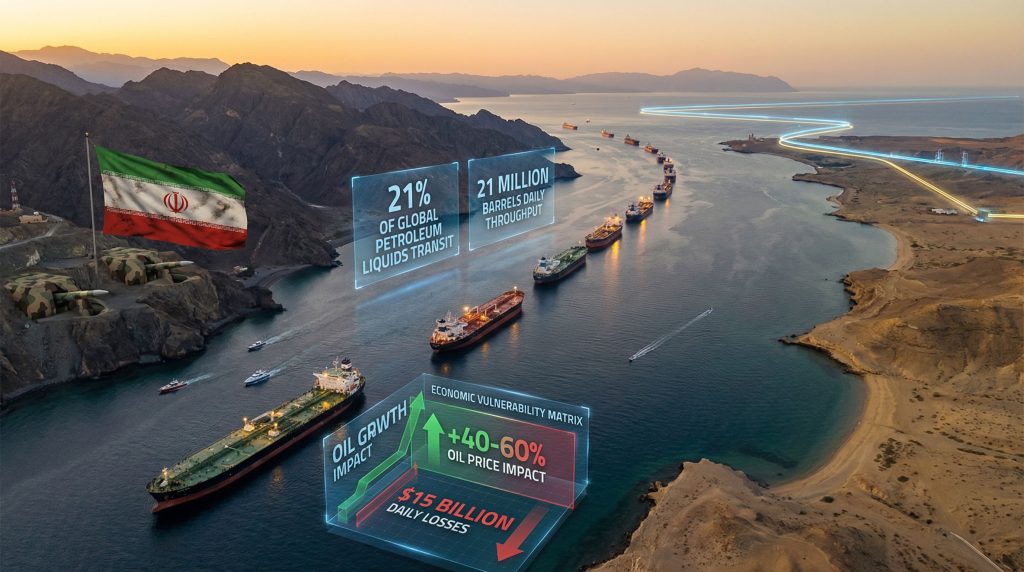
The Strait of Hormuz functions as an irreplaceable maritime gateway, channeling approximately 21% of global petroleum liquids through a passage measuring just 21 miles at its narrowest point. This geographic bottleneck connects major Gulf oil producers including Saudi Arabia, Iran, Iraq, and the United Arab Emirates with the Gulf of Oman and Arabian Sea, creating a single point of failure for regional energy exports.
Unlike other maritime routes with alternative pathways, the Persian Gulf producers face no viable pipeline substitutes capable of matching current export volumes. The strait handles a staggering 21 million barrels of crude oil and refined products daily, representing over $1.2 billion in energy trade value moving through the waterway each day.
Key vulnerability factors include:
• Physical geography limiting alternative routing options
• High tanker traffic density creating operational constraints
• Seasonal weather patterns affecting transit reliability
• Limited port infrastructure outside the Gulf region
The concentration of global LNG shipments through this passage adds another layer of complexity, with approximately 20% of worldwide liquefied natural gas depending on uninterrupted strait access. Furthermore, insurance markets reflect this vulnerability, with Lloyd's of London historically increasing premiums by 300% during closure threats, demonstrating the financial sector's assessment of disruption risks.
When big ASX news breaks, our subscribers know first
Market Impact Scenarios and Price Dynamics
Energy markets exhibit extreme sensitivity to Strait of Hormuz disruption scenarios, with price volatility patterns established through historical precedents. However, the OPEC production impact on global supply chains would become particularly pronounced during any blockade scenario.
The 2019 attacks on Saudi Arabia's Abqaiq and Kurais facilities, which temporarily removed 5.7 million barrels per day from global markets, triggered immediate 15% crude oil price increases and demonstrated market fragility to Gulf supply shocks.
How Would Oil Prices Respond to Extended Closure?
Market analysts project escalating price impacts based on closure duration:
| Disruption Period | Oil Price Impact | Gas Price Multiplier | Daily Economic Losses |
|---|---|---|---|
| 1-7 days | +40-60% | 2.5x | $15 billion |
| 2-4 weeks | +80-120% | 4x | $35 billion |
| 1-3 months | +150-200% | 6x | $75 billion |
These projections assume coordinated strategic petroleum reserve releases and alternative supply activation. In addition, historical analysis from the 1973 oil embargo period suggests 2-3% additional CPI increases during extended supply disruptions, with energy-intensive industries bearing disproportionate impacts.
Strategic Reserve Limitations
Global emergency stockpiles provide temporary buffers but face capacity constraints:
• US Strategic Petroleum Reserve: 90-day supply coverage at current consumption rates
• International Energy Agency coordination: 60-day collective release capacity
• Asian strategic reserves: Combined 45-day buffer for Japan, South Korea, and China
• Maximum coverage timeline: 4-6 months during complete strait closure
"The arithmetic of global oil storage reveals fundamental limitations in sustained crisis response, with strategic reserves designed for temporary market stabilization rather than long-term supply replacement."
Military Capabilities and Asymmetric Warfare
Iran's ability to threaten strait closure relies on asymmetric naval strategies designed to counter superior conventional forces. The Islamic Revolutionary Guard Corps Navy maintains specialised fast-attack craft fleets, diesel-electric submarines, and shore-based missile systems positioned along the strait's northern coastline.
Naval Asset Assessment
Iranian military capabilities include:
• Fast attack craft: Over 200 Revolutionary Guard speedboats equipped with anti-ship missiles
• Submarine operations: Multiple Kilo-class diesel-electric vessels capable of covert deployment
• Coastal defence systems: Extensive shore-based anti-ship missile batteries
• Mining capabilities: Estimated stockpiles exceeding 2,000 naval mines
The February 2026 escalation demonstrated operational missile capabilities, with Iranian forces targeting multiple Gulf nations hosting US military installations. Strikes reached Qatar, Kuwait, Bahrain, the United Arab Emirates, Saudi Arabia, and Oman, confirming the geographic range of Tehran's regional missile arsenal.
Defensive Advantages
Iran's strategic positioning provides several tactical benefits:
• Terrain control: Mountainous Zagros coastline offers concealed launch positions
• Island outposts: Abu Musa and Tunb islands function as forward surveillance bases
• Radar integration: Overlapping detection networks across strait approaches
• Air defence coordination: S-300 and indigenous systems protecting naval installations
Consequently, the Strait of Hormuz crisis represents a complex military challenge requiring sustained international coordination.
Alternative Transportation Infrastructure
Pipeline networks represent the primary alternative to maritime transit, though existing capacity falls far short of strait throughput volumes. Regional producers have invested in bypass infrastructure, but expansion timelines and capacity constraints limit near-term substitution potential.
Pipeline Bypass Analysis
| Route | Current Capacity (mbpd) | Expansion Potential | Implementation Timeline |
|---|---|---|---|
| Saudi East-West Pipeline | 5.0 | 7.5 | 18 months |
| UAE-Oman Pipeline | 1.5 | 2.8 | 24 months |
| Iraq-Turkey Pipeline | 0.6 | 1.2 | 36 months |
| Iran-Pakistan Pipeline | 0.0 | 1.0 | 48 months+ |
Saudi Arabia's East-West Pipeline represents the most significant alternative route, potentially handling 5.0 million barrels per day through Red Sea terminals at Yanbu. For instance, planned expansion to 7.5 million barrels per day requires substantial infrastructure investment and 18-month implementation periods under optimal conditions.
Maritime Rerouting Challenges
Ships diverted around the Cape of Good Hope face significant operational penalties:
• Extended transit times: Additional 15 days voyage duration
• Increased shipping costs: $2 per barrel transportation premium
• Fleet capacity constraints: Global tanker availability insufficient for 40% longer journeys
• Port congestion: Limited terminal capacity at alternative destinations
The Suez Canal provides northbound capacity of 5.5 million barrels per day maximum, but Red Sea security concerns from Yemen's Houthi militant activities create additional routing complications. Global shipping experienced significant disruptions from drone and missile attacks in Red Sea waters since the 2023 Gaza conflict outbreak.
Regional Response Strategies
Gulf Cooperation Council members maintain comprehensive contingency plans for strait closure scenarios, emphasising rapid alternative export activation and military cooperation frameworks. These preparations reflect decades of strategic planning for Persian Gulf supply disruptions.
Saudi Arabia's Strategic Positioning
The Kingdom's response framework prioritises:
• Pipeline capacity maximisation: Accelerated East-West Pipeline expansion to 7.5 million barrels per day
• Red Sea terminal development: Enhanced Yanbu and Jeddah export facility utilisation
• OPEC+ coordination: Spare capacity deployment through producer alliance mechanisms
• Military partnership: Joint operations with UAE forces and US Fifth Fleet assets
Saudi Arabia maintains approximately 2 million barrels per day of spare production capacity, providing market stabilisation tools during supply crises. However, the Kingdom's strategic petroleum reserves offer additional buffering capability, though specific quantities remain undisclosed for security reasons.
UAE Diversification Measures
The Emirates leverages geographic advantages through:
• Fujairah operations: Existing pipeline infrastructure to Arabian Sea terminals
• Strategic storage deployment: Emergency petroleum reserves estimated at 42 days consumption
• Air power projection: F-35 and Rafale squadron capabilities for escort operations
• Port expansion: Accelerated development of non-Gulf export terminals
International Military Coordination
Allied naval forces maintain persistent Gulf presence through established frameworks:
| Naval Component | Assets | Primary Mission |
|---|---|---|
| US Fifth Fleet | 20+ warships, carrier strike groups | Maritime security, convoy escort |
| UK Maritime Forces | Type 45 destroyers, support vessels | Coalition operations, mine clearance |
| French Naval Assets | Charles de Gaulle carrier rotation | Regional stability, intelligence |
| Coalition Minesweeping | Specialised clearance vessels | Channel reopening operations |
Sectoral Economic Impact Assessment
Strait closure affects global economic sectors through direct energy cost increases and supply chain disruptions. Industry vulnerability varies based on energy intensity, geographical exposure, and alternative sourcing capabilities.
Primary Industry Disruptions
| Economic Sector | Disruption Severity | Recovery Timeline | Primary Mitigation |
|---|---|---|---|
| Petrochemicals | Severe (80% impact) | 6-12 months | Alternative feedstock |
| Aviation | High (60% impact) | 3-6 months | Fuel hedging programs |
| Maritime Shipping | Critical (90% impact) | 1-3 months | Fleet redeployment |
| Manufacturing | Moderate (40% impact) | 6-9 months | Energy substitution |
The 2022 European energy crisis provides precedent for industrial adaptation, with petrochemical production declining 20-30% during natural gas shortages. Similarly, patterns would likely emerge in Asian manufacturing centres dependent on Gulf energy imports.
Regional Economic Consequences
Geographic proximity to the Gulf creates varying exposure levels:
• Gulf Cooperation Council: $200 billion annual export revenue at risk
• Asian energy importers: Japan, South Korea, China face 60% supply disruption
• European refineries: Mediterranean facilities lose 30% crude oil inputs
• Global inflation transmission: 2-3% additional consumer price increases
Japan's energy security remains particularly vulnerable, with approximately 80% of crude oil imports originating from Gulf producers. Furthermore, South Korea faces similar dependency at 75%, while China's exposure reaches 45% of total petroleum imports.
The US-China trade war effects would be significantly amplified during such a crisis, while US tariffs and inflation concerns would intensify considerably.
The next major ASX story will hit our subscribers first
Diplomatic Resolution Mechanisms
Multiple institutional frameworks exist for crisis de-escalation, though effectiveness depends on regional power dynamics and international coordination capabilities. Historical precedents suggest diplomatic success requires coordinated economic pressure and security guarantees.
Multilateral Intervention Channels
Available diplomatic mechanisms include:
• UN Security Council: Emergency maritime freedom resolutions
• International Maritime Organisation: Navigation rights enforcement protocols
• Gulf Cooperation Council: Regional mediation and dialogue initiatives
• Energy diplomacy: IEA-OPEC+ producer-consumer coordination
Previous crisis management during 2019 tanker incidents demonstrated the complexity of multilateral response coordination. Regional tensions between Iran and Gulf Arab states complicate direct negotiation pathways, requiring third-party mediation frameworks.
Economic Pressure Applications
Financial leverage mechanisms encompass:
• Enhanced sanctions targeting: Energy sector revenue streams and banking access
• Insurance market coordination: Lloyd's and European underwriter restrictions
• Technology export controls: Advanced oil and gas equipment limitations
• Asset freezing measures: Sovereign wealth fund and central bank holdings
However, the effectiveness of economic pressure depends on international consensus and alternative revenue source availability. Iran's expanding economic relationships with China and Russia provide potential sanctions circumvention pathways.
Long-Term Infrastructure Adaptation
Sustained strait closure would accelerate global energy infrastructure transformation, driving unprecedented investment in alternative supply chains and renewable energy deployment. These structural changes would permanently alter international energy trade patterns.
Accelerated Energy Transition
Crisis-driven adaptation scenarios include:
• Renewable deployment acceleration: 40% faster solar and wind installation rates
• Nuclear capacity expansion: Emergency fast-track approval processes for new facilities
• Strategic reserve expansion: Doubled storage requirements for energy security
• Pipeline diversification: $500 billion infrastructure investment surge globally
Supply Chain Restructuring
Permanent infrastructure modifications would encompass:
• Regional energy hub development: Distributed storage and processing networks
• Floating LNG terminal deployment: Mobile regasification platform strategies
• Alternative crude source development: Enhanced US shale and Canadian oil sands production
• Automated sharing protocols: Real-time International Energy Agency coordination systems
The broader context of oil price trade-war impact and energy exports challenges would reshape global markets permanently.
What Would Be the Immediate Global Response?
Any Iran Strait of Hormuz blockade would trigger immediate international mobilisation, with naval assets from multiple nations converging on the region within days. Emergency protocols established through decades of contingency planning would activate automatically, coordinating everything from strategic reserve releases to diplomatic intervention mechanisms.
The economic disruption from extended Strait of Hormuz closure would likely catalyse the largest energy infrastructure transformation since the 1970s oil crises. While immediate costs would prove severe, long-term effects might accelerate beneficial diversification and resilience improvements in global energy systems.
Investment Disclaimer: This analysis contains forward-looking projections based on hypothetical scenarios. Actual market impacts during geopolitical crises may vary significantly from modelled estimates. Energy market investments carry substantial volatility risks, particularly during regional conflict periods. Readers should consult qualified financial advisers before making investment decisions based on geopolitical risk assessments.
Looking for Energy Investment Opportunities During Geopolitical Uncertainty?
Discovery Alert's proprietary Discovery IQ model provides instant notifications on significant ASX mineral discoveries, delivering actionable insights precisely when geopolitical tensions create market volatility and investment opportunities. Explore how major mineral discoveries can generate exceptional returns during uncertain times and begin your 14-day free trial today to secure your market-leading advantage.