June 5, 2026
What Does Iran's Strategic Targeting of Gulf Infrastructure Mean for Oil Markets?
Global energy markets face unprecedented disruption as systematic attacks on critical infrastructure expose fundamental weaknesses in the international energy supply architecture. The recent Iran strikes Kuwait's Mina Al-Ahmadi refinery demonstrates how calculated strikes on processing facilities rather than production sites create distinct market dynamics that traditional oil pricing models struggle to accurately capture, fundamentally altering risk assessment frameworks across the energy sector.
The current market environment reflects this new reality with stark precision. Brent crude trading near $109 per barrel demonstrates sustained upward pressure, while WTI crude at $96.43 illustrates geographic market separation. Furthermore, oil price movements posting their fifth consecutive weekly gain signals persistent supply constraints that policy interventions have failed to adequately address. Most critically, the Strait of Hormuz remaining closed for a third consecutive week creates bottlenecks that affect global energy flows far beyond the immediate region.
When big ASX news breaks, our subscribers know first
Economic Warfare Through Energy Infrastructure Targeting
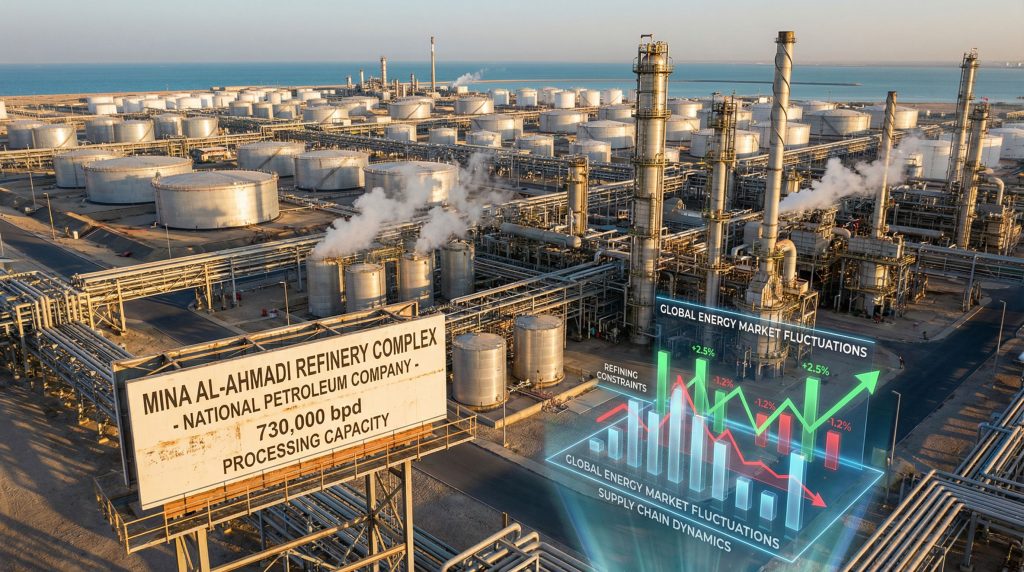
The sophistication of infrastructure targeting strategies becomes evident when examining specific facility impacts. Kuwait's Mina Al-Ahmadi refinery, processing 730,000 barrels per day, represents a critical chokepoint in regional refined product supply chains. However, Qatar's Ras Laffan LNG facility experiencing damage to 2 of 14 liquefaction trains eliminates 17% of global LNG capacity, creating immediate supply constraints across international natural gas markets.
Strategic targeting of downstream processing facilities creates more severe economic disruption than conventional upstream production attacks. Processing capacity constraints amplify price volatility because refined products have limited storage capabilities and shorter shelf lives compared to crude oil. When refineries halt operations, entire supply chains from crude availability through final product delivery experience immediate bottlenecks.
Key Strategic Implications Include:
• Refining bottlenecks create immediate supply constraints that cannot be mitigated through strategic reserves
• Processing capacity limitations amplify price volatility across all energy commodities
• Regional energy security becomes globally systemic risk affecting international economic stability
• Geographic market separation intensifies as supply chain disruptions prevent normal arbitrage mechanisms
The Brent-WTI spread widening to $12.57 per barrel, approaching an 11-year high, demonstrates how infrastructure attacks create geographic market separation. This spread widening indicates that European and Asian markets face substantially higher price pressures whilst U.S. markets maintain relatively lower exposure to Gulf disruptions.
How Do Refinery Attacks Differ From Traditional Oil Supply Disruptions?
Unlike conventional supply shocks targeting upstream crude oil extraction, attacks on downstream processing facilities create fundamentally different market dynamics with more immediate consumer-facing impacts. The distinction proves critical because global crude markets remain technically supplied whilst refined product shortages create severe constraints for transportation fuels, heating oil, and industrial feedstocks.
Processing Capacity Constraints Analysis
Current Supply Chain Stress Indicators:
| Product Category | Price Impact | Market Status |
|---|---|---|
| Fuel Oil (Asia/West Africa) | Above $1,000/metric tonne | Highest since 2022 |
| Heating Oil | +2.61% weekly | Supply rationing |
| Gasoline | +2.73% weekly | Limited availability |
| European Natural Gas | 20% weekly jump | Critical shortages |
| Bunkering Fuel | Rationing in Singapore | 24/7 operations struggling |
Regional Processing Infrastructure Vulnerabilities:
• Kuwait's Mina Al-Ahmadi: 730,000 bpd capacity representing primary regional refining asset
• Qatar's Ras Laffan: 14 liquefaction trains with 2 damaged requiring 3-5 years for repairs
• Saudi Arabia's facilities: Yanbu and Samref refineries experiencing operational disruptions
• UAE processing capacity: Multiple facilities operating under heightened security protocols
Supply Chain Amplification Effects
The transportation fuel markets experience disproportionate price increases relative to crude oil prices because refinery attacks specifically target the conversion process. Singapore implementing bunkering fuel rationing demonstrates how processing facility damage creates cascading supply chain constraints across global shipping operations. In addition, Fujairah struggling to maintain 24/7 operations indicates that even facilities not directly attacked experience operational stress due to regional supply constraints.
Modern refineries consist of multiple specialised processing units including crude distillation units (CDUs), fluid catalytic crackers (FCCs), and hydrotreaters. Damage to a single CDU can halt refining operations entirely until repairs are completed, as the CDU represents the initial stage of crude processing. The 3-5 year repair timeline for Qatar's damaged LNG trains indicates that critical processing equipment requires complete replacement rather than simple repair.
Geographic Mismatch in Processing Capacity:
• Global refining infrastructure concentrated in Middle East, Asia, and U.S. Gulf Coast
• Alternative refineries already operating near maximum capacity
• Limited ability to rapidly increase processing through supply redirection
• Geographic constraints prevent normal market adjustment mechanisms
Asian countries importing record volumes of Russian fuel oil following sanctions relief, with more than 3 million tonnes (615,000 b/day) expected in March 2026, demonstrates market adaptation through geographic supply redirection. However, this redirection cannot fully compensate for lost Middle Eastern processing capacity, particularly given the ongoing energy exports challenges facing major producers.
What Are the Macro-Economic Ripple Effects of Gulf Energy Infrastructure Attacks?
Infrastructure-focused conflicts create cascading economic consequences extending far beyond regional energy markets, fundamentally altering inflation expectations, monetary policy considerations, and economic growth projections. These ripple effects demonstrate how targeted attacks on processing facilities can influence global economic stability through multiple transmission mechanisms.
Inflationary Pressure Mechanisms
Energy infrastructure attacks create immediate policy dilemmas for central banks worldwide. Higher oil and energy prices translate into consumer inflation, creating pressure for interest rate increases precisely when economic uncertainty from regional conflicts suggests rates should remain accommodative. Consequently, US economic pressures intensify as U.S. inflation expectations surge amid oil price spikes, reflecting this fundamental policy tension.
Direct Price Transmission Channels:
• Transportation fuel costs: Gasoline prices at $3.91 per gallon representing 32% increase from typical baselines
• Industrial input prices: Heating oil at $4.455 per gallon affecting manufacturing costs
• Consumer energy expenditures: European natural gas prices surging 35% following Qatar LNG attacks
• Maritime transportation: Fuel oil prices exceeding $1,000 per metric tonne driving shipping cost increases
Secondary Economic Effects:
• Central bank policy response creating conflicting monetary objectives
• Economic growth forecast revisions reflecting supply-side constraints
• Currency market volatility amplification affecting international trade
• Government fiscal policy adjustments sacrificing revenue to maintain stability
Policy Response Coordination Challenges
Multiple policy interventions demonstrate recognition that energy price shocks threaten economic stability. The Trump administration's Jones Act waiver, Russian sanctions relief, and considerations for Strategic Petroleum Reserve releases indicate comprehensive attempts to address supply constraints through demand-side mechanisms.
Brazil's Finance Ministry proposal to eliminate diesel import taxes, estimated to cost $600 million monthly in lost tax revenue, exemplifies how energy price shocks force governments to sacrifice fiscal income to maintain economic stability. This represents a direct wealth transfer from public finances to energy consumers, demonstrating the political economy pressures created by infrastructure attacks.
International Energy Agency recommendations for working-from-home and reduced air travel represent implicit acknowledgment that energy supply constraints require economic activity compression. These measures indicate recognition that supply-side constraints cannot be eliminated through conventional policy tools, necessitating demand destruction to balance markets.
How Do Energy Infrastructure Strikes Influence Global Investment Flows?
Systematic attacks on Gulf processing facilities fundamentally alter risk assessment frameworks for energy sector investments, creating new categories of geopolitical risk that traditional financial models inadequately capture. These attacks demonstrate how regional conflicts can weaponise critical infrastructure to influence global capital allocation decisions, highlighting the importance of robust investment strategy components in managing such risks.
Investment Risk Recalibration
Energy Sector Capital Allocation Shifts:
| Investment Category | Risk Premium | Capital Requirement |
|---|---|---|
| Infrastructure Hardening | High | $50-100 billion annually |
| Geographic Diversification | Medium | $200-300 billion |
| Alternative Energy Transition | Accelerated | $500+ billion |
| Insurance Coverage | Critical | 300-500% cost increase |
Portfolio Risk Management Evolution:
• Energy security premium pricing becoming standard across all energy investments
• Regional exposure concentration limits requiring comprehensive portfolio restructuring
• Alternative energy transition acceleration driven by security rather than environmental concerns
• Infrastructure protection technology investments creating new market segments
The WTI-Brent spread reaching near 11-year extremes demonstrates how infrastructure vulnerabilities create persistent market distortions affecting long-term investment returns. Energy companies must now factor geopolitical infrastructure risks into capital allocation decisions, fundamentally altering project economics across the sector.
Technology Investment Acceleration:
• Energy infrastructure protection systems requiring advanced security technologies
• Alternative fuel processing capabilities reducing geographic concentration risks
• Emergency response and recovery technologies enabling rapid facility restoration
• Supply chain resilience investments creating distributed processing networks
Long-Term Capital Flow Implications
Qatar Energy projecting 3-5 years for Ras Laffan repairs with $20 billion annual revenue loss demonstrates the magnitude of capital destruction caused by infrastructure attacks. These losses create permanent changes in global energy investment patterns, as capital seeks more secure processing locations and technologies.
Japan's JERA company indicating that regional conflicts push LNG buyers toward U.S. and Canadian suppliers reshapes long-term contracting patterns. This geographic reorientation requires substantial infrastructure investments in North American processing and export facilities, representing hundreds of billions in capital flow redirection.
What Does This Conflict Reveal About Global Energy Security Architecture?
The systematic targeting of Gulf refining infrastructure exposes critical weaknesses in global energy system resilience to coordinated disruption, highlighting fundamental gaps in international energy security frameworks. These vulnerabilities demonstrate how concentrated processing capacity in geopolitically unstable regions creates systemic risks for the entire global economy.
Systemic Vulnerability Assessment
Critical Infrastructure Dependencies:
• Processing concentration: Middle Eastern facilities handle 40% of global refining capacity
• Geographic clustering: Key facilities within 200-mile radius creating single points of failure
• Supply chain integration: Downstream processing interdependencies amplifying disruption impacts
• Limited redundancy: Alternative processing capacity operating at 90%+ utilisation
Security Architecture Gaps:
• Inadequate protection systems for downstream energy infrastructure
• Limited international coordination mechanisms for rapid response
• Insufficient strategic reserve management for refined products
• Absence of emergency processing capacity allocation frameworks
The Strait of Hormuz closure affecting only 90 ships in three weeks, representing 3-4% of normal traffic, demonstrates how chokepoint vulnerabilities can effectively shut down global energy transportation networks. This near-complete closure indicates that current security frameworks cannot adequately protect critical energy infrastructure against coordinated attacks.
Emergency Response Framework Limitations
Current international energy security architecture lacks adequate mechanisms for responding to systematic infrastructure attacks. Unlike crude oil supply disruptions, which can be partially mitigated through Strategic Petroleum Reserve releases, refined product shortages require functioning processing capacity that cannot be rapidly replaced or supplemented. Moreover, countries facing energy transition challenges find their vulnerabilities further exposed during such crises.
Strategic Reserve Inadequacies:
• Governments maintain 30-90 days of refined product reserves versus unlimited crude storage
• No international coordination mechanism for refined product sharing during crises
• Limited ability to rapidly convert crude oil to refined products during processing capacity loss
• Absence of emergency refining capacity that can be activated during crises
The next major ASX story will hit our subscribers first
How Will This Crisis Reshape Long-Term Energy Market Structure?
The systematic targeting of Iran strikes Kuwait's Mina Al-Ahmadi refinery infrastructure and broader Gulf processing facilities accelerates existing trends toward energy market decentralisation, supply chain diversification, and alternative energy adoption whilst creating substantial investment opportunities in energy security technologies.
Structural Market Evolution
Supply Chain Reconfiguration Imperatives:
• Geographic diversification: Processing capacity development in politically stable regions
• Distributed systems: Smaller-scale processing facilities reducing concentration risks
• Supply chain resilience: Multiple pathway development for critical energy products
• Emergency capacity: Reserve processing capability for crisis situations
Technology Investment Acceleration:
| Technology Category | Investment Timeline | Market Size |
|---|---|---|
| Infrastructure Protection | 2-3 years | $100-150 billion |
| Alternative Processing | 5-7 years | $300-500 billion |
| Emergency Response | 3-5 years | $50-100 billion |
| Supply Chain Monitoring | 1-2 years | $25-50 billion |
Market Structure Transformation:
• Increased investment in distributed energy processing systems
• Enhanced focus on supply chain resilience over cost optimisation
• Technology development prioritising security and redundancy
• Regulatory frameworks emphasising infrastructure protection requirements
The Alaska lease sale receiving bids on 1.3 million acres from major energy companies demonstrates how security concerns drive investment toward politically stable regions. This represents a fundamental shift from cost-optimised global supply chains toward security-prioritised regional networks.
Long-Term Investment Implications
European Union's Russian LNG ban entering its first phase creates additional supply constraints that, combined with Middle Eastern processing disruptions, fundamentally reshape global energy trade patterns. These dual constraints require massive infrastructure investments in alternative supply sources and processing capabilities.
Reports from AP News indicate that Guinea considering bauxite export volume adjustments due to soaring freight costs demonstrates how energy infrastructure disruptions create cascading effects across all commodity markets. Higher shipping fuel costs affect global trade economics, potentially reshaping international commerce patterns beyond energy sectors.
What Are the Broader Geopolitical Implications of Energy Infrastructure Warfare?
Iran strikes Kuwait's Mina Al-Ahmadi refinery establishes new precedents for how regional conflicts can leverage economic warfare through infrastructure attacks, potentially reshaping international relations and conflict resolution mechanisms. These attacks demonstrate sophisticated understanding of how energy infrastructure vulnerabilities can be weaponised to achieve strategic objectives.
Strategic Precedent Analysis
Conflict Evolution Patterns:
• Economic targeting priority: Infrastructure attacks replacing traditional military objectives
• Vulnerability exploitation: Systematic identification and targeting of critical processing nodes
• Regional impact amplification: Local conflicts creating global economic consequences
• Asymmetric warfare effectiveness: Limited military resources achieving maximum economic disruption
Tehran officials considering transit fees for Hormuz passage indicates evolution toward economic control mechanisms that extend beyond military conflict. This represents transformation of geopolitical strategy from territorial control toward economic leverage through infrastructure dominance.
International Response Framework Development
The inadequacy of current international response mechanisms becomes evident when examining policy interventions attempted during this crisis. Trump administration efforts including Jones Act waivers, sanctions relief, and Strategic Petroleum Reserve considerations demonstrate comprehensive attempts to address supply constraints through available policy tools, yet these measures cannot substitute for lost processing capacity.
Collective Security Mechanism Requirements:
• International frameworks for protecting critical energy infrastructure
• Coordinated response protocols for systematic infrastructure attacks
• Economic sanctions effectiveness evaluation against infrastructure-focused conflicts
• Diplomatic intervention strategies addressing economic warfare through infrastructure targeting
Policy Coordination Challenges:
• National energy security priorities conflicting with international cooperation requirements
• Limited effectiveness of traditional diplomatic tools against infrastructure warfare
• Necessity for new international legal frameworks addressing civilian infrastructure attacks
• Development of economic response mechanisms beyond conventional sanctions
How Should Global Markets Prepare for Continued Energy Infrastructure Risks?
The ongoing targeting of Gulf energy facilities requires fundamental reassessment of risk management strategies, investment frameworks, and policy responses to ensure economic stability amid escalating infrastructure-focused conflicts. These preparations must address both immediate crisis management and long-term structural vulnerabilities.
Risk Mitigation Strategy Development
Market Preparation Mechanisms:
• Enhanced emergency protocols: Rapid response systems for infrastructure attacks
• Diversified supply sources: Alternative processing capacity development in secure locations
• Strategic reserve expansion: Refined product storage capability equivalent to crude oil reserves
• Technology deployment: Advanced monitoring and protection systems for critical facilities
Investment Strategy Adaptation:
| Risk Category | Mitigation Approach | Capital Requirement |
|---|---|---|
| Infrastructure Attacks | Hardening/Protection | $100-200 billion |
| Supply Chain Disruption | Geographic Diversification | $300-500 billion |
| Processing Capacity Loss | Emergency Facilities | $150-300 billion |
| Transportation Chokepoints | Alternative Routes | $200-400 billion |
Policy Response Coordination:
• International energy security cooperation agreements
• Emergency market intervention capabilities for rapid crisis response
• Long-term resilience building initiatives prioritising infrastructure protection
• Regulatory frameworks requiring minimum security standards for critical facilities
According to Oil Price reporting, the IEA's recommendations for demand reduction through working-from-home and reduced air travel represent acknowledgment that current supply-side responses prove insufficient. This indicates necessity for comprehensive demand management strategies during infrastructure-focused crises.
Brazil's proposed diesel import tax elimination costing $600 million monthly demonstrates the fiscal costs of maintaining economic stability during energy infrastructure attacks. Governments must prepare similar emergency fiscal mechanisms to address rapid energy price escalation during future conflicts.
Long-Term Preparedness Requirements
Infrastructure Resilience Investment:
• Processing facility protection systems resistant to advanced weapon systems
• Distributed processing networks reducing single points of failure
• Emergency restoration capabilities enabling rapid facility repairs
• Advanced monitoring systems providing early warning of potential attacks
The Qatar Energy 3-5 year repair timeline for damaged LNG facilities indicates that current infrastructure lacks rapid restoration capabilities. Future facility design must incorporate modular systems enabling partial operations during repairs and rapid component replacement following attacks.
Market Structure Adaptation:
• Pricing mechanisms reflecting infrastructure security premiums
• Insurance frameworks covering geopolitical infrastructure risks
• Investment allocation prioritising security over cost optimisation
• Regulatory requirements for infrastructure protection compliance
These systematic preparations acknowledge that Iran strikes Kuwait's Mina Al-Ahmadi refinery and broader Gulf infrastructure represent evolution in conflict strategies that global energy markets must address through fundamental structural adaptations rather than temporary crisis responses.
This analysis is provided for educational purposes and should not be considered financial advice. Energy market investments carry significant risks, particularly during periods of geopolitical instability and infrastructure attacks. Readers should consult qualified financial professionals before making investment decisions.
Seeking Opportunities in Energy Market Volatility?
Discovery Alert's proprietary Discovery IQ model delivers real-time alerts on significant ASX mineral discoveries, including energy and resource companies positioned to benefit from global supply chain disruptions and commodity price volatility. Understand why major mineral discoveries can lead to substantial market returns by exploring Discovery Alert's dedicated discoveries page, showcasing historic examples of exceptional outcomes, and begin your 14-day free trial today to position yourself ahead of the market during these unprecedented energy sector developments.