June 17, 2026
The Fragile Geometry of the World's Most Pressurised Shipping Corridor
Few chokepoints in the global energy system carry as much structural consequence as a narrow stretch of water sitting between the Iranian coastline and the Omani peninsula. The Strait of Hormuz is not simply a shipping lane. It is the arterial valve through which approximately one-fifth of the world's oil supply has historically moved, connecting the production heartlands of Saudi Arabia, Iraq, Kuwait, and the UAE to refining hubs across Asia and commodity markets globally. When that valve is forced shut, the consequences radiate outward across freight markets, insurance pricing, refinery scheduling, and energy policy on every continent.
Understanding the significance of Iranian tankers exiting the U.S. blockade in the Strait of Hormuz requires more than tracking ship movements on a maritime intelligence dashboard. It demands a clear-eyed reading of the diplomatic architecture, the operational realities facing shipowners, and the structural barriers that will shape whether this moment becomes a genuine turning point or simply an isolated breach in an otherwise intact enforcement perimeter.
When big ASX news breaks, our subscribers know first
How the Blockade Was Built and What It Actually Prevented
The U.S. Navy's blockade of Iranian ports and the Strait of Hormuz corridor was constructed over the course of the nearly four-month conflict between the United States and Iran. The enforcement mechanism targeted vessels with documented links to sanctioned entities and nations designated as adversaries, effectively transforming one of the world's busiest maritime corridors into a contested enforcement zone. The resulting oil market disruptions reverberated across global energy systems in ways that are still being assessed.
The practical outcome was severe. Iranian crude exports were effectively halted, hundreds of vessels became stranded across the region, and the backlog of loaded tankers waiting for any viable exit pathway grew into one of the largest concentrated maritime supply buildups in modern energy trade history. Broader Gulf shipping was disrupted, with ripple effects felt across Asian refining schedules, European energy balances, and global commodity pricing.
It is worth noting that the blockade did not function as a clean or uniform enforcement mechanism. Reporting from Reuters, the Financial Times, and PBS indicates that enforcement was inconsistent across different corridors and vessel types. Some ships were intercepted or disabled by U.S. naval forces, while others navigated through contested passages under significant operational pressure.
The First Exits: What the Data Actually Shows
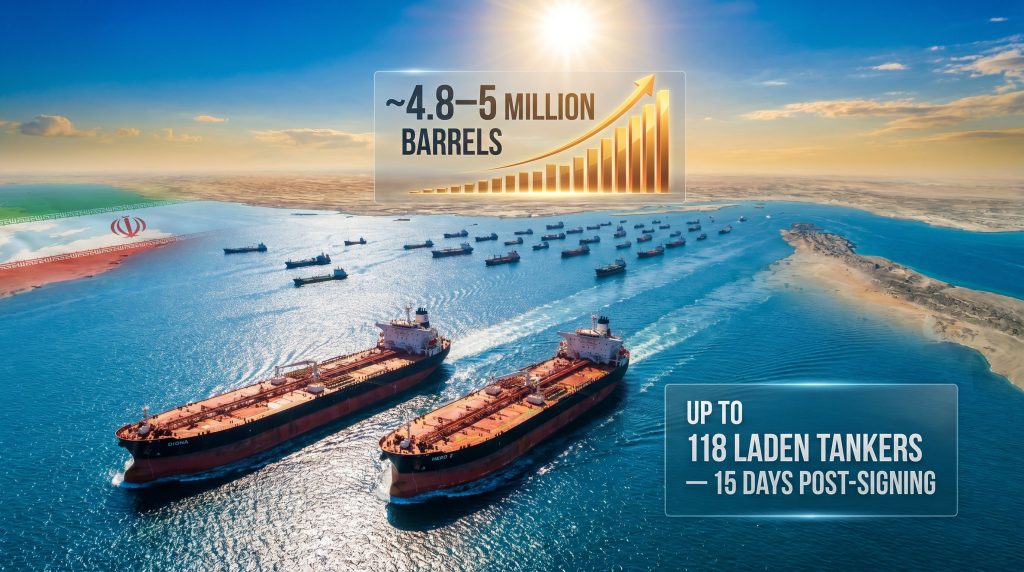
The first confirmed outbound tanker movements in approximately two months were tracked by maritime intelligence platforms Kpler and Windward. The initial exits involved three vessels carrying a combined cargo of nearly five million barrels of Iranian crude oil.
| Vessel | Ownership | Cargo Volume | Status |
|---|---|---|---|
| Diona | National Iranian Tanker Company (NITC) | ~1.9 million barrels | Exited blockade perimeter |
| Hero 2 | National Iranian Tanker Company (NITC) | ~1.9 million barrels | Exited blockade perimeter |
| Third Iran-linked tanker | Undisclosed | ~1.0 million barrels | Exited on Wednesday |
| Combined exit volume | ~4.8 to 5 million barrels | First outbound movement in ~2 months | |
| Six additional tankers | Various | Undisclosed | Turned back by U.S. forces |
| 19+ Iran-linked vessels | Various | Undisclosed | Reported by FT as having passed through corridor |
Both the Diona and Hero 2 remain under active U.S. Office of Foreign Assets Control (OFAC) sanctions designations. Their passage through the blockade perimeter occurred prior to any formal sanctions waiver being issued, which places both vessels in a legal and operational grey zone. This has significant implications for their commercial viability and the liability exposure of any counterparties involved in their cargo transactions.
Windward's maritime intelligence analysis noted that the departure of these vessels suggests other Iranian-trading tankers are also preparing to resume activity, pointing to a broader repositioning dynamic beginning to take shape across the fleet.
Why This Is Not a Blockade Collapse
The exits of these tankers must be contextualised carefully. They occurred before any formal diplomatic agreement was signed, under conditions of inconsistent enforcement, and alongside reports that six additional vessels attempting to exit were turned back by U.S. naval forces. This is not a systemic reopening. It reflects the operational complexity of enforcing maritime restrictions across a high-traffic international waterway at scale. Furthermore, the commodity market volatility triggered by these events continues to create uncertainty for traders and operators alike.
The maritime sector is treating the news with something closer to wary disbelief than celebration. — Lloyd's List Intelligence
The U.S. Navy formally communicated through UKMTO advisory channels that blockade conditions remain in full effect until the agreement is formally signed. Tim Wilkins, Managing Director of Intertanko, confirmed the industry received this notification directly, reinforcing that the legal basis for blockade enforcement has not yet changed.
The Diplomatic Framework: An MOU, a Geneva Signing, and a Nuclear Trade-Off
The broader context for these tanker movements is a U.S.-Iran Memorandum of Understanding signed on Monday, with a formal signing ceremony scheduled for Friday in Geneva. The MOU represents the diplomatic resolution of a conflict that lasted nearly four months, though its specific terms have not been publicly disclosed in full. The geopolitical trade tensions underlying this agreement have been building for considerably longer, however, shaping trade routes and energy policy well before the conflict began.
Reporting from the Wall Street Journal indicates the agreement would allow Iran to immediately resume oil and fuel sales upon formal signing. The central trade-off involves Iran committing to curb its nuclear programme in exchange for U.S. willingness to permit oil and fuel sales. Sanctions waivers on Iranian crude transactions are expected to accompany the formal agreement, though the precise scope of those waivers remains unclear.
This structure creates a scenario where:
- The diplomatic framework exists and has been agreed upon at the MOU level.
- The legal mechanism for sanctions relief has not yet been formally enacted.
- The blockade remains legally in effect until Friday's ceremony.
- Vessels that have already exited the perimeter remain under OFAC designations until waivers are issued.
The fragility of this interim period is not trivial. Until Friday, the commercial, legal, and operational status of tankers attempting Strait transits remains deeply uncertain.
Mapping the Industry Response: First-Movers Versus the Wait-and-See Majority
The shipping industry's response to the prospect of a Hormuz reopening has been characterised by a fundamental split between operators willing to absorb residual risk for potential commercial advantage and the majority choosing to wait for formal confirmation before committing vessels.
Operators Repositioning Early:
- Dozens of Very Large Crude Carriers (VLCCs) have sailed from the South China Sea and across the Indian Ocean toward UAE ports in anticipation of a restocking surge.
- At least 30 ships were already at anchor near UAE Gulf ports as of the reporting date, according to Windward intelligence data.
- These operators are pursuing what Lloyd's List Intelligence has characterised as a first-mover commercial advantage, positioning ahead of what is expected to be a concentrated surge in freight demand once the backlog begins to unwind.
Operators Holding Back:
- The majority of shipowners are awaiting formal confirmation before scheduling new Strait transits.
- Niels Rasmussen, Chief Shipping Analyst at BIMCO, noted that most shipowners appear to be cautiously awaiting more details before planning new transits of the Strait of Hormuz, with safety assurances required alongside permitted access before vessels are committed.
- War-risk insurance premiums remain elevated, and major underwriters have shown no indication of imminent reductions.
The asymmetry of risk in this environment is meaningful. First-movers gain potential freight rate advantages from the anticipated restocking surge but assume elevated insurance costs and residual legal exposure. Those waiting sacrifice early positioning but reduce their exposure to a scenario where the deal collapses or enforcement tightens again.
Quantifying the Backlog: Why the Supply Surge Will Be Concentrated, Not Sustained
The scale of the tanker backlog that has accumulated over two months of blockade conditions is significant by any historical measure. Kpler's analysis projects that up to 118 laden tankers could exit the region within 15 days of the formal deal signing.
| Timeframe Post-Signing | Expected Transit Activity | Confidence Level |
|---|---|---|
| First 15 days | Up to 118 laden tankers exit | High (Kpler estimate) |
| 30 days | Transits could approach ~50% of pre-war levels | Moderate (Kpler projection) |
| Beyond 30 days | Dependent on insurance normalisation and safety verification | Low, highly contingent |
Kpler's own analysis frames the 50% recovery within 30 days as a ceiling estimate contingent on no further geopolitical disruption, successful insurance market normalisation, and full implementation of MOU terms. It is not a baseline projection.
Critically, the initial surge of departing vessels is expected to represent a one-time unwinding of the accumulated backlog rather than a durable recovery in Strait traffic. The distinction matters enormously for freight rate forecasting. A concentrated one-time release creates a short, sharp demand spike for tanker capacity. A durable recovery in traffic volumes requires a fundamentally different set of conditions.
The Insurance Market as a Structural Bottleneck
Even in scenarios where the diplomatic agreement is signed and blockade conditions are formally lifted, the war-risk insurance market represents a structural barrier to rapid commercial normalisation. Lloyd's analysts have described the current environment as a fragile reprieve rather than a return to normalcy, with insurers requiring demonstrated evidence of sustained safety before premium structures are adjusted.
Historically, war-risk premium normalisation lags geopolitical resolution by weeks to months. This creates a scenario where the legal pathway through the Strait reopens before the commercial pathway becomes economically viable for risk-averse operators.
The next major ASX story will hit our subscribers first
Broader Oil Market Implications: Iranian Crude Re-Entry and Price Dynamics
The prospect of Iranian crude returning to global markets at scale introduces meaningful downward pressure on benchmark pricing. Consequently, the crude oil price trends that analysts have been tracking through 2025 and into 2026 are likely to shift materially if sanctions waivers are broadly applied and sustained. Furthermore, the geopolitical oil pressures that have shaped OPEC strategy throughout this period will need reassessment as Iranian supply re-enters the equation.
Asian refining hubs, which have historically been the primary destination for Iranian crude given its pricing discount structures and grade characteristics, are positioned to be the first markets to absorb resumed flows. This has implications for regional crude differentials, refinery run economics, and the competitive positioning of alternative crude suppliers who gained market share during the blockade period.
For VLCC operators, the freight rate environment carries a dual dynamic. The initial restocking surge is expected to drive a short-term rate spike as demand for tanker capacity concentrates around the Gulf. However, a rapid normalisation of Hormuz traffic over the subsequent weeks will likely compress spot freight rates as tanker supply-demand dynamics rebalance.
Key Considerations for the Road Ahead
The situation involving Iranian tankers exiting the U.S. blockade in the Strait of Hormuz remains in a transitional state that resists clean interpretation. Several structural factors will determine whether Friday's formal signing translates into genuine operational normalisation or simply a shift in the character of uncertainty.
- Legal clarity on sanctioned vessels is essential. Diona and Hero 2 remain under OFAC designations. Until sanctions waivers are formally issued, their commercial viability and the liability exposure of counterparties remains unresolved.
- Insurance market behaviour will be the rate-limiting factor for traffic recovery. Diplomatic agreements do not automatically reset underwriter risk models. Premium normalisation requires a sustained evidence base of incident-free operations.
- The one-time backlog release should not be interpreted as a forward indicator of sustained Hormuz throughput. The 118 tanker projection reflects accumulated inventory, not restored baseline capacity utilisation.
- Enforcement consistency between now and Friday remains a live operational variable. The U.S. Navy's communication that nothing has changed until the agreement is signed is an explicit reminder that the blockade has not been informally relaxed, even as some vessels have passed through.
- First-mover operators carry asymmetric risk that the broader market is pricing cautiously. The freight rate advantage of early positioning must be weighed against elevated insurance costs, legal ambiguity, and the possibility of enforcement action before formal peace conditions are established.
Disclaimer: This article contains forward-looking projections sourced from maritime intelligence providers including Kpler, Windward, BIMCO, and Lloyd's List Intelligence. These projections are subject to significant uncertainty and should not be construed as investment advice. Geopolitical developments, enforcement decisions, and insurance market dynamics can change rapidly and materially affect the outcomes described.
Want to Stay Ahead of the Next Major Commodity Market Shift?
Discovery Alert's proprietary Discovery IQ model scans ASX announcements in real time, instantly identifying significant mineral discoveries and actionable investment opportunities — including those in commodities directly exposed to geopolitical and supply chain disruptions like those reshaping global oil markets today. Explore how historic discoveries have generated substantial returns and begin your 14-day free trial at Discovery Alert to position yourself ahead of the broader market.