August 20, 2026
Global energy markets operate within an intricate web of supply dependencies that create vulnerability to geopolitical disruptions across multiple continents. When diplomatic tensions escalate between major powers and oil-producing nations, commodity markets respond through complex pricing mechanisms that extend far beyond immediate supply calculations. The Iran tension oil price increase phenomenon demonstrates how these mechanisms reflect decades of evolving trade relationships, strategic reserve policies, and financial instrument development that collectively determine how regional conflicts translate into global economic impacts.
The psychological dynamics driving trader behavior during Middle Eastern crises reveal systematic patterns that amplify price volatility beyond fundamental supply-demand calculations. Professional market participants maintain sophisticated positioning strategies that create feedback loops during geopolitical stress periods, while institutional hedging requirements generate additional momentum that can persist for weeks following initial diplomatic developments.
Understanding Geopolitical Risk Premiums in Energy Markets
Energy markets incorporate geopolitical uncertainty through risk premiums that function as insurance policies against supply disruption scenarios. These premiums represent the additional cost traders willingly pay above fundamental pricing to account for the probability of future supply constraints. Iran tension oil price increase patterns demonstrate how rapidly these premiums can expand when diplomatic relationships deteriorate or military threats emerge.
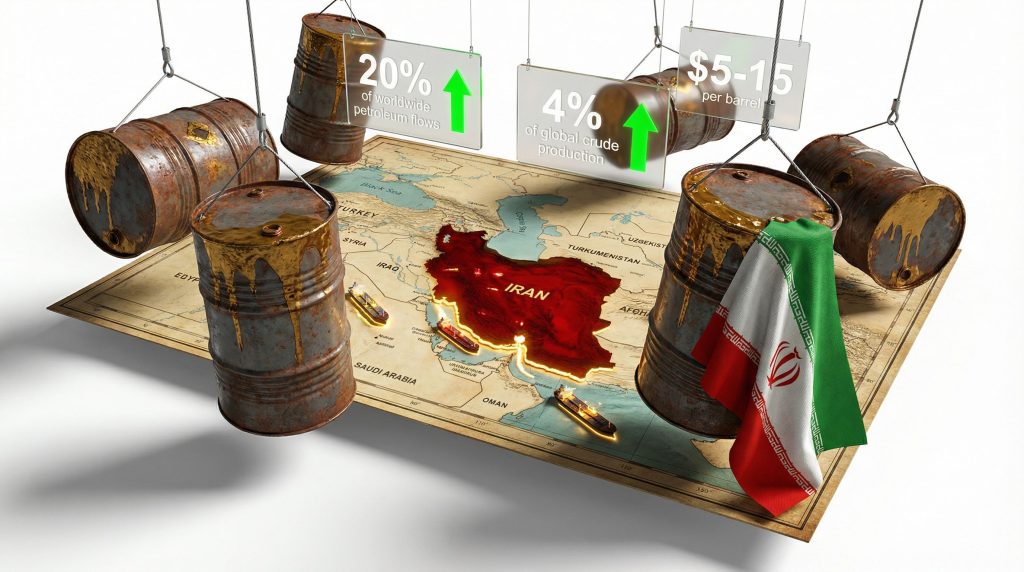
Current market positioning reveals the magnitude of potential volatility during crisis periods. According to data from Kpler's Bridgeton Research group, commodity trading advisers held 91% short positions in WTI crude prior to recent escalation events, creating conditions where even modest diplomatic tensions can trigger explosive price movements. Furthermore, this extreme bearish positioning transforms geopolitical developments into powerful catalysts for short-covering rallies that can add $5-15 per barrel to crude prices within trading sessions.
The Strait of Hormuz represents the world's most critical energy chokepoint, with approximately 20% of global petroleum flows transiting this narrow waterway daily. Iran's strategic position adjacent to this passage provides asymmetric leverage despite controlling only 4% of global crude production. However, this geographic advantage allows relatively modest military capabilities to threaten disproportionately large supply volumes, creating persistent risk premiums that fluctuate based on diplomatic relationship quality.
Recent market developments on January 8, 2026, illustrated these dynamics in real-time. West Texas Intermediate crude rose 3.2% to settle at $57.76 per barrel, while Brent crude increased 3.4% to $61.99 following diplomatic escalation between the United States and Iran. Consequently, prices continued climbing after settlement, gaining more than 1% in after-hours trading, demonstrating sustained momentum beyond initial crisis response.
Risk premium calculations incorporate multiple probability-weighted scenarios ranging from continued tensions without supply disruption to complete Strait closure events. Base case scenarios typically price 70% probability of tension resolution without physical supply impacts, adding $2-4 per barrel to baseline pricing. In addition, escalation scenarios with 25% probability of limited military engagement can drive premiums to $15-25 per barrel, while extreme scenarios involving complete Strait closure represent 5% probability events that could push premiums above $40 per barrel.
When big ASX news breaks, our subscribers know first
The Psychology Behind Trader Positioning During Middle East Crises
Professional trader psychology during geopolitical crises follows predictable patterns driven by portfolio risk management requirements and institutional mandate constraints. The concentration of short positions ahead of Iran-related developments creates mathematical conditions for amplified price movements that exceed fundamental justification based purely on supply calculations.
Short Covering Dynamics in Volatile Markets
The 91% short positioning observed in WTI crude represents an extreme concentration that transforms modest geopolitical developments into significant market events. This positioning occurs because traders often maintain bearish exposure during periods of anticipated oversupply, betting on continued price declines through fundamental analysis. However, when geopolitical events introduce supply risk, these same traders face immediate pressure to cover their exposure regardless of longer-term fundamental views.
Short covering mechanics operate through forced portfolio rebalancing rather than analytical reassessment. Fund managers maintaining short exposure during crisis periods face potential unlimited losses if supply disruptions materialise, creating institutional pressure to reduce bearish positions even if fundamental oversupply conditions persist. This mechanical covering process can persist for 2-6 weeks depending on position concentration and crisis duration.
The velocity of position adjustment determines price movement intensity. During the January 8, 2026 events, prices continued rising more than 1% after settlement, indicating that initial covering had not exhausted the mechanical rebalancing requirement. Professional traders often describe this phenomenon as momentum feeding on itself, where covering activity triggers additional covering requirements among other participants.
Options Market Hedging Strategies
Options markets provide sophisticated hedging mechanisms that reveal trader sentiment beyond simple long-short positioning. Call option demand strengthens during geopolitical uncertainty as portfolio managers seek upside protection without abandoning fundamental bearish views. For instance, Brent crude call skews have strengthened significantly during recent Iran tensions, indicating professional willingness to pay elevated premiums for upside exposure.
Volatility premiums expand systematically during Middle East crises as uncertainty increases across multiple timeframes. Options traders demand higher compensation for selling protection during periods when supply disruption probability cannot be calculated with historical data. These elevated premiums persist beyond initial crisis periods, creating sustained cost increases for hedging strategies.
Professional hedging approaches include:
• Long crude oil futures during tension escalation periods
• Natural gas positions for correlated energy sector moves
• Currency hedges against oil-importing nation weakness
• Inflation-protected securities for consumer price impacts
• Energy sector equity overweights for leveraged exposure
The temporal structure of options pricing reveals market expectations for crisis duration. Front-month contracts typically show greater volatility premiums than longer-dated options, reflecting expectations that geopolitical tensions resolve relatively quickly. Furthermore, when this pattern inverts, with longer-dated options commanding higher premiums, markets are signalling expectations of extended uncertainty periods.
Economic Transmission Mechanisms: From Geopolitics to Gas Pumps
Iran tension oil price increase effects transmit through global economic systems via multiple interconnected pathways that extend far beyond crude oil pricing. These transmission mechanisms operate at different velocities and magnitudes depending on regional energy infrastructure, strategic reserve policies, and alternative supply availability.
Immediate Market Response Patterns
Initial price reactions follow observable patterns based on threat severity assessment and market positioning dynamics. The January 8, 2026 events demonstrated classic response sequences where diplomatic threats triggered 3.2% WTI increases and 3.4% Brent increases within single trading sessions. These immediate responses typically range from 1-5% depending on positioning concentration and threat credibility.
Secondary price movements often exceed initial reactions as mechanical factors reinforce geopolitical impulses. Commodity index rebalancing during January 2026 created additional cash flows into crude oil that amplified initial geopolitical premiums. This rebalancing occurs annually and can add $2-5 per barrel of additional upward pressure independent of crisis fundamentals.
Key transmission factors include:
• Strait of Hormuz closure probability assessments
• Iranian export capacity degradation estimates
• Alternative supply route utilisation rates
• Strategic petroleum reserve deployment signals
• Regional military escalation risk evaluations
Secondary Economic Effects
Natural gas markets experience correlated movements during Iran tensions due to shared transportation infrastructure and alternative energy substitution dynamics. LNG shipping route security concerns affect European pricing mechanisms, while pipeline infrastructure in neighbouring regions faces elevated monitoring and insurance costs. These correlated effects typically add 10-20% to natural gas price volatility during Middle East crisis periods.
Refined product markets respond with varying lag times and magnitude relationships to crude oil movements. Gasoline crack spreads typically widen during supply uncertainty as refiners demand higher compensation for processing potentially disrupted crude supplies. However, diesel premiums increase more dramatically due to transportation industry demand inelasticity, while jet fuel costs can spike 15-25% above crude oil percentage increases due to airline hedging requirements.
Regional economic impacts distribute unevenly based on import dependency and alternative supplier relationships. Asian economies face disproportionate exposure due to geographic proximity and import reliance, with countries like South Korea (95% import dependence), Japan (88% import reliance), and India (85% external supply needs) experiencing amplified economic transmission effects compared to more energy-independent regions.
Venezuela Market Intervention Case Study
Recent US intervention in Venezuelan oil markets provides concrete illustration of how geopolitical energy control mechanisms operate beyond traditional supply-demand relationships. Energy Secretary Chris Wright announced plans for the US to control Venezuelan oil sales, initially offering stored crude through Treasury account management systems that could process 50 million barrels valued at more than $2 billion.
This intervention demonstrates trade flow redistribution rather than absolute supply creation. Energy market analyst Amrita Sen observed that the arrangement would result in more oil flowing to the US rather than China, but would not necessarily increase Venezuelan production capacity. This distinction reveals how geopolitical interventions often function as redistributive mechanisms that affect regional pricing without altering global supply totals.
Corporate participation in geopolitical energy reconfiguration involves complex licensing frameworks that determine market access. Vitol Group received preliminary US licences for oil negotiations, while Chevron extended operational licences for continued Venezuelan operations. Meanwhile, ConocoPhillips, Exxon Mobil Corporation, and other major operators examined participation opportunities, demonstrating how diplomatic arrangements translate into specific corporate strategic decisions.
Supply Chain Vulnerability Assessment
Global energy supply chains contain systematic vulnerabilities that create disproportionate pricing power for geographically strategic producers relative to their absolute production volumes. These vulnerabilities reflect decades of infrastructure development decisions that prioritised efficiency over redundancy, creating chokepoint dependencies that geopolitical actors can exploit for asymmetric leverage.
Critical Infrastructure Exposure
The Strait of Hormuz represents the most significant single vulnerability point in global energy infrastructure, handling daily throughput that exceeds 17 million barrels of crude oil and refined products. This narrow waterway connects Persian Gulf production centres with global markets, creating a geographic bottleneck that no alternative infrastructure can fully replace during extended closure periods.
Alternative routing capacity provides partial mitigation but cannot accommodate full Strait volumes during complete closure scenarios. The Saudi East-West pipeline offers 5 million barrels per day maximum capacity, while the UAE Abu Dhabi pipeline provides 1.5 million barrels daily. Combined alternative routes handle approximately 35% of Strait volume, creating substantial supply gaps during worst-case scenarios.
Iranian military capabilities for Strait disruption include naval mining, missile systems, and proxy force coordination that could halt shipping without requiring sustained naval engagement. These asymmetric capabilities allow relatively modest military investments to threaten infrastructure serving global economic systems, creating persistent risk premiums independent of diplomatic relationship quality.
Global Strategic Reserve Analysis
Strategic petroleum reserves provide buffer capacity during supply disruptions, but current inventory levels may prove insufficient for extended crisis periods. The United States maintains approximately 650 million barrels providing 90 days of import coverage, while China holds 500 million barrels for 85 days coverage, and Japan maintains 320 million barrels for 180 days coverage.
| Country | Reserve Size (Million Barrels) | Days of Import Coverage |
|---|---|---|
| United States | 650 | 90 |
| China | 500 | 85 |
| Japan | 320 | 180 |
| Germany | 240 | 120 |
| India | 45 | 22 |
Reserve deployment decisions involve complex political and economic calculations that extend beyond pure supply mathematics. Governments must balance immediate price relief against future crisis preparedness, while coordinating releases among consuming nations to maximise market impact. Recent coordinated releases during previous crises demonstrated both the potential effectiveness and political complexity of strategic reserve management.
Market Structure Analysis: Why Iran Tensions Matter More Now
Contemporary energy market structure amplifies the impact of Iran-related supply disruptions due to systematic changes in production geography, financial market participation, and geopolitical alliance patterns that have emerged over the past decade. These structural modifications create new vulnerability patterns that differ substantially from historical crisis response mechanisms.
Reduced OPEC+ Pricing Control
Non-OPEC production growth has fundamentally altered global market power distribution, reducing traditional producer cartel influence while simultaneously concentrating remaining pricing power in geographically strategic locations. United States shale production growth of approximately 1.2 million barrels daily annually, Brazilian pre-salt expansion of 400,000 barrels daily, Guyanese offshore development adding 300,000 barrels daily, and Canadian oil sands increases of 200,000 barrels daily have created alternative supply sources that reduce OPEC market share.
This production diversification paradoxically increases Iran's strategic importance by concentrating remaining chokepoint vulnerability in fewer geographic locations. While total global production has become more geographically distributed, the transportation infrastructure connecting Persian Gulf production to global markets remains concentrated in the Strait of Hormuz, creating enhanced leverage for actors controlling this passage. Understanding the OPEC production impact becomes crucial in this context.
Market structure changes reflect broader geopolitical realignment patterns where energy independence becomes strategic priority for major consuming nations. United States domestic production growth reduces import dependency while simultaneously increasing global supply available to other importing regions, creating new trade flow patterns that redistribute geopolitical energy relationships.
Commodity Index Rebalancing Mechanics
Financial market participation in energy commodities has expanded significantly through institutional index investment that creates mechanical buying and selling pressures independent of fundamental supply-demand calculations. Annual commodity index rebalancing typically occurs during January periods and can generate $5-10 billion in crude oil purchasing requirements that amplify geopolitical price movements.
The January 8, 2026 market movements occurred during this annual rebalancing period, creating compound effects where geopolitical tensions combined with mechanical institutional purchasing requirements. This timing coincidence demonstrates how financial market structure can amplify crisis premiums beyond levels justified by pure supply disruption probability calculations.
Index participation creates systematic vulnerability to technical trading factors that operate independently of geopolitical developments. Trend-following algorithms, momentum strategies, and risk parity allocation models generate additional buying pressure during upward price movements, creating feedback loops that extend crisis premiums beyond initial geopolitical impulses.
Corporate Energy Security Strategies
Major oil companies increasingly examine vertical integration strategies and supply chain control mechanisms that reduce exposure to geopolitical disruptions. The Venezuelan market reopening provides illustration of how corporate strategies adapt to changing geopolitical landscapes through licensing framework navigation and strategic partnership development.
Citgo Petroleum Corporation considers resuming Venezuelan crude purchases for the first time since 2019 sanctions implementation, while Trafigura Group expresses interest in renewed trading relationships. These corporate strategy adjustments reflect broader industry recognition that geopolitical energy access requires sophisticated regulatory compliance and government relationship management beyond traditional commercial negotiations.
Risk Assessment Framework for Energy Investors
Professional energy investment requires systematic risk assessment frameworks that incorporate geopolitical probability analysis alongside traditional fundamental and technical analysis methods. Iran tension oil price increase scenarios demand sophisticated modelling approaches that account for multiple probability-weighted outcomes and their corresponding portfolio implications.
Probability-Weighted Scenario Development
Base Case Scenario (70% probability): Continued diplomatic tensions without physical supply disruption
• Oil prices remain range-bound between $55-65 per barrel
• Risk premiums add $2-4 to baseline pricing structures
• Volatility elevated but manageable through standard hedging
• Strategic reserves remain uncommitted for potential future use
• Alternative supply routes operate at normal capacity utilisation
Escalation Scenario (25% probability): Limited military engagement affecting transportation
• Strait of Hormuz partially disrupted for 2-4 week periods
• Oil prices spike temporarily to $80-90 per barrel range
• Strategic petroleum reserves deployed for market stabilisation
• Alternative pipeline capacity utilised at maximum rates
• Regional military coordination increases shipping insurance costs
Extreme Scenario (5% probability): Complete Strait closure exceeding one month
• Shipping halt persists for 30+ days creating supply emergency
• Oil prices exceed $120 per barrel with potential rationing
• Coordinated strategic reserve releases prove insufficient
• Global recession risk from sustained energy price shock
• Alternative energy adoption accelerates dramatically
Portfolio Construction Strategies
Direct energy exposure strategies provide the most straightforward approach to Iran tension hedging through commodity futures, energy sector equities, and specialised exchange-traded funds. Long crude oil positions during tension escalation periods typically generate 15-25% returns during crisis months, while energy sector equity positions can produce 20-35% returns due to operating leverage effects.
Indirect hedging approaches offer portfolio protection without direct commodity exposure through currency hedging, inflation-protected securities, and sector rotation strategies. Oil-importing nations typically experience currency weakness during energy price spikes, creating opportunities for foreign exchange hedging strategies that complement direct energy positions. The tariffs market impact further influences these positioning decisions.
Professional hedging implementation includes:
• Direct Energy Exposure:
- Long crude oil futures during escalation periods
- Energy sector equity overweights for leveraged exposure
- Natural gas positions for correlated commodity movements
• Indirect Protection Strategies:
- Currency hedges against oil-importing nation weakness
- Inflation-protected bond allocations for consumer price impacts
- Transportation sector shorts for margin compression scenarios
• Derivative Enhancement Techniques:
- Call option purchases for asymmetric upside exposure
- Volatility strategies during uncertainty periods
- Spread trading between crude grades and regional markets
The next major ASX story will hit our subscribers first
Regional Economic Impact Distribution
Iran tension oil price increase effects distribute unevenly across global regions based on energy import dependency, alternative supplier relationships, and strategic reserve capacity. This uneven distribution creates investment opportunities for sophisticated portfolio managers who understand relative regional vulnerability patterns.
Asia-Pacific Vulnerability Concentration
Asian economies demonstrate the highest sensitivity to Iran-related supply disruptions due to geographic proximity to Middle East production centres and limited alternative supply diversification. South Korea's 95% oil import dependence creates extreme vulnerability to Strait of Hormuz disruptions, while Japan's 88% import reliance and India's 85% external supply needs generate significant economic transmission effects from relatively modest supply interruptions.
China's 70% import requirement represents the largest absolute volume at risk from Iran tensions, creating systematic global economic implications beyond regional energy market impacts. Chinese manufacturing capacity depends on stable energy input costs, making Iran-related price volatility a significant factor in global supply chain cost calculations and inflation transmission mechanisms.
Regional strategic reserve coordination in Asia lacks the institutional framework present in other regions, creating additional vulnerability during extended crisis periods. Unlike European and North American coordinated release mechanisms, Asian consuming nations operate independent reserve policies that reduce collective crisis response effectiveness. The Saudi exploration impact also influences regional supply calculations.
European Energy Security Evolution
European nations have systematically reduced Middle East import dependency following 2022 energy security reassessment, but remain vulnerable to global price shock transmission regardless of supply source diversification. Increased US shale imports, Norwegian production maximisation, and strategic reserve coordination provide supply security while global pricing mechanisms ensure continued exposure to Iran-related premiums.
European mitigation strategies include:
• Enhanced US shale crude import arrangements
• Norwegian production capacity maximisation agreements
• Coordinated strategic reserve deployment protocols
• Accelerated renewable energy infrastructure investment
• Regional pipeline interconnection development projects
North American Energy Independence
United States domestic production growth has achieved practical energy independence while creating global market influence through export capacity and strategic reserve management. This dual position allows American policy makers to influence global energy markets through both supply additions and demand management during crisis periods.
Canadian production integration with US refining infrastructure provides North American energy security that reduces regional vulnerability to Iran tensions while creating opportunities for petroleum product export during global price spikes. This integration demonstrates how regional energy partnerships can provide crisis resilience superior to individual national strategies.
Long-Term Structural Implications
Iran tensions consistently accelerate structural changes in global energy systems that extend far beyond immediate price volatility. These long-term implications reshape investment flows, technology development, and geopolitical alliance patterns in ways that create persistent effects long after specific diplomatic crises resolve.
Energy Transition Acceleration
Each major Middle East crisis historically increases clean energy investment by 15-25% in subsequent years as governments and corporations seek supply security through diversification strategies. Iran-related tensions provide political justification for renewable energy acceleration policies that might otherwise face economic or technical resistance during stable energy price periods.
Investment flow acceleration patterns include:
• Solar and wind capacity additions surge 30-40% above baseline projections
• Battery storage deployment accelerates through grid stability requirements
• Electric vehicle adoption increases via fuel cost hedging strategies
• Hydrogen infrastructure development expands through strategic security priorities
• Nuclear power reconsideration in previously opposed jurisdictions
Technology development acceleration occurs through both public and private investment increases that create self-reinforcing advancement cycles. Crisis-driven research funding often produces breakthrough developments that reduce renewable energy costs below fossil fuel alternatives, creating permanent market structure changes that persist beyond crisis resolution.
Geopolitical Realignment Dynamics
Sustained Iran tensions reshape global energy partnership patterns through alliance formation, trade agreement modification, and infrastructure development priorities that create new geopolitical dependencies. These realignments often prove more durable than the specific tensions that triggered their formation. The broader oil price trade wars context shapes these relationships.
Emerging alliance patterns include:
• US-Gulf state strategic cooperation expansion
• India-Russia energy partnership strengthening
• China-Iran economic relationship deepening
• European-African supply corridor development
• Latin American regional integration acceleration
Market Timing and Trading Considerations
Iran tension oil price increase events create specific technical and fundamental analysis challenges that require modified trading approaches during crisis periods. Traditional analytical methods often prove insufficient when geopolitical factors dominate fundamental supply-demand calculations. Understanding the oil rally analysis provides additional context for these movements.
Technical Analysis During Crisis Periods
Standard technical indicators frequently fail during geopolitical events as fundamental factors override historical price pattern relationships. However, specific resistance and support levels maintain relevance through options market positioning and institutional trading algorithm programming.
Critical price thresholds include:
• $65/barrel WTI: First major resistance triggering algorithmic covering
• $70/barrel WTI: Sustained levels signal serious disruption concerns
• $75/barrel WTI: Strategic reserve deployment discussion threshold
• $50/barrel WTI: Psychological support level during de-escalation
• $45/barrel WTI: OPEC+ intervention trigger for production cuts
• $40/barrel WTI: Production shutdown levels for high-cost operators
Volume analysis provides more reliable signals during crisis periods than price pattern recognition, as institutional position adjustments create observable trading flow patterns independent of retail sentiment indicators. Professional traders monitor options market activity and futures positioning data rather than traditional chart patterns during high volatility periods.
Volatility Trading Implementation
Iran tensions create elevated implied volatility conditions that sophisticated traders can exploit through various derivative strategies. Calendar spread opportunities emerge when front-month premiums expand relative to longer-dated contracts, while backwardation structures develop during severe disruption scenarios.
Professional volatility strategies include:
• Calendar spreads capturing front-month premium expansion
• Straddle purchases during uncertainty peak periods
• Volatility arbitrage between crude oil and refined products
• Cross-commodity spread trading between energy sectors
• Options market making during elevated premium periods
Risk management during volatility trading requires sophisticated position sizing and correlation analysis, as energy market volatility often coincides with broader financial market stress periods that can create liquidity constraints and margin requirement increases across multiple asset classes.
Furthermore, the intensifying protests within Iran itself add another layer of complexity to market dynamics, as internal political instability can amplify external geopolitical tensions.
Iran tension oil price increase patterns will likely intensify as global energy infrastructure becomes increasingly complex and geopolitically fragmented. Understanding these dynamics through systematic risk assessment, appropriate hedging strategies, and sophisticated market timing approaches provides essential portfolio protection and opportunity recognition for energy market participants navigating an uncertain geopolitical landscape.
Looking to Capitalise on Energy Market Volatility?
Discovery Alert's proprietary Discovery IQ model delivers instant notifications on significant ASX mineral discoveries, including energy commodities, providing subscribers with rapid insights that enable swift positioning ahead of major price movements. Begin your 30-day free trial today to gain a market-leading edge in identifying actionable opportunities during periods of heightened geopolitical uncertainty.