July 28, 2026
The Chokepoint at the Centre of Everything
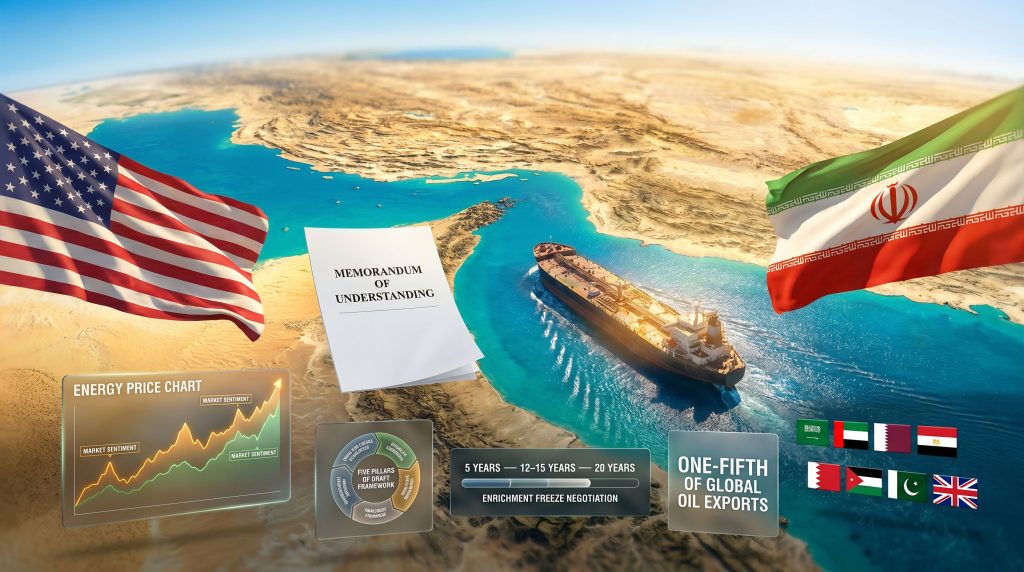
Few geographic features carry as much economic weight as a strait that can be crossed in minutes but whose disruption sends shockwaves through every fuel-dependent economy on earth. The Strait of Hormuz, a narrow passage between Iran and Oman, sits at the intersection of energy security, nuclear politics, and great power rivalry in a way that no other waterway does. When it functions normally, roughly one-fifth of global oil exports pass through it daily. When it does not, the consequences extend from European petrol forecourts to Asian manufacturing supply chains within weeks.
The events of early 2026 brought that vulnerability into sharp focus. A sequence of military operations, ceasefire negotiations, port blockades, and diplomatic back-channels has produced what may, depending on the next several weeks, either become a landmark de-escalation between Washington and Tehran or another chapter in their decades-long strategic confrontation. Understanding the current Iran and US deal to end war requires moving beyond the headline figures and examining the structural forces that have shaped this moment, and the multiple scenarios that still lie ahead.
When big ASX news breaks, our subscribers know first
Why This Moment Is Structurally Different From Previous Negotiations
The Long Shadow of the JCPOA's Collapse
The 2015 Joint Comprehensive Plan of Action represented the most ambitious multilateral attempt to constrain Iran's nuclear programme through a framework of enrichment limits, sanctions relief, and international verification. Its unravelling following the US withdrawal in 2018 did not simply end a diplomatic arrangement. It systematically dismantled the inspection architecture, froze the economic incentives that had encouraged Iranian compliance, and removed the political cover that moderate Iranian leaders needed to argue for restraint domestically.
By 2026, Iran's uranium enrichment had advanced significantly beyond 2015 levels, the inspection regime had effectively collapsed, and the conditions for conventional diplomacy had been replaced by direct military confrontation. Furthermore, uranium market volatility had already been reshaping investor expectations well before the conflict escalated. Any new framework, therefore, must not merely replicate the 2015 structure but address why that structure failed to create durable incentives for compliance on both sides.
The distinction between the current draft memorandum of understanding and a binding treaty is not a legal technicality. It is the central structural feature of the negotiation. A memorandum carries no enforcement mechanism under international law, meaning compliance depends entirely on the political will of both administrations, which is itself subject to domestic pressures, electoral cycles, and leadership continuity in both Washington and Tehran.
A Timeline of Escalation and Opening
The path from military operations to the current negotiating table followed a compressed but consequential sequence of events.
| Date | Event |
|---|---|
| February 28, 2026 | US-Israeli military operations against Iran commence |
| April 8, 2026 | US-Iran ceasefire takes effect |
| April 13, 2026 | US naval blockade of Iranian ports imposed |
| April (late), 2026 | Pakistan-mediated face-to-face US-Iran talks held |
| May 23-24, 2026 | Draft MOU reported as largely negotiated; announcement described as potentially imminent |
What is notable about this timeline is the simultaneity of the ceasefire and the blockade. Washington halted offensive operations while maintaining significant economic pressure through port restrictions. This reflected a deliberate strategic calculation: preserving negotiating leverage without recommitting to active military engagement. The question of whether that leverage translated into durable concessions or simply hardened Iranian domestic opinion against any agreement remains unresolved.
What Is Actually Being Negotiated
The Architecture of the Draft Framework
According to reporting from Iran via Fars news agency and subsequent international coverage, the draft one-page memorandum is built around five interconnected provisions.
- A halt or suspension of Iranian uranium enrichment for a contested duration
- Partial release of Iran's frozen foreign assets held under international sanctions
- Termination of the US naval blockade of Iranian ports
- Restoration of Strait of Hormuz passage to pre-conflict traffic levels under Iranian management
- Temporary sanctions relief on Iranian oil, gas, petrochemicals, and their derivatives during a defined negotiation window
The reported framework is explicitly structured as a pause mechanism, not a final resolution. The nuclear question has reportedly been deferred by 60 days under the current draft, creating a negotiation runway rather than an immediate settlement.
This architecture reflects a calculated trade-off. Iran receives immediate economic benefits, including the ability to sell oil freely during the negotiation period, in exchange for a temporary freeze on enrichment activity. The United States receives a pause in Iran's nuclear programme and the political optics of reopening a critical global waterway. Neither side achieves its stated maximalist objective, which is precisely why the framework faces internal opposition in both capitals.
The Enrichment Gap: The Hardest Problem at the Table
The single most consequential unresolved variable in the current negotiations is the duration of any enrichment freeze. The positions reported as of May 2026 reveal a significant gap that any final agreement must bridge.
| Party | Reported Position on Enrichment Freeze Duration |
|---|---|
| United States | Up to 20 years |
| Iran | Approximately 5 years |
| Reported Middle Ground | 12-15 years |
The disagreement over duration is not simply numerical. It reflects fundamentally different theories of what the freeze is supposed to accomplish. For Washington, a longer freeze ensures that any future Iranian enrichment activity occurs in a political environment shaped by sustained economic integration and diplomatic normalisation. For Tehran, a shorter freeze preserves the option to resume enrichment as a strategic deterrent if the political or security environment deteriorates.
Verification remains equally contested. The proposed use of snap inspections by United Nations inspectors, combined with restrictions on underground nuclear facilities, addresses the JCPOA's weakness of advance notification requirements. Whether Iran's current leadership would accept this level of intrusion is far from clear.
A Comparative Trade-Off Analysis
| Concession | Beneficiary |
|---|---|
| Sanctions relief on energy exports | Iran |
| Release of frozen assets | Iran |
| End of naval blockade | Iran |
| Strait of Hormuz reopened | Global energy markets and US allies |
| Enrichment freeze (contested duration) | United States |
| Nuclear programme deferred, not dismantled | Iran (contested framing) |
| 60-day negotiation window | Both parties |
The Strait of Hormuz Dimension
What the Blockade Has Cost Global Markets
In normal operating conditions, the Strait of Hormuz handles approximately one-fifth of global oil exports, making it the world's most economically sensitive maritime chokepoint. The Iranian-imposed shipping restrictions since late February 2026 have created sustained upward pressure on energy prices globally, with cascading effects on airline operating costs, industrial production, and consumer energy bills across Europe and Asia.
The urgency of European leaders' response reflects this exposure directly. European Commission President Ursula von der Leyen publicly welcomed diplomatic progress, and UK Prime Minister Keir Starmer expressed commitment to working with international partners to advance the peace effort. Both statements came from leaders whose domestic economies face acute vulnerability to sustained energy price elevation. This dynamic is closely linked to the broader oil price shock already rippling through energy-dependent economies.
What is less widely noted is the secondary effect on Gulf shipping insurance premiums, which have risen sharply since the Hormuz restrictions began. Even a partial reopening under Iranian management would provide meaningful relief to commercial operators across the region.
Scenario Modelling: Three Pathways Forward
The range of possible outcomes from the current negotiating process carries materially different implications for global energy markets, regional security, and the broader trajectory of US-Iran relations.
Scenario A: Deal Confirmed, Strait Reopens Within 30 Days
- Immediate downward pressure on oil futures as supply uncertainty resolves
- Restoration of Iranian oil to global markets during the negotiation window
- Significant reduction in Gulf shipping insurance costs
- Political relief for European governments facing domestic energy price pressures
Scenario B: Partial Agreement, Extended Negotiation Period
- Ceasefire extended by 60 days with Strait partially reopened under Iranian oversight
- Continued uncertainty premium embedded in energy price benchmarks
- Gradual Iranian oil market re-entry as sanctions relief takes effect
- Unresolved nuclear question maintains strategic risk premium
Scenario C: Talks Collapse, Hostilities Resume
- Renewed military operations with potential for broader regional escalation
- Sustained or worsening Strait of Hormuz disruption
- Sharp upward movement in Brent crude and LNG spot prices
- Heightened systemic risk to global supply chains and regional financial markets
Even under Scenario B, the deferred nuclear question means markets and governments face a 60-day countdown before the fundamental strategic uncertainty is resolved. This creates a narrow but meaningful window of economic stabilisation without geopolitical resolution.
The Regional Stakeholder Map
Gulf States: Economic Relief Versus Strategic Anxiety
Leaders from Saudi Arabia, the UAE, Qatar, Egypt, Jordan, and Bahrain, alongside representatives from Turkey and Pakistan, participated in a direct call with President Trump on May 24, 2026, to discuss the emerging deal framework. The participation of this group reflects a dual interest that characterises Gulf state positioning throughout the negotiations.
On one hand, the reopening of the Strait of Hormuz and the reduction of regional conflict risk provides direct economic benefit to states whose prosperity depends on stable energy transit and investor confidence. On the other hand, a framework that leaves Iran's nuclear programme intact, even temporarily frozen, creates a long-term strategic concern that no Gulf leader can dismiss. A nuclear-capable Iran, even one operating under a temporary enrichment freeze, fundamentally alters the regional balance of power in ways that Gulf states cannot fully hedge against through conventional military or diplomatic means.
The temporary sanctions lift on Iranian oil also creates a complex dynamic for OPEC production strategy. Iranian barrels re-entering global markets during the negotiation window would increase overall supply at a moment when Gulf producers have been managing output levels carefully. The coordination challenge this creates within OPEC+ has received relatively little attention in mainstream coverage but represents a meaningful secondary consequence of any deal.
Pakistan's Mediation Role: An Emerging Strategic Pivot
Pakistan's facilitation of the face-to-face US-Iran negotiations in April 2026 represents one of the more consequential diplomatic developments of the conflict period. Prime Minister Shehbaz Sharif confirmed Pakistan's readiness to host further rounds of talks, and Army Chief Asim Munir's direct visit to Tehran on May 23-24 appears to have played a meaningful role in advancing the final negotiating phase.
This positions Islamabad as a newly significant actor in Middle Eastern diplomacy, a role it has not historically occupied. Pakistan's ability to maintain communication channels with both Washington and Tehran simultaneously reflects its unique geographic and political position: a nuclear-armed Muslim-majority state with existing relationships across the Gulf region and longstanding security ties with the United States.
Israel's Conditional Non-Interference
Reports that Israeli Prime Minister Netanyahu communicated to President Trump that Israel would retain its freedom to act against perceived threats represent a significant variable in any durable framework. This is not an endorsement of the deal. It is a conditional non-interference signal that preserves Israeli strategic options while avoiding direct obstruction of a US-led negotiating process.
The distinction between a US-Iran ceasefire agreement and a comprehensive regional security architecture is critical here. A bilateral memorandum does not bind Israel, does not address Israeli security concerns about Iranian proxy activity, and does not prevent unilateral Israeli action if Tehran's nuclear programme is assessed to have crossed a threshold that Israeli decision-makers consider unacceptable.
Domestic Political Resistance in Washington
Republican Opposition: Three Core Arguments
A significant bloc of Republican senators has publicly opposed the emerging framework, with criticism concentrated around three distinct objections.
-
Military gains surrendered prematurely. Senator Roger Wicker, the leading Republican voice on defence policy in the Senate, argued that agreeing to a 60-day ceasefire extension would effectively erase the strategic achievements of the military operations conducted under the Operation Epic Fury designation.
-
Iran retains nuclear capability. Senators Ted Cruz and Lindsey Graham expressed concern that any framework allowing Iran to continue enrichment at any level, or to resume enrichment after a temporary freeze, would leave intact the pathway to a nuclear weapon.
-
Economic benefits flow to an adversary. Critics objected to Iran receiving the ability to sell oil freely and access frozen assets while remaining under leadership hostile to US interests.
Senator Thom Tillis of North Carolina raised a pointed question about internal consistency in the administration's position: if the Department of Defense had previously stated that Iran's defensive capabilities had been largely eliminated and that nuclear material recovery was imminent, then accepting a deal in which that material remains in Iran required explanation.
Senator Ted Cruz characterised an outcome in which Iran's leadership retained control, received significant financial resources, maintained enrichment capability, and held influence over the Strait of Hormuz as a fundamental strategic error.
The Trump Administration's Balancing Act
President Trump's communications during the May 24 period reflected a deliberate effort to manage competing pressures simultaneously. His Truth Social statement that time was on the US side and that negotiators should not rush served a dual purpose: it signalled continued leverage to Iranian counterparts while providing domestic critics with evidence that the administration was not capitulating under time pressure.
The framing of the deal as a process rather than a final outcome is similarly calibrated. By positioning the MOU as the beginning of a negotiating runway rather than the conclusion of the conflict, the administration attempts to address Republican concerns about appearing to reward Iran with immediate concessions while delivering incomplete strategic objectives. Consequently, the Iran and US deal to end war continues to be shaped as much by domestic political constraints as by the substance of the negotiations themselves.
Comparing 2015 and 2026: Structural Differences That Matter
The Trump administration's explicit rejection of the Obama-era JCPOA as a reference point shapes the current framework's design in important ways.
| Feature | 2015 JCPOA | 2026 Draft MOU |
|---|---|---|
| Enrichment limits | Capped at 3.67% | Duration contested (5-20 years) |
| Verification mechanism | IAEA inspections with advance notice | Snap inspections proposed |
| Sanctions relief | Phased, multilateral process | Temporary, during negotiation window |
| Nuclear sunset clauses | Yes (10-15 years) | Under active negotiation |
| US domestic ratification | Executive agreement | Non-binding MOU framework |
The proposed snap inspection mechanism addresses one of the JCPOA's most widely criticised weaknesses. Under the 2015 framework, Iran received advance notification of inspections in many circumstances, limiting their effectiveness as a verification tool. Whether the current Iranian leadership would accept unrestricted snap access to facilities, including underground enrichment sites, remains one of the most uncertain variables in the negotiation.
The next major ASX story will hit our subscribers first
Key Indicators to Watch in the Weeks Ahead
The resolution of the Iran and US deal to end war will be shaped by several observable signals that analysts, policymakers, and market participants should track closely. In addition, OPEC's global influence over production decisions means that any Iranian oil re-entry will have consequences well beyond the bilateral negotiation itself.
-
The 60-day nuclear negotiation clock: Once any MOU is formalised, the countdown to substantive nuclear talks begins. The outcome of that window will determine whether the current process represents a genuine peace framework or a temporary suspension of hostilities.
-
Strait of Hormuz reopening timeline: Confirmed restoration of commercial shipping passage is the first concrete implementation signal. Markets will price this almost immediately upon verification.
-
Republican congressional positioning: Sustained opposition from senior Senate Republicans could constrain the administration's flexibility in the nuclear negotiation phase, particularly if critics move toward legislative action.
-
Iran's domestic political dynamics: Hard-line domestic constituencies within Iran mirror Republican resistance in the United States. Both governments face internal audiences deeply resistant to compromise, and both leaderships must manage those audiences simultaneously.
-
Israel's strategic calculus: Any Israeli assessment that the emerging framework leaves Iran's nuclear programme at an unacceptable threshold of advancement could produce unilateral action that destabilises the entire agreement architecture.
-
OPEC+ production strategy response: The re-entry of Iranian oil barrels into global markets during any sanctions relief window will require coordination or conflict within the existing OPEC+ framework. This secondary but economically significant consequence also carries a broader global market impact that deserves close attention.
FAQ: Understanding the Iran-US Negotiations
What is the current status of the Iran-US peace deal?
As of May 24, 2026, a draft one-page memorandum of understanding had been reported as largely negotiated. US Secretary of State Marco Rubio indicated during a visit to India that an announcement could potentially come within hours. No final agreement had been formally confirmed at the time of reporting, and President Trump publicly instructed negotiators not to rush. Iran has suggested the resolution may reflect its own terms rather than a straightforward US-led framework.
Would the deal end Iran's nuclear programme?
No. The reported framework defers nuclear negotiations for 60 days following any initial agreement. The deal does not immediately eliminate or dismantle Iran's nuclear capabilities. It is intended to create a structured window within which those negotiations can occur under conditions of reduced military tension.
Why does the Strait of Hormuz matter to global oil prices?
The Strait of Hormuz is the world's most critical oil transit chokepoint, handling approximately one-fifth of global oil exports under normal conditions. Iranian-imposed shipping restrictions since February 2026 have contributed directly to sustained global energy price pressure, affecting everything from airline fuel costs to consumer electricity bills across Europe and Asia.
Who is mediating the US-Iran negotiations?
Pakistan has played a central mediation role, facilitating face-to-face talks between US and Iranian delegations in April 2026. Regional leaders from Saudi Arabia, the UAE, Qatar, Egypt, Jordan, and Bahrain have also been engaged through multilateral consultations with the Trump administration. Pakistan's Army Chief Asim Munir visited Tehran directly in the final days before the May 24 announcement window.
How long would the enrichment freeze last under the deal?
This remains the most consequential unresolved issue. The United States has reportedly sought a freeze of up to 20 years. Iran has proposed approximately 5 years. A potential compromise figure of 12 to 15 years has been discussed, though neither side has publicly confirmed acceptance of any middle-ground duration.
What happens if the deal falls apart?
A collapse in negotiations would risk renewed military escalation, continued or worsening Strait of Hormuz disruption, and sustained upward pressure on global energy prices. The absence of any framework would also remove the 60-day nuclear negotiation window, potentially accelerating Iranian enrichment activity without the verification mechanisms that an Iran and US deal to end war would otherwise impose.
Want To Stay Ahead of the Market Shifts Driving Commodity Prices?
The geopolitical forces reshaping global energy markets — from Hormuz shipping restrictions to OPEC+ production dynamics — create cascading effects across commodity sectors, including the mineral discoveries that can generate exceptional investor returns. Discovery Alert's proprietary Discovery IQ model delivers real-time alerts on significant ASX mineral discoveries the moment they are announced, transforming complex market signals into actionable opportunities — and with a 14-day free trial, there has never been a better time to explore why historic discoveries have rewarded early investors so handsomely.