August 6, 2026
When the World's Most Critical Waterway Closes, Southeast Asia Pays First
Geopolitical risk has always carried an asymmetric quality. The nations that fire the weapons rarely absorb the full economic consequences. The economies that suffer most are often those furthest from the battlefield, yet most dependent on the supply chains that run through it.
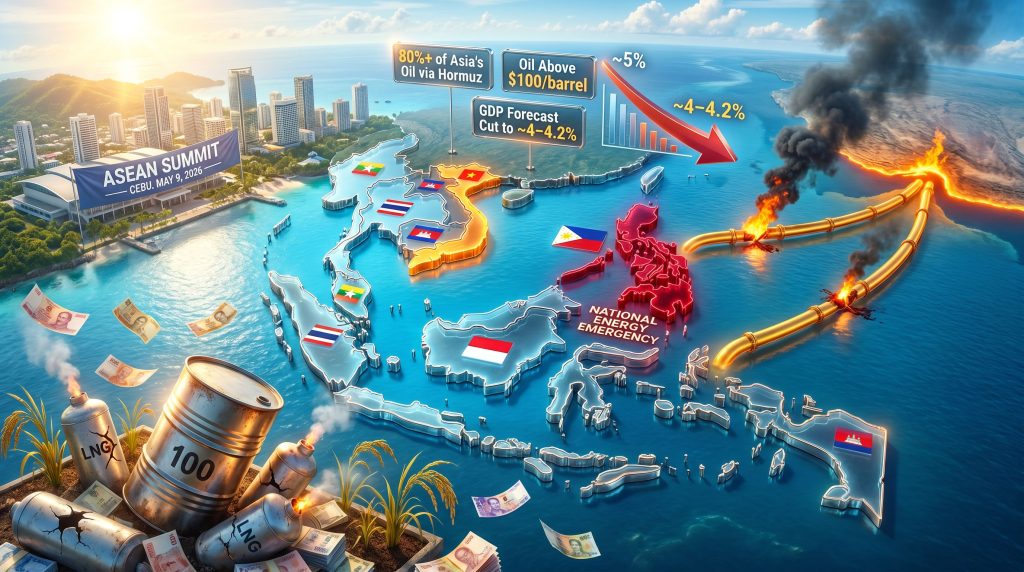
The Strait of Hormuz illustrates this principle with uncomfortable precision. Running roughly 33 kilometres at its narrowest point between Oman and Iran, this waterway handles more than 80% of Asia's crude oil and liquefied natural gas imports, according to reporting by Arab News. For Southeast Asia, a region of more than 680 million people with limited domestic hydrocarbon production and shallow strategic reserves, the closure of this chokepoint following US and Israeli military operations against Iran beginning on February 28, 2026 has triggered an economic crisis with few peacetime precedents.
The Iran war ASEAN summit economic fallout now defines the most urgent policy conversation in the region. Understanding how a conflict thousands of kilometres away created fuel queues in Manila, fertilizer shortages in Cambodia, and GDP forecast downgrades across eleven economies requires mapping the exact transmission mechanisms at work.
When big ASX news breaks, our subscribers know first
The Anatomy of ASEAN's Energy Dependency Problem
Why Import Dependency Creates Asymmetric Vulnerability
Not all import dependency is equal. An economy that imports 60% of its oil but holds 120 days of strategic petroleum reserves faces a fundamentally different risk profile than one that imports 85% of its oil with reserves covering fewer than 30 days of consumption. ASEAN member states overwhelmingly fall into the second category, which is why the Hormuz closure did not merely inflate energy prices — it physically severed supply lines with immediate downstream consequences.
The dependency profile across the bloc varies in severity, but the common thread is structural overexposure to a single transit corridor:
| Country | Gulf Energy Dependency | Key Vulnerability |
|---|---|---|
| Philippines | Near-total crude oil reliance on Middle East | National energy emergency declared late March 2026 |
| Vietnam | Approximately 85% of oil sourced from Gulf states | Reserves approaching critically low thresholds |
| Cambodia, Laos, Myanmar | High diesel import dependency | Petrol station closures and retail supply halts reported |
| Thailand | Significant Gulf energy and tourism exposure | Dual shock combining energy cost surge and tourism revenue decline |
| Pakistan (ASEAN-adjacent) | 99% of LNG from UAE; 40% of total energy from Gulf | Among the most acutely exposed non-member economies in the wider region |
Source: Arab News, May 2026
The Philippines: Ground Zero for the Energy Emergency
The Philippines serves as the clearest case study in how rapidly a Hormuz disruption translates into domestic crisis. As a nation of 110 million people depending almost entirely on Middle Eastern crude, the country had virtually no supply redundancy to absorb the shock.
By late March 2026, the Philippine government formally declared a national energy emergency after local diesel and petrol prices more than doubled in the weeks following the strait's closure. This is not a gradual price increase characteristic of normal commodity cycles. It represents a supply destruction event at the retail level — the kind of shock that cascades immediately into food prices, transport costs, and industrial operating margins.
Furthermore, understanding oil's role in the global economy makes it clear why even a temporary closure of a single chokepoint can produce consequences of this magnitude.
The Philippines' experience illustrates a broader structural truth: when an economy lacks both domestic production capacity and substantial strategic reserves, a physical supply disruption converts almost immediately into a humanitarian and economic emergency, not merely a price adjustment.
How the Crisis Moves Through an Economy: Three Pathways
The Energy Supply Disruption Channel
The most direct transmission mechanism is the one most visible to ordinary citizens. Petrol station closures spread across Cambodia, Laos, Myanmar, and Thailand as reported by Channel News Asia, reflecting not just price unaffordability but actual physical absence of supply. Industrial sectors dependent on diesel — including manufacturing, construction, logistics, and cold-chain food distribution — faced simultaneous cost increases and supply uncertainty.
For electricity grids in countries where LNG-fired power plants form a significant share of the generation mix, the Hormuz closure also introduced risk of generation capacity constraints. The energy disruption channel thus operates at three levels simultaneously: retail fuel supply, industrial operating costs, and electricity generation reliability. Closely linked to these pressures is the broader LNG supply outlook for the region, which was already under strain well before the conflict escalated.
The Food Security Deterioration Channel
Less immediately visible but arguably more consequential over the medium term, the food security transmission pathway operates through fertilizer supply chains. Gulf-linked supply chains carry substantial fertilizer volumes to Southeast Asian agricultural markets, and the conflict fractured these flows across Cambodia, Thailand, the Philippines, and Vietnam.
The cascading logic is straightforward but devastating:
- Fertilizer supply contracts, reducing crop input availability
- Elevated diesel prices increase the operating cost of agricultural machinery
- Food transportation costs rise, expanding the farm-to-consumer price gap
- Rice cultivation cycles are disrupted, threatening the region's dietary staple
- Rural agricultural incomes contract, expanding poverty risk in already-vulnerable communities
Rice is not merely an economic commodity in Southeast Asia. It is the central food security metric against which governments measure stability. Disruptions to planting cycles carry political as well as nutritional consequences.
The Macroeconomic Deceleration Channel
The third pathway operates at the highest level of abstraction but carries the most durable consequences. Currency depreciation across multiple ASEAN economies, driven by rising import costs and capital flow volatility, compounded the price pressure from energy and food. The result is a dual-pressure environment: inflation pushing upward while growth decelerates.
The World Bank's response to these dynamics was to cut approximately one percentage point from its regional GDP growth forecasts, revising projections downward from roughly 5% to a range of 4–4.2%, according to Arab News reporting. In absolute terms, across an ASEAN bloc with a combined economic output exceeding three trillion US dollars, a single percentage point reduction in growth represents tens of billions of dollars in foregone economic activity.
When supply shock, cost-push inflation, and demand destruction operate simultaneously, the resulting economic environment resembles stagflation rather than a conventional recession. Standard monetary policy tools prove poorly equipped for this scenario: cutting interest rates to support growth risks accelerating inflation, while raising rates to control prices risks deepening the growth slowdown.
Inside the Cebu Summit: What ASEAN Leaders Are Actually Doing
The Three-Priority Framework Driving Every Conversation
Philippine President Ferdinand Marcos Jr., chairing the 2026 ASEAN Summit in Cebu on May 9, 2026, framed the bloc's response around three explicit operational priorities, as reported by Arab News: energy supply stabilisation, food security and agricultural continuity, and protection of migrant worker remittance flows.
The deliberate simplicity of this framework — described by Marcos himself as a focus on oil, food, and migrant workers — reflects the nature of the summit's constraints. With the crisis ongoing and geopolitical uncertainty limiting long-range planning, the meeting prioritises immediate coordination over structural transformation.
According to Arab News, Marcos articulated the challenge facing member states: what does ASEAN do collectively, how can members support each other, and what position does the bloc take on external shocks arriving simultaneously from multiple directions. These are not rhetorical questions. They frame the practical policy architecture the summit is attempting to construct.
Coordinated Policy Measures on the Table
The summit is expected to produce a formal collective response document establishing a coordination framework for managing both the immediate crisis and future energy emergencies, according to the Philippines' ASEAN spokesperson Dominic Xavier Imperial, as reported by Arab News. The specific measures being advanced include:
- Emergency fuel-sharing arrangements allowing member states with available energy stocks to redistribute supply to alleviate acute shortages in the most affected economies
- A collective commitment to trade openness, resisting the protectionist impulse to impose export restrictions on essential goods at a moment when open supply chains are most critical
- Acceleration of existing free trade agreement frameworks with partners including China, South Korea, and Canada, to diversify trade relationships and reduce vulnerability concentration
- Advancement of the ASEAN power grid initiative, elevating regional electricity network interconnection from a long-term aspiration to an operational priority
Philippine Trade Secretary Cristina Roque articulated the underlying logic of the trade openness commitment: that in periods of heightened uncertainty, predictability itself becomes a form of economic stability, and that stability depends on maintaining the movement of goods across borders.
The Migrant Worker Dimension: A Less-Discussed Vulnerability
The inclusion of migrant workers as one of three summit priorities reflects an economic dynamic that receives less analytical attention than energy or food security but carries significant macroeconomic weight. Countries including the Philippines, Indonesia, and Vietnam depend heavily on remittance flows from workers employed in Gulf states.
When energy sector disruption in the Gulf contracts employment in oil-related industries, these remittance flows face downward pressure. For the Philippines, where remittances from overseas workers represent a substantial share of household income for millions of families, any contraction in Gulf employment has direct domestic consumption implications.
Structural Vulnerabilities the Crisis Has Exposed
Energy Diversification: From Aspiration to Necessity
Tereso Panga, Director General of the Philippine Economic Zone Authority, summarised the structural lesson the crisis has delivered with notable directness, as reported by Arab News: the conflict has demonstrated how volatile the region remains to oil price fluctuations and availability. Intensifying cooperation to share energy stocks, stabilise supply, and conduct joint exploration within the region represents the path toward reducing reliance on vulnerable Hormuz-transiting supply lines.
This framing is significant because it shifts energy diversification from the domain of long-term climate policy into immediate economic security strategy. The crisis has created political conditions for accelerating decisions that have historically struggled to gain traction against incumbency inertia. Analysts at the Lowy Institute have similarly noted that the conflict's toll on the Indo-Pacific has accelerated structural conversations that would otherwise have taken years to reach the policy agenda.
Three diversification pathways have gained renewed urgency:
- Intra-regional oil and gas exploration to reduce the proportion of energy sourced through Hormuz-transiting routes
- Accelerated renewable energy deployment across solar, wind, and hydroelectric capacity, building the economic case that energy security and emissions reduction share the same infrastructure investment
- Strategic petroleum reserve expansion to extend the buffer between supply disruption and consumer-level impact, a gap that proved dangerously narrow across most ASEAN economies in early 2026
Four Secondary Pressures Compounding the Primary Crisis
The Iran war ASEAN summit economic fallout extends beyond the energy sector into several additional pressure points that interact and amplify each other:
| Pressure Point | Affected Economies | Mechanism |
|---|---|---|
| Tourism revenue decline | Thailand, Philippines, Indonesia | Reduced international arrivals; elevated aviation and travel costs |
| Remittance flow contraction | Philippines, Indonesia, Vietnam | Gulf-based overseas worker employment contracting under energy sector stress |
| US trade negotiation complexity | Vietnam, Thailand, Malaysia, Indonesia, Philippines | Middle East instability introduces new variables into bilateral deal-making |
| Domestic social tensions | Muslim-majority ASEAN members | Geopolitical conflict narrative creates internal social cohesion risk |
The Stagflation Scenario and Its Policy Constraints
If ceasefire negotiations fail and the Strait of Hormuz closure extends beyond mid-2026, economic modelling suggests meaningful portions of Asia face genuine recession risk. The analytical challenge is that the combination of supply-constrained energy, food price inflation, weakening currencies, and declining export demand creates conditions that conventional monetary policy is poorly positioned to address.
Central banks across the region face a fundamental contradiction: the inflation environment argues for tighter monetary conditions, while the growth deterioration argues for accommodation. Countries that have already reduced their monetary policy headroom face the hardest choices, with limited capacity to ease without risking currency depreciation that would further inflate import costs.
The Geopolitical Repositioning Underway
ASEAN's Non-Alignment Under Real-World Stress
ASEAN has historically maintained structural non-alignment, building its diplomatic identity around consensus and engagement with all major powers rather than formal bloc-based security commitments. The Iran war tests this posture because the US — ASEAN's primary security partner — is directly involved in the military action producing the economic disruption the bloc is attempting to manage.
The bloc's collective call for a halt to the conflict, framed around the sustained economic challenges being imposed on member states' populations, represents ASEAN's most direct collective political statement on a major-power conflict in recent memory. Significantly, it frames the call in economic rather than security or moral terms, consistent with ASEAN's preference for pragmatic engagement over ideological positioning.
However, the geopolitical oil price drivers shaping this environment extend well beyond the strait itself — they include sanctions architecture, shipping insurance markets, and the behaviour of non-aligned producers, all of which ASEAN has limited ability to influence directly.
China's Expanding Economic Leverage
As ASEAN accelerates FTA processes and deepens regional economic integration, China's position within that framework strengthens. China possesses meaningful insulation from Hormuz dependency through overland pipeline infrastructure and diversified supply arrangements, positioning it as a potentially stabilising energy partner for Southeast Asian states seeking supply diversification.
The crisis therefore accelerates a structural shift in ASEAN's economic centre of gravity toward intra-Asian trade frameworks — a dynamic that predated the conflict but has gained new momentum under current conditions. Whether this shift creates strategic dependency risks that offset energy security gains represents one of the more consequential long-term questions the bloc will need to navigate.
In addition, supply chain disruptions triggered by the broader geopolitical environment have further complicated ASEAN's efforts to stabilise trade flows and maintain its integration momentum.
The next major ASX story will hit our subscribers first
Key Metrics at a Glance
| Metric | Data Point |
|---|---|
| Share of Asia's oil and LNG transiting Hormuz | More than 80% |
| Oil price threshold breached post-closure | Above $100 per barrel |
| World Bank GDP forecast reduction | Approximately 1 percentage point |
| Regional growth forecast revised to | 4.0–4.2% (from approximately 5%) |
| Philippines fuel price change post-closure | More than doubled |
| Vietnam Gulf oil dependency | Approximately 85% of total oil imports |
| Pakistan LNG Gulf dependency | 99% of LNG sourced from UAE |
| ASEAN summit location and date | Cebu, Philippines, May 9, 2026 |
Source: Arab News, May 6, 2026
Frequently Asked Questions
Why is the Strait of Hormuz closure particularly damaging for Southeast Asia compared to other regions?
Western economies have diversified energy supply portfolios, including domestic production, Atlantic Basin imports, and pipeline infrastructure that bypasses the Strait. Most ASEAN economies lack these alternatives. Their import dependency from Gulf sources is higher, their domestic production capacity is lower, and their strategic petroleum reserves provide fewer days of supply buffer. This means supply disruptions convert to consumer-level shortages far faster than in economies with greater structural resilience.
Which ASEAN country has experienced the most severe immediate impact?
The Philippines declared a national energy emergency in late March 2026 after fuel prices more than doubled, representing one of the most acute governmental responses to the crisis within the bloc. Vietnam, Cambodia, Laos, Myanmar, and Thailand have also experienced significant supply disruptions, including petrol station closures reported across multiple provinces.
What specific outcomes is the Cebu Summit designed to deliver?
The summit is focused on formalising an emergency fuel-sharing framework among member states, reaffirming collective commitment to trade openness, advancing the ASEAN power grid initiative as a structural energy diversification mechanism, and accelerating free trade agreement processes with key partners. A formal leaders' statement establishing coordination frameworks for current and future energy emergencies is expected as the primary output.
How much economic damage has the crisis already caused?
The World Bank has cut approximately one percentage point from its regional GDP forecasts, revising projected growth from roughly 5% down to a range of 4–4.2%. If the Hormuz closure persists into the second half of 2026, stagflation conditions and recession risk across portions of the region become increasingly credible economic scenarios.
What is ASEAN's long-term energy strategy to reduce Hormuz dependency?
The emerging multi-track strategy involves coordinated intra-regional oil and gas exploration to expand domestic supply capacity, accelerated renewable energy deployment to reduce structural reliance on imported hydrocarbons, strategic petroleum reserve expansion to extend the buffer against future supply disruptions, and the ASEAN power grid initiative to enable cross-border electricity sharing. The oil price rally of the preceding period had already signalled the fragility of import-dependent energy models, however the Hormuz closure transformed that warning into an operational emergency.
From Crisis Management to Structural Transformation
The Iran war ASEAN summit economic fallout represents more than a regional energy emergency. It functions as a stress test that has simultaneously exposed the bloc's deepest structural vulnerabilities and generated the political conditions for its most coordinated collective response in years.
The decisions made at Cebu — on fuel sharing, trade openness, power grid integration, and free trade acceleration — are not merely emergency management measures. They are the first architecture of a more resilient energy future for Southeast Asia. Whether that architecture is built with sufficient speed and ambition will determine how the next supply disruption, from whatever source, lands on the populations of these eleven economies.
The broader strategic lesson the Iran war is delivering to ASEAN extends beyond energy policy. In an interconnected global economy, military conflicts in distant regions can trigger domestic energy emergencies, food insecurity, and GDP contraction within weeks. The region's response — prioritising coordination, openness, and diversification over unilateral protectionism — offers a template for how middle-power blocs can navigate great-power conflicts without becoming their most damaging economic casualties.
Disclaimer: This article contains forward-looking assessments of economic conditions, GDP forecasts, and policy outcomes that are inherently uncertain. GDP projections and scenario analyses reflect conditions as reported at the time of source publication and are subject to change based on developments in the Iran conflict, global energy markets, and ASEAN policy implementation. Readers should not interpret any portion of this article as financial or investment advice.
Want to Capitalise on the Next Major Mineral Discovery Before the Broader Market Reacts?
While geopolitical shocks reshape global energy and commodity supply chains, Discovery Alert's proprietary Discovery IQ model scans ASX announcements in real time, instantly identifying significant mineral discoveries and delivering actionable alerts to subscribers — explore historic discovery returns to understand the opportunity, then begin your 14-day free trial at Discovery Alert to position yourself ahead of the market.