June 8, 2026
The Iran war impact on global oil demand has created unprecedented disruptions across international energy markets, triggering complex demand destruction patterns that extend far beyond immediate supply concerns. Furthermore, these market adjustments reveal the intricate vulnerabilities within modern energy infrastructure and the cascading effects on global economic systems.
Understanding Demand Destruction in Energy Crisis Scenarios
Energy market disruptions trigger cascading consumption adjustments that extend far beyond immediate pricing concerns. The Iran war impact on global oil demand demonstrates how geopolitical tensions translate into measurable economic consequences across multiple sectors and geographic regions.
Recent market analysis indicates that global oil demand has contracted by approximately 4 million barrels per day since the onset of Middle Eastern conflicts, representing a significant departure from pre-crisis consumption patterns. This demand destruction occurs through several interconnected mechanisms that affect both industrial and consumer behaviors.
Industrial Sector Response Patterns
Manufacturing facilities implement immediate operational adjustments when energy costs exceed sustainable profit margins. Energy-intensive industries face particularly acute pressures:
- Petrochemical production: Facilities reduce throughput by 15-20% when feedstock costs spike
- Steel manufacturing: Electric arc furnace operations shift to off-peak consumption periods
- Aluminum smelting: Production schedules adjust to minimize peak energy demand exposure
- Cement production: Extended maintenance periods coincide with high-cost energy phases
Transportation Sector Adaptations
Commercial transportation networks demonstrate remarkable adaptability during energy price volatility. Fleet operators implement sophisticated cost management strategies that reshape logistics patterns:
| Adaptation Strategy | Implementation Timeline | Cost Reduction Potential |
|---|---|---|
| Route optimization | Immediate (0-7 days) | 8-12% fuel savings |
| Modal shifts to rail | Medium-term (1-3 months) | 15-25% cost reduction |
| Fleet efficiency upgrades | Long-term (6-18 months) | 20-30% improvement |
| Load consolidation | Immediate (0-14 days) | 10-18% efficiency gains |
When big ASX news breaks, our subscribers know first
Regional Vulnerability Assessment Across Global Markets
The Iran war impact on global oil demand varies significantly across different economic regions, with vulnerability determined by factors including energy import dependence, fiscal resilience, and infrastructure flexibility.
Asia-Pacific Market Dynamics
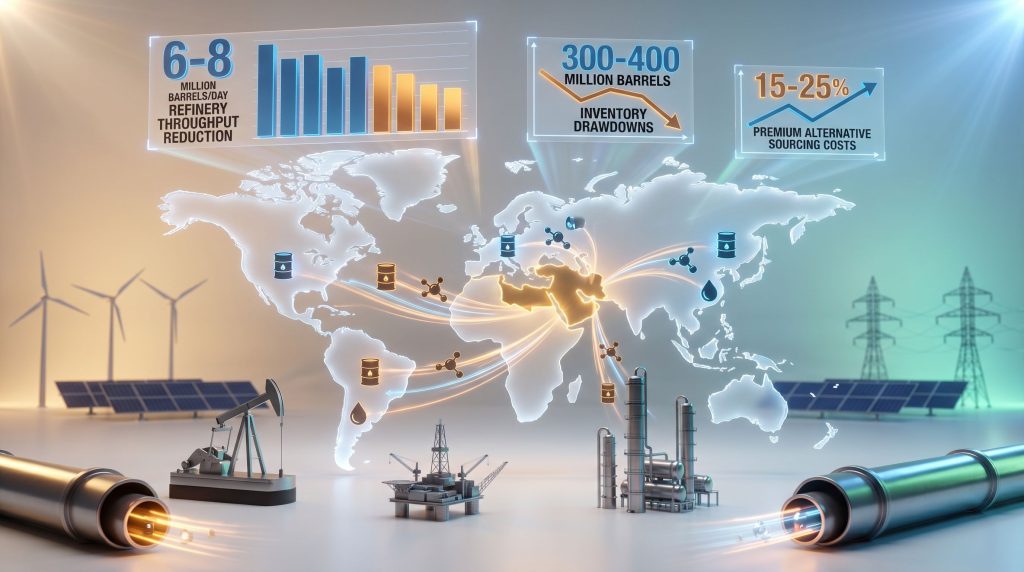
The Asia-Pacific region's heavy reliance on Middle Eastern energy supplies creates unique economic pressures. Refinery throughput reductions of 6-8 million barrels per day have forced significant operational adjustments across the region's industrial base.
Manufacturing centers in China, Japan, and South Korea experience immediate cost pressures that translate into:
- Input cost inflation reaching 10-15% for energy-derived raw materials
- Production scheduling shifts toward lower-cost energy consumption periods
- Supply chain reconfiguration emphasising geographic diversification
European Energy Security Responses
European markets demonstrate sophisticated adaptation mechanisms developed through previous energy crises. The region's response to current disruptions reveals enhanced resilience compared to historical patterns.
"European industrial sectors have implemented demand response programs that provide 20-30% consumption flexibility during peak pricing periods, significantly reducing vulnerability to supply shocks", according to recent energy market analysis.
Financial Market Pricing of Long-Term Energy Risks
Commodity futures markets increasingly distinguish between immediate physical constraints and longer-term structural adjustments. This divergence creates complex pricing dynamics that affect investment flows and strategic planning across energy-dependent sectors.
Volatility Term Structure Analysis
Market participants observe significant differences between near-term and long-dated contract pricing. Oil and gas volatility surged approximately 300% during the initial weeks of conflict, far exceeding pre-crisis expectations. Meanwhile, many analysts point to an oil price rally as potentially exacerbating these market tensions.
Financial institutions report that:
- Margin requirements increased 8-12 times normal levels for energy derivatives
- Credit facilities for commodity trading expanded to accommodate higher volatility
- Risk management protocols adapted to handle sustained uncertainty periods
Investment Flow Redirection Patterns
Capital allocation patterns shift dramatically during extended energy crises. Strategic petroleum reserve policies undergo reassessment as governments evaluate stockpile adequacy:
- Alternative energy infrastructure receives accelerated investment commitments
- Supply chain resilience projects gain priority in corporate capital planning
- Geographic diversification initiatives expand beyond traditional sourcing regions
Infrastructure Recovery and Supply Chain Normalisation
The timeline for energy system recovery extends well beyond initial conflict resolution. Cumulative global oil production losses total approximately 600-700 million barrels, with projections indicating potential increases to 1 billion barrels even with near-term supply restoration.
Refinery Restart Procedures
Refinery operations require extensive safety protocols before resuming normal production. Industry analysis indicates:
- Initial safety inspections: 2-4 weeks for comprehensive facility assessment
- System pressure testing: 1-2 weeks for pipeline and storage verification
- Operational testing phases: 3-5 weeks for gradual throughput increases
- Full capacity restoration: 8-12 weeks under optimal conditions
Product Inventory Management
Strategic inventory drawdowns during crisis periods create medium-term supply vulnerabilities. Product inventory losses of 300-400 million barrels require systematic rebuilding processes that affect market dynamics for extended periods.
In addition, experts warn of oil price stagnation if geopolitical tensions persist, further complicating recovery efforts.
Technology Innovation and Market Adaptation
Energy market disruptions accelerate technological innovation across multiple sectors. The Iran war impact on global oil demand catalyses investment in alternative energy systems and efficiency improvements.
Energy Efficiency Advancement
Industrial energy efficiency technologies receive increased investment during high-cost periods:
- Advanced process optimisation: Real-time energy management systems
- Waste heat recovery: Industrial thermal management applications
- Smart grid integration: Demand response automation technologies
- Energy storage deployment: Grid-scale and industrial storage systems
Alternative Fuel Development
Market disruptions create economic incentives for accelerated alternative fuel production. However, renewable energy solutions continue to face implementation challenges despite increased investment:
- Hydrogen production scaling: Electrolysis capacity expansion programmes
- Biofuel processing enhancement: Advanced conversion technology deployment
- Synthetic fuel development: Carbon capture and utilisation integration
According to Reuters reporting, "Biofuel production facilities are experiencing unprecedented demand as traditional fuel costs soar beyond sustainable levels for many industrial applications".
Macroeconomic Implications of Energy Price Volatility
Central bank policy responses to energy-driven inflation create complex trade-offs between price stability and economic growth support. The transmission of energy price shocks through economic systems occurs via multiple channels that affect both direct and indirect economic sectors.
Inflationary Pressure Mechanisms
Energy price increases propagate through economic systems through interconnected pathways:
- Direct cost pass-through affects transportation and heating expenses immediately
- Manufacturing cost increases impact energy-intensive production processes
- Service sector adjustments reflect higher operational costs across hospitality and retail
Policy Response Frameworks
Monetary authorities implement sophisticated response strategies that balance competing economic objectives. However, considerations around US economy tariffs complicate international coordination efforts:
| Policy Tool | Implementation Speed | Economic Impact |
|---|---|---|
| Interest rate adjustments | Immediate (0-30 days) | Broad monetary tightening |
| Strategic reserve releases | Medium-term (30-90 days) | Direct price stabilisation |
| Emergency lending facilities | Immediate (0-14 days) | Financial sector support |
| Fiscal energy subsidies | Medium-term (60-180 days) | Targeted consumer relief |
The next major ASX story will hit our subscribers first
Long-Term Structural Market Changes
Extended energy security crises reshape fundamental market structures and investment priorities. Nations and corporations accelerate strategic shifts that reduce dependence on traditional energy supply chains.
Geographic Diversification Initiatives
Supply source diversification becomes a strategic priority for energy-dependent economies:
- Alternative supplier development: Bilateral energy cooperation agreements expand
- Transportation route redundancy: Pipeline and shipping alternative construction
- Regional energy hub establishment: Decentralised trading and distribution centres
Infrastructure Resilience Enhancement
Long-term infrastructure investments focus on reducing single-point-of-failure vulnerabilities. Consequently, energy transition security becomes paramount for national strategic planning:
- Distributed energy systems: Reduced reliance on centralised production facilities
- Emergency response capabilities: Rapid deployment alternative supply mechanisms
- Cross-border interconnection: Enhanced regional energy integration projects
Investment Opportunities in Energy Transition
Market disruptions create catalysts for accelerated investment in energy transition technologies. The Iran war impact on global oil demand demonstrates how crisis periods reshape capital allocation priorities across energy sectors.
Technology Development Acceleration
Energy market volatility drives investment in innovative solutions:
- Grid modernisation projects: Smart grid and energy storage integration
- Industrial process optimisation: Advanced automation and efficiency systems
- Carbon utilisation technologies: Direct air capture and conversion processes
Frontier Market Development
Previously marginal energy regions gain strategic importance during supply disruptions:
- Unconventional resource development: Enhanced oil recovery and extraction technologies
- Renewable energy expansion: Solar, wind, and geothermal capacity increases
- Energy storage deployment: Grid-scale and distributed storage systems
This analysis is based on publicly available market data and industry reports. Energy market conditions remain highly dynamic, and actual outcomes may vary significantly from current projections. Investors should conduct thorough due diligence and consider professional advice before making energy-related investment decisions.
Interested in Capitalising on Global Energy Market Disruptions?
Discovery Alert's proprietary Discovery IQ model delivers real-time alerts on significant ASX mineral discoveries, instantly empowering subscribers to identify actionable opportunities as global energy dynamics reshape commodity markets. Explore how major mineral discoveries can generate substantial returns during periods of market volatility and begin your 14-day free trial today to position yourself ahead of evolving energy and resource markets.