July 31, 2026
The global energy landscape faces unprecedented disruption as strategic waterways become increasingly vulnerable to geopolitical tensions. The ongoing Iran war oil impact demonstrates how supply chain bottlenecks cascade through interconnected markets, revealing the fragility of systems that power modern economies. Furthermore, risk assessment frameworks traditionally focus on production capacity, yet transportation chokepoints often prove more decisive in determining energy security outcomes.
Geographic Chokepoint Analysis and Strategic Positioning
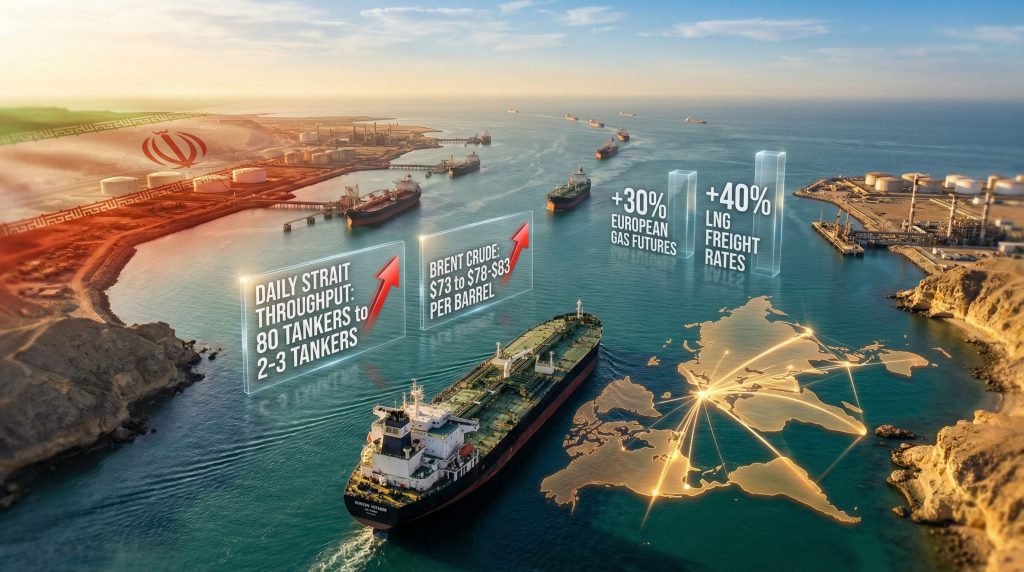
The Strait of Hormuz represents one of the world's most critical energy transportation corridors, controlling approximately 20% of global oil flows through a narrow waterway off Iran's southern coast. Under normal operating conditions, this strategic passage facilitates the transit of roughly 80 oil and gas tankers daily, alongside nearly 160 container ships and car carriers.
Current disruptions have reduced this vital throughput to catastrophic levels. Recent monitoring data indicates only 2-3 tankers have successfully crossed the strait over multiple days, representing a 96-99% decline from baseline traffic volumes. This dramatic reduction illustrates how psychological barriers can create supply bottlenecks even when physical infrastructure remains largely intact.
Energy Infrastructure Vulnerability Mapping
The waterway's strategic importance extends beyond simple throughput statistics. Major producing nations including Saudi Arabia, Iraq, Iran, and the United Arab Emirates rely on this singular passage for energy exports, creating a critical single-point-of-failure risk. Consequently, alternative routing options face significant constraints:
- Land-based pipeline capacity: Limited expansion possibilities for emergency diversification
- Alternative sea routes: Substantial cost increases and delivery delays via Suez Canal or Cape of Good Hope passages
- Storage infrastructure: Regional terminals lack sufficient capacity for extended traffic disruptions
- LNG transportation: Specialized cooling requirements complicate rerouting for liquefied natural gas shipments
Historical data reveals that over 80% of energy resources transported through the Strait of Hormuz during 2024 were destined for Asian markets, with China, India, Japan, and South Korea representing the primary importers. This concentration creates asymmetric vulnerability for Asia-Pacific economies heavily dependent on Middle Eastern energy supplies.
When big ASX news breaks, our subscribers know first
Price Volatility Patterns and Risk Premium Calculations
Energy markets have responded swiftly to transportation disruptions, with Brent crude prices escalating from a baseline of $73 per barrel to approximately $81 per barrel within days of conflict initiation. This 12% price increase reflects market participants pricing risk based on perceived uncertainty rather than actual infrastructure damage.
The pricing mechanism reveals how fear-driven premiums can exceed fundamental supply loss calculations. In addition, the recent oil price rally demonstrates how US-China trade strategies influence global commodity pricing beyond regional conflicts. Initial damage assessments suggested facility impacts were not catastrophic, yet prices continued climbing as shipping companies prioritised crew safety and insurance cost considerations over commercial operations.
Market Psychology and Trader Positioning
Professional energy traders describe current conditions as a de facto closure of the waterway, with significant vessel inventories accumulating on both sides of the strait while operators avoid transit risks. This psychological barrier demonstrates how risk perception can create supply constraints independent of physical blockades.
Insurance premium escalations compound the transportation challenge, as shipping companies face dual pressures from direct physical risks and elevated financial coverage costs. However, while specific insurance rate increases remain undisclosed, historical precedent suggests conflict-zone premiums can increase coverage costs by 200-500% during active hostilities.
Natural gas markets have experienced parallel disruptions, with European and Asian futures contracts surging following Qatar's production halts at key LNG facilities. For instance, the natural gas price forecast indicates European natural gas futures have increased by an estimated 30%, reflecting both direct supply reductions and market anticipation of extended disruptions.
Shipping Traffic Disruption and Alternative Route Analysis
Transportation logistics reveal the complexity of global energy distribution networks. Normal operations depend on predictable, high-frequency vessel movements through established corridors. Current disruptions have fundamentally altered these patterns:
Vessel Positioning and Risk Mitigation:
- Tankers broadcasting false location data to obscure movements
- Some vessels completely disabling position transmission systems
- Strategic cargo prioritisation by operators accepting higher risk premiums
- Inventory accumulation at both ends of the strait creating secondary bottlenecks
The situation highlights how operational security practices can complicate real-time supply chain visibility. When vessels transmit false locations or disable tracking systems entirely, market participants lose transparency into actual commodity flows, potentially amplifying price volatility through information asymmetry.
Regional Production Hub Status Assessment
Multiple production facilities have experienced varying degrees of disruption, creating cascading supply effects beyond transportation constraints:
| Facility | Status | Impact Type | Recovery Timeline |
|---|---|---|---|
| Qatar LNG Plants | Production Halted | Direct Attack | Undetermined |
| Fujairah Energy Hub | Fire Damage | Collateral Debris | Assessment Ongoing |
| Iranian Facilities | Operational Threats | Military Escalation | Conflict-Dependent |
| Saudi Export Terminals | Operational | Precautionary Measures | Monitoring Phase |
Qatar's LNG production halt represents a direct supply reduction affecting Asian import markets, while the Fujairah fire demonstrates how conflict spillover can damage critical infrastructure through indirect means. Furthermore, the Strait of Hormuz closure threatens global oil trade as these facility-level impacts compound transportation disruptions, creating multiple layers of supply vulnerability.
Economic Impact Cascades Across Global Markets
Energy supply disruptions create ripple effects that extend far beyond commodity trading floors. The Iran war oil impact demonstrates how manufacturing sectors face immediate cost pressures as elevated energy prices translate into higher production expenses, particularly for energy-intensive industries including petrochemicals, steel production, and aluminium smelting.
Asian economies bear disproportionate exposure due to their heavy reliance on Middle Eastern energy imports. However, strategic petroleum reserves provide temporary buffers, with most major consuming nations maintaining stockpiles sufficient for 1-3 months of normal consumption. Extended disruptions beyond this timeframe could trigger structural economic damage through:
- Manufacturing competitiveness erosion: Energy-intensive industries face margin compression
- Inflation acceleration: Higher energy costs transmit through supply chains
- Economic growth deceleration: Elevated input costs reduce consumer spending capacity
- Current account pressures: Energy importing nations face trade balance deterioration
Strategic Reserve Utilisation and Depletion Risks
Government stockpiles serve as critical buffers during supply emergencies, yet their finite nature creates time-sensitive policy decisions. Reserve drawdown rates accelerate when normal import flows cease entirely, potentially exhausting strategic supplies within months rather than the typical 6-12 month emergency planning horizons.
Countries with limited domestic energy production face particularly acute vulnerability. Japan's energy import dependency exceeds 90% for oil and natural gas, while South Korea similarly relies on imports for over 95% of petroleum consumption. These structural dependencies create scenarios where extended supply disruptions could necessitate demand rationing or industrial production curtailment.
Scenario Modelling for Extended Disruption Periods
Energy market analysts have developed multiple scenarios for potential disruption durations, each carrying distinct economic implications:
Short-Term Disruption (2-4 weeks):
- Strategic reserve utilisation maintains supply adequacy
- Price premiums remain elevated but manageable for most economies
- Limited structural economic damage beyond energy sector margins
- Recovery probability high with diplomatic resolution
Medium-Term Disruption (1-3 months):
- Reserve depletion accelerates, triggering demand response measures
- Manufacturing sector cost pressures create supply chain adjustments
- Recession risks increase for energy-import-dependent economies
- Alternative supply route development becomes critical priority
Extended Disruption (3+ months):
- Energy rationing becomes necessary in vulnerable economies
- Industrial production curtailments create unemployment pressures
- Global recession probability increases significantly
- Structural shifts toward energy diversification accelerate
Historical precedent suggests that energy supply shocks exceeding 90 days often trigger lasting structural changes in consumption patterns and supply chain configurations. For instance, the 1979 Iranian Revolution created a 2 million barrel per day supply reduction that persisted for months, ultimately reshaping global energy trade relationships.
Strategic Response Frameworks and Military Intervention
Government responses to energy supply crises typically follow escalating intervention protocols, beginning with diplomatic engagement and progressing toward direct military involvement when economic stakes justify force deployment.
Recent policy announcements include provisions for naval escort operations and political risk insurance programmes designed to incentivise commercial shipping resumption. These measures acknowledge that psychological barriers often prove more decisive than physical constraints in determining transportation flows.
Emergency Coordination Mechanisms
International energy security frameworks provide structured approaches for crisis management, including:
- Strategic reserve coordination: Synchronised drawdowns among allied nations to maximise supply impact
- Emergency sharing agreements: Bilateral and multilateral arrangements for supply redistribution
- Alternative route development: Accelerated infrastructure investment to bypass critical chokepoints
- Demand response programmes: Industrial and commercial consumption adjustment protocols
The effectiveness of these mechanisms depends on sustained international cooperation and willingness to accept short-term economic costs for longer-term energy security benefits. Moreover, the OPEC production impact and trade war oil impact further complicate these coordination efforts.
The next major ASX story will hit our subscribers first
Investment Sector Opportunities and Risk Assessment
Energy supply disruptions create divergent investment outcomes across different market segments. Upstream oil and gas producers typically benefit from elevated commodity prices, while downstream consumers face margin compression from higher input costs.
Upstream Energy Sector Benefits:
- Production companies experience immediate revenue increases from higher oil prices
- Exploration and development projects gain economic viability at elevated price levels
- Service companies benefit from increased drilling and infrastructure activity
- Geographic diversification strategies become more valuable
Transportation and Logistics Adjustments:
- Tanker shipping rates command significant premiums during supply crises
- Alternative route infrastructure gains strategic value
- Port capacity utilisation increases at non-disrupted terminals
- Insurance and risk management services experience elevated demand
Renewable energy investments often receive accelerated attention during fossil fuel supply crises, as energy security concerns drive policy support for domestic generation capacity. However, the capital-intensive nature and extended development timelines for renewable projects limit their effectiveness as immediate crisis responses.
Historical Context and Precedent Analysis
Previous energy supply disruptions provide valuable frameworks for understanding potential outcomes and recovery patterns. The 1979 Iranian Revolution eliminated approximately 2 million barrels per day from global markets, creating price increases that persisted for several years and fundamentally altered global energy trade relationships.
More recent disruptions offer additional context for current events. For instance, Iran's energy scenario is becoming a nightmare reality, as the 2019 attacks on Saudi Aramco facilities temporarily reduced global oil supply by 5.7 million barrels per day, yet markets recovered within weeks due to strategic reserve releases and spare production capacity deployment.
Recovery Timeline Patterns
Historical analysis reveals that supply chain recovery depends on multiple factors beyond conflict resolution:
- Infrastructure repair requirements: Physical damage assessment and reconstruction timelines
- Insurance market normalisation: Coverage availability and premium stabilisation
- Operational confidence restoration: Crew willingness to resume high-risk transit operations
- Geopolitical stability: Sustainable cease-fire or conflict resolution mechanisms
The current situation's unique characteristics include the complete transportation avoidance rather than infrastructure destruction, suggesting that recovery could occur rapidly once security conditions improve. Nevertheless, the psychological impact on shipping operators may create lasting risk premium requirements even after physical threats subside.
Long-Term Strategic Implications for Energy Markets
Supply chain vulnerabilities exposed during crisis periods often catalyse structural changes that persist long after immediate threats resolve. The Iran war oil impact demonstrates how energy importing nations typically respond to supply security threats through diversification strategies that reduce dependence on vulnerable transportation corridors.
Infrastructure Development Priorities:
- Alternative pipeline construction to bypass critical chokepoints
- Strategic reserve capacity expansion for extended emergency coverage
- Renewable energy acceleration to reduce import dependencies
- Regional energy cooperation agreements for enhanced supply security
These structural adjustments create lasting impacts on global energy trade patterns, potentially reducing long-term demand for Middle Eastern energy exports as consuming nations prioritise supply chain resilience over cost optimisation.
Disclaimer: This analysis is based on publicly available information and market data current as of March 2026. Energy market conditions remain highly volatile during ongoing geopolitical conflicts, and actual outcomes may differ significantly from scenario projections. Investors should conduct independent analysis and consider professional advisory services before making investment decisions related to energy sector exposure during crisis periods.
Ready to Capitalise on Energy Market Disruptions?
Discovery Alert's proprietary Discovery IQ model delivers real-time alerts on significant ASX mineral discoveries, helping investors identify actionable opportunities across critical commodities like oil, gas, and strategic minerals during volatile market conditions. Explore Discovery Alert's proven track record with historic discoveries and begin your 14-day free trial today to secure your market-leading advantage whilst energy markets remain in flux.