
June 22, 2026
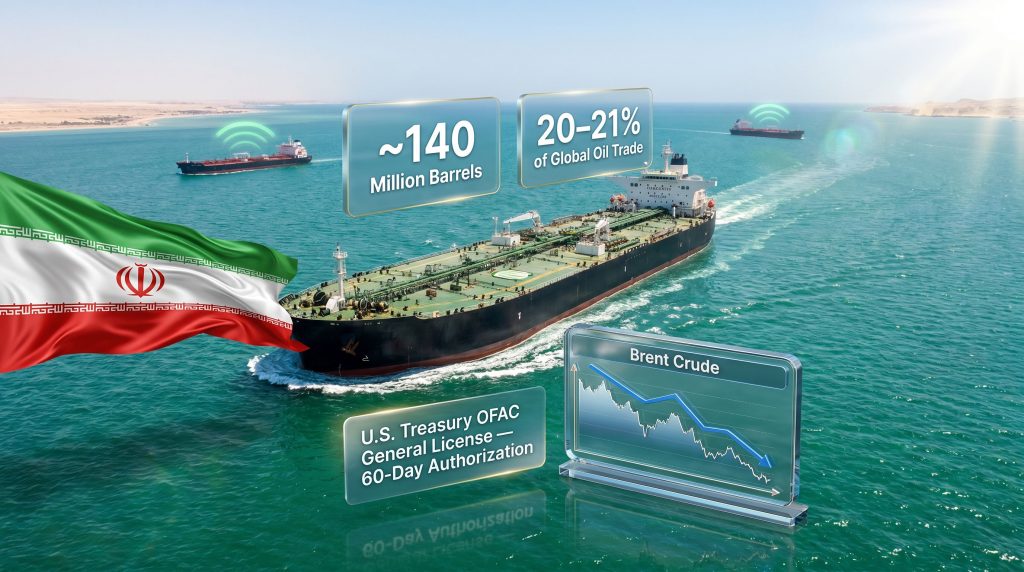
Sanctions Architecture in Motion: Understanding What a 60-Day Iranian Oil License Actually Does to Global Energy Markets
Global oil markets are rarely moved by single events in isolation. Instead, they respond to the architecture of policy frameworks, the credibility of diplomatic signals, and the structural design choices embedded within regulatory instruments. The U.S. Treasury authorizes Iranian oil sales under a 60-day general license, and this is best understood not as a news event but as a policy mechanism with layered implications for supply dynamics, geopolitical risk pricing, and OPEC+ cohesion. Unpacking how this instrument works, and what it signals, requires moving beyond headlines into the regulatory and market mechanics that actually drive outcomes.
When big ASX news breaks, our subscribers know first
How a General License Differs From a Sanctions Waiver
Many observers conflate general licenses with broader sanctions relief, but the distinction is operationally significant. A U.S. Treasury general license, issued by the Office of Foreign Assets Control (OFAC), creates a scoped, temporary authorisation for a defined category of transactions that would otherwise violate U.S. sanctions law. It does not suspend the underlying sanctions regime, alter the legal status of designated Iranian entities, or create any entitlement to ongoing access.
The instrument issued in June 2026, described by U.S. Treasury Secretary Scott Bessent as a 60-day general license, authorises the production, delivery, and sale of Iranian oil within a defined operational window. The structure of the authorisation carries three deliberate design features that market participants should understand clearly:
- Reversibility: The licence expires by design, with no automatic renewal pathway, preserving the full sanctions architecture as a negotiating instrument
- Scope limitation: Coverage extends to oil already in transit, not new production commitments or forward purchase agreements
- Leverage preservation: Iran's broader production capacity and its designated financial channels remain fully sanctioned, maintaining structural pressure on Tehran
The "in-transit only" scope is a sophisticated policy choice, not a limitation born of oversight. It allows Washington to demonstrate diplomatic goodwill without creating entrenched supply dependencies that would complicate future sanctions reimposition if talks collapse.
Furthermore, understanding the sanctions on oil trading framework helps contextualise why these design features matter so significantly for global energy markets.
Transactions permitted under the licence:
- Production, delivery, and sale of Iranian-origin crude oil and petroleum products already loaded on vessels
- Maritime services including vessel insurance, docking, and salvage operations related to in-transit cargoes
- Transit logistics for oil departing Iranian ports within the licence window
Transactions explicitly excluded:
- New purchase agreements for Iranian crude not yet loaded
- Long-term supply contracts or forward delivery structures
- Engagement with sanctioned Iranian financial or energy entities outside the defined scope
The Diplomatic Framework Behind the Authorisation
Switzerland Talks and What Progress Actually Means
The temporary oil authorisation did not emerge in isolation. It followed diplomatic engagement conducted through intermediary channels in Switzerland over the weekend of June 21–22, 2026. U.S. Vice President JD Vance characterised the outcome as representing substantial forward movement in the negotiating process, while Bessent's announcement confirmed the licence as a direct output of that framework.
Critically, the commitments exchanged during this process were reciprocal and specific, not merely rhetorical. Understanding the architecture of those mutual concessions matters for assessing whether this represents durable progress or a fragile confidence-building measure.
| Commitment | Party Responsible |
|---|---|
| Granting access to IAEA weapons inspectors | Iran |
| Commitment to free and open Strait of Hormuz transit | Iran |
| Issuance of 60-day general licence for oil sales | United States |
| Lifting of U.S. Navy blockade of Iranian ports and coastal areas | United States |
The U.S. Navy had imposed a blockade on Iranian ports and coastal areas during the preceding conflict period. That blockade was lifted on Thursday, June 19, 2026, prior to the licence announcement. In parallel, Iranian supertankers that had disabled their Automatic Identification System (AIS) transponders during the conflict period began reactivating those tracking systems as they departed the region carrying oil cargoes.
The AIS Transponder Signal: What Dark Tankers Tell Markets
The practice of Iranian vessels going AIS-dark is not incidental. Supertankers disable transponders to obscure their movements from sanctions enforcement authorities, satellite tracking services, and commodity intelligence firms. The mass reactivation of these systems following the licence announcement is a behaviourally significant market signal for several reasons:
- It confirms that Iranian operators anticipate regulatory cover for their movements within the licence window
- It restores supply visibility for commodity traders and tanker market participants who rely on vessel tracking data
- It creates a temporary window during which Iranian cargo volumes and destination patterns become observable, providing rare data on actual export flows that are normally obscured
For tanker market participants, the normalisation of Iranian supertanker activity has direct implications for Very Large Crude Carrier (VLCC) rate dynamics, since Iranian shadow fleet vessels re-entering transparent market activity can affect available capacity and spot rate formation. According to reporting from Shipping Telegraph, the authorisation specifically targets oil stranded in tankers, reinforcing the in-transit scope of the licence.
Quantifying the Supply Impact: 140 Million Barrels in Context
What 140 Million Barrels Actually Represents
Estimates tied to the current authorisation suggest approximately 140 million barrels of Iranian-origin crude and petroleum products could reach global markets under the licence. Understanding what that volume actually means requires placing it against global demand and production benchmarks.
| Metric | Estimated Figure |
|---|---|
| Estimated barrels released under licence | ~140 million barrels |
| Licence duration | 60 days |
| Global daily oil consumption (2026 estimate) | ~102–103 million barrels/day |
| Implied supply equivalent | ~1.3–1.4 days of global demand |
| New Iranian production authorised | None |
On a purely volumetric basis, 140 million barrels spread across a 60-day window represents a relatively modest supply addition, equivalent to roughly 2.3 million barrels per day of incremental flow. This is meaningful but not structurally disruptive to global balances in isolation. However, oil price movements in the near term will likely reflect the psychological signal of the licence as much as the physical volumes themselves.
Analyst perspective: The psychological impact of sanctions relief signals often moves markets more forcefully than the underlying physical volumes justify. Risk premium compression in energy futures can occur rapidly when geopolitical uncertainty diminishes, sometimes overreacting to the signal before the physical supply change registers in inventory data.
The Shadow Inventory Problem
One dimension that receives insufficient attention in mainstream coverage is the existence of what analysts sometimes call Iranian shadow inventory: crude stored aboard anchored or slowly drifting supertankers in the Persian Gulf and adjacent waters, maintained as floating storage precisely because land-based delivery was blocked or commercially risky. When AIS transponders reactivate and vessels begin moving toward discharge ports, the release of this shadow inventory can create a front-loaded supply pulse that temporarily exceeds the steady-state rate implied by the 60-day licence window.
This dynamic is particularly relevant for buyers in China, which has been Iran's primary informal export destination throughout the sanctions period. Chinese independent refiners, known within the industry as teapot refineries, have developed sophisticated procurement channels for discounted Iranian crude. The normalisation of Iranian export logistics may shift some of those volumes from informal discount channels toward more transparent pricing, potentially compressing the crude discount that Iranian barrels have historically traded at relative to Brent benchmarks.
Iranian Oil in the Global Supply Architecture
Iran's Structural Position Within OPEC+
Iran holds the world's fourth-largest proven crude oil reserves, estimated at approximately 208 billion barrels, and has been an OPEC founding member since the organisation's establishment in 1960. Despite sustained sanctions pressure, Iran has maintained residual production capacity through domestic demand fulfilment, informal export channels, and selective engagement with sanctions-tolerant buyers.
Iran's oil sector snapshot (2025–2026):
| Indicator | Estimated Figure |
|---|---|
| Proven crude oil reserves | ~208 billion barrels |
| Pre-sanctions peak production capacity | ~3.8 mb/d |
| Estimated production under active sanctions | ~3.0–3.3 mb/d |
| Primary informal export destination | China |
| OPEC membership | Active founding member |
The quality profile of Iranian crude is also relevant for buyers and refiners assessing market impact. Iran produces a range of crude grades, including Iranian Heavy (approximately 31–32 degrees API, with sulphur content around 1.7%) and Iranian Light (approximately 33–34 degrees API, lower sulphur). These medium-sour grades compete directly with comparable Saudi and Iraqi benchmark crudes, making the pricing discount at which Iranian barrels trade a direct factor in regional crude market dynamics.
OPEC+ Tension: The Accommodation Problem
Any sustained expansion of Iranian oil exports beyond the current in-transit authorisation would introduce structural tension within the OPEC+ production management framework. OPEC's market influence remains considerable, and the alliance's current architecture was calibrated without meaningful Iranian export volumes. Reintegrating a producer with 3.0–3.8 mb/d of capacity into transparent market flows creates a genuine dilemma for the group's largest producers:
- Accommodate and cut: Saudi Arabia and the UAE absorb Iranian volumes by reducing their own quota allocations, defending price targets at the cost of market share
- Defend share and accept lower prices: OPEC+ maintains current production levels, allowing the market to price in Iranian supply addition through lower benchmark values
- Renegotiate quota frameworks: A formal restructuring of OPEC+ production agreements to incorporate Iranian growth, a politically complex process that would require consensus across a 20-plus member coalition
None of these pathways is frictionless. Saudi Arabia in particular has demonstrated a preference for price stability over market share defence in recent OPEC+ cycles, but absorbing Iranian volumes through production cuts has a practical ceiling that constrains Riyadh's flexibility.
The Strait of Hormuz: Why Closure Threats Move Markets Even When They Don't Close
Information Asymmetry and the Risk Premium Effect
The Strait of Hormuz is a maritime passage approximately 33 kilometres wide at its narrowest navigable point, connecting the Persian Gulf to the Gulf of Oman and ultimately to global seaborne oil markets. An estimated 20–21% of global seaborne oil trade transits this corridor daily, including the majority of crude exports from Saudi Arabia, Iraq, Kuwait, the UAE, and Iran itself.
During the conflict period preceding the licence announcement, Iran declared that the Strait had been closed, a claim that U.S. Central Command publicly contradicted. This episode illustrates a critical dynamic in energy market psychology: threatened disruption to the Strait generates measurable risk premium even when the physical closure does not materialise. The mere credibility of the threat is sufficient to move futures markets because traders must price the expected value of a tail-risk scenario, not just its certainty.
Iran's commitment to free and open Hormuz transit, as confirmed by Bessent as part of the diplomatic framework, directly targets this risk premium mechanism. When that commitment is made credibly, futures markets can release embedded geopolitical premiums, contributing to downward pressure on Brent and WTI benchmarks. Consequently, these geopolitical oil price factors are independent of any physical supply change and operate purely through market psychology.
The next major ASX story will hit our subscribers first
Secondary Sanctions and Global Buyer Compliance
The Extraterritorial Reach of U.S. Sanctions Law
A dimension frequently underappreciated by non-specialist observers is that U.S. Iranian oil sanctions operate through both primary and secondary enforcement channels. Primary sanctions apply directly to U.S. persons and entities. Secondary sanctions, however, extend U.S. enforcement jurisdiction to foreign companies, banks, shipping operators, and governments that transact with sanctioned Iranian entities, even where those transactions involve no U.S. person or U.S. dollar clearing.
This extraterritorial architecture has historically deterred European, Japanese, South Korean, and even some Chinese buyers from engaging with Iranian crude despite their domestic legal frameworks permitting such trade. The legal instruments underpinning this framework include:
| Instrument | Function |
|---|---|
| IEEPA Executive Orders | Presidential authority to impose, modify, or terminate sanctions |
| OFAC General Licences | Temporary, scoped authorisations for otherwise-prohibited transactions |
| CISADA Secondary Sanctions | Penalise foreign entities transacting with sanctioned Iranian counterparties |
| IAEA Safeguards Agreements | Nuclear verification framework linked to phased sanctions relief |
The issuance of a general licence reduces the primary sanctions exposure for transactions within its defined scope but does not eliminate residual compliance risk for non-U.S. buyers. The Atlantic Council has noted that sanctions waivers on both Russian and Iranian oil carry significant expiry risks that markets must price carefully. Legal advisors with OFAC compliance expertise consistently recommend independent review of any transaction structure involving Iranian-origin petroleum products, even under an active general licence.
Market Indicators to Monitor During the 60-Day Window
Short-Term vs. Medium-Term Price Dynamics
In addition to the supply-side mechanics, it is important to consider how oil market trade risks interact with the diplomatic framework, particularly if broader geopolitical tensions resurface during the licence window.
Short-term (0–60 days):
- Modest downward pressure on Brent and WTI spot benchmarks as in-transit volumes reach discharge ports
- Compression of geopolitical risk premium in energy futures as Hormuz closure fears diminish
- Normalisation of Iranian crude discount relative to comparable medium-sour grades as export channels regularise
- VLCC tanker rate movements as Iranian shadow fleet vessels re-enter transparent market activity
Medium-term (60 days to 12 months):
- Outcome entirely contingent on whether diplomatic progress translates into a formal nuclear framework
- Potential for expanded OFAC authorisation if talks advance, introducing structurally larger Iranian production volumes
- Risk of full sanctions reimposition if negotiations collapse within the window, creating renewed supply uncertainty and risk premium rebuild
- OPEC+ response dynamics as the alliance assesses whether Iranian reintegration requires quota renegotiation
Disclaimer: The projections and scenario analysis presented in this section involve forward-looking assumptions about geopolitical developments, diplomatic outcomes, and commodity market behaviour. These represent analytical frameworks, not investment recommendations. Readers should conduct independent research and seek professional financial advice before making investment decisions related to energy markets or equities with oil price exposure.
Frequently Asked Questions
Does the 60-Day General Licence Mean U.S.-Iran Nuclear Negotiations Have Concluded?
No. The licence is explicitly a confidence-building measure within an ongoing diplomatic framework. It reflects forward movement in the negotiating process but is not evidence of a concluded nuclear agreement or comprehensive sanctions removal. The U.S. Treasury authorizes Iranian oil sales under a 60-day general license precisely because a more permanent framework has not yet been finalised.
Why Does the "In-Transit Only" Scope Matter for Global Supply Calculations?
Because it limits the authorisation to crude already loaded on vessels, it prevents new production from being contracted under the licence window. This caps the immediate supply addition at volumes already physically in the pipeline, preserving the full sanctions architecture against Iran's forward production capacity.
How Does This Affect Asian Buyers of Iranian Crude?
Chinese independent refiners that have been purchasing Iranian crude through informal discount channels may find that some of those volumes shift toward more transparent pricing structures as logistics normalise. This could compress the discount at which Iranian crude trades relative to Brent benchmarks, affecting refiner margins for buyers accustomed to discounted feedstock costs.
What Happens If the Diplomatic Framework Collapses Before the 60-Day Window Closes?
The general licence can be revoked by OFAC before its expiration date. A breakdown in talks would likely trigger rapid sanctions reimposition, a reversal of risk premium compression in energy futures, and a return of Iranian supertankers to AIS-dark operational status.
Is the Strait of Hormuz Actually Open?
U.S. Central Command contradicted Iran's declaration that Hormuz had been closed during the conflict period. Iran's subsequent commitment to free and open transit, as part of the diplomatic framework, reinforces the operational status of the corridor. However, independent verification of physical passage conditions remains an ongoing monitoring requirement for maritime risk assessment.
Want to Stay Ahead of the Next Major Commodity Market Shift?
Discovery Alert's proprietary Discovery IQ model scans ASX announcements in real time, instantly identifying significant mineral discoveries across more than 30 commodities — from energy-linked plays to base and precious metals — so investors can act before the broader market catches on. Explore historic discovery returns on Discovery Alert's discoveries page and begin your 14-day free trial to secure a market-leading edge.