
August 14, 2026
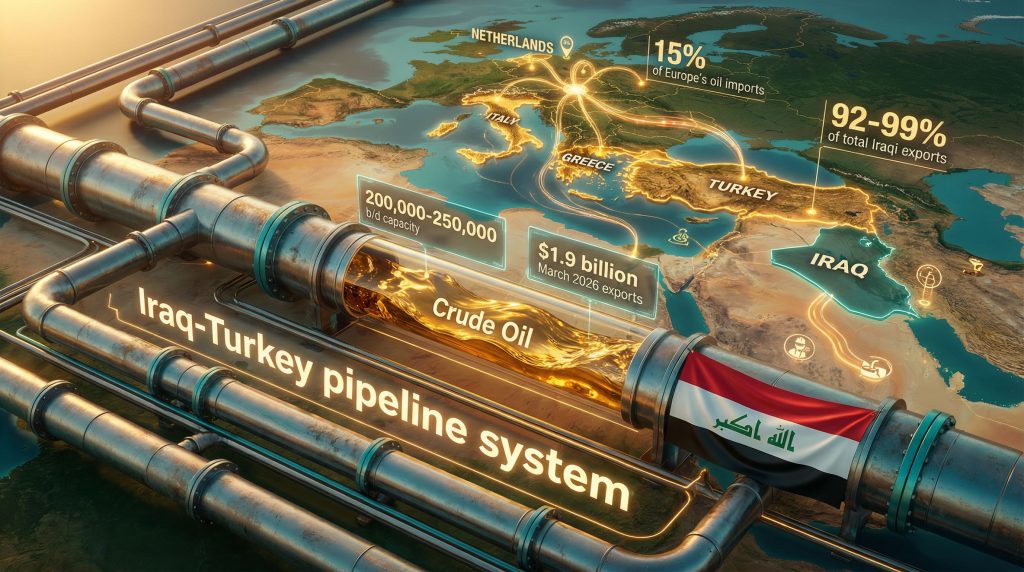
The complexities of global energy infrastructure have become increasingly apparent as geopolitical tensions strain traditional supply chains. Furthermore, the concentration of oil exports through limited pathways creates systemic vulnerabilities that impact regional economies far beyond the immediate producing areas. However, Iraq crude exports to Europe represent a critical component of European energy security, demonstrating how alternative routing strategies can mitigate supply risks during periods of uncertainty.
Understanding Critical Export Infrastructure Dependencies
Modern oil export systems concentrate enormous volumes through limited pathways, creating inherent vulnerabilities that become apparent during crisis periods. The global petroleum trade moves approximately 100 million barrels daily, with significant portions flowing through just a handful of strategic corridors. Consequently, this concentration amplifies the impact when any single route experiences disruption.
Table: Global Oil Chokepoint Vulnerabilities
| Chokepoint | Daily Volume (mb/d) | Regional Impact | Alternative Capacity |
|---|---|---|---|
| Strait of Hormuz | 20-21 | Global crude markets | Limited pipeline alternatives |
| Suez Canal/SUMED | 5-6 | Europe/Asia trade | Cape route bypass |
| Strait of Malacca | 15-16 | Asian imports | Lombok/Makassar alternatives |
| Danish Straits | 3-4 | Northern Europe | Overland pipeline systems |
Moreover, the mathematics of route dependency reveal why producers invest heavily in diversification strategies. A 20% reduction in primary export capacity typically requires 200-300% utilisation of secondary routes to maintain equivalent volumes, assuming those alternatives possess sufficient capacity.
When big ASX news breaks, our subscribers know first
Economic Pressures Behind Export Route Diversification
Countries heavily dependent on oil revenues face existential fiscal challenges when primary export routes become unavailable. Historical analysis reveals that petroleum exporters with over 80% revenue dependency on oil face severe economic disruption during extended supply interruptions lasting more than 30-45 days.
The revenue calculations demonstrate this vulnerability clearly. When export volumes decline by 70-80%, even 100% price increases only partially offset the revenue impact. Subsequently, this mathematical reality drives strategic infrastructure investments in alternative pathways, regardless of their higher per-barrel costs.
Key Economic Dependencies:
- Oil revenue share of total exports: 85-95% for major Gulf producers
- Fiscal breakeven oil prices: $60-80/barrel for most regional budgets
- Infrastructure utilisation: Primary routes typically operate at 70-85% capacity
- Alternative route costs: 150-300% premium over pipeline transport
Domestic consumption patterns further constrain available export volumes. Major oil producers typically consume 15-25% of total production domestically, reducing the surplus available for international sales. In addition, this internal demand creates additional pressure on export route efficiency, as smaller available volumes must generate sufficient revenue to maintain government operations.
Pipeline Infrastructure and Mediterranean Access Strategies
The Iraq-Turkey pipeline system exemplifies how secondary infrastructure can become strategically critical during primary route disruptions. This 400,000-550,000 barrel per day capacity system historically operated as a supplementary export channel. However, it demonstrates the value of maintaining redundant infrastructure investments, particularly for the oil price rally 2025.
Pipeline System Advantages:
- Direct Mediterranean access avoiding maritime chokepoints
- European distribution integration through Turkish terminals
- Operational flexibility allowing rapid volume adjustments
- Quality maintenance preventing crude contamination during transport
The technical specifications of pipeline systems create distinct advantages over alternative transport methods. Pipeline transport typically costs $2-4 per barrel compared to $8-15 per barrel for trucking over equivalent distances. Nevertheless, these cost differentials become secondary considerations during crisis periods when route availability matters more than transport economics.
European refineries demonstrate consistent preferences for reliable supply sources, even accepting 5-10% price premiums for delivery certainty during volatile periods. Therefore, this buyer behaviour creates economic incentives for producers to maintain multiple export pathways, as premium pricing can offset higher infrastructure costs.
European Energy Security and Supply Diversification
European oil import patterns reflect strategic diversification efforts designed to reduce dependency on any single supplier or transport route. The continent imports approximately 12-15 million barrels daily, with Middle Eastern sources comprising 30-40% of total volumes through various pathways. Furthermore, Iraqi oil exports continue to play a vital role in maintaining European energy security.
European Import Diversification:
- Russian crude: 25-30% (pre-2022 sanctions)
- Middle Eastern sources: 30-35% via multiple routes
- African suppliers: 20-25% Atlantic basin sources
- North American imports: 10-15% growing LTO volumes
The Netherlands, Italy, and Greece serve as primary European entry points for Middle Eastern crude, with specialised refinery configurations designed to process specific crude grades. These facilities demonstrate technical lock-in effects where switching between crude sources requires operational adjustments and yield optimisation changes.
Mediterranean refineries particularly value supply reliability due to their strategic location serving both European and regional markets. Additionally, the ability to maintain consistent crude flows enables these facilities to optimise production schedules and product yield patterns, creating mutual dependencies between suppliers and buyers.
European energy security calculations increasingly emphasise supply route diversity over pure cost optimisation. The willingness to accept premium pricing for reliable deliveries reflects lessons learned from previous supply disruptions and geopolitical tensions affecting energy imports.
Alternative Transport Networks and Logistics Innovation
Overland trucking operations represent the most flexible but cost-intensive alternative to pipeline systems for crude oil transport. A 50,000 barrel per day trucking capacity requires approximately 1,250-1,500 daily truck movements, highlighting the logistical complexity of scaling road-based oil transport.
Trucking Operation Requirements:
- Fleet capacity: 40-50 specialised crude tanker trucks per 1,000 b/d
- Driver logistics: 24/7 operations requiring 150-200 qualified operators
- Border coordination: Multi-jurisdiction regulatory compliance
- Storage infrastructure: Loading/unloading facilities at both endpoints
The economics of trucking crude oil involve significant cost premiums but provide operational advantages during crisis periods. Transport costs typically range $15-25 per barrel for distances exceeding 500 kilometres. Comparatively, this represents a substantial premium over $3-6 per barrel for equivalent pipeline transport.
Syrian and Jordanian route development illustrates how neighbouring countries can provide critical alternatives during regional disruptions. Historical precedents include the 15,000-20,000 barrel per day Iraq-Jordan agreements that provided modest but strategically important export alternatives during various crisis periods.
Regional cooperation frameworks enable shared infrastructure utilisation that benefits multiple countries. These arrangements typically involve complex commercial negotiations but create strategic redundancy valuable during supply emergencies, particularly relevant considering the trade war oil impact on global supply chains.
Geopolitical Risk Assessment and Infrastructure Planning
Historical analysis of energy infrastructure disruptions reveals patterns that inform long-term planning strategies. The 1967 Six-Day War closed the Suez Canal for eight years, forcing global shipping route adaptations. Similarly, the 1980-1988 Iran-Iraq War featured multiple pipeline attacks and tanker targeting that reduced regional export capacity by millions of barrels daily.
Risk Categories Affecting Export Infrastructure:
- Military conflicts targeting energy infrastructure
- Political instability disrupting cross-border agreements
- Technical failures requiring extended maintenance periods
- Weather events impacting maritime and overland transport
The 2019 attacks on Saudi Aramco facilities demonstrated how precision strikes can temporarily reduce global oil supply by 5-6 million barrels daily. Consequently, this emphasised the vulnerability of concentrated production infrastructure and its impact on global markets.
Energy companies and governments increasingly incorporate scenario planning that assumes primary route disruptions lasting 90-180 days. This drives investments in alternative capacity that may operate below optimal utilisation during normal periods, considering the US oil production impact on global supply dynamics.
Modern conflict patterns show increasing targeting of energy infrastructure as strategic objectives. The 2022-2023 attacks on Ukrainian power infrastructure and various Middle Eastern pipeline incidents illustrate how energy systems become military targets during conflicts.
The next major ASX story will hit our subscribers first
Market Dynamics Supporting Premium Crude Pricing
Oil pricing mechanisms respond rapidly to supply route reliability concerns, with quality premiums and security premiums becoming distinct pricing components during volatile periods. Buyers demonstrate willingness to pay $5-15 per barrel above benchmark prices for guaranteed delivery during supply uncertainty.
Premium Pricing Components:
- Quality specifications: API gravity and sulfur content matching refinery needs
- Delivery reliability: Consistent timing and volume commitments
- Route security: Lower probability of delivery interruption
- Geographic advantage: Reduced transport time and logistics complexity
Historical data indicates crude price premiums typically range 10-25% above benchmark levels during sustained supply disruptions affecting major producing regions. These premiums reflect both reduced supply availability and increased buyer competition for secure deliveries.
Market psychology during supply crises demonstrates how buyer behaviour shifts from cost optimisation to supply security. Refineries operating on thin margins accept higher input costs rather than risk supply interruptions that could force production cutbacks.
The relationship between crude quality and refinery optimisation creates additional pricing dynamics. Specific crude grades that match refinery configurations command premiums beyond pure supply-demand fundamentals, particularly when alternative grades require operational adjustments.
Regional Pipeline Networks and Cooperative Frameworks
Gulf Cooperation Council pipeline integration projects represent long-term infrastructure strategies designed to provide mutual support during individual country supply disruptions. The proposed 1.8 million barrel per day Abu Dhabi-Fujairah pipeline exemplifies bypass route development avoiding traditional chokepoints.
Regional Integration Benefits:
- Shared infrastructure costs reducing individual country investment requirements
- Operational redundancy enabling mutual assistance during emergencies
- Technical standardisation facilitating cross-border crude flows
- Political stability through enhanced economic interdependence
The East-West Pipeline in Saudi Arabia provides 5 million barrel per day capacity connecting eastern production centres with Red Sea export terminals. This demonstrates the scale of investment required for meaningful alternative capacity, particularly relevant for understanding OPEC meeting insights and production coordination strategies.
International pipeline projects face complex commercial negotiations involving revenue sharing, operational control, and maintenance responsibilities. For instance, the Baku-Tbilisi-Ceyhan pipeline required eight years of negotiations and $4 billion investment before achieving operational status.
Cross-border infrastructure requires political stability and sustained cooperation between participating countries. Historical examples show how political tensions can disrupt pipeline operations, emphasising the importance of robust legal frameworks and dispute resolution mechanisms.
Investment Implications and Strategic Planning
Energy infrastructure investments increasingly emphasise resilience over efficiency, reflecting lessons learned from supply disruption events. The traditional focus on lowest-cost transport solutions has shifted toward diversified pathway strategies that may accept higher operational costs for reduced systemic risk.
Investment Priority Evolution:
- Primary route optimisation: Traditional focus on cost minimisation
- Secondary route development: Redundancy capacity for crisis scenarios
- Storage expansion: Strategic reserves enabling supply flexibility
- Technology integration: Monitoring and rapid response capabilities
The financial mathematics of redundant infrastructure investments show positive returns when disruption probability exceeds certain thresholds. Analysis indicates that alternative route investments provide positive net present value when primary routes face greater than 15-20% annual disruption probability.
Private sector energy companies increasingly factor geopolitical risk premiums into project economics. Infrastructure investments in stable regions command 20-40% lower required returns compared to politically volatile areas.
Government strategic petroleum reserves programmes reflect similar risk management thinking. Countries maintain 30-180 day import equivalent storage capacity to buffer supply interruptions while alternative sources are secured. This approach aligns with broader oil price stagnation analysis trends affecting global markets.
Iraq Crude Exports to Europe: Strategic Implications
Iraq crude exports to Europe continue to evolve as geopolitical pressures reshape traditional supply chains. The development of alternative routing strategies reflects broader energy security considerations that extend beyond immediate economic calculations.
Regional stability factors increasingly influence Iraq crude exports to Europe, with buyers prioritising supply chain reliability over pure cost optimisation. These market dynamics create opportunities for producers who can demonstrate consistent delivery capabilities through diversified export infrastructure.
Finally, Iraq crude exports to Europe represent a critical case study in how energy exporters adapt to changing geopolitical realities whilst maintaining essential revenue streams. The evolution of these trade relationships demonstrates the strategic importance of infrastructure flexibility in maintaining global energy security.
Furthermore, the ongoing development of European crude import data continues to reflect these changing dynamics in international energy markets.
Ready to Capitalise on Emerging Energy Market Opportunities?
Discovery Alert's proprietary Discovery IQ model delivers instant notifications on significant ASX mineral discoveries, helping subscribers identify actionable opportunities in critical resources including energy minerals and rare earths. Stay ahead of global supply chain shifts by accessing Discovery Alert's proven track record of identifying transformative mineral discoveries, then begin your 14-day free trial today to secure your market advantage.