
July 17, 2026
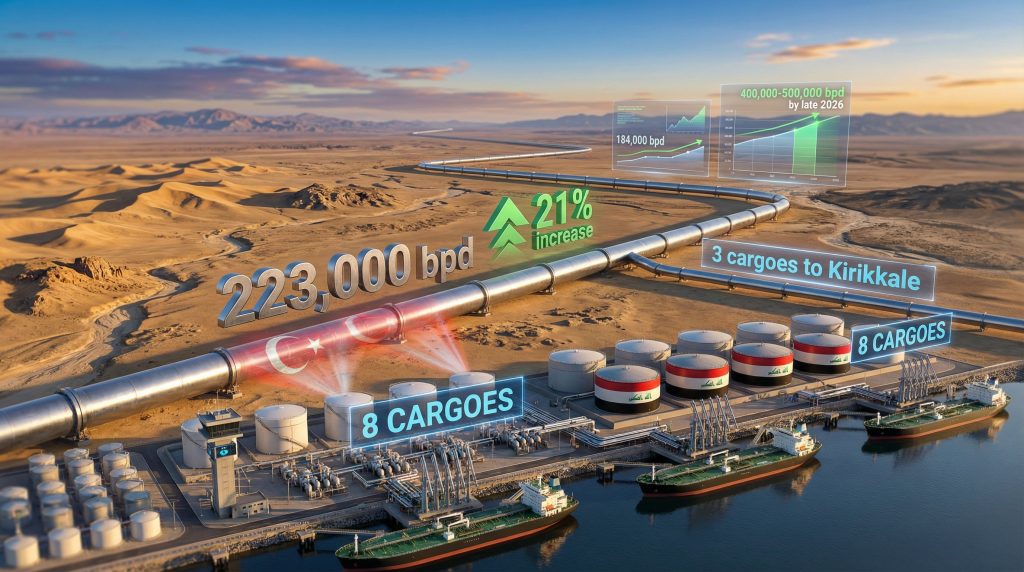
Iraq's ambitious expansion plans unfold as the nation prepares to significantly boost its northern crude oil export capacity through the Kirkuk-Ceyhan pipeline. This strategic initiative demonstrates how Middle Eastern producers adapt to evolving market conditions while addressing infrastructure challenges. Furthermore, the oil price rally context creates favourable conditions for Iraq to maximise revenue from increased export volumes.
Strategic Infrastructure Recovery Transforms Regional Oil Distribution Networks
Iraq to export more Kirkuk crude oil represents a fundamental shift in Middle Eastern energy logistics. The country plans to boost February 2026 exports to 223,000 barrels per day (bpd), marking a substantial 21% increase from January's 184,000 bpd baseline. This expansion demonstrates Iraq's commitment to maximising northern pipeline utilisation following extensive operational recovery efforts.
The February loading programme reveals sophisticated distribution strategies designed to serve multiple market segments simultaneously. Eight cargoes will flow through Turkey's Ceyhan terminal for international spot market distribution, while three additional shipments utilise the Kirikkale pipeline route directly to Turkish refiner Tupras for bilateral processing arrangements.
Export Volume Progression:
- January 2026: 184,000 bpd
- February 2026: 223,000 bpd (21% monthly increase)
- Additional capacity: 39,000 bpd
- Long-term target: 400,000-500,000 bpd by late 2026
Northern Pipeline Infrastructure Optimisation
The Kirkuk-Ceyhan pipeline resumption after a two-and-a-half-year suspension showcases Iraq's successful infrastructure recovery capabilities. Initial restart operations in late September 2025 demonstrated throughput capacity of approximately 150,000-160,000 bpd, with subsequent optimisation reaching current February levels exceeding 220,000 bpd.
This operational performance indicates significant room for additional expansion without major capital infrastructure investments. The pipeline's technical specifications support substantially higher volumes, suggesting that political agreements rather than mechanical constraints represent the primary limitation for future growth.
When big ASX news breaks, our subscribers know first
Historical Context Behind Extended Pipeline Suspension
The prolonged pipeline closure from mid-2023 through September 2025 created substantial challenges for Iraq's northern oil distribution capabilities. During this extended period, Kirkuk crude production faced limited export alternatives, forcing increased dependency on southern terminal infrastructure and creating potential bottlenecks in Iraq's overall export capacity.
Suspension Impact Analysis:
- Duration: Two-and-a-half years (mid-2023 to September 2025)
- Lost capacity: Approximately 180,000-220,000 bpd based on current volumes
- Revenue implications: Reduced pricing flexibility and market access
- Infrastructure stress: Over-reliance on southern export terminals
The suspension period forced Iraqi crude marketers to develop alternative distribution strategies, including increased utilisation of Basra-area terminals and adjusted shipping logistics. These adaptations, while functional, lacked the geographic diversification benefits provided by northern pipeline access to Mediterranean markets.
Complex Diplomatic Resolution Requirements
The pipeline's successful restart required extensive multi-party negotiations involving federal Iraqi authorities, Kurdish regional government representatives, and Turkish transit partners. These diplomatic coordination efforts addressed competing territorial interests, revenue-sharing arrangements, and technical operational standards necessary for sustained pipeline operation.
The resolution process demonstrates Iraq's capacity to navigate complex regional political dynamics whilst maintaining focus on economic optimisation objectives. This diplomatic success provides confidence for addressing future infrastructure challenges and contract renewals.
Market Supply Dynamics and Global Oil Price Implications
Iraq to export more Kirkuk crude oil represents a strategic addition to global supply flexibility during periods of heightened geopolitical uncertainty. The 39,000 bpd increase provides market participants with enhanced supply security, though the absolute volume represents a modest percentage of global crude production exceeding 100 million bpd. However, the OPEC production impact on global markets makes even modest increases strategically significant.
Global Market Context:
| Factor | Current Impact | Strategic Significance |
|---|---|---|
| Additional Supply | 39,000 bpd | Enhanced route diversification |
| Global Percentage | ~0.04% of total production | Marginal volume, important flexibility |
| Market Positioning | Mediterranean access | European refinery optionality |
| Risk Mitigation | Reduced single-point failure | Improved supply chain resilience |
The increased Kirkuk exports provide particular value to European and Mediterranean refineries seeking supply diversification. Ceyhan terminal access offers competitive shipping logistics to key consuming regions, potentially influencing regional pricing benchmarks more significantly than global crude averages. Moreover, the oil price trade war dynamics make geographical supply diversification increasingly valuable for market stability.
Supply Route Diversification Benefits
Iraq's dual-outlet strategy through both Ceyhan terminal and Kirikkale pipeline arrangements demonstrates sophisticated market positioning. The 8-cargo international distribution component serves spot market flexibility requirements, while the 3-cargo Tupras bilateral arrangement ensures stable, contracted offtake agreements.
This distribution pattern suggests approximately 73% exposure to international spot markets and 27% coverage through long-term bilateral contracts. This balance provides Iraq with pricing optimisation opportunities whilst maintaining secure demand relationships with established refinery partners.
Technical Logistics and Operational Capabilities
The February 2026 export schedule demonstrates remarkable operational coordination across multiple distribution channels. Iraq to export more Kirkuk crude oil through this dual-pathway approach maximises infrastructure utilisation whilst serving distinct market segments with specialised requirements.
Operational Performance Metrics:
- Pipeline restart date: Late September 2025
- Initial capacity: 150,000-160,000 bpd
- Current optimisation: 223,000 bpd February levels
- Capacity expansion: ~73,000 bpd improvement since restart
The transition from initial restart volumes to current February levels demonstrates successful operational ramp-up without major mechanical interventions. This performance indicates the pipeline infrastructure possesses sufficient technical capacity to support continued volume increases through operational optimisation rather than capital expansion.
Dual-Route Market Integration
Ceyhan Terminal Operations:
The eight international cargoes scheduled through Ceyhan provide access to Mediterranean and European spot markets, offering Iraq pricing flexibility based on regional demand conditions. According to recent market analysis, Ceyhan's strategic location enables efficient shipping logistics to multiple consuming regions.
Kirikkale Pipeline Arrangement:
Direct delivery to Tupras through the Kirikkale pipeline establishes stable bilateral processing relationships independent of spot market volatility. This arrangement provides Iraq with predictable offtake agreements whilst supplying Tupras with consistent crude feed requirements.
Infrastructure Agreement Challenges and Contract Negotiations
Critical timeline considerations emerge from Turkey's announcement regarding existing pipeline agreement expiration in July 2026. This creates approximately six months for successful renegotiation of transit terms, revenue-sharing arrangements, and operational protocols necessary for continued pipeline utilisation.
Contract Timeline Analysis:
- Current agreement expiration: July 2026
- Negotiation window: ~6 months from January 2026
- Operational risk: Potential service interruption without renewal
- Alternative routes: Limited northern export alternatives available
The Turkish position regarding transit agreement renewal introduces leverage dynamics that could influence future revenue-sharing terms. Turkey's control over the primary northern export route creates asymmetric negotiating power that may affect Iraq's export economics and operational flexibility.
Contingency Planning Requirements
Iraq's successful February export increase demonstrates current operational capabilities, but sustained growth depends on resolving July 2026 contract expiration challenges. Without successful renegotiation, the 223,000 bpd February volumes cannot be maintained through the northern pipeline route.
Risk Mitigation Scenarios:
- Successful renewal: Maintains current export flexibility and growth trajectory
- Renegotiation challenges: Potential temporary service disruptions
- Alternative arrangements: Limited northern route options require southern infrastructure dependency
Strategic Energy Portfolio Integration
Iraq to export more Kirkuk crude oil aligns with broader national energy strategies emphasising production optimisation and revenue maximisation across multiple field developments. The northern pipeline recovery provides enhanced flexibility for upstream investment planning and field development prioritisation. This complements the broader regional context where Saudi exploration licenses are reshaping Middle Eastern energy dynamics.
Strategic Integration Objectives:
- Revenue optimisation: Enhanced pricing flexibility through multiple export routes
- Infrastructure resilience: Reduced dependency on single distribution channels
- Market diversification: Expanded access to European and Mediterranean consumers
- Investment attraction: Demonstrated infrastructure reliability for international partners
The Kirkuk export expansion creates positive investment signals for international energy companies evaluating Iraqi market opportunities. Proven ability to restart complex infrastructure and resolve multi-party disputes enhances Iraq's competitive positioning for attracting upstream development partnerships.
Production Capacity Coordination
Northern pipeline recovery enables better coordination between field production optimisation and export logistics planning. Enhanced export capacity provides upstream operators with greater confidence in production investment decisions, knowing that increased output can reach international markets efficiently.
The integration of Kirkuk exports with Iraq's broader production portfolio demonstrates the country's evolving approach to energy infrastructure management. Rather than treating individual fields or pipelines as isolated assets, Iraq increasingly emphasises coordinated development strategies that maximise overall system efficiency.
The next major ASX story will hit our subscribers first
Investment Climate and Capital Allocation Considerations
The successful Kirkuk pipeline restart and subsequent volume increases create important precedents for international energy investors evaluating Iraqi market exposure. Demonstrated operational reliability and diplomatic coordination capabilities address key investor concerns about infrastructure sustainability and political risk management.
Investment Attractiveness Factors:
- Operational reliability: Proven capacity to restart complex infrastructure
- Diplomatic coordination: Successful multi-party agreement resolution
- Growth potential: Clear pathway to substantial volume increases
- Market access: Diverse export route portfolio development
Iraq's ability to optimise export infrastructure whilst managing complex regional relationships enhances its competitive position for attracting international energy partnerships. The country's demonstrated commitment to infrastructure development provides confidence for long-term capital allocation decisions.
Regional Energy Investment Context
Iraq to export more Kirkuk crude oil occurs within a broader Middle Eastern energy investment environment characterised by significant capital flows into production capacity enhancement and infrastructure modernisation. Regional producers increasingly compete for international partnerships through demonstrated operational excellence and market access capabilities. Furthermore, the tariff market impact on energy investments creates additional complexity for regional decision-making.
The Kirkuk export expansion positions Iraq favourably within this competitive landscape by showcasing both technical capabilities and diplomatic effectiveness. International energy companies evaluating regional opportunities increasingly prioritise partners with proven track records of infrastructure optimisation and stakeholder coordination.
Market Psychology and Investor Sentiment Analysis
The timing of Iraq's export expansion coincides with global energy markets experiencing heightened volatility due to geopolitical tensions and supply chain uncertainties. Investors increasingly value supply diversity and infrastructure resilience over simple volume maximisation, making Iraq's dual-route strategy particularly attractive.
Investor Priority Considerations:
- Supply security: Multiple export pathways reduce single-point failure risks
- Operational flexibility: Ability to serve different market segments simultaneously
- Political stability: Demonstrated capacity to resolve complex disputes
- Growth scalability: Clear technical pathway for volume expansion
Market participants recognise that Iraq to export more Kirkuk crude oil provides strategic value beyond absolute volume increases. The enhanced export route diversity offers protection against potential disruptions whilst creating opportunities for optimised market positioning based on regional demand dynamics.
Risk-Adjusted Return Frameworks
Energy investors increasingly employ sophisticated risk-adjusted return models that weight infrastructure reliability and political coordination capabilities alongside traditional production metrics. Iraq's successful pipeline restart and volume optimisation demonstrate competencies that align with these evolving investment criteria.
The country's ability to navigate complex stakeholder relationships whilst maintaining operational focus creates confidence in its capacity to manage future challenges and opportunities. This reputation for effective problem-solving enhances Iraq's ability to attract capital for additional infrastructure development and field expansion projects.
Future Capacity Projections and Development Pathways
Iraq's commitment to reaching 400,000-500,000 bpd through the northern pipeline by late 2026 represents ambitious but technically achievable growth targets. Current operational performance suggests the infrastructure can support these volumes provided that diplomatic agreements facilitate continued expansion.
Growth Trajectory Analysis:
- Current baseline: 223,000 bpd (February 2026)
- Target capacity: 400,000-500,000 bpd (late 2026)
- Required increase: ~180,000-280,000 bpd additional capacity
- Technical feasibility: Pipeline infrastructure capable of supporting targets
The progression from 150,000 bpd initial restart volumes to 223,000 bpd February levels demonstrates Iraq's operational optimisation capabilities. This 73,000 bpd improvement within approximately five months suggests that achieving 400,000+ bpd targets remains within realistic implementation timelines.
Infrastructure Scalability Assessment
Pipeline engineering specifications and pump station configurations indicate substantial additional throughput capacity beyond current utilisation levels. The primary constraints for achieving higher volumes involve operational optimisation, loading terminal coordination, and market demand rather than fundamental infrastructure limitations.
Iraq to export more Kirkuk crude oil through systematic capacity increases provides a sustainable pathway for revenue growth without requiring major capital infrastructure investments. This approach aligns with Iraq's broader strategy of maximising returns from existing assets whilst building foundation for future expansion opportunities. According to industry reports, the strategic importance of pipeline infrastructure continues to drive regional negotiations.
Long-term Strategic Implications and Market Positioning
The Kirkuk export expansion establishes Iraq as a more reliable and flexible crude oil supplier within global energy markets. Enhanced infrastructure reliability and operational competence create competitive advantages that extend beyond current volume increases to influence long-term market positioning.
Strategic Market Position:
- Supply reliability: Proven infrastructure recovery and optimisation capabilities
- Export flexibility: Multiple route options for different market segments
- Growth capacity: Clear pathway for substantial volume increases
- Political coordination: Demonstrated ability to resolve complex stakeholder challenges
Iraq's success with northern pipeline recovery provides a model for addressing similar infrastructure challenges across the broader oil production portfolio. The operational and diplomatic competencies developed through this project create transferable capabilities for managing future development initiatives.
Important Considerations:
The success of Iraq's export expansion depends on continued diplomatic coordination with transit partners and sustained operational optimisation. Whilst technical capabilities support ambitious growth targets, political agreements and market conditions will ultimately determine achievement of projected capacity levels.
This analysis is based on publicly available information and market observations as of January 2026. Energy markets involve inherent uncertainties, and actual developments may differ from current projections due to political, technical, or market factors beyond the scope of this assessment.
Ready to Capitalise on Global Energy Market Opportunities?
Discovery Alert's proprietary Discovery IQ model delivers real-time alerts on significant ASX mineral discoveries, including energy and commodities sectors that directly benefit from global supply dynamics like Iraq's pipeline developments. Explore how major mineral discoveries can generate substantial returns by visiting Discovery Alert's dedicated discoveries page, then begin your 30-day free trial today to position yourself ahead of the market.