August 23, 2026
The Mathematical Reality of Iraq's Chokepoint Crisis
Strategic vulnerability often manifests through seemingly abstract infrastructure dependencies until crisis transforms theoretical risk into operational paralysis. Iraq's position within global energy networks exemplifies this phenomenon, where geographic positioning creates mathematical constraints that transcend political maneuvering or diplomatic solutions. The Iraq oil export crisis through Hormuz represents a critical junction where geopolitical tensions intersect with economic realities.
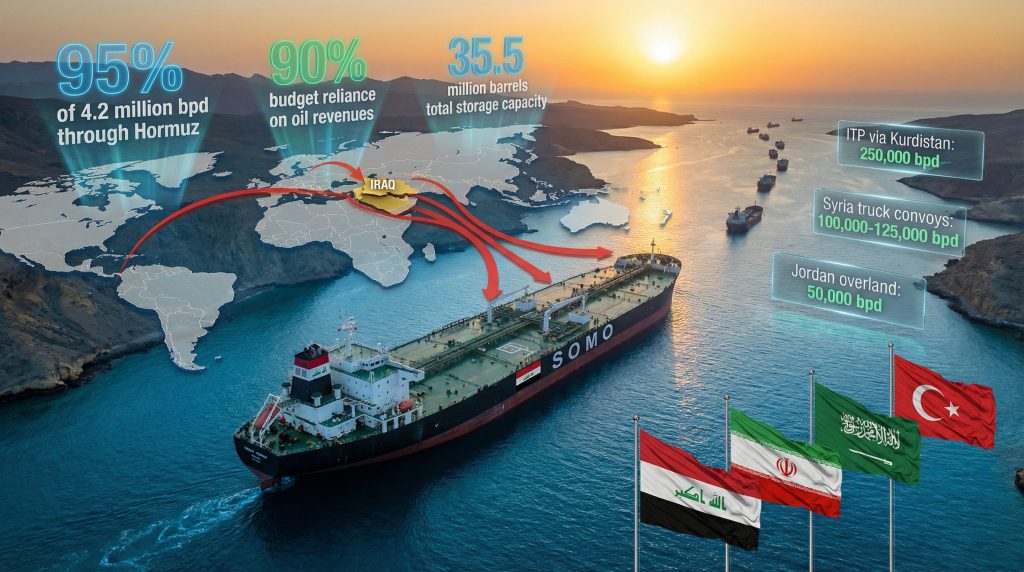
Unlike diversified Gulf producers maintaining multiple export pathways and substantial sovereign reserves, Iraq operates within a uniquely constrained framework where 95% of oil exports must transit the Strait of Hormuz before monetisation occurs. This dependency extends beyond mere logistics into fundamental fiscal architecture, with over 90% of Iraq's annual budget deriving from petroleum revenues according to recent energy sector analysis.
The stark mathematical reality emerges when examining Iraq's current production capacity of 4.2 million barrels per day against available storage infrastructure totalling 35.5 million barrels across Basra terminals, field facilities, and floating storage. Under reduced production scenarios, this creates a storage saturation timeline of approximately 25-30 days, forcing complete field shutdowns across major installations including Rumaila, West Qurna, and Zubair.
When big ASX news breaks, our subscribers know first
Infrastructure Bottlenecks Create Cascading Economic Pressure
Current alternative export routes demonstrate the severity of Iraq's infrastructure constraints through quantifiable capacity limitations. Furthermore, these limitations highlight how the Iraq oil export crisis through Hormuz creates unprecedented challenges for regional energy security.
Northern Pipeline Capacity Assessment:
| Route | Current Capacity | Maximum Potential | Political Risk Level |
|---|---|---|---|
| Iraq-Turkey Pipeline | 250,000 bpd | 500,000 bpd | High (autonomy disputes) |
| Syria truck convoys | 100,000-125,000 bpd | 200,000 bpd | Extreme (conflict zones) |
| Jordan overland | 50,000 bpd | 150,000 bpd | Moderate (infrastructure) |
Combined theoretical maximum capacity: 850,000 bpd
This aggregate represents approximately 20% of Iraq's total production capacity, creating what analysts describe as the most severe export capacity constraint facing any major oil producer since the Iran-Iraq War of the 1980s.
The Iraq-Turkey Pipeline arrangement through Kurdistan Regional Government territory exemplifies the complexity of alternative routing. Recent agreements allow southern Iraqi crude to flow through KRG-controlled infrastructure at up to 250,000 bpd initially, scaling toward 500,000 bpd capacity. However, this arrangement transforms the pipeline from infrastructure asset into geopolitical leverage mechanism.
Kurdistan's semi-autonomous status creates inherent tension with Baghdad's federal authority, particularly given the pipeline's role as the KRG's primary economic lifeline. Consequently, oil price movements reflect these geopolitical uncertainties. Historical patterns demonstrate Baghdad's resistance to Kurdish pipeline utilisation for independent crude sales, establishing precedent for federal-regional conflict over export infrastructure control.
Syria Transit Routes Expose Geopolitical Trade-offs
Syria presents Iraq's most operationally complex alternative, involving overland tanker convoys crossing active conflict zones to reach Mediterranean terminals. Current operations utilise approximately 300 tanker trucks daily, with expansion targets reaching 500 trucks per day.
Technical Logistics Framework:
- Standard tanker capacity: 200-250 barrels per truck
- Current daily throughput: 60,000-75,000 barrels
- Expanded target capacity: 100,000-125,000 barrels daily
- Al-Waleed border crossing: Reopened on trial basis
- Terminal destination: Baniyas refinery and Mediterranean port
Insurance premiums for Syrian route operations reach 15-20% of cargo value, reflecting security risks that make economics marginal even during crisis pricing scenarios. These premiums effectively function as a tax on Iraqi export revenues, reducing net government receipts during periods when fiscal pressure is most acute.
The revival of the 825-kilometre Iraq-Syria pipeline linking Kirkuk region to Baniyas represents a more substantial infrastructure investment requiring coordinated technical assessment, reconstruction financing, and security corridor establishment. Previously supported by Beijing and Moscow through funding and technical assistance pledges, this pipeline option carries explicit geopolitical alignment implications. In addition, Saudi exploration licenses demonstrate regional competition for energy infrastructure development.
Storage Saturation Timeline Accelerates Decision Pressure
Iraq's storage infrastructure creates a mathematical countdown that compresses decision timelines regardless of political preferences. Moreover, this timeline intensifies the broader Iraq oil export crisis through Hormuz implications.
Storage Capacity Breakdown:
- Basra export terminals: 8.5 million barrels
- Field storage facilities: 12 million barrels
- Floating storage capacity: 15 million barrels
- Total available storage: 35.5 million barrels
Under current production rates of approximately 840,000 bpd (representing an 80% reduction from baseline capacity due to export constraints), Iraq reaches storage saturation within 25-30 days. This timeline creates what economists term a fiscal cliff scenario where continued production becomes economically destructive.
Storage overflow triggers a cascading mechanism where Iraq must either halt production entirely or accept negative pricing for crude sales, both pathways leading toward state insolvency within 60-90 days.
Daily Economic Impact Assessment:
- Lost oil revenue: $280 million per day
- Supply chain disruption costs: $150 million per day
- Combined daily impact: $430 million
These figures demonstrate how storage constraints transform from operational challenges into fiscal emergencies, forcing Iraq into time-sensitive decisions with long-term strategic consequences. Furthermore, oil price stagnation compounds these pressures through reduced global pricing leverage.
Alternative Routes Function as Strategic Alignment Mechanisms
Each export pathway now operates simultaneously as logistics solution and geopolitical declaration, eliminating Iraq's historical ability to maintain strategic ambiguity. For instance, the US–China trade war impact influences infrastructure financing decisions.
Kurdistan Pipeline Expansion Implications
Increased reliance on KRG-controlled infrastructure strengthens Kurdish autonomy claims while reducing Baghdad's federal control over oil revenues. This arrangement aligns with U.S. preferences for decentralised Iraqi governance but risks permanent fragmentation of fiscal unity.
Revenue-sharing agreements currently channel all proceeds to Baghdad's federal treasury, yet expanded dependence could shift negotiating leverage permanently toward Erbil. The pipeline serves as the KRG's primary economic lifeline, providing leverage for continued semi-independent regional function.
Syria Route Geopolitical Costs
Syrian transit alignment deepens Iraq's integration into Russian and Chinese influence spheres while triggering potential U.S. sanctions exposure. The route connects Iraq to Iran's broader "Land Bridge" strategy, facilitating weapons delivery networks across the Levant.
This pathway historically supported Beijing's, Moscow's, and Tehran's efforts to establish integrated transit infrastructure linking Iran and Russia through Iraq and Syria to Mediterranean access points. Such integration dramatically enhances regional power projection capabilities whilst compromising Western relationships.
Iran Transit Dependency Analysis
Direct cooperation with Iran for Hormuz passage transforms Iraq from independent oil exporter into Iranian client state, enabling joint sanctions evasion mechanisms, shared field development, and integrated export labelling systems. According to Reuters analysis of Hormuz closure implications, regional powers face divergent outcomes from transit disruptions.
Iran's petroleum sector experience demonstrates sophisticated methods for disguising sanctioned oil through shared reservoir labelling. Iraqi and Iranian production originates from identical geological formations across shared fields including Azadegan/Majnoon, Yadavaran/Sinbad, and Azar/Badra reservoirs.
Technical obfuscation involves disabling automatic identification systems on transport vessels, at-sea cargo transfers to third-country flagged tankers, and documentation modification at multiple transit points. These mechanisms create integrated export systems resistant to sanctions enforcement.
Import Dependency Amplifies Crisis Scope
Iraq's export crisis extends beyond petroleum sales into comprehensive import dependency, creating multiplicative economic impacts. However, the Iraq oil export crisis through Hormuz represents the most critical vulnerability:
| Import Category | Hormuz Dependency | Alternative Routes | Shortage Timeline |
|---|---|---|---|
| Food products | 85% | Jordan/Turkey | 45-60 days |
| Medical supplies | 90% | Air freight only | 30-45 days |
| Industrial equipment | 95% | None viable | 60-90 days |
| Consumer goods | 80% | Limited overland | 30-60 days |
Historical Iranian gas and electricity imports comprise approximately 40% of Iraq's total energy requirements, creating additional dependency vectors beyond crude oil exports. U.S. legislative responses including the "No Iranian Energy Act" and "Iran Waiver Rescissions Act" specifically target these arrangements through comprehensive sanctions frameworks.
These import disruptions create cascading economic effects where export revenue loss combines with supply chain breakdown to accelerate fiscal deterioration beyond simple oil price calculations. Consequently, tariffs impact on markets further complicates Iraq's economic position.
The next major ASX story will hit our subscribers first
Strategic Petroleum Reserves Reveal Global Vulnerability
Current global emergency reserves total approximately 1.5 billion barrels, yet sustained Iraqi disruption combined with broader Middle Eastern supply constraints could deplete strategic stocks within 180-240 days if alternative producers cannot compensate adequately.
Iraq's crisis forces global energy security recalibration where permanent geopolitical risk premiums of $15-25 per barrel become standard for Middle Eastern crude pricing. This fundamental repricing reflects structural recognition that geographic chokepoints create systemic vulnerabilities resistant to diplomatic solutions.
Investment Flow Redirection Patterns
Crisis-driven capital reallocation accelerates renewable energy deployment, strategic mineral stockpiling programmes, alternative supply route development, and energy independence policy prioritisation across consuming nations. Moreover, OilPrice.com reports emphasise the urgency of Iraq's supply chain challenges.
Oil markets must now incorporate permanent risk premiums reflecting the mathematical reality that critical infrastructure remains vulnerable to geographic and political disruption regardless of technological advancement or diplomatic engagement.
Long-term Infrastructure Reconfiguration Requirements
Post-crisis Iraq will require fundamental infrastructure investment including:
- Red Sea Pipeline Development: Direct routing to Saudi export terminals
- Mediterranean Access Enhancement: Expanded Syria-Turkey corridor capacity
- Strategic Storage Expansion: 90-day emergency reserve construction
- National Fleet Development: Reduced third-party shipping dependency
These investments represent multi-billion dollar commitments requiring sustained political consensus and international financing coordination. Each option carries distinct geopolitical alignment implications that extend beyond immediate crisis resolution.
Regional Power Dynamic Acceleration
Iraq's infrastructure constraints accelerate broader Middle Eastern realignment where Saudi Arabia gains leverage as alternative supplier, Iran consolidates regional transit control, Turkey emerges as critical gateway state, and China/Russia expand infrastructure financing influence.
The resolution of Iraq's current crisis establishes precedents for energy transit security, regional power projection, and the intersection of economic dependency with geopolitical alignment. These precedents will influence global energy infrastructure planning and risk assessment frameworks for decades.
Risk Assessment Framework Evolution
Energy security calculations must now incorporate geographic chokepoint analysis, storage capacity constraints, alternative route development timelines, and geopolitical alignment costs as primary variables rather than secondary considerations.
Iraq's mathematical vulnerability demonstrates how seemingly stable supply arrangements can transform into strategic crises when infrastructure dependencies align with geopolitical pressure points. This case study provides essential insights for energy planners seeking to understand systemic vulnerabilities within global supply networks.
This analysis is provided for informational purposes only and should not be considered as financial or investment advice. Energy market investments involve significant risks including geopolitical instability, price volatility, and regulatory changes that may result in substantial losses.
Seeking Opportunities in Middle Eastern Energy Markets?
Discovery Alert's proprietary Discovery IQ model delivers real-time alerts on significant ASX mineral discoveries, instantly empowering subscribers to identify actionable opportunities ahead of the broader market whilst energy sector volatilities create new investment landscapes. Explore Discovery Alert's dedicated discoveries page to understand how historic discoveries have generated substantial returns, then begin your 14-day free trial today to secure your market-leading advantage.