July 31, 2026
The Architecture of Risk: Why Export Route Design Defines Iraq's Economic Future
Every major oil-producing nation faces a foundational strategic question: how vulnerable is the pathway between its reserves and its customers? For most Gulf producers, the Strait of Hormuz has functioned as a tolerable bottleneck, one narrow enough to worry about but historically stable enough to rely upon. Iraq's position, however, has always been more precarious than its neighbours.
Sitting at the northern end of the Gulf with its primary southern export terminals clustered around Basra, Iraq has channelled the overwhelming majority of its crude through a single maritime chokepoint for decades. When Iran's closure of the Strait of Hormuz transformed that theoretical vulnerability into an operational crisis, the pressure on Baghdad to architect an entirely different export model became impossible to defer.
What followed was not a minor policy adjustment. It was a wholesale reorientation of Iraq's pipeline ambitions, shifting the country's strategic focus from Gulf-facing routes toward a network of westbound and northbound corridors. The result is an evolving set of Iraq oil export pipelines to Turkey and Syria, alongside a parallel Red Sea initiative through Jordan, that collectively represent the most ambitious rethinking of Iraqi energy infrastructure in a generation.
When big ASX news breaks, our subscribers know first
Why the Gulf Was Quietly Abandoned as a Pipeline Partner
The pivot away from Gulf transit routes did not happen overnight, and it did not happen purely because of the Hormuz closure. The groundwork for disillusionment was laid earlier. Throughout 2025, Iraqi officials explored the possibility of constructing a pipeline toward Oman, bypassing the Strait by routing crude to ports outside the Gulf's primary gateway. Energy analysts familiar with the proposal noted that such a pipeline would span approximately 2,500 kilometres and would require transit through at least one Gulf state before reaching Omani territory.
Overland, the pipeline would have to pass through Kuwait and Saudi Arabia. A subsea alternative would need to cross through UAE territorial waters before accessing Oman's coast. In both cases, the Iraqi proposal ran into the same structural resistance: Gulf states were deeply reluctant to allow Iraqi pipeline infrastructure through their territory.
The reasoning from those states was not publicly stated in explicit terms, but the logic was transparent. Energy analyst Walid Khaddouri, who previously served as information director at the Organisation of Arab Petroleum Exporting Countries (OAPEC), explained that Gulf countries were concerned that hosting an Iraqi pipeline could make their own oil facilities a target during periods of regional conflict. The repeated Iranian military actions against Gulf-adjacent energy infrastructure during the Iran-US confrontation validated precisely this concern, transforming a theoretical risk into a lived reality.
Furthermore, these geopolitical trade tensions effectively closed off the Gulf pipeline option for Iraq entirely. With that door shut, Baghdad's attention shifted decisively northward and westward, toward Turkey, Syria, and Jordan — all of which maintain functional bilateral relationships with Iraq and sit outside the immediate conflict exposure zone that now characterises the Gulf littoral.
The Kirkuk-Ceyhan Pipeline: An Old Corridor With New Urgency
The pipeline connecting Kirkuk's oilfields to the Turkish Mediterranean port of Ceyhan is one of the region's most historically significant cross-border energy corridors. First constructed decades ago, it has experienced numerous disruptions over the years, ranging from technical failures and maintenance deferrals to the deep political friction between Baghdad and the Kurdistan Regional Government (KRG) over revenue-sharing and operational control of northern Iraqi fields.
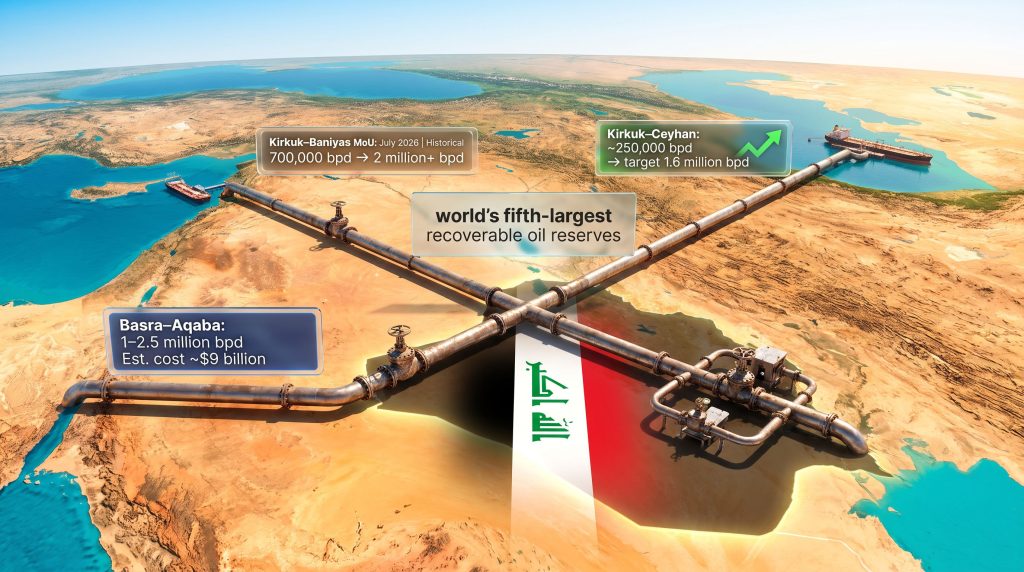
As of early 2026, the pipeline has been placed back into operational mode, with reported throughput of approximately 250,000 barrels per day. That figure represents only a fraction of the system's potential. Near-term rehabilitation targets aim to push flows to 650,000 barrels per day, while longer-range plans envision a fully modernised system capable of handling up to 1.6 million barrels per day.
Ceyhan's strategic value extends beyond its physical infrastructure. The port already handles crude from the Caspian basin, including Azerbaijani oil transported through the Baku-Tbilisi-Ceyhan pipeline, which gives it established relationships with Mediterranean buyers and efficient loading infrastructure. For Iraqi crude, Ceyhan offers something the Gulf cannot currently provide: direct Mediterranean market access without any exposure to Hormuz dynamics or Gulf state transit complications.
Iraq's cabinet has authorised the oil ministry to enter a Head of Agreement with a consortium of Qatari and US companies to conduct detailed feasibility studies covering both the Turkey and Syria pipeline corridors. A Head of Agreement at this stage signals that the project has moved beyond conceptual discussion into structured commercial engagement, though it falls well short of a final investment decision.
The KRG dimension remains a persistent complicating factor. Unresolved revenue disputes between Erbil and Baghdad have historically stalled northern pipeline operations, and any sustained scale-up of Kirkuk-Ceyhan flows will require a durable political settlement on how export revenues are distributed between the federal government and the Kurdish regional administration.
Reviving a Pipeline Dormant Since 2003: The Kirkuk-Baniyas Corridor
Perhaps the most symbolically striking element of Iraq's export strategy is the proposed revival of the Kirkuk-Baniyas pipeline, a route that carried Iraqi crude to Syria's Mediterranean coast before being shut down in the aftermath of the 2003 invasion. More than two decades of disuse, compounded by Syria's subsequent civil war and the physical damage sustained by infrastructure across the country, have left the pipeline in a state that would require comprehensive engineering assessment before any rehabilitation could begin.
Iraq and Syria formalised their intent to revive this corridor through a Memorandum of Understanding signed in July 2026. The historical capacity of the pipeline sat at approximately 700,000 barrels per day, but proposed upgrade scenarios associated with the revival discussions reference throughput potential exceeding 2 million barrels per day, which would make it one of the highest-capacity pipeline corridors in the entire Middle East.
The Baniyas port on Syria's Mediterranean coastline would serve as the export terminal, offering access to European and Mediterranean Asian buyers. The pipeline's southern feedstock would connect via the proposed Basra-Haditha trunk line, theoretically enabling Iraq to move crude from its largest southern producing regions all the way to the Syrian coast without any Gulf exposure.
However, several risk factors complicate the Syria route's near-term viability:
- Residual instability across parts of Syrian territory raises security concerns for infrastructure investment
- International financiers and energy companies with global exposure must navigate complex sanctions frameworks that still apply to Syria
- The physical state of the pipeline after more than 20 years of non-operation is unknown without detailed engineering surveys
- Post-conflict reconstruction financing for Syria as a transit country remains uncertain
Despite these challenges, the geopolitical logic of the Syria route is compelling. As Damascus continues its regional reintegration process, the pipeline could serve as both a commercial corridor and a diplomatic instrument strengthening Iraq-Syria ties. The broader considerations around oil trade and geopolitics make this route particularly significant for Iraq's long-term positioning.
The Basra-Aqaba Pipeline: Iraq's Third Export Axis
While the Turkey and Syria routes have captured recent attention, the Basra-Aqaba pipeline represents a third, structurally distinct export corridor that would give Iraq access to the Red Sea rather than the Mediterranean. The foundational agreement underpinning the project dates to a bilateral framework signed between Iraq and Jordan in 2013, making it one of the region's longer-running infrastructure ambitions.
Iraq's oil ministry published a detailed assessment in 2024 that established the project's commercial parameters. The pipeline would carry between 1 and 2.5 million barrels per day from the Basra oil hub in southern Iraq to the Jordanian port of Aqaba, with a total estimated construction cost of approximately $9 billion. Iraq confirmed in 2019 that it had invited pre-qualified global companies to submit bids, but the combination of government cash shortages and security conditions in Al-Anbar province along the proposed routing stalled meaningful progress.
The project has regained momentum in 2026. Iraq's cabinet has formally approved it as part of the broader export diversification strategy, and Jordan's industry and energy ministers conducted a working visit to Baghdad, meeting with Prime Minister Ali Al-Zaidi specifically to discuss funding mechanisms. The financing question remains the project's central unresolved issue: at $9 billion, the Basra-Aqaba pipeline requires a financing structure that Iraq's government cannot fund unilaterally in the current environment.
Aqaba's appeal as an export destination lies in its position at the northern tip of the Red Sea, providing access to Suez Canal shipping lanes and, through them, to both European and Asian crude markets. Unlike Ceyhan and Baniyas, which both access the Mediterranean, Aqaba adds genuine geographic diversification to Iraq's export portfolio. These energy export challenges are broadly reflective of the financing hurdles facing energy infrastructure globally.
Comparing the Three Corridors: A Strategic Assessment
| Dimension | Iraq-Turkey (Ceyhan) | Iraq-Syria (Baniyas) | Iraq-Jordan (Aqaba) |
|---|---|---|---|
| Current operational status | Restarting at 250,000 bpd | MoU signed; rehabilitation needed | Cabinet-approved; pre-financing stage |
| Capacity potential | Up to 1.6 million bpd | Up to 2+ million bpd | 1-2.5 million bpd |
| Market access | Mediterranean | Mediterranean | Red Sea / Suez |
| Transit country political risk | Moderate (KRG dynamics) | Moderate (post-conflict recovery) | Low |
| Primary constraint | Revenue-sharing disputes | Rehabilitation complexity + sanctions | Financing gap ($9bn) |
| International consortium involvement | Qatari-US study underway | Feasibility stage | Funding discussions active |
The next major ASX story will hit our subscribers first
The Fiscal Stakes: Why Export Infrastructure Is a Sovereignty Issue
Understanding why Iraq is pursuing three pipeline corridors simultaneously requires understanding the structural relationship between oil revenues and Iraqi state finances. Crude exports fund approximately 90% of government expenditure in Iraq, which means that any sustained disruption to export flows translates almost immediately into a fiscal crisis affecting public sector salaries, infrastructure budgets, and social programmes.
This dependency creates a risk profile unlike that of any other OPEC member. Saudi Arabia maintains substantial sovereign wealth reserves that provide a buffer against temporary revenue disruption. Iraq does not have that cushion at comparable scale. A prolonged Hormuz closure would therefore threaten not just commercial oil revenue but the operational continuity of the Iraqi state itself.
Iraqi economist Manar Al Obaidi has articulated this structural vulnerability clearly, noting that Iraq requires a reliable and structurally secure long-term export outlet and that the current pipeline initiatives reflect exactly that strategic intent. The pipeline network being assembled is, in this framing, less a commercial infrastructure project than a sovereign risk management programme.
In addition, the commodity price impacts of sustained export disruption extend well beyond Iraq's borders, with downstream effects on global energy markets. Consequently, OPEC's market influence over price stability is directly tied to Iraq's ability to maintain consistent export volumes.
Key insight: A reduction in Iraq's Hormuz dependency could have a secondary commercial benefit beyond security. If buyers and traders assess Iraqi crude as carrying lower geopolitical disruption risk, the discount applied to Iraqi crude relative to benchmark prices could narrow, improving the netback value Baghdad receives per barrel even before a single additional barrel is exported.
Scenario Pathways: What Iraq's Pipeline Network Could Look Like by 2030
Projecting forward, three broad scenarios frame the range of outcomes:
-
Optimistic trajectory: The Kirkuk-Ceyhan pipeline reaches 650,000 bpd by 2027-2028 following sustained rehabilitation investment. The Basra-Aqaba project secures financing through a multilateral or sovereign wealth fund structure and enters construction by 2028. The Kirkuk-Baniyas corridor completes its engineering assessment and begins partial rehabilitation by 2029. By the early 2030s, Iraq's Hormuz-exposed export share falls below 50%.
-
Base case trajectory: The Turkey route achieves meaningful throughput expansion and becomes the dominant alternative corridor. The Jordan route advances through financing negotiations but construction begins later than planned. The Syria route faces a longer rehabilitation timeline due to infrastructure complexity and international financing caution.
-
Constrained trajectory: Financing gaps, unresolved KRG disputes, and cautious international investor sentiment limit meaningful progress to the Turkey route alone. Iraq remains structurally Hormuz-dependent through the late 2020s.
Frequently Asked Questions: Iraq Oil Export Pipelines to Turkey and Syria
What is the current operational status of the Iraq-Turkey pipeline?
The Kirkuk-Ceyhan pipeline is in active rehabilitation and restart mode, with reported flows of approximately 250,000 barrels per day in early 2026. Rehabilitation targets aim for 650,000 bpd in the near term, with longer-term system capacity potentially reaching 1.6 million bpd.
Why did Iraq abandon the Gulf pipeline options?
Gulf states expressed reluctance to host Iraqi pipeline infrastructure through their territory, citing concerns that the presence of such a pipeline could expose their own energy assets to attack during regional conflicts. Iranian military actions against Gulf-adjacent infrastructure reinforced those concerns and effectively ended Iraq's Gulf-facing pipeline discussions.
What is the Iraq-Syria pipeline's historical background?
The Kirkuk-Baniyas pipeline operated before the 2003 invasion of Iraq and was subsequently shut down. It remained non-operational for over two decades. A Memorandum of Understanding signed in July 2026 formalised Iraq and Syria's intent to assess and revive the corridor, representing a significant diplomatic and commercial step forward.
How much does the Basra-Aqaba pipeline cost?
Iraq's oil ministry estimated in 2024 that the Basra-Aqaba pipeline would cost approximately $9 billion, with a design capacity of 1 to 2.5 million barrels per day.
Which companies are studying the Turkey and Syria pipeline routes?
Iraq's cabinet has authorised the oil ministry to sign a Head of Agreement with a consortium of Qatari and US companies for feasibility studies covering both the Turkey and Syria export corridors.
How does Iraq's OPEC position relate to the pipeline strategy?
Iraq holds the world's fifth-largest recoverable oil reserves and is an OPEC member with production ambitions that have historically been constrained by export infrastructure limitations. Expanding and diversifying pipeline capacity is directly connected to Iraq's ability to realise its production potential and meet OPEC output targets. Indeed, recent reporting confirms that Iraq and Syria are accelerating these pipeline plans as a core part of that broader ambition.
This article contains forward-looking scenarios, capacity projections, and cost estimates drawn from publicly available reporting and official Iraqi government assessments. Actual project timelines, costs, and throughput figures may differ materially from those referenced. This article does not constitute financial or investment advice.
Want to Track the Next Major Resource Discovery Before the Market Does?
Iraq's pipeline reorientation is a reminder of how swiftly geopolitical shifts can reshape commodity flows and investment opportunities — and for ASX-focused investors, staying ahead of those moves demands real-time intelligence. Discovery Alert's proprietary Discovery IQ model scans ASX announcements the moment they are released, delivering instant alerts on significant mineral discoveries across more than 30 commodities, so subscribers can act before the broader market catches on — explore historic discovery returns to see what early positioning can mean, and begin your 14-day free trial today.