July 8, 2026
The Geology of Ambition: Why Iraq's Reservoir Architecture Makes 7 Million bpd Theoretically Achievable
Most large-scale oil production debates centre on geopolitics and investment capital. Rarely discussed is the subsurface geology that either enables or prevents ambitious output targets from becoming physical reality. Iraq's southern Mesopotamian Basin holds some of the world's most prolific carbonate reservoir systems, characterised by thick, high-porosity limestone formations that respond exceptionally well to pressure maintenance techniques. This geological advantage is not incidental to the Iraq oil production to 7 million bpd ambition. It is its foundational premise.
Understanding why Iraq's reservoirs behave differently from most producing basins globally helps explain why Western supermajors are circling Baghdad with renewed urgency, and why the structural enablers for expansion are converging at this particular moment in history rather than at any point during the past decade.
When big ASX news breaks, our subscribers know first
Why Iraq's 7 Million bpd Target Is Structurally Different From Previous Announcements
The Credibility Gap That Has Defined Iraq's Oil Targets for a Decade
Iraq has issued production ambition statements with remarkable regularity. The pattern is well-established: a target of either 6 or 7 million bpd, a three-year delivery window, and a prime ministerial visit to Washington to deepen strategic ties. What typically followed was a cycle of partial commitments, continued Iranian energy dependency, and output that remained stubbornly anchored in the 4.0 to 4.5 million bpd range.
The current iteration of this announcement differs in one critical respect: the structural conditions surrounding it have changed more substantially than at any prior point. A confidential Iraqi government strategy document from 2012, commissioned by then-Prime Minister Nouri al-Maliki and known as the Integrated National Energy Strategy, had already mapped out a credible pathway to 13 million bpd in its highest production scenario by 2017, with 9 million bpd as a medium scenario by 2020 and 6 million bpd in the low scenario by 2025.
These benchmarks reveal that the current 7 million bpd target, achievable within three years, was already within the lower range of projections conceived over a decade ago. The question has never been geological feasibility. It has always been the convergence of investment, infrastructure, and political alignment. Furthermore, Iraq's oil production strategy has long been shaped by this tension between resource abundance and structural bottlenecks.
| Production Metric | Current Estimate |
|---|---|
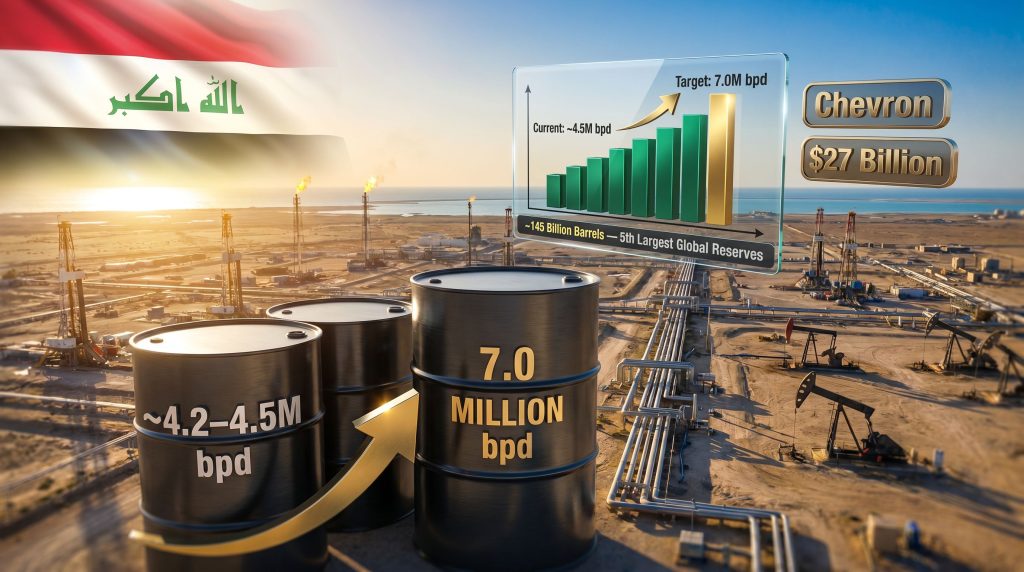
| Current daily output | ~4.2–4.5 million bpd |
| Target daily output | 7.0 million bpd |
| Required volume increase | ~2.5–2.8 million bpd |
| Percentage growth needed | +55–65% |
| Target achievement window | ~3 years (by ~2029) |
| Proven reserves (official, EIA) | ~145 billion barrels |
| Estimated unofficial reserves | ~215 billion barrels |
| Share of Middle East reserves | ~18% |
| Global reserve ranking | 5th largest |
Historical Scenario Benchmarks vs. Today's Target
- High Production Scenario (2012 strategy): Plateau of 13 million bpd targeted by 2017
- Medium Production Scenario: 9 million bpd plateau targeted by 2020
- Low Production Scenario: 6 million bpd plateau targeted by 2025
- Current 2026 announcement: 7 million bpd within 3 years, falling within lower-bound projections conceived over a decade ago
Key Insight: Reaching Iraq oil production to 7 million bpd within three years would require a volume increase of roughly 2.5 to 2.8 million bpd, representing a 55 to 65 percent expansion from the current output base. This is one of the most aggressive upstream expansion commitments of any OPEC member in recent history, but it is not without precedent in Iraq's own strategic planning history.
Who Controls Iraq's Oil Fields and Why It Matters
The Chinese Operational Footprint in Iraqi Upstream
The single most overlooked dimension of Iraq's oil production story is the degree to which Chinese energy firms dominate day-to-day field operations. Chinese companies currently manage more than two-thirds of Iraq's total production, controlling approximately 3.0 million bpd of the current output base. This concentration of non-Western operational control is the central tension underpinning Baghdad's investment realignment calculus.
Any credible pathway toward achieving Iraq oil production of 7 million bpd requires either Chinese firms scaling their operations significantly, or Western operators displacing them at key fields. The US-China trade war dynamics of 2025 and 2026 have made the second scenario increasingly plausible, adding a geopolitical dimension that extends well beyond the oil sector itself.
What is less commonly discussed in mainstream energy analysis is that this Chinese dominance was itself a product of Western disinvestment following the 2003 invasion, subsequent security deterioration, and commercial uncertainty during Iraq's reconstruction period. The current Western re-entry is therefore a partial reversal of a decade-long trend, not a continuation of existing momentum.
The West Qurna 2 Transition: From Russian Operatorship to Potential Western Control
West Qurna 2 is one of the world's genuinely supergiant oil fields, holding estimated recoverable reserves of approximately 13 billion barrels. It has historically accounted for close to 10 percent of Iraq's total recent production and roughly 0.5 percent of global oil supply. Its significance within any Iraq expansion strategy is therefore outsized relative to even its considerable reserve base.
| Field Metric | Detail |
|---|---|
| Field name | West Qurna 2 |
| Estimated recoverable reserves | ~13 billion barrels |
| Share of Iraq's total production | ~10% of recent historical output |
| Share of global oil supply | ~0.5% |
| Previous operator | Lukoil (Russia) |
| Current negotiation partner | Chevron (USA) |
| Status | Non-disclosure agreement signed; exclusive talks since February 2026 |
A particularly significant but under-reported detail concerns the field's actual productive capacity under Russian operatorship. Industry sources with proximity to Iraq's Oil Ministry indicate that Lukoil's declared output figures for West Qurna 2 consistently understated the field's true productive potential. This implies that Chevron, assuming it secures a development agreement, may inherit a reservoir system with substantially more immediate upside than official production history would suggest.
Western sanctions on Russia following the 2022 Ukraine invasion rendered continued Russian commercial operations at West Qurna 2 untenable, creating the entry opportunity now being pursued exclusively by Chevron. The Basra Oil Company and Chevron formalised a non-disclosure agreement in mid-2026 to govern data exchange during field evaluation, representing the due diligence phase preceding any formal development contract.
Senior Iraqi Oil Ministry sources have indicated their expectation that Chevron could realistically double West Qurna 2's output within a relatively short operational timeframe. Given the field's geology and the suspected underreporting during prior operatorship, this assessment is not considered speculative by those with direct knowledge of the reservoir's characteristics. According to reporting from Oil Price, Iraq has already begun accelerating key megaprojects specifically to meet this production target.
The Common Seawater Supply Project: The Infrastructure Constraint Nobody Talks About
Why Reservoir Pressure Management Is the Binding Constraint
Iraq's southern fields, including West Qurna 2, are mature carbonate reservoirs. As hydrocarbons are extracted, subsurface pressure declines, reducing natural flow rates and ultimately requiring costly artificial lift mechanisms. Without active pressure maintenance through water injection, production from these fields will decline regardless of how much capital is committed to drilling new wells.
The Common Seawater Supply Project addresses this constraint directly. The CSSP involves extracting large volumes of seawater from the Persian Gulf and transporting it via pipeline networks to injection points at key southern Iraqi reservoirs. The water is injected into the reservoir formations to maintain subsurface pressure, sustaining production rates that would otherwise deteriorate as the fields mature.
Without the CSSP, the 7 million bpd expansion target is physically unachievable from Iraq's existing southern field base. This makes the project not merely an infrastructure investment but a precondition for the entire expansion strategy. In addition, monitoring WTI and Brent futures will be essential for understanding how market participants are pricing in Iraqi supply additions as the CSSP progresses.
TotalEnergies is leading CSSP implementation as one component of its four-part, $27 billion investment programme in Iraq. The scale of this commitment reflects both the commercial opportunity TotalEnergies has identified and the strategic importance Baghdad attaches to securing French involvement as a counterweight to Chinese dominance.
| Investment Track | Focus Area | Lead Entities |
|---|---|---|
| Track 1: Field Development | Upstream drilling, reservoir management, enhanced recovery | Chevron, TotalEnergies, Western supermajors |
| Track 2: Supporting Infrastructure | Seawater injection (CSSP), pipelines, export terminals | TotalEnergies, Iraqi state entities |
| Track 3: Exploration | New field identification and appraisal | To be determined under new investment framework |
The U.S. Legislative Squeeze: Four Instruments Reshaping Baghdad's Options
How Washington Converts Financial Pressure Into Investment Access
The mechanism through which U.S. policy pressure translates into Iraqi investment realignment is rarely mapped with precision. Four distinct legislative and regulatory instruments have progressively narrowed Baghdad's strategic room to manoeuvre since early 2025. Furthermore, the trade war oil impact has compounded these pressures, making Iraqi alignment with Western partners simultaneously more costly to avoid and more commercially attractive to pursue.
-
Waiver Termination (March 2025): The blocking of Iraq's exemption to continue importing Iranian electricity directly targeted Baghdad's domestic power sector dependency on Tehran, removing the safety valve that had allowed Iraq to defer decoupling.
-
Free Iraq from Iran Act: Legislation designed to systematically dismantle Iranian political, economic, and military influence within Iraq, including restrictions on Iranian LNG imports and coordinated action by U.S. State and Treasury Departments against Iran-backed networks operating within Iraqi territory.
-
No Iranian Energy Act: Proposed sanctions on Iraqi importation of Iranian natural gas, targeting the foundational energy supply that has underpinned Iraq's domestic power generation for years. Iranian gas has historically provided the fuel for electricity generation that powers oil field operations, creating a deep structural dependency.
-
Dollar Flow Restrictions: U.S. Treasury blocking of large-scale dollar transfers through Iraqi banking channels used to route hard currency to Iranian entities. This measure also involved direct sanctions on senior Iraqi officials implicated in oil-smuggling networks that blend Iranian and Iraqi crude to generate revenues for Tehran.
Policy Mechanics: These measures collectively function as a financial and energy squeeze. Iraqi banks face dollar liquidity constraints, Baghdad's domestic power sector loses Iranian supply, and officials engaged in sanctions evasion face personal legal exposure. The net effect is that continued Iraqi alignment with Iran becomes increasingly costly precisely as Western investment partnerships become more available and more necessary.
The Sanctions Leverage Mechanism
The logic chain connecting U.S. policy pressure to Iraqi investment realignment operates across several sequential steps:
- U.S. restricts dollar flows through Iraqi banking channels
- Iraqi financial institutions face hard currency constraints affecting government revenue flows
- Baghdad requires large-scale Western investment to fund oil sector expansion and maintain fiscal stability
- Western investment is implicitly conditional on reducing Iranian energy dependency
- Iraq accelerates the shift toward Western operators and away from Iranian energy supply arrangements
What makes this dynamic particularly significant in 2026 is that the prior Iraqi strategy of extracting commitments from Washington while maintaining Iranian ties has been directly tested by an administration less willing to extend waivers or tolerate continued ambiguity. The pattern of securing U.S. funding while returning to pre-existing arrangements has collided with a more transactional U.S. approach to bilateral engagement.
Three Scenarios for Iraq Reaching 7 Million bpd
Scenario 1: Full Western Investment Alignment (Base Case)
Conditions required:
- Chevron secures operational control of West Qurna 2 and achieves meaningful output increases within two to three years
- TotalEnergies' $27 billion programme advances on schedule, with CSSP reaching operational capacity
- Baghdad formally and demonstrably reduces Iranian energy imports, unlocking expanded U.S. financial engagement
- OPEC grants Iraq quota flexibility commensurate with expanded capacity
Assessment: Moderate-to-high probability given current geopolitical momentum, but execution risk remains material
Scenario 2: Partial Realignment with Structural Delays (Moderate Case)
Conditions:
- Western firms enter key fields but face contractual, bureaucratic, and infrastructure delays consistent with Iraq's historical operating environment
- Iranian energy imports are reduced but not eliminated, constraining the pace of Western funding flows
- Production reaches 5.5 to 6.0 million bpd by 2029 rather than the stated 7 million bpd target
Assessment: High probability. This scenario is most consistent with Iraq's historical track record of announcing ambitious targets and delivering partial but real progress.
Scenario 3: Geopolitical Reversal and Stagnation (Bear Case)
Conditions:
- U.S.-Iraq diplomatic engagement produces insufficient investment commitments relative to Iraq's fiscal needs
- Iranian proxy networks reassert political influence within Iraqi government structures
- Chinese operators retain dominant field control, limiting Western technology transfer and operational improvement
- Output remains below 5 million bpd through 2029
Assessment: Low-to-moderate probability given the weight of current structural pressures, but not negligible given Iraq's complex internal political dynamics
The next major ASX story will hit our subscribers first
The Four Structural Enablers: A Convergence Assessment
Whether Iraq oil production reaches 7 million bpd by 2029 ultimately depends on whether four independent structural enablers are materialising simultaneously for what would be the first time in the country's modern oil history.
| Enabler | Current Status | Assessment |
|---|---|---|
| Western operator entry (Chevron, TotalEnergies) | Active: NDA signed, $27B programme underway | Converging |
| Reduced Iranian energy dependency | Partial: U.S. pressure intensifying but incomplete | In Progress |
| OPEC quota flexibility | Sought: outcome remains uncertain | Unresolved |
| Infrastructure readiness (CSSP) | Under implementation by TotalEnergies | In Progress |
Iraq has historically failed to achieve its production targets not because the geology was unfavourable or the reserves insufficient, but because these four enablers have never converged simultaneously. The current environment represents the closest alignment of these conditions the country has experienced, without guaranteeing a successful outcome.
Global Market Implications If Iraq Delivers
The Supply Addition Scenario and Benchmark Pricing
Adding 2.5 to 2.8 million bpd of Iraqi supply to global markets over three years would represent one of the largest single-country production increases since U.S. shale's rapid expansion phase. At prevailing demand growth trajectories, this volume addition — particularly if concurrent with broader OPEC+ unwinding of existing production cuts — could exert meaningful downward pressure on global crude benchmarks.
Citigroup has separately modelled scenarios where Brent crude falls toward $60 per barrel as Middle East supply normalises. Iraqi expansion at scale would amplify this dynamic. Consequently, understanding crude oil price trends will be increasingly important for investors seeking to navigate the supply-side shifts now underway.
The OPEC market influence adds a further layer of complexity. Iraq has historically been among the least compliant OPEC members with agreed production quotas, suggesting the 7 million bpd ambition may be pursued regardless of whether formal quota accommodation is secured. If other OPEC members simultaneously increase output, the combined supply effect on global pricing could be substantial.
Iraq's Geographic Export Advantage
One underappreciated dimension of Iraq's strategic value is its export geography. Iraq borders Syria and the Mediterranean Sea to the west and Turkey to the north, providing multiple potential export pathways that reduce dependence on Strait of Hormuz transit. During a simulated or actual Strait of Hormuz closure scenario, Iraqi production has been estimated to have fallen as low as approximately 1.3 million bpd, exposing severe infrastructure vulnerability.
Any credible expansion plan must address pipeline and export terminal diversification alongside upstream capacity growth. This geographic positioning also makes Iraq strategically valuable as a potential transit corridor for regional energy flows, a dimension that adds non-oil-production value to whoever holds operational influence over its energy infrastructure.
Three Indicators to Watch Over the Next 12 to 18 Months
The strategic verdict on Iraq oil production to 7 million bpd will not be rendered in a single announcement. It will, however, be determined by the sequential resolution of three observable indicators:
-
Chevron's West Qurna 2 deal formalisation: A signed development agreement would represent the most significant Western re-entry into Iraqi upstream operations in decades, and would provide the clearest signal that Baghdad has moved beyond strategic ambiguity toward genuine Western alignment
-
Iranian energy import reduction metrics: Whether Baghdad demonstrably reduces Iranian gas and electricity dependency in measurable, verifiable terms will determine the pace of U.S. financial engagement and investor confidence in Iraq's stated trajectory
-
OPEC quota negotiation outcomes: Iraq's ability to secure formal production ceiling increases will determine whether the 7 million bpd target is pursued within the OPEC framework or, consistent with Iraq's historical compliance record, outside it
Iraq's reserve base is not in question. Its geology is not an obstacle. For the first time in the country's modern oil history, the geopolitical, commercial, and legislative conditions are simultaneously creating pressure toward a genuine structural shift. Whether the enablers converge fast enough to deliver 7 million bpd by 2029 remains one of the defining supply-side questions for global oil markets through the remainder of this decade.
This article contains forward-looking analysis, scenario modelling, and market projections that are inherently speculative. Production targets, pricing scenarios, and investment timelines represent analytical assessments and should not be construed as investment advice. Readers should conduct independent research before making any financial or investment decisions.
Want to Stay Ahead of the Next Major Resource Discovery?
While Iraq's upstream expansion reshapes global oil supply dynamics, Discovery Alert's proprietary Discovery IQ model delivers real-time alerts on significant ASX mineral discoveries — instantly translating complex resource data into actionable investment insights for traders and long-term investors alike. Explore how historic discoveries have generated substantial returns on Discovery Alert's dedicated discoveries page, and begin your 14-day free trial today to position yourself ahead of the broader market.