July 8, 2026
The Anatomy of a Chokepoint: Why the Strait of Hormuz Defines Global Energy Security
Every major energy supply shock in modern history traces back, at some point, to geography. Pipelines can be rerouted, terminals can be relocated, and production can be diversified. But certain physical corridors exist where the world's energy arteries narrow to a width so constrained that a single actor with sufficient military capability can threaten the economic stability of nations thousands of kilometres away. The Strait of Hormuz is the defining example of this structural vulnerability, and US resumes strikes on Iran after Hormuz attacks has become the defining headline of July 2026, demonstrating precisely how fragile the assumptions underpinning global energy trade can become when that geography is contested.
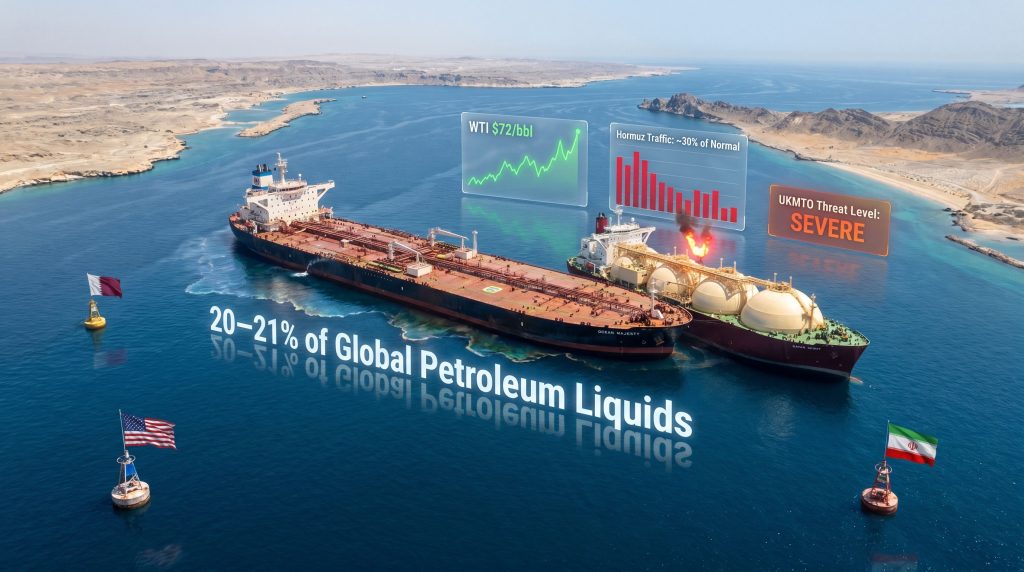
Roughly 20 to 21 percent of global petroleum liquids transit through a navigable corridor no more than 40 kilometres wide at its tightest point. No pipeline alternative currently operating can absorb that volume. The UAE's Habshan-to-Fujairah pipeline carries approximately 1.5 million barrels per day, and Saudi Arabia's East-West Petroline can move a portion of Kingdom output to the Red Sea coast, but neither route comes close to substituting for full Hormuz transit capacity.
This asymmetry is the source of Iran's strategic leverage: a relatively modest military force, through selective targeting of commercial vessels, can impose costs on the global economy that are wildly disproportionate to the resources deployed. Understanding the broader context of oil trade and geopolitics is essential to grasping why this corridor carries such outsized strategic importance.
When big ASX news breaks, our subscribers know first
From Ceasefire to Crisis: The Escalation Timeline
The conflict arc that culminated in US resumes strikes on Iran after Hormuz attacks in July 2026 began on 28 February 2026, when hostilities first broke out. What followed was a grinding sequence of partial closures, diplomatic interventions, and intermittent military exchanges that progressively degraded confidence in Hormuz as a reliable transit corridor.
The most significant diplomatic milestone was the 18 June interim agreement, under which both the United States and Iran committed to a full commercial reopening of the strait and Iran was offered sanctions relief in exchange. The US Treasury Department's Office of Foreign Assets Control issued a licence on 22 June authorising purchases of Iranian crude, refined petroleum products, and petrochemicals. A deadline of 21 August was set for finalising a comprehensive peace framework.
The agreement produced a brief recovery in transit activity. However, traffic through the strait had only recovered to approximately 30 percent of pre-conflict levels in the week immediately preceding the fresh escalation. That partial recovery proved illusory.
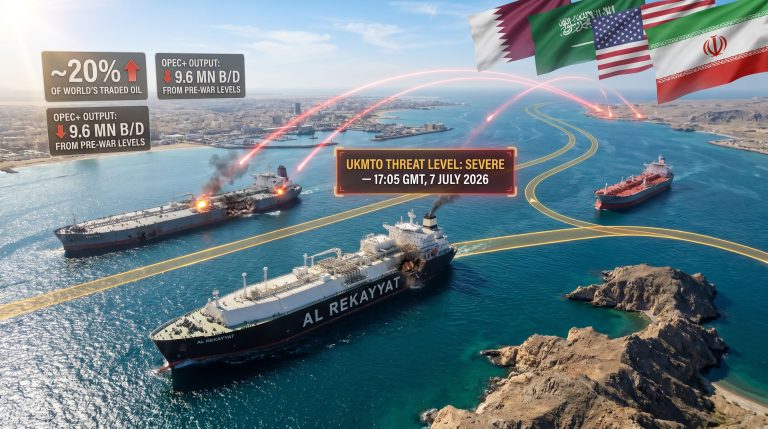
On 7 July 2026, Iranian forces attacked three commercial vessels transiting the southern corridor of the strait, specifically the route near the Omani coastline that both the US and the International Maritime Organization had designated as the recommended safe passage lane. The vessels targeted included:
- A very large crude carrier (VLCC) struck approximately 16 nautical miles east of Khor Fakkan, UAE, while exiting the strait
- A second tanker hit approximately 6 nautical miles off the Musandam Peninsula, Oman, sustaining minor structural damage with no casualties reported
- The LNG tanker Al Rekayyat, identified by Qatar, which was subsequently reported as abandoned following the strike
The UK Maritime Trade Organization (UKMTO) escalated its threat classification from "substantial" to "severe" at 17:05 GMT, the second-highest tier on the Joint Maritime Information Committee's five-level scale. At this classification level, attacks on commercial vessels are assessed as highly probable, triggering immediate route recalculations by major shipping operators and automatic changes to war risk insurance underwriting conditions.
Operational Context: The UKMTO's elevation to "severe" is not a symbolic designation. It activates concrete responses across the commercial shipping ecosystem, including mandatory insurer notifications, potential suspension of hull and machinery coverage, and in some cases contractual force majeure triggers in charter party agreements.
US Central Command subsequently announced it had begun launching military strikes against targets in Iran at 5:15pm ET on Tuesday 7 July, marking the resumption of direct military exchange between the two countries. The previous exchange of fire had occurred on 27 to 28 June, also following Iranian vessel attacks.
The Interim Deal's Structural Weakness
To understand why the 18 June agreement collapsed so rapidly, it is necessary to examine what it actually resolved versus what it left deliberately ambiguous. The deal paused hostilities and created a temporary commercial framework. What it did not resolve was the fundamental jurisdictional dispute at the core of the conflict: Iran's assertion of sovereign control over the strait, and specifically over the southern Omani-coast corridor.
Tehran's continued targeting of vessels using the US-endorsed transit route represents a deliberate assertion of authority rather than opportunistic aggression. By attacking ships specifically on the route that the United States and the IMO had endorsed as safe passage, Iran was signalling that no transit through Hormuz occurs without Iranian consent, regardless of what any interim agreement states.
The rapid unravelling of the OFAC licence tells the same story from the American side. An authorisation issued on 22 June was revoked on 7 July, less than three weeks after it was granted. Buyers who had contracted Iranian oil since the 22 June authorisation were given until 17 July to close out those transactions, with all outstanding payments directed to designated escrow accounts. The speed of that reversal sends a damaging signal about the reliability of any future US-Iran commercial framework, even if negotiations resume.
Critical Insight: The sanctions-reversal cycle creates a compounding credibility problem. Each time a US authorisation for Iranian oil purchases is granted and then revoked, it becomes harder for Asian refiners and other buyers to build Iranian supply into their long-term procurement strategies, regardless of what any future agreement promises.
How Energy Markets Responded
WTI crude futures crossed $72 per barrel on 7 July following the Iranian vessel attacks, before US military strikes began. This price movement reflects the market's asymmetric response pattern to Hormuz escalation events: the upside risk premium is priced in rapidly, while recoveries on de-escalation news tend to be slower and more conditional. Furthermore, WTI and Brent futures had already been under significant pressure throughout the broader conflict period.
The commodity classes most directly exposed to sustained Hormuz disruption are summarised below:
| Commodity | Hormuz Dependency | Primary Exposed Routes | Risk Level |
|---|---|---|---|
| Middle East crude exports | Very High | Saudi Arabia, Iraq, Kuwait, UAE, Iran | Critical |
| Qatari LNG | Very High | Qatar to Asia Pacific and Europe | Critical |
| Gulf refined products | High | Gulf refineries to Asian buyers | High |
| Petrochemicals | Moderate to High | Gulf feedstock export chains | High |
| LPG and NGL | High | Gulf producers to Asia | High |
The OPEC's market influence dimension adds further complexity. Seven core members including Saudi Arabia, Russia, Iraq, Kuwait, Kazakhstan, Algeria, and Oman agreed on 5 July to implement an additional 188,000 barrels per day increase to their collective production ceiling for August, marking the fifth consecutive output target increase since hostilities began on 28 February.
The scale of the production disruption this conflict has caused is significant. Argus estimates that Saudi Arabia, Iraq, and Kuwait collectively produced approximately 8.7 million barrels per day in May, roughly 8.5 million b/d below their combined pre-conflict target ceiling. Overall OPEC+ output in May was down approximately 9.6 million b/d from pre-war levels. The group's next scheduled meeting is 2 August, at which further adjustments contingent on Hormuz normalisation are likely to be discussed.
The implicit logic of OPEC+'s incremental target increases is a bet on de-escalation. The group is positioning to restore output rapidly once the strait normalises, but the 7 July escalation has materially complicated that timeline.
Three Strategic Scenarios for the US-Iran Conflict
Rather than treating the current crisis as a linear news event, it is more analytically useful to model it as a scenario tree with distinct probability-weighted pathways.
Scenario 1: Controlled De-escalation and Renewed Diplomacy
Conditions required: Both parties agree to a revised interim framework with enforceable mechanisms; Iranian attacks on commercial shipping cease; US suspends further military strikes pending negotiations.
Supporting factors: President Trump's statement on 7 July that productive discussions with Iran had taken place, made before the US strikes began, signals that diplomatic channels remain technically open. Turkey's dual relationships with Washington and Tehran, amplified by Trump's presence at the NATO summit in Ankara, create a potential mediation channel. Iranian economic pressure from reimposed sanctions creates incentive for Tehran to re-engage.
Market implications: WTI crude retreats toward the $65 to $68 per barrel range; Hormuz traffic recovers to 70 to 80 percent of pre-war volumes within four to six weeks; OPEC+ accelerates output restoration; war risk insurance premiums decline but remain elevated for 60 to 90 days.
Scenario 2: Protracted Low-Intensity Conflict with Intermittent Attacks
Conditions: Neither side achieves decisive military advantage; Iran continues selective vessel targeting to preserve leverage; the 21 August deadline passes without a comprehensive agreement.
Market implications: Hormuz traffic stabilises at 30 to 50 percent of pre-war levels; crude prices range between $70 and $85 per barrel with high volatility; the LNG supply outlook deteriorates sharply as Qatari export reliability comes into question; global shipping rerouting costs escalate as vessels divert via the Cape of Good Hope, adding 10 to 14 days to voyage times between the Gulf and European ports.
Structural consequence: This scenario accelerates long-term investment in alternative energy supply chain architecture, including expanded UAE bypass pipeline capacity and diversified LNG sourcing away from the Gulf.
Scenario 3: Full Strait Closure and Major Escalation
Conditions: Iran formally closes the strait to all commercial traffic; US and allied naval forces attempt to enforce freedom of navigation; military confrontation exceeds the threshold of targeted strikes.
Market implications: Crude oil prices surge above $120 per barrel; global LNG markets face an acute supply shock; coordinated IEA strategic petroleum reserve releases are activated; global recession risk becomes material.
Geopolitical cascade: Gulf Cooperation Council states face acute positioning pressure between US alliance obligations and physical exposure to Iranian retaliation. China's energy security calculus, given its substantial dependence on Gulf crude, shifts dramatically.
Scenario Weighting: As of early July 2026, market signals and available diplomatic indicators point toward Scenario 1 as the most probable near-term outcome. Scenario 2 represents the credible alternative if the 21 August deadline passes without agreement. Scenario 3 remains a low-probability but extreme-consequence tail risk that energy markets cannot price out entirely.
The OFAC Revocation and What It Means for Asian Buyers
The immediate practical effect of OFAC's 7 July revocation falls most heavily on Asian refiners, particularly Chinese and Indian buyers who had begun structuring Iranian crude procurement following the 22 June authorisation. These buyers now face a narrow wind-down window until 17 July, with payments routed to escrow rather than directly to Iranian counterparties.
This is not the first time global oil markets have navigated Iranian sanctions cycles. Previous rounds in 2012 and 2018 to 2019 established a market adaptation pattern that is likely to repeat:
- A short-term scramble by exposed buyers to source replacement barrels from alternative origins
- A widening of the Iranian crude discount to comparable grades, historically ranging between $5 and $15 per barrel, creating incentives for non-compliant purchasing
- Increased activity by shadow fleet tankers operating outside the formal insurance and compliance framework
- Gradual re-engineering of Asian refinery crude slates toward non-Iranian sources
The critical difference in 2026 is the speed of the reversal. The 16-day window between the authorisation and its revocation is shorter than any previous sanctions relief cycle, and this compressed timeline makes it genuinely difficult for large refinery operations to adapt their procurement planning without absorbing significant costs.
The next major ASX story will hit our subscribers first
Shipping Market Adaptations and the War Risk Premium
The maritime industry's response to Hormuz instability is playing out across multiple dimensions simultaneously. The Al Rekayyat incident is particularly significant because it demonstrates that even high-value, strategically important LNG cargoes under Qatari flag are not exempt from Iranian targeting calculations.
The compromise of the southern Omani-coast transit corridor changes the risk calculus for every vessel operator with Gulf exposure. What had been considered a relatively protected route, operating under US military air support for approximately two weeks, has now been demonstrably shown to be vulnerable. Maritime security analysts at Windward have assessed that the integrity of that southern corridor is now in serious question, a conclusion that will immediately feed into insurance underwriting and voyage planning across the industry.
For operators facing the economics of avoidance, the Cape of Good Hope reroute adds approximately 10 to 14 days to transit times between the Gulf and European destinations. At current vessel operating costs, that represents a meaningful uplift per voyage, with knock-on effects for fleet availability and charter rate dynamics across multiple shipping segments.
Long-Term Structural Consequences: Beyond the Immediate Crisis
If Hormuz instability persists through Q3 and Q4 2026, the structural consequences extend well beyond short-term price volatility. There are three dimensions worth examining carefully. Consequently, the oil market disruption already under way may reshape energy infrastructure investment decisions for years to come.
Energy infrastructure diversification becomes economically compelling at sustained oil price levels above $75 per barrel. Investment cases for expanding the UAE's Fujairah bypass pipeline capacity and increasing Saudi Petroline throughput become materially stronger. These projects require multi-year construction timelines, meaning decisions made in 2026 shape supply chain resilience in the late 2020s and beyond.
Energy transition acceleration is a less obvious but historically well-supported consequence of prolonged oil price volatility. Analysis of previous price shock cycles shows that sustained prices above $75 per barrel have consistently brought forward investment in alternative energy infrastructure and accelerated electric vehicle adoption curves in import-dependent economies. The Hormuz crisis, if it extends, could become an unintentional catalyst for faster-than-projected transition timelines across Asia and Europe.
OPEC+ cohesion faces a genuine test. Saudi Arabia sits in an uncomfortable position: it is simultaneously a major Hormuz-dependent exporter, a nation physically exposed to potential Iranian retaliation, and a core architect of the production management framework that requires Hormuz normalisation to deliver its promised output gains. The tension between these roles will intensify with each week that a resolution remains out of reach. Ongoing diplomatic efforts to restore the ceasefire suggest that US resumes strikes on Iran after Hormuz attacks may not mark the end of negotiated pathways, but the window for a swift resolution is narrowing.
This article presents analysis of publicly available market information and scenario modelling based on reported events. Nothing in this article constitutes financial or investment advice. Commodity price forecasts and scenario probabilities represent analytical estimates and are inherently subject to uncertainty. Readers should conduct independent research before making any commercial or investment decisions related to energy markets.
Want to Stay Ahead of the Next Major Resource Discovery Driven by Global Energy Shifts?
When geopolitical crises reshape commodity markets at speed, Discovery Alert's proprietary Discovery IQ model scans ASX announcements in real time, instantly identifying significant mineral discoveries across energy-relevant commodities before the broader market reacts — explore historic discoveries and their returns to see what early positioning can mean, then begin your 14-day free trial at Discovery Alert to secure your market-leading edge.