
August 5, 2026
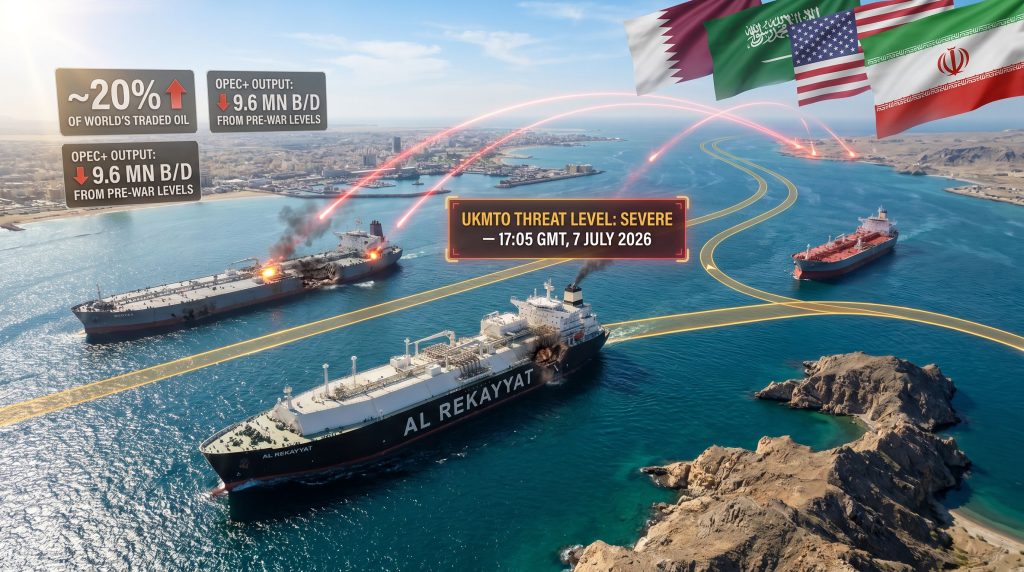
The Architecture of a Chokepoint: Why the Strait of Hormuz Cannot Be Replaced
Energy security analysts have long described the Strait of Hormuz not merely as a shipping lane, but as a physical valve controlling the pulse of the global oil system. No other geographic feature on Earth concentrates so much economic consequence into such a narrow corridor. When that corridor becomes a battlefield, the reverberations extend far beyond the tankers caught in the crossfire.
The strait measures roughly 21 nautical miles at its narrowest navigable point, yet the actual usable shipping lanes are far tighter: two designated corridors, each approximately 2 nautical miles wide, separated by a median zone. Through this compressed geography flows approximately 20% of the world's traded oil and a substantial share of the global LNG supply outlook, predominantly from Qatar. No cost-equivalent alternative exists. The Suez Canal cannot absorb the volume. Cape of Good Hope rerouting adds weeks to voyage times and dramatically increases freight costs. Overland pipeline alternatives lack the throughput capacity to substitute meaningfully for strait flows.
This irreplaceability is precisely what makes the Strait of Hormuz a geopolitical instrument as much as a trade route, and it explains why renewed Iran shipping attacks in the Strait of Hormuz carry consequences that extend well beyond the immediate vessels involved.
When big ASX news breaks, our subscribers know first
Three Vessels, One Strategic Message: The July 6-7 Attacks in Detail
On July 6-7, 2026, Iranian forces struck three commercial vessels transiting the southern corridor of the strait, an area that US military assets had been actively promoting as a safer alternative to the Iran-adjacent lanes. The targeting of ships on this specific route was not incidental. It represented a deliberate repudiation of the US naval deterrence posture and a direct challenge to the premise that Washington could guarantee safe passage through the waterway.
The three incidents can be summarised as follows:
| Vessel | Type | Strike Location | Damage | Flag/Ownership |
|---|---|---|---|---|
| Al Rekayyat | LNG Tanker | Near Oman's Musandam Peninsula | Port side hit near engine room; vessel abandoned | Qatar / Nakilat |
| Wedyan | VLCC (Crude Supertanker) | ~16 nm east of Khor Fakkan, UAE | Structural damage confirmed | Saudi-flagged |
| Unnamed third vessel | Commercial tanker | ~6 nm off Musandam Peninsula, Oman | Minor structural damage | Undisclosed |
No casualties were reported across all three incidents. Both the VLCC Wedyan and the unnamed third tanker continued to their next port of call following their respective strikes. The Al Rekayyat presented a sharply different outcome: its crew abandoned the vessel following the hit to the port side near the engine room, a threshold event in maritime risk assessment terms.
Why the Al Rekayyat Abandonment Matters Beyond the Incident Itself
Vessel abandonment is not a routine outcome in commercial shipping incidents. It signals that the crew safety threshold was crossed, a determination made under internationally recognised maritime safety protocols. When a crew abandons a laden LNG tanker, the insurance and risk calculus for every subsequent transit through the same corridor shifts materially.
The Al Rekayyat is operated by Nakilat, Qatar's national LNG shipping company, making the attack a direct strike against a Gulf Cooperation Council member state's flagship energy infrastructure. Qatar's formal diplomatic condemnation framed the incident as a serious violation of international maritime law. The GCC's collective characterisation of the strikes as brutal further introduces a multilateral political dimension into what had previously been framed as a bilateral US-Iran dispute.
Iran's state television framed the attacks differently, asserting that the Al Rekayyat had disregarded Iranian navigational warnings and that Tehran-approved routes were the only guarantee of safe passage. This framing is legally significant: it constitutes an explicit assertion that Iran holds sovereign authority to designate and enforce shipping corridors within the strait, a claim directly at odds with established international maritime law. For further context on tensions near the Strait of Hormuz, recent vessel seizures have underscored just how volatile the corridor has become.
UNCLOS, Territorial Seas, and the Legal Battle Beneath the Surface
The legal architecture governing the Strait of Hormuz is rooted in UNCLOS Article 38, which guarantees all vessels, including warships, the right of transit passage through international straits used for international navigation. This right requires no prior notification to, or consent from, the bordering state. Iran is a signatory to UNCLOS but has consistently advanced a competing interpretation that conflates its 12 nautical mile territorial sea jurisdiction with the ability to control the internationally recognised transit passage regime.
The southern corridor struck on July 6-7 sits primarily within Omani territorial waters, adding a further layer of legal complexity. Furthermore, Iranian missile strikes on vessels transiting Omani sovereign waters carry implications under bilateral maritime agreements and Omani sovereignty that extend beyond the US-Iran bilateral framework.
Historical precedent offers limited resolution. Iran's tanker war tactics during the 1980s Iran-Iraq War established patterns of commercial vessel interdiction that were never formally adjudicated under international law. The 2019 IRGC seizure of the British-flagged Stena Impero demonstrated more recently how Iran uses vessel detention as geopolitical leverage. The persistent gap: no standing international tribunal has jurisdiction to issue binding real-time interim measures against state-sponsored shipping attacks, leaving naval deterrence as the practical enforcement ceiling.
The UKMTO Threat Level Upgrade: What Severe Actually Means Operationally
At 17:05 GMT on 7 July 2026, the UK Maritime Trade Operations authority elevated the Strait of Hormuz threat classification from Substantial to Severe, the second-highest tier on the Joint Maritime Information Committee's five-tier scale. Understanding what each level triggers operationally is essential context:
- Low — Minimal credible threat; standard precautions apply
- Moderate — Some threat present; heightened situational awareness recommended
- Substantial — Credible threat confirmed; active security measures required
- Severe — Attack is considered highly likely; transit risk is operationally significant
- Critical — Attack is imminent or actively underway; transit should be suspended
The upgrade from Substantial to Severe activates a cascade of mandatory operational responses:
- All transiting vessels must comply with mandatory incident reporting protocols
- Increased coordination with naval escort programmes becomes required rather than advisory
- Immediate notification obligations to flag state authorities and P&I clubs are triggered
- War risk insurance underwriters, including Lloyd's of London specialists, must reassess and reprice premiums
Maritime security analysis following the July 6-7 attacks indicated that the simultaneous targeting of three vessels on the US-promoted southern corridor demonstrated that air support coverage alone cannot guarantee safe passage, a conclusion with far-reaching implications for naval deterrence doctrine in the region.
OFAC's Sanctions Reversal: Architecture of the Snap-Back
The US Treasury Department's Office of Foreign Assets Control had issued a purchase authorisation license on 22 June 2026, permitting buyers to acquire Iranian crude oil, refined products, and petrochemicals as a direct concession embedded within the interim peace deal signed on 18 June 2026. That license was originally scheduled to remain valid until 21 August 2026.
Within hours of the July 6-7 attacks, OFAC issued a replacement license on 7 July 2026 revoking all purchase authorisations with immediate effect. The key terms of the reversal:
| Parameter | Detail |
|---|---|
| Original license issued | 22 June 2026 |
| Original expiry | 21 August 2026 |
| Revocation date | 7 July 2026 |
| Wind-down deadline | 17 July 2026 |
| Payment handling | Outstanding funds directed to escrow accounts |
The 10-day wind-down window is notably compressed relative to standard OFAC practice, reflecting the urgency of the US policy response. The escrow mechanism is a deliberate financial pressure instrument: Iran cannot access funds from existing oil sale contracts, but buyers who contracted in good faith between 22 June and 7 July are not subjected to full retroactive penalisation.
Key Policy Signal: The speed of the OFAC reversal suggests the US had pre-engineered a sanctions snap-back mechanism as a contingency clause within the interim deal architecture, rather than improvising a response to the attacks. This has significant implications for how future US-Iran diplomatic frameworks may be constructed.
The broader sanctions implication is a potential return to maximum pressure conditions, including secondary sanctions targeting Iranian oil buyers in Asia, a category of buyer that had moved quickly to capitalise on the 22 June authorisation window. These oil market disruption risks are compounding an already fragile global supply environment.
OPEC+ Production Recovery and the July Threat to Its Trajectory
The energy market context surrounding these attacks involves one of the most dramatic production disruption-and-recovery cycles in OPEC+ history. When Iran severely disrupted Hormuz shipping following the outbreak of US-Iran hostilities on 28 February 2026, Gulf producers including Saudi Arabia, Iraq, and Kuwait were forced to implement production reductions on an unprecedented scale.
According to Argus estimates, crude output from Saudi Arabia, Iraq, and Kuwait collectively reached approximately 8.7 million b/d in May 2026, roughly 8.5 million b/d below their combined production target. Total OPEC+ output in May 2026 was down approximately 9.6 million b/d from pre-war levels.
The recovery trajectory had been gaining momentum. On 5 July 2026, seven core OPEC+ members including Saudi Arabia, Russia, Iraq, Kuwait, Kazakhstan, Algeria, and Oman agreed to raise collective production targets by a further 188,000 b/d in August, the fifth consecutive monthly increase since the conflict began. OPEC's influence on oil markets remains a defining factor in how quickly supply can realistically be restored. This left only 188,000 b/d of voluntary cuts remaining, with a full unwind potentially on the table for September.
The July 6-7 attacks place this entire recovery trajectory at risk. If strait transits deteriorate following the renewed IRGC strikes, the August production target increase becomes operationally undeliverable for Gulf producers, effectively reversing weeks of logistical and diplomatic progress.
The next major ASX story will hit our subscribers first
Energy Market Stress Points: From Crude Benchmarks to LNG Supply Chains
The commodity market consequences of renewed Iran shipping attacks in the Strait of Hormuz operate across several interconnected layers:
Crude oil pricing dynamics:
- Brent crude and Middle Eastern benchmark grades face the sharpest upward volatility in a disruption scenario
- Atlantic Basin and North American grades experience comparatively smaller geopolitical premiums
- Asian refiners dependent on Middle Eastern crude face simultaneous supply availability risk and elevated freight cost structures
LNG market exposure:
- The Al Rekayyat attack directly implicates Qatari LNG supply chains, which serve as a primary source for European energy security diversification following the post-2022 shift away from Russian supply
- Qatar supplies a significant portion of Europe's LNG import volumes; any sustained threat to Nakilat's fleet operations creates structural supply anxiety in European gas markets
Freight and insurance market implications:
- War risk surcharges on VLCC and LNG carrier routes through the Gulf are expected to spike materially following the UKMTO threat upgrade
- Historical comparison: during peak Houthi attack periods in the Red Sea throughout 2024, war risk premiums for Gulf of Aden transits increased by approximately 0.5-1.0% of vessel value per voyage. Hormuz escalation, given the strategic value of cargo transiting that corridor, could generate comparable or higher surcharges
- The Lloyd's of London Joint War Committee listed areas framework triggers automatic additional premium requirements for vessels in designated high-risk zones; the UKMTO Severe classification is expected to prompt a JWC area listing review for the southern Hormuz corridor
Scenario Pathways: Three Trajectories for the Weeks Ahead
Scenario 1: Diplomatic Re-engagement and Partial Stabilisation
Iran's absence of a formal public claim of responsibility for the July 6-7 attacks preserves a degree of diplomatic deniability. If back-channel negotiations between Washington and Tehran resume within a narrow window, and Iran signals restraint on IRGC maritime operations as a confidence-building measure, a partial stabilisation is achievable. Under this pathway, crude oil price trends suggest premiums persist but do not escalate further, and the OPEC+ August production increase proceeds broadly on schedule.
Scenario 2: Sustained Low-Intensity Interdiction
Iran's framing of the Al Rekayyat strike as a response to navigational non-compliance suggests a rules-based interdiction approach rather than indiscriminate warfare. Under this scenario, Iran continues selective vessel strikes while avoiding full strait closure, and the US expands naval presence without direct military confrontation. War risk insurance premiums remain structurally elevated. Tanker rerouting via the Cape of Good Hope increases freight costs by an estimated 10-14 additional days per voyage, with compounding effects on Asian refinery input costs.
Scenario 3: Full Strait Closure and Maximum Pressure Escalation
The most severe pathway involves a US military response triggering an Iranian declaration of strait closure, combined with full reinstatement of maximum pressure sanctions including secondary sanctions on Asian buyers. The geopolitical oil price drivers at play here are particularly acute, and the pre-prepared nature of the OFAC snap-back mechanism suggests US contingency planning already accounts for this trajectory. Market outcomes under this scenario include a significant Brent crude price shock, global LNG spot market disruption, and an emergency OPEC+ coordination requirement. The BBC's coverage of the broader conflict provides additional context on the rapidly evolving diplomatic landscape.
Operational Guidance: What Shipping Operators, Insurers, and Energy Traders Should Do Now
For vessel operators and shipowners:
- Reassess all planned Hormuz transits against the current UKMTO Severe threat classification before departure
- Notify P&I clubs and war risk underwriters of any Gulf transits scheduled within the next 30 days
- Review force majeure clauses in cargo contracts covering Middle Eastern loading ports
- Conduct a Cape of Good Hope rerouting cost-benefit analysis against current war risk premium structures
- Confirm crew emergency protocols and vessel abandonment procedures are current and actively drilled
For energy traders:
- Crude traders holding Middle Eastern physical positions should evaluate basis risk between paper benchmarks and actual cargo delivery certainty
- LNG traders with Qatari supply exposure should review force majeure provisions within long-term supply agreements
- Refined products traders in Asia should monitor Singapore complex crack spreads for early signals of Middle Eastern crude supply tightening
Disclaimer: This article contains forward-looking analysis, scenario projections, and market assessments that involve significant uncertainty. Nothing in this article constitutes financial or investment advice. Readers should conduct independent due diligence and consult qualified professionals before making any commercial, trading, or investment decisions related to the matters discussed.
Want to Stay Ahead of the Resource Opportunities Emerging From Energy Market Disruption?
When geopolitical shocks reshape global commodity markets, the window for identifying high-potential ASX mineral discoveries can open and close rapidly — Discovery Alert's proprietary Discovery IQ model delivers real-time alerts on significant ASX discoveries across 30+ commodities, ensuring subscribers can act on actionable opportunities before the broader market catches on. Explore how historic mineral discoveries have generated substantial returns and begin your 14-day free trial today to position yourself ahead of the next major market move.