July 8, 2026
The Invisible Architecture of Gasoline Pricing: Why Pump Prices Resist Political Commands
Every time crude oil prices fall sharply, a predictable pattern emerges in public discourse: consumers watch the benchmarks drop on the news ticker and expect immediate relief at the gas station forecourt. When that relief arrives slowly, or not at all, accusations of corporate greed are never far behind. This tension between commodity markets and retail fuel pricing is one of the most persistently misunderstood dynamics in energy economics, and it has now collided with one of the most combustible political environments in recent U.S. history.
The Trump price gouging push against Big Oil represents more than a presidential social media moment. It exposes the structural limitations of U.S. energy market regulation, the geopolitical consequences of military action in the Middle East, and the fundamental contradiction at the heart of an administration that simultaneously champions maximum domestic oil production while demanding consumer-level price controls.
When big ASX news breaks, our subscribers know first
Why Gasoline Prices Don't Follow Crude Oil in Real Time
To understand why the Trump price gouging push against Big Oil is legally and economically complicated, it helps to first understand what actually determines the price of gasoline at the pump. Crude oil is just one input in a layered cost structure that includes refining, transportation, wholesale distribution, retail markup, and both federal and state taxes. Understanding crude oil price trends is therefore essential context for any serious analysis of pump-level pricing.
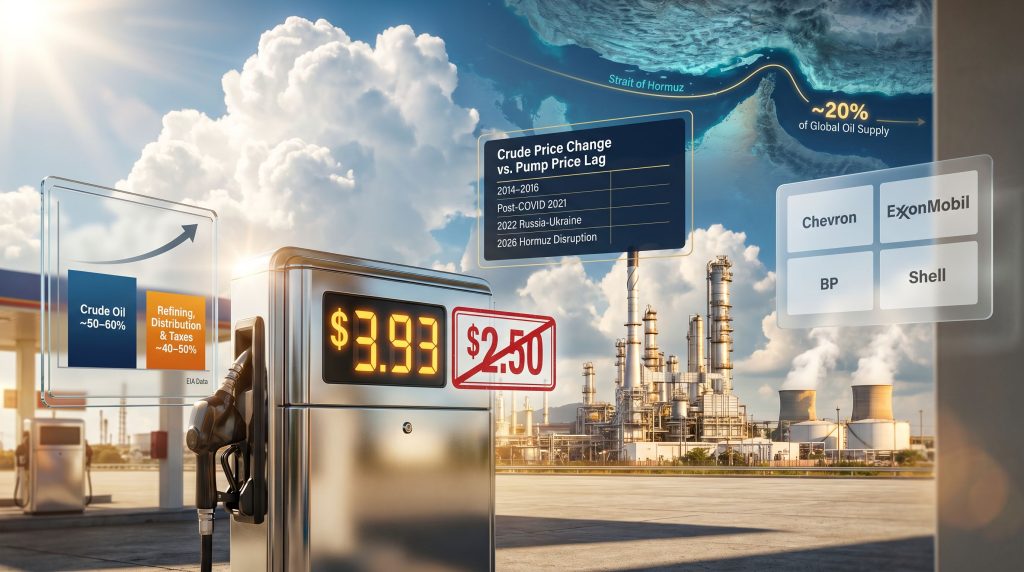
According to data from the U.S. Energy Information Administration, crude oil costs typically represent roughly 50 to 60 percent of the retail price of regular gasoline. The remaining 40 to 50 percent is absorbed by refining margins, distribution logistics, marketing costs, and taxes. None of these components fall automatically when crude benchmarks decline. A federal fuel excise tax of 18.4 cents per gallon applies uniformly regardless of where oil trades, and state taxes add anywhere from 8 cents to over 70 cents per gallon depending on jurisdiction.
This cost architecture means that even substantial crude oil price declines translate into only partial and delayed reductions at the pump. Industry economists refer to this as the "rockets and feathers" phenomenon: prices rise rapidly when crude climbs, but descend much more slowly when it falls. This asymmetric response is well-documented across multiple price cycles and reflects genuine market mechanics rather than coordinated manipulation.
The historical record supports this interpretation:
| Period | Crude Price Movement | Retail Pump Price Response |
|---|---|---|
| 2014–2016 Oil Collapse | -70% over 18 months | 3–6 month average lag downward |
| Post-COVID Recovery (2021) | +80% in 12 months | Near-immediate upward pass-through |
| 2022 Russia-Ukraine Spike | +40% in 3 months | Rapid upward, protracted downward |
| 2026 Hormuz Disruption | Sharp spike, partial recovery | Under active political scrutiny |
Refinery utilisation rates, regional inventory levels, and seasonal fuel blending requirements all introduce additional friction into price transmission. Summer blend gasoline, required in many U.S. markets to meet environmental standards, costs more to produce than winter-grade formulations and cannot be substituted interchangeably. These technical realities create pricing lags that are invisible to the average consumer but entirely real in operational terms.
The Hormuz Catalyst: How a Military Decision Became a Domestic Political Problem
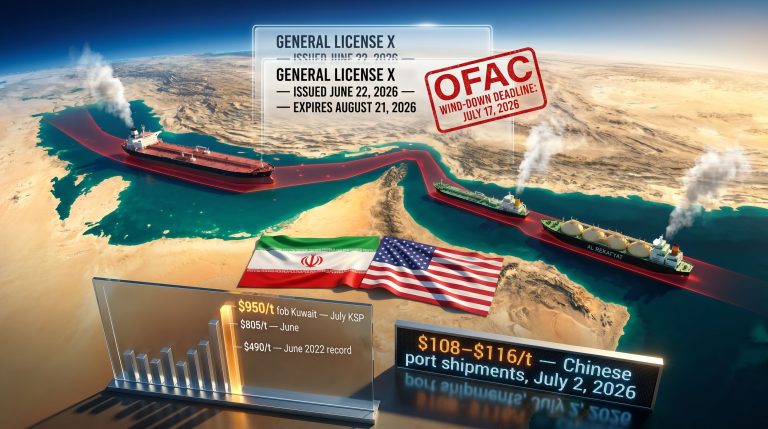
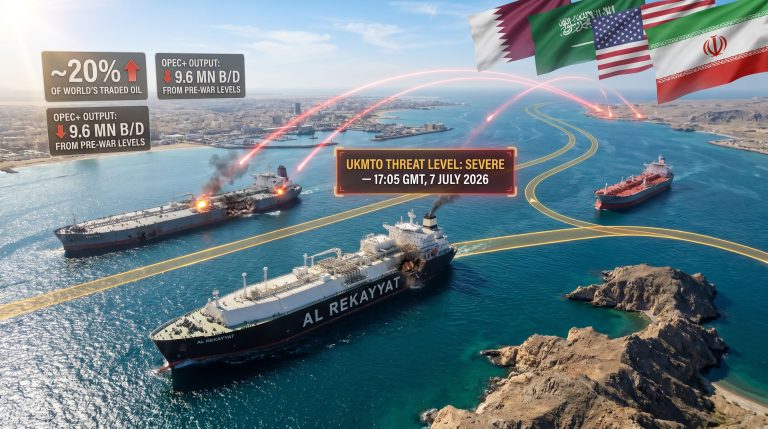
The proximate cause of the current price environment is the Strait of Hormuz disruption that followed U.S. and Israeli military strikes against Iran beginning February 28, 2026. Iran's closure of the strait, through which approximately 20 percent of global daily oil supply normally transits, created an immediate supply shock that drove both WTI and Brent crude benchmarks sharply higher, though prices did not reach the $100-plus per barrel levels recorded during the 2022 Russia-Ukraine crisis.
What makes the 2026 episode politically distinctive is the feedback loop it created. U.S. crude producers stepped into the global supply gap left by reduced Middle Eastern exports, recording record volumes of crude and refined product shipments to international buyers. This export surge simultaneously reinforced America's status as the world's dominant energy exporter while tightening domestic supply and placing upward pressure on domestic pump prices. Furthermore, the oil market trade war impact added yet another layer of complexity to an already strained pricing environment.
The same export-driven revenue record that bolstered claims of U.S. energy dominance contributed directly to the elevated retail gasoline prices that Trump then accused the industry of engineering through price gouging.
This circularity places the administration in an uncomfortable position. The policy framework designed to maximise U.S. production and export capacity has produced exactly the market dynamics that now require a populist response.
What Federal Law Actually Allows: The DOJ's Narrow Investigative Lane
When Trump instructed the Department of Justice to investigate oil companies for fuel price gouging, many observers assumed this reflected a straightforward legal pathway. In reality, the regulatory architecture available to federal investigators is far more constrained. Fortune's coverage of Trump's accusations against Big Oil highlights just how significant this legal gap is in practice.
The United States has no comprehensive federal price gouging statute. Price gouging laws, where they exist, are primarily a state-level legal construct, and most apply only during declared emergencies and to essential retail goods. Major integrated oil companies operating in upstream production, refining, and wholesale distribution may fall entirely outside the technical scope of most state statutes.
At the federal level, the DOJ's investigative tools are drawn from antitrust law, primarily the Sherman Act and the Clayton Act. These statutes prohibit coordinated price-fixing between competitors and other anti-competitive conduct, but they do not make high prices illegal on their own. A company charging elevated prices during a supply disruption, even dramatically elevated prices, does not automatically violate antitrust law unless investigators can demonstrate coordinated behaviour or deliberate supply manipulation.
The DOJ's concurrent directive urging state attorneys general to apply their own fuel price gouging statutes is telling. It signals that federal investigators are working at the edge of their jurisdictional authority and seeking to leverage state-level enforcement as a supplement. In practical terms, this means the investigation is more likely to function as reputational and political pressure than a direct enforcement mechanism.
The contrast with other jurisdictions is instructive:
| Country/Region | Regulatory Mechanism | Outcome |
|---|---|---|
| United States (2026) | DOJ investigation directive | Ongoing; no charges filed |
| South Korea (2026) | Formal charges against domestic refiners | Active legal proceedings |
| United Kingdom | Regulatory review of pricing conduct | No evidence of gouging found |
| European Union | Windfall profit tax (2022–2023) | Revenue collected; contested by industry |
South Korea pursued direct legal action against domestic refiners for price gouging in 2026, representing the most structurally defined response of any comparable jurisdiction. The EU's windfall profit tax approach sidesteps the evidentiary burden of proving illegal conduct by simply taxing excess earnings above a defined threshold. The U.S. approach, by contrast, lacks both the legal infrastructure of the Korean model and the legislative mechanism of the European model.
The $2.50 Target: Political Arithmetic Versus Market Reality
Trump's assertion that gasoline should sell for approximately $2.50 per gallon reflects crude oil prices at the time of his public statements. The national average was sitting near $3.93 per gallon, representing a gap of roughly $1.43 between the president's target and prevailing market conditions. Trump has named Chevron, ExxonMobil, BP, and Shell as the parties responsible for this discrepancy.
The arithmetic problem with the $2.50 figure is straightforward. Even if crude oil input costs fell to levels consistent with that retail price target, the structural cost floor of U.S. gasoline would still include:
- Federal excise tax: 18.4 cents per gallon (fixed, legislatively set)
- Average state fuel taxes: 30 to 70+ cents per gallon depending on location
- Refining costs: typically 40 to 80 cents per gallon under normal operating conditions
- Distribution and retail markup: roughly 20 to 40 cents per gallon
Taken together, these non-crude costs represent between $1.00 and $1.50 per gallon even under favourable market conditions. The American Petroleum Institute's position, articulated publicly by spokeswoman Bethany Williams, is that retail gasoline prices do not track crude oil directly, particularly during periods of major global supply disruption affecting refinery throughput and inventory levels simultaneously. This argument is technically well-founded, even if it carries limited political traction when consumers are paying nearly four dollars per gallon.
Big Oil's $100 Million Political Problem
The political dimension of the Trump price gouging push against Big Oil is impossible to separate from the financial relationship between the administration and the industry. The U.S. oil sector contributed approximately $100 million to support Trump's return to the presidency. The price gouging accusation therefore represents a significant rupture in what had been a strategically aligned relationship.
How the Trump tariff impact Has Complicated Industry Relations
Big Oil's lobbying apparatus has been activated in response, with oil majors reportedly engaging White House contacts to de-escalate tensions before Q2 2026 earnings are publicly disclosed. The timing problem for the industry is acute. Chevron and ExxonMobil are expected to report their strongest quarterly results since 2022, when Western sanctions on Russia pushed Brent crude above $100 per barrel.
Publishing record profits while the sitting president is publicly accusing the sector of gouging working-class consumers creates a convergence of reputational and regulatory risk that financial markets are already beginning to price in. The 2022 legislative attempt to impose a windfall profit tax in the U.S. Congress, the Windfall Profits for Consumers Act, failed in part due to sustained industry lobbying. That legislative template remains available, and elevated Q2 earnings could reignite congressional interest in revisiting it.
The next major ASX story will hit our subscribers first
Key Factors That Determine Whether a Price Gouging Investigation Produces Results
Based on historical precedent from analogous federal investigations, including the FTC's post-Hurricane Katrina review in 2005 to 2006 and the Biden administration's 2021 to 2022 FTC inquiry into oil company pricing, five conditions tend to determine whether an investigation moves from political pressure to actual enforcement:
- Evidence of coordination: Documentation showing competing firms aligned pricing decisions rather than acting independently.
- Supply withholding: Proof that companies deliberately reduced supply to artificially inflate prices rather than responding to genuine market constraints.
- Margin deviation: Pricing behaviour that diverges materially from verifiable cost-plus structures without legitimate market justification.
- Applicable statutes: Existence of legal frameworks that specifically cover the conduct in question, not just elevated prices in general.
- Sustained political will: Commitment to pursue prosecution through a full legal process despite industry pushback and legal complexity.
Both the Katrina-era and Biden-era investigations concluded without producing enforcement actions, finding insufficient evidence of illegal conduct despite significant public and political pressure. The 2026 investigation faces the same structural constraints.
Four Scenarios for the White House-Big Oil Standoff
The trajectory of the Trump price gouging push against Big Oil will likely be determined by crude price movements and Hormuz normalisation rather than legal proceedings. Four plausible scenarios are worth mapping:
Scenario 1: Political Pressure Without Legal Consequence. The DOJ investigation finds no actionable antitrust violations. Big Oil's Q2 earnings create a public relations crisis but no regulatory action follows. The administration uses the investigation as a midterm messaging tool. This is the path of least legal resistance given the absence of federal price gouging legislation.
Scenario 2: Congressional Legislation Emerges. Record earnings and continued consumer anger prompt bipartisan interest in a federal price gouging statute or windfall profit tax. Industry lobbying intensifies significantly. The political window for this scenario narrows as the November 2026 midterm elections approach.
Scenario 3: Hormuz Normalisation Resolves the Tension. Ongoing U.S.-Iran peace negotiations produce a ceasefire, Hormuz traffic fully normalises, crude prices decline sufficiently, and pump prices fall below the politically sensitive threshold. The White House claims victory without formal enforcement action.
Scenario 4: Formal Antitrust Action. DOJ investigators identify specific evidence of coordinated pricing or supply manipulation. Formal proceedings are initiated against one or more major oil companies. This scenario would generate significant equity volatility for named companies and could produce a chilling effect on domestic production investment at precisely the moment the administration is seeking expanded output.
How geopolitical trade tensions Factor Into Each Scenario
Each of the four scenarios above is also shaped by broader geopolitical dynamics. If regional instability persists or escalates, the energy supply equation becomes considerably more volatile. Consequently, investors and policymakers alike are monitoring diplomatic developments in the Middle East as closely as they are watching any DOJ announcements. Understanding how tariffs work alongside energy policy also helps explain why some of the administration's economic objectives can pull in opposing directions.
FAQ: Understanding the Trump Price Gouging Push Against Big Oil
Is fuel price gouging by oil companies actually illegal under U.S. federal law?
There is currently no comprehensive federal price gouging statute. Antitrust laws prohibit coordinated price-fixing between competitors, but unilaterally high pricing during a supply crisis is not inherently illegal under federal law. NBC News has reported extensively on the legal constraints facing federal investigators pursuing this matter.
Why does gasoline stay expensive after crude oil prices fall?
Retail gasoline prices reflect a layered cost structure that includes crude inputs, refining, transportation, taxes, and retail margin. When crude falls, the pass-through to pump prices is delayed by weeks to months due to existing inventory contracts, seasonal blending requirements, and refinery scheduling cycles.
What is Citi's oil price outlook as Hormuz normalises?
Analysts at Citi have projected that WTI crude could fall toward $60 per barrel if Hormuz traffic fully normalises, which would create conditions more consistent with the administration's pump price objectives, though still unlikely to produce $2.50-per-gallon gasoline.
How does the U.S. regulatory response compare internationally?
South Korea pursued formal legal charges against domestic refiners. The EU implemented a windfall profit tax. The UK found no evidence of price manipulation after a regulatory review. The U.S. approach remains the least structurally defined of these responses, constrained by the absence of a federal price gouging statute.
This article is intended for informational purposes only and does not constitute financial, legal, or investment advice. Forecasts, scenario projections, and references to expected earnings reflect available reporting at the time of writing and are subject to change. Readers should conduct their own due diligence before making investment decisions. For live crude oil price data and ongoing energy market coverage, visit OilPrice.com.
Want to Track the ASX Stocks Positioned to Benefit From Global Energy Market Shifts?
When commodity price volatility reshapes investment landscapes — as Hormuz disruptions and crude oil swings are doing right now — Discovery Alert's proprietary Discovery IQ model instantly identifies significant ASX mineral discoveries and delivers real-time alerts, ensuring subscribers can act on high-potential opportunities before the broader market catches on. Explore historic examples of major discoveries and their returns, then begin your 14-day free trial to gain an immediate market-leading edge.