May 12, 2026
Global energy markets face unprecedented structural vulnerabilities when single-route dependencies create cascading supply disruptions. The petroleum sector's interconnected infrastructure networks demonstrate how localised disruptions can rapidly escalate into systemic market imbalances, forcing rapid recalibration of production levels, transportation logistics, and fiscal planning across multiple economies simultaneously. Iraq oil production cuts have emerged as a critical factor in understanding these complex market dynamics.
Iraq's Production Infrastructure Under Extreme Stress
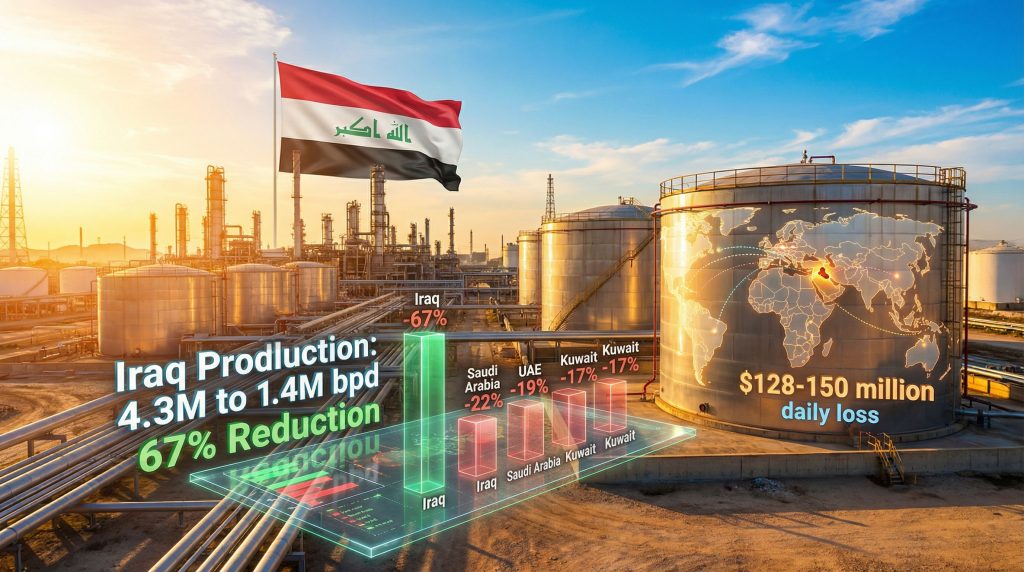
Iraq's petroleum sector demonstrates the acute vulnerabilities inherent in centralised export systems. The country's current crude oil output has stabilised at approximately 1.4 million barrels per day, representing a dramatic contraction from previous operational capacity levels. This production level reflects the operational reality of constrained export routes and infrastructure limitations rather than geological or technical production constraints.
The southern oilfields, which form the backbone of Iraq's petroleum operations, have experienced a 70% production decline to 1.3 million barrels per day. This reduction illustrates the direct correlation between export capability and sustainable production levels in petroleum-dependent economies. When primary export routes become unavailable, production cuts become inevitable due to storage capacity limitations and domestic market absorption constraints.
Current Transportation Alternatives:
- Overland truck transport capacity: 200,000 barrels per day through Turkey, Syria, and Jordan
- Requested Kurdistan Regional Government contribution: minimum 100,000 barrels per day from Kirkuk oilfields
- Potential Ceyhan pipeline agreement under negotiation for additional export capacity
The Iraqi Oil Ministry has requested the Kurdistan Regional Government to contribute production from state-managed Kirkuk oilfields, highlighting the critical need for alternative supply sources. This coordination between federal and regional authorities demonstrates the systemic nature of current supply constraints and the requirement for multi-jurisdictional cooperation in crisis management.
When big ASX news breaks, our subscribers know first
Economic Dependency Creates Fiscal Vulnerability
Iraq's economic structure reveals the extreme risks associated with petroleum revenue dependence. Oil sales constitute more than 90% of government income, creating immediate budgetary pressures when production disruptions occur. This structural vulnerability extends beyond simple revenue reduction to encompass broader economic stability concerns including currency management, import financing, and inflation control.
The fiscal implications of sustained Iraq oil production cuts create compounding economic pressures. Government expenditure obligations continue whilst revenue streams contract dramatically, forcing difficult decisions regarding public spending priorities, infrastructure maintenance, and social programme funding. The petroleum dependency ratio in Iraq represents one of the highest globally among oil-producing nations, amplifying the economic impact of supply disruptions.
Immediate Economic Challenges:
- Currency stability pressures from reduced export earnings
- Import financing constraints for essential goods and services
- Inflation risks from supply chain disruptions and currency devaluation
- Budget deficit expansion requiring emergency fiscal measures
Central bank interventions become necessary to maintain monetary stability during extended production cuts. Foreign currency reserves face depletion pressure as import requirements continue whilst export earnings decline substantially. The timeline for economic sustainability under current production constraints depends heavily on the restoration of primary export routes and the development of alternative transportation infrastructure.
Regional Supply Coordination and Market Management
Middle Eastern petroleum producers demonstrate sophisticated coordination mechanisms during supply disruptions. The sequential implementation of production adjustments across multiple countries suggests systematic market management rather than isolated national responses. Furthermore, this coordinated approach helps maintain regional market stability whilst individual nations address specific infrastructure challenges, particularly when analysing the broader OPEC production impact on global markets.
The concentration of production cuts within the Gulf region creates particular market dynamics. When multiple major producers simultaneously reduce output due to infrastructure constraints, global petroleum markets experience concentrated supply pressure from a single geographic area. This geographic concentration amplifies market volatility compared to distributed supply disruptions across multiple regions.
Regional Production Adjustments:
| Country | Production Impact | Strategic Response |
|---|---|---|
| Iraq | 67% reduction | Alternative route development |
| Other Gulf states | Coordinated cuts | Strategic reserve utilisation |
| Regional coordination | Market stabilisation | Infrastructure sharing agreements |
The coordination extends beyond production cuts to include strategic reserve management and infrastructure sharing agreements. Regional producers are exploring enhanced cooperation mechanisms to reduce individual vulnerability to single-point-of-failure scenarios in export infrastructure. This collaboration represents an evolution in regional energy security planning and risk management approaches.
Infrastructure Diversification Imperatives
Current supply disruptions highlight the critical importance of diversified export infrastructure for petroleum-producing nations. Single-route dependencies create systemic vulnerabilities that can rapidly transform from operational challenges into economic crises. Consequently, the development of multiple export corridors requires substantial capital investment but provides essential risk mitigation for petroleum-dependent economies.
Alternative transportation routes under consideration include enhanced pipeline capacity through the Kurdistan region to Turkey's Ceyhan port, western corridor options through Jordan and Syria, and expanded overland trucking operations. Each alternative presents different cost structures, capacity limitations, and security considerations that must be evaluated within broader strategic planning frameworks.
According to Reuters reporting, Iraq's oil production has collapsed significantly due to the ongoing shipping crisis affecting the Strait of Hormuz.
Infrastructure Investment Requirements:
- Pipeline construction: Multi-billion dollar capital commitments for major route development
- Port facility enhancements: Substantial investment in loading and storage infrastructure
- Security systems: Ongoing operational costs for route protection and monitoring
- Maintenance programmes: Long-term commitment to infrastructure reliability
The timeline for infrastructure diversification projects typically extends across multiple years, highlighting the importance of proactive planning rather than crisis-driven development. Emergency transportation arrangements, whilst necessary for immediate supply management, cannot substitute for comprehensive infrastructure development in long-term strategic planning.
Global Market Response and Price Dynamics
International petroleum markets demonstrate significant sensitivity to supply disruptions from major producing regions. The removal of substantial production capacity from global supply calculations triggers immediate price adjustments and strategic purchasing behaviour changes among international buyers. However, market participants rapidly adjust procurement strategies to secure alternative supply sources and manage price volatility exposure, which has contributed to the recent oil price rally.
The concentration of supply cuts within a single geographic region amplifies market impact compared to distributed disruptions across multiple areas. When approximately 6% of global petroleum supply faces simultaneous constraints, international markets experience concentrated pressure that affects pricing mechanisms, trading patterns, and strategic reserve utilisation decisions.
Market Adjustment Mechanisms:
- Price volatility: Rapid adjustment to supply constraint realities
- Strategic reserves: Emergency stockpile utilisation by major consuming nations
- Alternative sourcing: Enhanced procurement from non-affected regions
- Contract modifications: Flexible arrangements to accommodate supply changes
International energy buyers are implementing rapid procurement strategy adjustments, including enhanced contracts with African producers, increased North Sea crude imports, and accelerated strategic petroleum reserve drawdowns. These adjustments demonstrate the global market's capacity for supply chain reconfiguration, though at significant cost premiums compared to normal market conditions.
How Are Trading Patterns Adapting to Supply Disruptions?
The disruption has fundamentally altered global trading patterns, with buyers increasingly focusing on WTI/Brent oil futures to hedge against supply uncertainties. Furthermore, trading strategies now emphasise geographic diversification and enhanced contract flexibility to manage unprecedented supply chain risks.
Investment Strategy Implications for Energy Markets
Current supply disruptions create multiple investment implications across the energy sector. Infrastructure resilience becomes a critical evaluation factor for energy investments, with geographic diversification and supply chain redundancy representing essential risk management considerations. In addition, investors are reassessing energy sector allocations based on infrastructure vulnerability assessments and alternative energy transition timelines.
The crisis highlights the investment case for enhanced storage capacity, transportation infrastructure diversification, and emergency supply management systems. Energy sector investment strategies increasingly incorporate geopolitical risk assessment, infrastructure vulnerability analysis, and supply chain resilience evaluation as core components of due diligence processes.
According to Oil Price analysis, Iraq's oil output has plunged by 70% as the Gulf shipping crisis continues to deepen, highlighting the severity of current supply constraints.
Key Investment Considerations:
- Infrastructure resilience: Multi-route export capability and redundant systems
- Geographic diversification: Reduced concentration risk across supply sources
- Storage capacity: Enhanced ability to manage temporary supply disruptions
- Alternative energy acceleration: Reduced dependence on single fuel sources
What Risk Factors Should Investors Prioritise?
Investors must now consider comprehensive market volatility hedging strategies that account for infrastructure vulnerabilities and geopolitical supply chain risks. For instance, energy sector portfolios require enhanced diversification across geographic regions and production technologies to mitigate single-point-of-failure scenarios.
Investment Risk Assessment Framework:
Geopolitical stability analysis, infrastructure vulnerability evaluation, and supply chain diversification requirements now represent fundamental components of energy sector investment analysis. The current crisis provides practical demonstration of how infrastructure dependencies translate into financial performance impacts.
Energy investment strategies are evolving to incorporate lessons from current supply disruptions, with enhanced focus on resilience factors alongside traditional production and reserve metrics. This shift reflects broader recognition that operational sustainability requires comprehensive risk management beyond geological and technical considerations.
The next major ASX story will hit our subscribers first
Understanding Trade War Implications
The current crisis demonstrates how supply disruptions can amplify existing trade tensions and create additional market pressures. Analysing trade war oil effects becomes crucial for understanding how geopolitical conflicts interact with infrastructure vulnerabilities to create compound market risks.
Long-term Energy Security and Strategic Planning
The current crisis accelerates discussions regarding comprehensive energy security frameworks for petroleum-producing nations. Diversification strategies extend beyond infrastructure development to encompass domestic refining capacity enhancement, strategic petroleum reserve establishment, and regional coordination mechanisms for emergency response capabilities.
Long-term strategic planning increasingly emphasises supply chain resilience over single-metric optimisation. The experience of rapid Iraq oil production cuts due to infrastructure constraints demonstrates how seemingly robust production systems can face immediate vulnerabilities when export routes become unavailable. This recognition drives comprehensive planning approaches that incorporate multiple scenario assessments and contingency response capabilities.
Strategic Planning Components:
- Multiple export corridors: Reduced dependence on single transportation routes
- Enhanced domestic capacity: Increased ability to absorb production during export disruptions
- Regional cooperation: Coordinated emergency response and infrastructure sharing agreements
- Alternative energy integration: Reduced overall petroleum dependency over extended timelines
The crisis provides practical lessons for energy security planning that extend beyond immediate operational responses to encompass comprehensive strategic framework development. Nations dependent on petroleum revenues are reassessing long-term development strategies to incorporate enhanced resilience factors and reduced vulnerability to infrastructure disruptions.
How Can Nations Build Supply Chain Resilience?
Regional energy security cooperation is evolving to address collective infrastructure vulnerabilities and coordinated response capabilities. This collaboration represents recognition that individual national approaches may prove insufficient for managing systematic regional disruptions, requiring enhanced multilateral coordination and resource sharing agreements.
The focus on Iraq oil production cuts highlights broader systemic vulnerabilities that require comprehensive strategic responses. Consequently, nations are developing multi-layered approaches that combine infrastructure diversification, strategic reserve management, and regional cooperation frameworks to enhance overall energy security.
Disclaimer: This analysis is based on publicly available information and market observations. Energy market conditions remain highly volatile, and production levels, infrastructure availability, and geopolitical factors can change rapidly. Readers should consult current official sources and professional advisors for investment and policy decisions. Forward-looking statements regarding market conditions, infrastructure development, and economic impacts involve inherent uncertainties and should be evaluated accordingly.
Want to Capitalise on Energy Market Volatility?
The ongoing supply disruptions and Iraq oil production cuts demonstrate how rapidly energy markets can shift, creating significant opportunities for informed investors. Discovery Alert's proprietary Discovery IQ model delivers real-time alerts on significant ASX mineral discoveries, including energy sector developments, instantly empowering subscribers to identify actionable opportunities ahead of the broader market and begin your 14-day free trial today to secure your market-leading advantage.