June 25, 2026
When Quota Architecture Becomes a Geopolitical Flashpoint
Production alliances built on voluntary compliance have always carried an inherent fragility. When member governments face acute fiscal stress, the distance between a formally assigned quota and a country's actual export ambition becomes a fault line rather than a technical discrepancy. Iraq denies Opec exit reports seeks higher output cap, and its evolving confrontation with the OPEC+ quota framework is precisely that kind of fault line, with the tremors it produces being felt across global crude markets with increasing regularity.
Understanding why Iraq's position matters requires stepping back from the immediate news cycle and examining the structural mechanics at work. Baghdad is not simply disputing a number. It is contesting the foundational logic of how production entitlements are allocated within one of the world's most consequential commodity cartels, and the outcome of that contest will shape global oil supply balances well into the latter part of this decade.
When big ASX news breaks, our subscribers know first
What Iraq Is Actually Demanding from OPEC+ and Why the Gap Is So Large
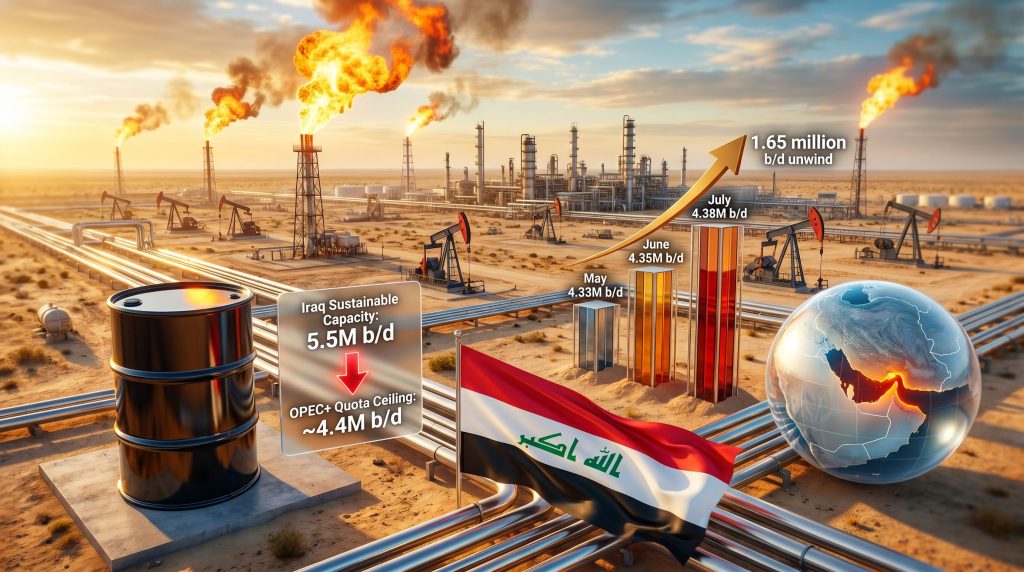
The arithmetic at the centre of this dispute is striking in its scale. Iraq's assessed sustainable production capacity sits at approximately 5.5 million barrels per day (b/d), a figure reflecting the country's substantial upstream investment over the past decade and its position as holder of the world's fifth-largest proven oil reserves. Yet its current OPEC+ quota ceiling sits at roughly 4.4 million b/d, leaving a structural shortfall of approximately 1.1 million b/d between what Iraq can produce and what the alliance formally permits.
This is not a marginal rounding difference. For a government that derives the overwhelming majority of its revenue from oil exports, a production ceiling that constrains output below physical capacity translates directly into constrained public expenditure, reduced reconstruction funding, limited capacity to service obligations, and compressed social spending in a country still managing significant post-conflict recovery requirements.
Baghdad is specifically pushing for a quota increase of up to 300,000 b/d as an interim step, while the longer-term ambition is to have its allocation formally recalibrated to reflect its full sustainable production potential. Iraq contends this recalibration should account not only for raw production data but also for the country's security circumstances, economic reconstruction needs, population size, and reserve base, all of which, in Baghdad's view, justify a materially larger share of collective OPEC+ output.
How the Exit Rumours Started and What Iraq's Official Response Actually Signals
The UAE Precedent and Its Ripple Effect Within the Alliance
The departure of the UAE from OPEC in early 2026 introduced a new variable into alliance dynamics that observers may have underestimated. For quota-constrained members, the UAE's exit was not merely a bilateral event between Abu Dhabi and Riyadh. It functioned as a proof of concept, demonstrating that a major producer with substantial capacity could calculate that the costs of alliance membership outweighed its benefits and act on that calculation without precipitating a disorderly market collapse.
Baghdad interpreted the UAE precedent as a structural opening. Consequently, with the alliance's cohesion now visibly imperfect, Iraq's negotiating position within OPEC+ was quietly strengthened by the implicit availability of an exit pathway, even if formally denied. Furthermore, OPEC's global influence over member states has clearly become more complex to maintain as individual producers reassess their strategic interests.
Iraq's Oil Ministry Denial: A Two-Track Diplomatic Strategy
Iraq's Oil Ministry moved to categorically reject reports circulating in mid-2026 that Baghdad had been weighing a formal withdrawal from OPEC, stating that such claims did not represent the government's official position and that neither the prime minister nor the cabinet had advanced any such proposal.
Critically, however, the denial arrived alongside a restatement of Iraq's demand for a substantial upward revision to its production ceiling. This combination is characteristic of a deliberate two-track diplomatic posture: managing market sentiment through reassurance while simultaneously applying pressure through the back channel of quota reform advocacy.
In OPEC politics, official denials frequently operate as confidence management tools rather than genuine foreclosures of strategic options. The denial of exit and the demand for reform are not contradictory positions; they represent calibrated signalling designed to extract concessions through institutional channels while preserving the option of escalation.
Iraq's Production Reality in 2026: A Table of Disconnected Numbers
The gap between Iraq's assigned targets and its actual output in May 2026 illustrates how geopolitical disruption can completely decouple quota mechanics from physical market reality.
| Metric | Figure |
|---|---|
| Iraq's sustainable production capacity | ~5.5 million b/d |
| Current OPEC+ quota ceiling (approximate) | ~4.4 million b/d |
| Assigned production target for June 2026 | 4.35 million b/d |
| Assigned production target for July 2026 | 4.38 million b/d |
| Actual Iraqi output (May 2026 estimate) | ~1.55 million b/d |
| Quota increase Baghdad is seeking | Up to 300,000 b/d |
The figure that commands the most attention in that table is Iraq's May 2026 actual output of just 1.55 million b/d against a target of 4.33 million b/d. That is not a compliance shortfall in the traditional OPEC+ sense. It reflects a near-total disruption of export capacity caused by factors largely outside Baghdad's immediate control.
The Hormuz Variable: Why Iraq's Export Dependency Is a Systemic Vulnerability
The US-Iran conflict that preceded the interim deal struck in mid-2026 forced Mideast Gulf producers, including Iraq, to drastically curtail shipments through the Strait of Hormuz. The disruption exposed a structural characteristic of Iraq's export model that is often underweighted in quota discussions: Baghdad's export infrastructure is almost entirely dependent on Strait of Hormuz transit, leaving it uniquely exposed to any disruption in that waterway.
Compounding the Hormuz disruption were longstanding challenges with the Kurdistan Regional Government (KRG) pipeline network serving northern Iraqi export volumes, which have intermittently constrained the country's ability to utilise its full northern export corridor as an alternative route. These oil geopolitical risks represent a layer of vulnerability that no quota negotiation can fully resolve.
Following the US-Iran interim deal, Iran established the Persian Gulf Strait Authority (PGSA) to administer transit through the waterway. While the interim arrangement calls for passage to return to pre-war levels within approximately 30 days of the agreement, Iran has signalled its intent to maintain administrative oversight of Hormuz traffic on a permanent basis, a position that introduces a new and structurally novel layer of transit uncertainty for all Persian Gulf exporters, Iraq included.
The normalisation of Hormuz transit is not simply a logistical prerequisite for Iraq to close the gap between its quota and actual output. It is a geopolitical condition that Baghdad cannot control unilaterally and that now involves a complex institutional arrangement between Iran, Oman, and the United States.
What the OPEC+ MSC Review Means and Why 2027 Is a Pivotal Year
At the centre of Iraq's formal strategy for quota reform is the Maximum Sustainable Capacity (MSC) assessment process agreed within OPEC+. Understanding how this mechanism works is essential to evaluating whether Baghdad has a credible institutional path to achieving its production ambitions without resorting to unilateral action.
The MSC review is an independent evaluation of each member country's realistic long-term production ceiling, conducted by an independent US-based consulting firm according to an agreed timetable. The results of this assessment are designed to establish new production baselines that will take effect from 2027 onwards, replacing older quota allocations that several members, including Iraq, argue no longer reflect their current resource base, infrastructure investment, or production capacity.
Iraq is confirmed to be actively participating in the assessment process. For Baghdad, this represents the legitimate institutional channel through which it can formally argue that its allocation should reflect its 5.5 million b/d capacity ambition, supported by evidence of reserve size, upstream investment, and demonstrated production potential.
The systemic risk embedded in the MSC review is equally important to recognise. If the independent assessment delivers a baseline that falls materially short of Iraq's aspirations, the likelihood of Baghdad pursuing a de facto overproduction strategy, or escalating toward formal exit, increases substantially. The review is both a potential resolution mechanism and a potential detonator, depending on its outcome.
The 1.65 Million b/d Unwind: Iraq Within the Broader Restoration Framework
Iraq's incremental quota increases over recent months are occurring within the context of a coordinated OPEC+ effort to restore previously curtailed output across the alliance. On 8 June, eight core OPEC+ members agreed to add 188,000 b/d to their collective July production target, forming part of the phased unwind of 1.65 million b/d in prior voluntary cuts.
Iraq's target trajectory under this restoration process has moved from 4.33 million b/d in May to 4.35 million b/d for June and 4.38 million b/d for July. The alliance's stated expectation is that all voluntary cuts will be fully unwound over the coming months. In addition, OPEC demand forecasts will play a significant role in shaping how aggressively the alliance pursues this restoration timeline.
Comparing Alliance Positions on Output Restoration
| Member | Stance on Restoration | Quota Pressure Level |
|---|---|---|
| Iraq | Supports restoration; demands additional capacity review | High – seeking 300,000 b/d above current ceiling |
| UAE | Exited OPEC; pursuing independent production strategy | Resolved via exit |
| Saudi Arabia | Leads output management; balancing price stability and market share | Moderate |
| Kazakhstan | Frequently exceeds assigned quota; faces ongoing compliance scrutiny | High |
| Russia | Committed to cuts; compliance record variable | Moderate-High |
Kazakhstan's position on this table is worth noting separately. The country's persistent pattern of producing above its assigned quota without facing meaningful enforcement consequences has not been lost on other quota-constrained members. It demonstrates that selective non-compliance within OPEC+ carries lower institutional costs than formal exit, a calculus that likely features in Baghdad's internal strategic assessment.
The next major ASX story will hit our subscribers first
Three Scenarios for Iraq if the MSC Review Disappoints
Scenario 1: Successful MSC Renegotiation (Base Case)
The 2027 baseline review delivers a materially higher production allocation for Iraq, with incremental interim increases agreed in the lead-up to that date. Baghdad secures a pathway toward an allocation that meaningfully reflects its sustainable capacity, alliance cohesion is maintained, and Iraq remains a committed OPEC+ participant.
- Key dependency: Saudi Arabia's willingness to accommodate Iraq's demands without creating a precedent that triggers equivalent claims from Kazakhstan, Iran, and others.
Scenario 2: Stalemate and De Facto Overproduction (Elevated Risk Case)
The MSC review delivers a modest increase that falls short of Iraq's 5.5 million b/d ambition. Baghdad pursues a strategy of selective overproduction, mirroring patterns historically observed in Nigeria, Angola, and currently Kazakhstan, while maintaining formal alliance membership.
- Market implication: Gradual upward pressure on global crude supply, progressive erosion of OPEC+ credibility as a price management mechanism, and potential repricing of the alliance's production discipline premium in crude benchmarks. Monitoring crude price trends will be essential for investors navigating this scenario.
Scenario 3: Formal Exit Following the UAE Precedent (Tail Risk Case)
Quota negotiations collapse in the aftermath of a disappointing MSC review. Iraq formally exits OPEC, pursues bilateral production agreements, and ramps output toward its sustainable capacity ceiling without alliance constraints.
- Market implication: Significant bearish signal for crude prices, potential fragmentation of the OPEC+ coalition, and an acceleration of output from other quota-constrained members who interpret Baghdad's exit as clearing a path for their own departures.
Risk Assessment: The tail-risk scenario remains formally off the table according to Iraq's Oil Ministry. However, the combination of fiscal pressure, the UAE exit precedent, and the structural gap between Iraq's capacity and its current ceiling creates a set of conditions that, if the MSC review disappoints materially, could shift the probability calculus in ways that crude markets may not be fully pricing today.
A Long Campaign With Deep Historical Roots
Iraq's frustration with its OPEC quota is not a recent development. Successive Iraqi governments spanning more than a decade have consistently advanced the argument that Baghdad's allocation undervalues the country's reserve base and production trajectory. This is a structural grievance with institutional continuity, not a transient political complaint.
Former Prime Minister Mohammed Shia al-Sudani was particularly vocal on this point, arguing before taking office in October 2022 that OPEC+ production agreements were structurally unfavourable to Iraq's interests and pledging to seek a formal review if appointed to the role. He maintained that position throughout his tenure, most recently in October 2024, when he publicly called for a formal reassessment of Iraq's production quota on the grounds that the existing allocation no longer reflected the country's resource development trajectory or its reconstruction requirements. The current administration under Prime Minister Ali al-Zaidi has maintained that advocacy position without interruption.
The structural problem this creates for OPEC+ is significant. Iraq's case for a higher allocation has genuine merit on resource grounds. However, if Baghdad's quota is raised to reflect its full production capacity, members including Kazakhstan and potentially Iran hold equivalent arguments that would be difficult to reject without appearing institutionally inconsistent. Furthermore, the zero-sum nature of quota allocation within a production-capped alliance means that accommodating Iraq's ambitions requires either accepting higher collective output or compressing another member's entitlement, neither of which resolves cleanly within the current consensus architecture.
Frequently Asked Questions: Iraq, OPEC, and the Quota Dispute
Is Iraq leaving OPEC?
Iraq's Oil Ministry has explicitly rejected reports of any planned withdrawal, confirming that such claims do not represent the government's official position. Baghdad is engaging through the alliance's established review mechanisms, including the MSC assessment process. Iraq wants OPEC to approve higher oil exports rather than pursuing a formal exit, according to most analysts tracking the dispute.
What production level is Iraq targeting?
Iraq is seeking a quota increase of up to 300,000 b/d above its current ceiling as an interim measure, with a longer-term ambition to have its allocation reflect its 5.5 million b/d sustainable production capacity.
When does the OPEC+ MSC review take effect?
The Maximum Sustainable Capacity review, conducted by an independent US-based consulting firm, is expected to reshape production baselines from 2027 onwards.
Why did Iraq's actual output fall so far below its target in May 2026?
Disruptions to Strait of Hormuz shipping routes caused by the US-Iran conflict forced Mideast Gulf producers to significantly curtail exports, driving a wide gap between Iraq's assigned target of 4.33 million b/d and its actual May output of approximately 1.55 million b/d.
What are the broader market implications if Iraq exits OPEC?
A formal Iraqi exit would likely exert bearish pressure on crude prices by removing a major producer from the alliance's collective output management framework and could trigger a broader unravelling of production discipline among other quota-constrained members. The oil prices and geopolitics dimension of such a scenario would have far-reaching consequences beyond the immediate supply balance shift.
What Energy Markets Should Monitor Heading Into 2027
The resolution of Iraq's quota campaign represents one of the most consequential near-term variables for global crude supply balances as the market approaches the 2027 MSC baseline reset. Several specific indicators warrant close attention:
- Iraq's actual production trajectory relative to its incrementally rising monthly targets, particularly as Hormuz transit normalises following the US-Iran interim deal
- The MSC review process timeline and any signals emerging from the independent assessment, including whether the consulting firm's preliminary findings align with Iraq's capacity claims
- OPEC+ ministerial meeting outcomes and whether Baghdad's quota demands gain any formal traction within the alliance's consensus-based decision structure
- Hormuz transit normalisation progress under the newly established PGSA framework and the Iran-Oman joint working group, which will determine how quickly Iraq can physically close the gap between its rising targets and actual export volumes
- Kazakhstan's compliance trajectory, which will shape the political space available to Saudi Arabia when responding to Iraq's demands without appearing to apply selective enforcement
The interplay between these variables will determine whether OPEC+ enters 2027 as a cohesive production management mechanism or as an alliance under structural strain from multiple directions simultaneously. For energy markets, that distinction carries meaningful price consequences in both directions. Indeed, Iraq denies Opec exit reports seeks higher output cap, yet the underlying tensions that generated those reports remain firmly unresolved, ensuring this dispute will continue to shape how analysts and traders assess the reliability of OPEC+ as a market stabilisation force through the remainder of this decade.
Want to Stay Ahead of Commodity Market Shifts Driven by Geopolitical Disruption?
Discovery Alert's proprietary Discovery IQ model delivers real-time alerts on significant ASX mineral discoveries, transforming complex commodity market dynamics into actionable investment insights — explore historic discoveries and their market returns to understand the scale of opportunity that early positioning can generate, then begin a 14-day free trial at Discovery Alert to secure a market-leading edge before the next major move.