June 25, 2026
The Hidden Tension in Global Steel Supply Chains Most Analysts Are Missing
When a steel mill in Ohio produces its first fully degassed 12-inch slab, the immediate reaction from most observers is to frame it as a domestic manufacturing win. That framing is not wrong, but it is incomplete. The more consequential question is not what was produced, but what it signals about the directional intent of US steelmakers to reduce their structural dependence on imported semi-finished material. JSW Steel USA slab production and Brazilian slab exports, when examined alongside a deteriorating Brazilian export environment and a global slab market recalibrating after months of artificial tightness, reveals a steel trade dynamic far more complex than a single facility upgrade would suggest.
When big ASX news breaks, our subscribers know first
Why Domestic Slab Capability Is Not the Same as Domestic Slab Independence
There is a meaningful distinction in steel market analysis between capacity expansion and capability expansion, and it is one that frequently gets collapsed in coverage of new facility milestones. JSW Steel USA's more than $145 million upgrade programme at its Mingo Junction, Ohio facility falls firmly into the second category. The investment, which included the installation of a twin-tank vacuum degasser and a full rebuild of one caster strand with dynamic soft reduction technology, did not materially increase the facility's output ceiling. The electric arc furnace (EAF) at Mingo Junction retains its published nameplate capacity of 1.5 million short tons per year.
What Did the Upgrade Actually Change?
What changed is the type of slab the mill can now produce. Specifically, the facility can now manufacture fully degassed slabs in both 9-inch and 12-inch dimensions. According to JSW Steel USA, only a handful of domestic mills in the United States are capable of producing fully degassed slabs in these configurations. That scarcity matters because fully degassed slab is not a commodity product. It is a precision input required for high-specification downstream applications, including heavy plate products and longitudinal submerged arc-welded (LSAW) pipe, both of which are manufactured at JSW Steel USA's Baytown, Texas operations.
The internal supply chain logic is straightforward: Mingo Junction now produces the slab that Baytown needs, reducing dependence on external procurement for grades that previously could not be sourced domestically from within the JSW group. JSW Steel USA confirmed this explicitly, noting that the upgrade advances its positioning as a producer of steel that is melted and manufactured in the USA, covering plate, hot-rolled coil, and pipe products.
Critically, however, the company declined to disclose what proportion of the EAF's annual capacity is actually allocated to slab production versus other product forms. That opacity is not a minor footnote. It is the central variable that prevents any precise quantification of import displacement risk. Without slab allocation data, market participants are left estimating the impact in a vacuum.
JSW Steel USA Slab Production and Brazilian Slab Exports: The Supply Chain Collision
The timing of JSW Steel USA's capability milestone intersects with a Brazilian slab export environment that is already under significant strain. Understanding the full picture requires examining both sides of the trade relationship simultaneously rather than in isolation. Furthermore, the global steel outlook for 2025 and beyond adds additional context to these shifting supply dynamics.
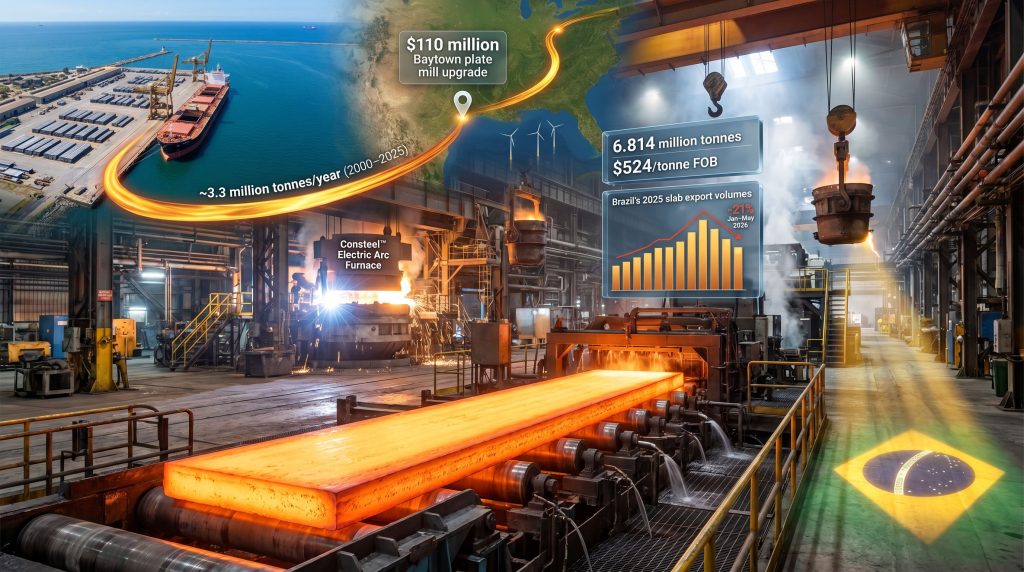
Brazil has historically been the single largest source of imported slab for the United States. According to Brazilian customs data sourced from the Ministry of Development, Industry, Trade and Services (MDIC) Comex Stat, Brazilian semi-finished steel exports to the US averaged approximately 3.3 million tonnes per year between 2000 and 2025. Major Brazilian exporters with US-directed volumes include Ternium at approximately 183,700 tonnes and ArcelorMittal Tubarão at approximately 155,000 tonnes, though these represent only a portion of the total flow.
That structural relationship is now showing signs of meaningful erosion. In the January to May 2026 period, Brazilian semi-finished steel exports to the US totalled approximately 2.08 million tonnes, representing a year-on-year decline of around 21% from the 2.63 million tonnes shipped in the same period of 2025. That decline coincides directly with the escalation of US steel tariffs to 50% on imported steel, which came into effect in June 2025.
| Period | Brazilian Semi-Finished Exports to US | Year-on-Year Change |
|---|---|---|
| Jan–May 2025 | ~2.63 million tonnes | Baseline |
| Jan–May 2026 | ~2.08 million tonnes | -21% |
| Full-year 2025 average (per tonne FOB) | $524/tonne | +24% vs. 2024 |
| Full-year 2025 total export volume | 6.814 million tonnes | +24% YoY |
An important nuance here is that the apparent surge in early 2026 export volumes, where Brazilian semi-finished shipments to the US reportedly increased by approximately 117% in early months, reflects pre-tariff front-loading behaviour rather than genuine demand recovery. December 2025 alone saw 762,400 tonnes exported, up from 641,500 tonnes in November 2025, a pattern consistent with buyers accelerating purchases ahead of anticipated policy changes rather than expanding their structural import programmes.
Analytical Caution: Front-loading effects in commodity trade flows routinely obscure the underlying demand trajectory. A volume surge immediately preceding a tariff event should be interpreted as demand brought forward, not demand created. The 21% Jan–May 2026 decline, read alongside the December 2025 surge, strongly suggests accelerated pre-positioning rather than durable appetite expansion.
The European Demand Withdrawal and Its Delayed Consequences
Compounding Brazil's US export difficulties is a simultaneous softening in European demand, which had provided an alternative outlet during periods of reduced US offtake. The European dynamic in the first half of 2026 was heavily shaped by ArcelorMittal Brasil's decision to prioritise intra-group shipments to its European rolling mills, following maintenance shutdowns at both the Fos-sur-Mer and Dunkirk facilities in France.
According to Fastmarkets reporting from February 2026, European mills booked more than 300,000 tonnes of Brazilian slab during this period. The underlying driver was the EU Carbon Border Adjustment Mechanism (CBAM), which has elevated the cost of carbon permits for European steelmakers to levels where sourcing imported slab feedstock and running rolling-only operations became more economically rational than operating integrated steelmaking at full capacity.
However, the maintenance-driven demand cycle is now reversing. Dunkirk has already partially restarted operations, and ArcelorMittal signalled a potential Fos-sur-Mer resumption in June 2026. As these facilities return to normal output, the need for externally sourced slab feedstock diminishes, removing a temporary support mechanism for Brazilian export volumes.
How Are Buyers Responding to Supply Disruptions?
The broader behavioural consequence deserves attention. When a major supplier prioritises internal allocation over spot market commitments during a period of tight availability, buyers are incentivised to accelerate their search for alternative supply arrangements. That behaviour was confirmed by trader sources in the market, who noted that tight spot availability in early 2026 prompted some buyers to secure and develop alternative procurement channels. The commercial risk in this dynamic is asymmetric: once a buyer establishes an alternative supply relationship, switching costs create inertia that can persist well beyond the original supply disruption.
Brazilian Slab Price Dynamics: From Rally to Correction
The price trajectory for Brazilian slab through late 2025 and into 2026 encapsulates the broader supply story in condensed form. In addition, the influence of tariffs and iron ore on raw material costs has further complicated pricing signals across the semi-finished steel complex.
| Period | Brazilian Slab FOB Price | Trend Direction |
|---|---|---|
| November 2025 | Rally begins | ↑ Rising |
| January 2026 | ~$515/tonne (seven-month high) | ↑ Peak approach |
| April 2026 | Continued elevation | ↑ Six consecutive monthly increases |
| May 4, 2026 | First downward movement recorded | ↓ Turning point |
| Week of June 19, 2026 | $575–$590/tonne | ↓ Third consecutive weekly decline |
| Change since May 4, 2026 | -4.18% | ↓ Correction underway |
Fastmarkets' weekly price assessment for steel slab export, fob main port Brazil, was assessed at $575–590 per tonne on June 19, 2026, down $5–10 per tonne from the prior week's $580–600 per tonne. The six-month price rally that preceded this correction was itself a product of the ArcelorMittal-driven supply tightness in European markets. As that tightness resolves, spot availability normalises and buyers exercise their newly diversified procurement options, and regional slab market prices demonstrate that downward price pressure is a logical consequence across multiple geographies.
Scenario Analysis: Three Futures for US Slab Import Dependency
The critical unknown in this equation is how much of JSW Steel USA's Ohio EAF capacity is actually dedicated to slab production. Without that number, the displacement question cannot be answered definitively. However, scenario analysis provides a structured way to think through the range of plausible outcomes.
| Scenario | Description | Key Trigger |
|---|---|---|
| Marginal Displacement | Ohio output replaces a modest fraction of imported slab; overall import volumes remain structurally necessary | Limited slab allocation from EAF; Baytown demand grows modestly |
| Progressive Substitution | As renewable energy and infrastructure procurement scales, Ohio slab progressively displaces imported material at Baytown | Offshore wind monopile and LSAW pipe orders accelerate significantly |
| Hybrid Blended Model | JSW maintains domestic slab for premium and specification-critical grades while continuing to import for volume balancing | Consistent with Brazilian producer source commentary |
The hybrid model is arguably the most consistent with the available evidence. JSW Steel USA confirmed that imported slab is expected to remain part of its supply strategy despite the Mingo Junction capability expansion. What changes is the mix rather than the complete elimination of imports, at least in the near term.
The Baytown facility's exposure to offshore wind energy adds a longer-term variable that is genuinely difficult to model. The $110 million Baytown plate mill upgrade targeting monopile steel plates for offshore wind creates a potential demand channel where domestic slab sourcing may be commercially or reputationally advantageous. Whether that translates into material volume reduction in Brazilian import demand depends on the pace of offshore wind project execution and the specification requirements of individual procurement contracts. Consequently, developments in green steel pricing may also influence how buyers weigh domestically produced versus imported slab feedstock in their procurement decisions.
The next major ASX story will hit our subscribers first
What Brazilian Exporters Must Do Differently
Three distinct pressure vectors are converging simultaneously on Brazilian slab exporters, and the strategic response needs to address all three rather than hoping for any single factor to reverse.
-
US market deterioration driven by the 50% Section 232 tariff environment and incremental domestic capability growth at facilities like Mingo Junction
-
European demand normalisation as ArcelorMittal's maintenance-driven import requirements ease and intra-group supply relationships are re-established
-
Buyer diversification momentum accelerated by the early 2026 supply tightness episode, which incentivised procurement teams to establish alternative sourcing relationships
The strategic options available to Brazilian producers are well understood in theory but demanding in execution:
-
Volume diversification across non-US and non-EU markets to reduce bilateral concentration risk, particularly into Asian and Latin American markets as regional steel demand is projected to recover toward 2027
-
Grade and specification upgrading to compete on product quality in premium segments where domestic US alternatives remain limited
-
Long-term offtake agreements that lock in committed volumes with key buyers, reducing exposure to spot market volatility and buyer diversification behaviour
-
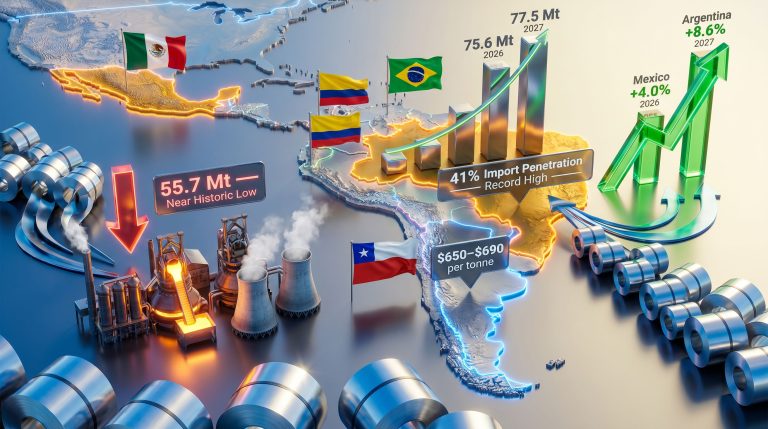
Intra-regional Latin American positioning as apparent steel consumption in the region is expected to stabilise in 2026 before recovering more meaningfully in 2027, according to the Latin American steel association Alacero
Furthermore, the pressures facing Brazilian exporters mirror broader shifts in the china steel market, where overcapacity and shifting demand patterns are forcing exporters globally to reconsider their market positioning strategies.
Strategic Perspective: The steel slab market rewards structural relationships over spot market opportunism during periods of supply normalisation. Brazilian producers that prioritised intra-group European allocations during the 2025–2026 tightness cycle may find themselves facing a more competitive landscape for spot business precisely when available demand contracts.
The Variables That Will Define the Second Half of 2026
For participants monitoring JSW Steel USA slab production and Brazilian slab exports, the following data points will be most instructive in the months ahead:
-
Whether JSW Steel USA discloses any slab allocation figures from the Ohio EAF, which would allow market participants to size the displacement effect with greater precision
-
The timing and operational status of the ArcelorMittal Fos-sur-Mer restart, which directly affects the European demand outlet for Brazilian material
-
Brazilian slab FOB price direction as supply availability continues to normalise and the early 2026 front-loading effect fully works through the system
-
The trajectory of Section 232 tariff policy within the current US trade framework, which remains the single largest structural variable for import economics
-
Offshore wind monopile procurement decisions in the US market, which could clarify the medium-term slab demand picture at Baytown
The weight of current evidence points to incremental structural adjustment rather than a decisive rupture in US-Brazil slab trade flows. JSW Steel USA's Ohio capability milestone is genuinely significant as a technical achievement and a signal of long-term strategic intent, but the absence of volume transparency limits its near-term market impact. Brazilian exporters retain substantial scale advantages and deeply established customer relationships. What has changed is the direction of travel, and in commodity markets, directional momentum has a way of compounding before it becomes obvious.
Disclaimer: This article is intended for informational purposes only and does not constitute investment, financial, or trading advice. All price references and volume statistics are sourced from Fastmarkets and Brazilian customs data (MDIC Comex Stat). Forward-looking statements and scenario analyses involve uncertainty and should not be treated as forecasts or guarantees of future market outcomes.
Want to Stay Ahead of the Next Major Mineral Discovery on the ASX?
While global steel supply chains continue to shift, significant commodity discoveries on the ASX can emerge rapidly — and Discovery Alert's proprietary Discovery IQ model delivers real-time alerts the moment they are announced, turning complex mineral data into actionable opportunities for both traders and long-term investors. Explore historic examples of exceptional discovery returns and begin a 14-day free trial today to ensure you are positioned ahead of the broader market.