June 25, 2026
When Consumption Holds But Production Doesn't: Latin America's Steel Paradox
There is a particular kind of structural tension that builds slowly in commodity markets before becoming impossible to ignore. It emerges not from a sudden collapse in demand or a production crisis, but from a quiet and persistent divergence between what a region consumes and what it actually makes. The Latin America steel imports and demand forecast for 2026 and 2027 reveals just how deep this imbalance has become, with the region's steel industry living that tension right now.
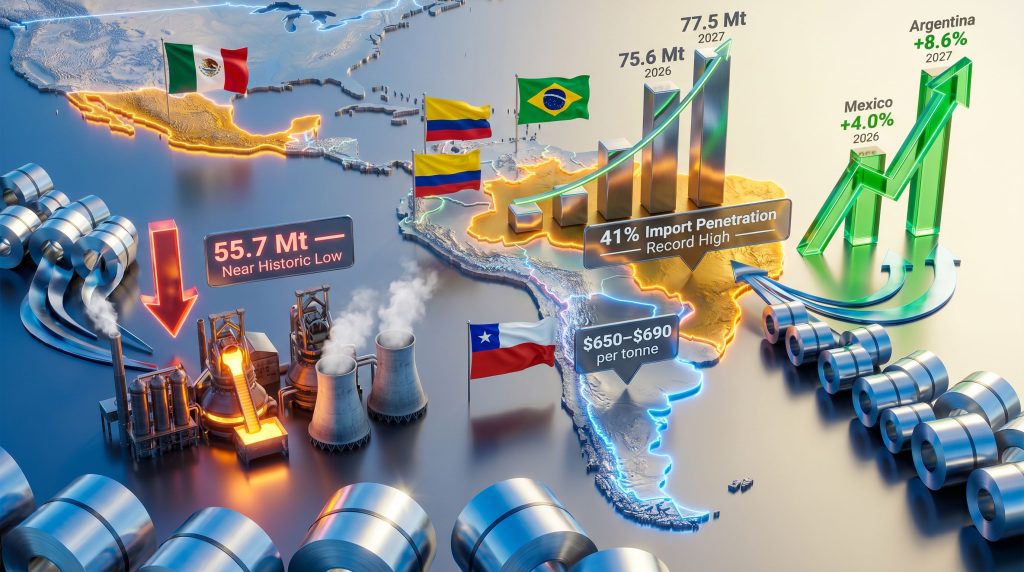
Regional consumption has remained broadly stable for several years, hovering between 74 and 75 million tonnes annually. Yet domestic production has fallen to levels not seen in over a decade and a half, with crude steel output across the region totalling approximately 55.7 million tonnes in 2025 — a figure that sits below what the region produced during the disruption of the Covid-19 pandemic in 2020. The gap between what Latin America consumes and what it produces is being filled by one source above all others: imports.
When big ASX news breaks, our subscribers know first
The Import Penetration Story the Numbers Tell
Import penetration has reached a record 41% of regional apparent steel consumption in 2025. To put that figure in practical terms, more than four out of every ten kilograms of steel consumed across the region now originates from a foreign producer. This is not a temporary blip driven by supply disruptions. It reflects a structural realignment of the regional supply balance that has been building across multiple years.
Total steel imports into Latin America have climbed from roughly 20 million tonnes several years ago to more than 30 million tonnes currently, according to data from Alacero, the Latin American Steel Association. Finished steel production, by contrast, totalled 42.0 million tonnes in 2025 and is forecast to edge upward only marginally to 42.2 million tonnes in 2026, an increase of just 0.5% against a backdrop of broadly stable consumption.
Early 2026 trade data reinforces the trend:
| Period | Import Volume | Year-on-Year Change | Trade Deficit |
|---|---|---|---|
| February 2026 | 2.46 million mt | +7.8% | 1.94 million mt |
| January–February 2026 | 5.02 million mt | +3.1% | 3.93 million mt |
The regional trade deficit in finished steel during just the first two months of 2026 already exceeded 3.9 million tonnes, underscoring the scale at which foreign material is displacing potential domestic production. Furthermore, as the global crude steel outlook continues to reflect excess capacity in key producing nations, Latin American markets remain particularly exposed to this displacement dynamic.
Demand Forecasts for 2026 and 2027: A Transition, Not a Recovery
Alacero's current demand outlook describes 2026 as a transition year. Apparent steel consumption across Latin America is forecast to reach 75.6 million tonnes in 2026, representing growth of just 0.5% year on year. This is a significant revision from the association's earlier projection of 2.8% growth made in February 2026, representing a downward cut of 2.3 percentage points within a matter of months.
The more meaningful recovery is anticipated in 2027, when regional consumption is projected to reach 77.5 million tonnes, implying growth of 2.5%. This would represent the strongest annual expansion in the current forecast cycle, though it remains contingent on several conditions aligning.
Country-by-Country Breakdown: Where Growth Is and Isn't Coming From
The regional aggregate masks significant divergence at the country level. Mexico and Brazil are expected to anchor near-term demand growth, while Argentina and Colombia face short-term contractions.
| Country | 2025 Consumption (Mt) | 2026 Forecast (Mt) | 2026 YoY (%) | 2027 Forecast (Mt) | 2027 YoY (%) |
|---|---|---|---|---|---|
| Brazil | 26.8 | 27.0 | +0.9% | 27.7 | +2.5% |
| Mexico | 25.0 | 26.0 | +4.0% | 26.8 | +3.2% |
| Argentina | 4.0 | 3.9 | -0.8% | 4.3 | +8.6% |
| Colombia | 3.9 | 3.8 | -2.4% | 3.9 | +3.3% |
| Other Markets | 15.6 | 14.9 | -4.9% | 14.8 | -0.6% |
| LATAM Total | 75.2 | 75.6 | +0.5% | 77.5 | +2.5% |
Source: Alacero (Latin American Steel Association)
Mexico leads the region with projected demand growth of 4.0% in 2026, supported by the government's introduction of tariffs covering more than 1,400 imported product categories and by nearshoring-driven manufacturing investment. The automotive sector has provided additional momentum, with vehicle production recording an 18.6% surge in March 2026.
Argentina presents the highest variance in the outlook. A near-term contraction of 0.8% in 2026 reflects construction weakness and elevated inventory levels following heavy import volumes in 2025. The projected 8.6% rebound in 2027 would be driven primarily by capital expenditure in energy and mining, making it the single highest upside scenario in the regional forecast.
February 2026 country-level consumption provided further granularity: regional apparent consumption reached 6.01 million metric tons for the month, up 4.2% year on year, while the January to February cumulative total reached 12.18 million metric tons, up just 0.4%. Argentina's February reading fell 6.4% to only 196,000 metric tons, illustrating the structural headwinds facing that market in the near term.
Why the Forecast Was Cut: The Inventory Correction Mechanism
Understanding the 2026 forecast revision requires understanding how steel inventory dynamics interact with apparent consumption metrics. Apparent consumption is calculated as domestic production plus imports minus exports, and it does not directly measure actual end-use demand. When import volumes surge and a portion of that material is absorbed into distributor and warehouse inventories rather than entering active use, apparent consumption is inflated temporarily.
The sequence that followed 2025's record import wave unfolded in four stages:
- Record import volumes entered the region throughout 2025, with totals exceeding 30 million tonnes.
- A meaningful portion of that material was held in distributor inventories rather than flowing directly to end users.
- Elevated inventory levels led downstream buyers to reduce new purchase orders in early 2026, suppressing reported consumption growth.
- The correction is expected to work through the supply chain across 2026, clearing the path for a genuine demand-driven recovery in 2027.
Compounding this dynamic was weakness in the construction sector, which accounts for approximately 50% of regional steel demand. Construction activity contracted 1.3% in February 2026, reflecting softer housing markets and delayed infrastructure project timelines in Argentina, Colombia, and several smaller regional economies.
The Global Overcapacity Engine Driving Regional Import Pressure
No analysis of the Latin America steel imports and demand forecast is complete without examining the external forces supplying that import pressure. Global steelmaking excess capacity is projected by the OECD to expand from approximately 640 million tonnes in 2025 to 721 million tonnes by 2027, an increase of 81 million tonnes in just two years.
The geographic concentration of this surplus capacity is significant:
| Region | New Surplus Capacity Contribution (by 2027) |
|---|---|
| China | ~47.3 million tonnes |
| India | ~30.4 million tonnes |
| ASEAN | ~14.8 million tonnes |
| Other regions | Remaining balance |
| Total New Surplus | ~165 million tonnes |
China's position warrants particular attention. The China steel outlook reflects a domestic demand environment characterised by a contracting property sector and a maturing infrastructure investment cycle. Yet Chinese crude steel production continues to run near 1 billion tonnes per year, sustained by state-linked production incentives and competitive cost structures. The resulting exportable surplus of approximately 200 million tonnes is roughly four times Latin America's entire annual steel output.
What makes this dynamic more complex is that China's export reach extends beyond direct shipments. Chinese steelmakers have established significant manufacturing investments across Southeast Asia, particularly in Vietnam, creating additional production capacity in jurisdictions that are not subject to the same trade barriers as Chinese-origin material. Exports from Vietnam, South Korea, Egypt, and Turkey have all grown in relevance to Latin American import flows, effectively broadening the channels through which the global overcapacity problem enters the region.
The effective supply overhang bearing down on Latin American steel markets extends well beyond what Chinese export statistics alone would suggest, once secondary production routes through Chinese-invested overseas facilities are factored in.
Trade Defense: Which Countries Are Acting and Which Are Exposed
The policy response across Latin America has been uneven, which itself creates a new risk dimension: trade diversion. As the United States and the European Union tighten barriers against subsidised steel imports, displaced volumes search for markets with lower resistance. Latin American countries without active trade defence frameworks become the natural destination. Indeed, the broader issue of tariffs and iron ore markets illustrates how shifts in trade policy in major economies routinely redirect commodity flows toward less-protected regions.
The current trade defence landscape across the region:
| Country | Trade Defense Action | Objective |
|---|---|---|
| Brazil | Anti-dumping and safeguard measures | Protect domestic flat steel producers |
| Mexico | Tariffs on 1,400+ imported product categories | Limit import penetration |
| Colombia | Import duties on steel products | Support domestic industry |
| Peru | Trade defence instruments | Counter subsidised imports |
| Chile | Increased tariffs on Chinese steel | Level competitive conditions |
Early evidence suggests that where measures have been implemented, the results are beginning to register. In Mexico and Argentina, import volumes declined during the January to February 2026 period, contrasting with continued increases in Brazil and Colombia. Hot-rolled coil import prices at major South American ports were assessed at $650 to $690 per tonne in mid-June 2026, down $15 to $20 per tonne from the prior week's assessment of $665 to $710 per tonne, reflecting ongoing pricing pressure from surplus global supply.
Alacero has identified the protection gap across smaller regional markets as a systemic vulnerability. The risk is asymmetric: countries that have not yet deployed trade instruments face accelerating import penetration, while those that have acted are already showing early signs of stabilisation. Industry groups, as reported by Fastmarkets, are actively calling for stronger safeguards and a clearer regulatory landscape heading into 2026.
The next major ASX story will hit our subscribers first
The Deindustrialisation Concern: Steel as a Barometer of Industrial Health
The steel sector's challenges sit within a broader economic narrative that extends well beyond commodity markets. Manufacturing's share of Latin American GDP has declined over recent decades, with regional export profiles becoming progressively more weighted toward primary commodities rather than higher-value manufactured goods. This structural shift has been associated with an estimated four-percentage-point decline in manufacturing's contribution to GDP across the region.
Steel is an upstream enabler for a wide range of downstream industries. When domestic steel production weakens, the effects cascade through automotive manufacturing, construction materials, machinery production, and consumer durables. The erosion of steelmaking capacity is therefore not simply a sector-level problem but a potential drag on the entire industrial value chain.
The per capita consumption gap reinforces the stakes. Latin America currently consumes approximately 100 kilograms of steel per capita annually. Developed economies typically consume between 180 and 250 kilograms per capita, and industrialising economies such as China and South Korea consumed far more during their peak infrastructure build-out phases. This gap represents a structural growth ceiling that remains largely untapped, offering significant long-term potential if demand growth translates into expanded domestic production rather than simply higher import volumes.
Sector Performance and the 2027 Recovery Conditions
The sectoral composition of regional steel demand illustrates where 2027 recovery catalysts are most likely to emerge:
| Sector | Share of Regional Demand | Recent Trend |
|---|---|---|
| Construction | ~50% | Contracted 1.3% (Feb 2026) |
| Automotive | ~18% | Surged 18.6% (Mar 2026) |
| Metal Products | ~14% | Broadly stable |
| Machinery | ~13% | Strong in Brazil, Argentina, Chile |
| Household Appliances | ~2% | Declining |
| Electrical Equipment | ~2% | Declining |
| Other Transport | ~1% | Stable |
For the 2027 growth projection of 77.5 million tonnes to materialise, the following conditions must align:
- Construction sector recovery as infrastructure project pipelines advance and housing activity stabilises across key markets.
- Trade policy effectiveness in reducing the volume of unfairly traded imports reaching regional consumers.
- Inventory normalisation as elevated distributor stock levels are drawn down through 2026, restoring genuine procurement activity in early 2027.
- Energy and mining capital expenditure in Argentina generating steel-intensive project demand.
- Nearshoring-driven industrial investment in Mexico sustaining elevated manufacturing sector consumption.
Scenario Analysis: What Could Shift the 2027 Outcome?
| Scenario | Trigger | Impact on 2027 Demand |
|---|---|---|
| Upside | Accelerated infrastructure spending and trade protection effectiveness | Demand exceeds 78 million mt |
| Base Case | Inventory normalisation and moderate policy support | 77.5 million mt (+2.5%) |
| Downside | Trade diversion intensifies and construction remains weak | Demand falls short of 76 million mt |
| Tail Risk | Global recession combined with Chinese export acceleration | Material contraction in consumption and production |
The Competitive Foundation: Why Latin America's Long-Term Potential Remains Intact
Despite the pressures visible in the near-term data, the structural foundation for Latin American steelmaking competitiveness over a longer horizon is not without substance. The region holds abundant iron ore reserves, an expanding renewable energy capacity that could support lower-emission steelmaking processes over time, and an established industrial workforce with decades of sector experience. Brazil alone is among the world's largest iron ore producers, giving the regional industry a raw material cost advantage that few other steel-producing regions can replicate.
The transition toward lower-carbon production is also reshaping competitive dynamics globally. Green steel pricing trends indicate that producers able to leverage renewable energy inputs will hold a structural advantage as decarbonisation requirements tighten. Latin America's renewable energy endowment positions it well for this shift, provided domestic steelmakers can attract the capital investment required.
The question the industry is now confronting is whether that competitive foundation can be preserved through the current cycle of import pressure, or whether the sustained erosion of domestic production capacity will make it progressively harder to rebuild even as demand eventually grows. The concern is not that Latin American steel consumption will decline permanently. It is that future demand growth could increasingly benefit foreign producers rather than the region's own industrial base.
This deepening structural imbalance, already made visible by 2025 and 2026 data, has prompted warnings of deindustrialisation risk from industry bodies across the region. Furthermore, the China steel market challenges facing producers there are likely to sustain elevated export pressure on Latin American markets for the foreseeable future, making trade defence not merely a policy preference but an industrial necessity.
For the Latin America steel imports and demand forecast to deliver on its 2027 upside potential, the decisive variable may not be consumption growth at all. It may be whether the region's governments and industries can act decisively enough to ensure that the demand recovery is matched by a production recovery, rather than simply another year of record import penetration.
This article contains forward-looking forecasts and projections sourced from Alacero and the OECD. All demand, production, and trade figures referenced are subject to revision as market conditions evolve. This content does not constitute financial or investment advice.
Want to Stay Ahead of the Next Major Mineral Discovery on the ASX?
While Latin America navigates record steel import penetration and structural production gaps, commodity markets globally continue to generate significant discovery opportunities — and Discovery Alert's proprietary Discovery IQ model delivers real-time alerts the moment significant ASX mineral discoveries are announced, turning complex data across 30+ commodities into clear, actionable insights. Explore the historic returns major discoveries have generated and begin a 14-day free trial to position yourself ahead of the broader market.