June 25, 2026
The Architecture of Protection: How the UK's New Steel Quota System Reshapes Trade from July 2026
Global steel markets have spent the better part of a decade grappling with chronic overcapacity, largely driven by Asian producers operating at scales that dwarf Western competitors. The resulting downward pressure on prices has forced governments to construct increasingly sophisticated trade defence mechanisms. The United Kingdom's post-Brexit steel trade policy sits squarely within this broader strategic context, and the framework of UK steel safeguard quotas taking effect from 1 July 2026 represents its most significant structural recalibration yet.
When big ASX news breaks, our subscribers know first
Why the Outgoing Safeguard Measure No Longer Fits the Market
The safeguard regime governing UK steel imports since Brexit operated on a progressively liberalising basis, applying a 25% additional duty on above-quota volumes while gradually expanding quota allowances by roughly 3% annually. That architecture made sense as a transitional tool, but it was never designed as a permanent framework. As it approaches its expiry on 30 June 2026, the UK government opted not to extend or lightly modify the existing system but to replace it with something fundamentally different.
The incoming tariff-rate quota (TRQ) structure is distinguished from its predecessor in three critical ways: the above-quota penalty doubles to 50%, the duty-free volume allowance is sharply reduced compared to prior years, and quota administration shifts to a first-come, first-served daily allocation model. This is not arbitrary tightening — the policy rationale is anchored in evidence of continued global steel overcapacity and sustained competitive pressure from Asian exporters.
Furthermore, mounting concern about the long-term viability of the UK's domestic steelmaking capacity, at a moment when significant capital investment decisions are being weighed, has reinforced the case for a more protective framework. The broader global steel outlook for 2025 and beyond illustrates precisely why governments are tightening these mechanisms now.
How the New UK Steel Safeguard Quota System Works in Practice
Understanding the mechanics of the new TRQ framework is essential for importers, traders, and downstream buyers who need to plan procurement strategies around the changed cost environment.
Structural Comparison: Old Regime vs. New Framework
| Feature | Outgoing Safeguard (to 30 June 2026) | New TRQ System (from 1 July 2026) |
|---|---|---|
| Above-Quota Tariff | 25% | 50% |
| Duty-Free Volume | Annual 3% liberalisation | Reduced by ~51% vs. prior year |
| Quota Administration | Quarterly | Quarterly, first-come-first-served |
| Unused Quota Treatment | Not explicitly carried forward | Carry-forward up to 12 months |
| Product Scope | 20 steel product categories | Same 20 categories, defined by commodity codes |
| Ukraine Status | Standard rules applied | Fully exempt |
Step-by-Step: How Importers Access Quota Allocations
- Identify the applicable steel product category (1–28) and associated commodity code
- Check country-specific quota availability through the National Data Library, which updates on a daily basis
- Confirm that the shipment falls within the current quarterly window (Q1 opens 1 July 2026)
- Submit a customs declaration with an explicit quota claim entered in Box 39
- If the quota for that category is exhausted, assess whether landing the material at a 50% above-quota tariff is commercially viable
- Monitor carry-forward balances for subsequent quarters, as unused quota from any period can roll into the next, subject to a 12-month maximum
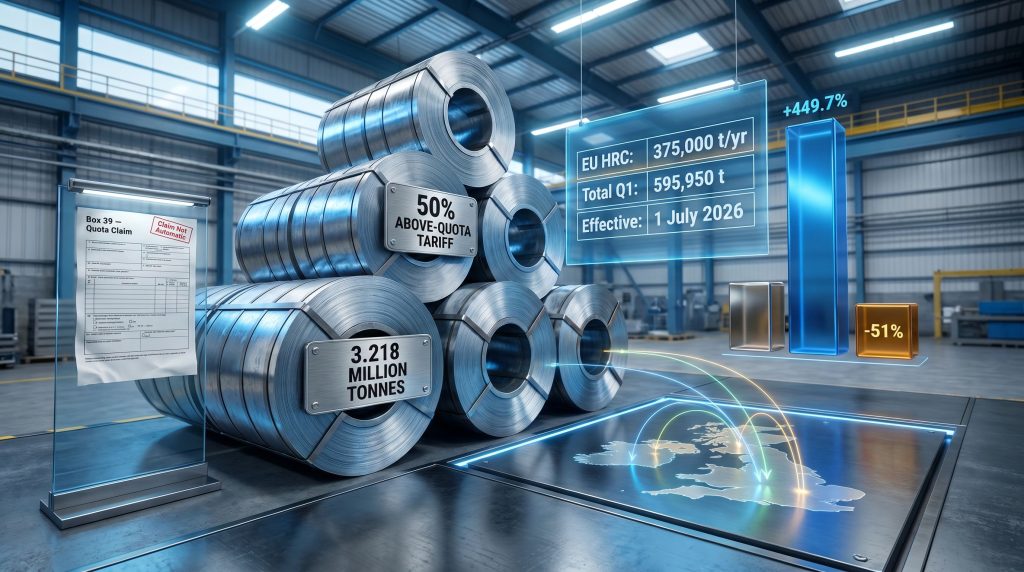
Critical Importer Warning: Quota entitlement is not applied automatically by HMRC. Importers who fail to actively declare their quota claim at the point of customs entry will default to the full 50% above-quota tariff, regardless of whether quota capacity remains available. This is one of the most commercially consequential administrative requirements in the new framework.
The Numbers Behind the New UK Steel Safeguard Quotas
The headline figure from the UK government's final determination, published in late June 2026, is 3.218 million tonnes per year. This was a meaningful upward revision from the provisional 2.66 million tonnes announced in March 2026, representing a 21% increase on the provisional figure. Despite this revision, the total quota still sits 51% below the volume permitted under the expiring safeguard year, softened from the initial proposal of a 60% reduction.
The first quarterly allocation for Q1 (1 July to 30 September 2026) totals 595,950 tonnes, with key country-specific breakdowns as follows:
| Supplying Country/Region | Q1 Quota (tonnes) |
|---|---|
| European Union | 93,750 |
| India | 8,364 |
| South Korea | 2,196 |
| Maximum per-country cap (40% rule) | 238,380 |
| Total Q1 Quota | 595,950 |
The South Korean quarterly HRC figure of approximately 2,196 tonnes has drawn particular scrutiny from trade participants. At that volume, regular commercial shipment programmes become logistically and economically marginal, raising legitimate questions about whether country-specific allocations at this scale serve any practical function in managing trade flows.
Hot-Rolled Coil: The Category That Changed Most
Of all 20 product categories covered by the UK steel safeguard quotas, the hot-rolled coil (HRC) category underwent the most dramatic revision between March's provisional announcement and the final June determination.
| Country | Provisional Annual Quota (t/yr) | Final Annual Quota (t/yr) | Change |
|---|---|---|---|
| European Union | 68,226 | 375,000 | +449.7% |
| India | 12,405 | 33,456 | +169.7% |
| South Korea | 3,258 | 8,785 | +169.7% |
| Residual (all others) | 18,452 | 49,763 | +169.8% |
The EU's HRC allocation rising nearly fivefold from provisional levels reflects the depth of bilateral engagement between the UK and EU governments on preserving established trade flows. The UK government publicly acknowledged the highly interconnected nature of UK-EU steel supply chains as a key consideration in calibrating final volumes. Indeed, the EU steel action plan has similarly emphasised protecting these supply chain linkages at a European level.
Two notable casualties of the final determination are Turkey and Taiwan, both of which have lost their country-specific HRC allocations. Their volumes have been absorbed into the expanded residual pool rather than being assigned dedicated quota lines — a structural change with real implications for suppliers from those countries who previously benefited from guaranteed access.
Despite the upward revisions, the total HRC quota remains materially tighter than under the expiring safeguard year. The most recent assessment of UK HRC stood at approximately £715 per tonne delivered duty paid (ddp) Midlands in late June 2026, and the constrained import environment positions domestic producers to maintain pricing above that level if quota utilisation rates run high.
Hot-Dipped Galvanised Steel: A Divergent Outcome by Origin
The HDG category (Category 4) produced a notably different result from HRC, with the EU allocation actually reduced from the provisional figure while other major supplier countries held their volumes unchanged.
| Country | Annual Quota (t/yr) | Status vs. Provisional |
|---|---|---|
| European Union | 510,273 | Reduced from 634,773 |
| Vietnam | 174,367 | Unchanged |
| India | 125,796 | Unchanged |
| South Korea | 100,753 | Unchanged |
The scale of Vietnamese HDG volumes permitted under the new framework has become a point of concern for domestic producers. This tension illustrates a recurring challenge in designing quota frameworks: reducing exposure from one origin can simply redirect trade flows from another. Consequently, the China steel market dynamic — where excess capacity frequently redirects to third-country exporters — remains a complicating factor in quota design.
The next major ASX story will hit our subscribers first
Categories With the Most Significant Quota Revisions
Beyond the headline flat products, several other categories saw material changes between the March provisional figures and the final June determination:
| Category | Product Type | Final Annual Quota (t/yr) | Change vs. Provisional |
|---|---|---|---|
| Category 6 | Tin mill products | 69,795 | +491.7% |
| Category 12B | Non-alloy merchant bars and light sections | 70,812 | +955.3% |
| Category 17 | Angles, shapes and sections (non-alloy steel) | 270,762 | +119.8% |
| Category 28 | Non-alloy wire | 59,734 | -25.5% |
The extraordinary percentage increase in Category 12B reflects both a very low provisional baseline and evidence of strong downstream demand for non-alloy merchant bar products that cannot be fully met by domestic production alone. The reduction in Category 28, by contrast, suggests updated production evidence supported tighter restrictions on non-alloy wire imports.
Commodity Code Changes: What Importers Must Review Immediately
One of the less-discussed but practically significant aspects of the final determination is the addition and removal of specific commodity codes from the safeguard scope. The government confirmed that codes were amended where new evidence confirmed either the presence or absence of UK production capacity.
Codes added to the safeguard scope:
- Category 12A (alloy merchant bars and light sections): 72283070 added
- Category 12B (non-alloy merchant bars and light sections): 72149950 added
- Category 28 (non-alloy wire): 72173049 and 72173090 added
Codes removed from the safeguard scope:
- Category 14 (stainless bars and light sections): 72221910 and 72221990 removed
- Category 26 (other welded tubes): 73061100 and 73062100 removed
- Category 28 (non-alloy wire): 72172010, 72172030, 72172050, 72172090, 72179020, 72179050, and 72179090 removed
Compliance Priority: Any business importing steel products in or near these commodity code ranges should conduct an immediate classification review before the 1 July 2026 effective date. The financial consequences of misclassifying a shipment under the new 50% above-quota tariff are substantial.
Exemptions: Who Sits Outside the Quota Framework
Not all steel origins are subject to the new quota restrictions. Two categories of suppliers operate outside the main quota pool:
Ukraine: Steel products originating from Ukraine remain fully exempt from safeguard quota restrictions across all 20 product categories, with no volume caps applied. This exemption reflects the UK's broader trade policy orientation toward Ukraine and has been maintained throughout successive iterations of the safeguard framework.
Low-volume developing country exporters: Countries accounting for 3% or less of total UK steel imports qualify as low-volume exporters and draw from a separate allocation outside the main quota pool. This protection lapses if the combined share of all such exporters collectively exceeds 9% of total UK imports, at which point standard quota rules are triggered.
Transitional Relief for Pre-Announcement Contracts
Businesses operating under contracts signed before 14 March 2026, covering goods physically imported between 1 and 30 September 2026, may be eligible for transitional relief arrangements. Companies in this position should urgently review their contractual documentation and engage with HMRC to confirm eligibility before shipments are dispatched. This is a narrow and time-limited provision, and missing the window for relief carries direct financial exposure.
Price Outlook and Market Dynamics Under the New Framework
The tighter overall quota architecture, even after the upward revision from provisional levels, is broadly expected to support UK domestic steel prices, particularly in flat products. With above-quota tariff costs now at 50%, the landed cost of material shipped outside quota entitlement becomes prohibitive for most buyers. However, the broader context of steel and aluminium tariffs globally means that trade diversion pressures remain a persistent variable to monitor.
Tata Steel UK, the country's largest integrated steelmaker, has publicly stated that the final quota levels do not adequately reflect actual UK market conditions. The company identified three specific product segments as remaining particularly vulnerable:
- Metallic coated steel
- Packaging steel
- Hollow sections
The company's position is that sustained competitive import pressure in these categories could undermine the investment case for domestic production. In addition, green steel pricing pressures are adding further complexity to the investment calculus for UK producers navigating both the quota regime and decarbonisation requirements simultaneously.
The following scenario framework illustrates the range of price outcomes depending on how quickly quotas are utilised in early quarters:
| Scenario | Quota Utilisation | Expected Price Impact | Domestic Producer Outlook |
|---|---|---|---|
| High utilisation (quotas fill rapidly in Q1) | Above 90% | Strong support; £730–750/t range | Positive for margins |
| Moderate utilisation | 60–90% | Stable near current £715/t | Neutral to marginally positive |
| Low utilisation (quotas underfilled) | Below 60% | Downward pressure; sub-£700/t possible | Negative for margins |
Note: Price projections are illustrative and based on market conditions as of late June 2026. Actual outcomes will depend on global steel market dynamics, exchange rate movements, and downstream demand patterns. This does not constitute financial or commercial advice.
Frequently Asked Questions on UK Steel Safeguard Quotas
What tariff applies to imports above the quota limit?
Above-quota imports are subject to a 50% tariff, double the rate that applied under the outgoing safeguard measure.
When does the new system take effect?
The TRQ system activates on 1 July 2026, immediately following the expiry of the current safeguard on 30 June 2026.
Does the safeguard cover all steel products?
No. The measure applies only to products with confirmed UK domestic production capacity. Products without established UK manufacturing capability have been removed from the commodity code scope. For a detailed breakdown of applicable quota claim procedures, importers should consult the most recent government guidance.
How often are quota balances updated?
Balances are updated daily through the UK National Data Library.
Can unused quota roll over between quarters?
Yes. Unused quota carries forward to the following quarter, subject to a 12-month maximum carry-forward period.
Must importers actively claim quota on customs declarations?
Yes. Quota entitlement must be explicitly claimed in Box 39 of the customs declaration. HMRC does not apply the nil-rate automatically.
Key Facts at a Glance
- Total annual quota: 3.218 million tonnes, up 21% from March provisional figures but 51% below the expiring safeguard year
- Above-quota tariff rate: 50%, doubled from the 25% rate under the outgoing measure
- Largest single volume revision: EU HRC allocation, rising from 68,226 t/yr to 375,000 t/yr
- Notable reduction: EU HDG allocation, cut from 634,773 t/yr to 510,273 t/yr
- Ukraine: Fully exempt across all 20 product categories
- Importer obligation: Active quota claim required at customs entry point
- Effective date: 1 July 2026
Want to Stay Ahead of the Commodity Shifts Reshaping Global Markets?
As tightening trade frameworks like the UK's new steel safeguard quotas reshape supply chains and commodity pricing worldwide, identifying emerging mineral discovery opportunities on the ASX has never been more compelling. Discovery Alert's proprietary Discovery IQ model delivers real-time alerts the moment significant ASX mineral discoveries are announced, transforming complex market data into actionable investment insights — explore historic discovery returns on Discovery Alert's discoveries page and begin your 14-day free trial to position yourself ahead of the market.