June 25, 2026
The Quota Trap: How OPEC's Production Architecture Creates Fiscal Crises for Member States
Across the history of producer cartels, the most persistent source of internal friction has rarely been price disagreements. It has been the structural mismatch between what a member nation can produce and what it is permitted to export. When that gap widens under conditions of acute financial stress, the alliance itself becomes a constraint rather than a tool, and member states begin evaluating whether the benefits of coordination still outweigh the costs of restraint.
That dynamic is now playing out with unusual intensity around the Iraq OPEC quota increase debate, a situation that carries implications far beyond bilateral negotiations between Baghdad and Riyadh. Furthermore, geopolitical trade tensions in the broader region are amplifying the urgency of Baghdad's position at the negotiating table.
When big ASX news breaks, our subscribers know first
Understanding Iraq's Capacity-to-Quota Gap
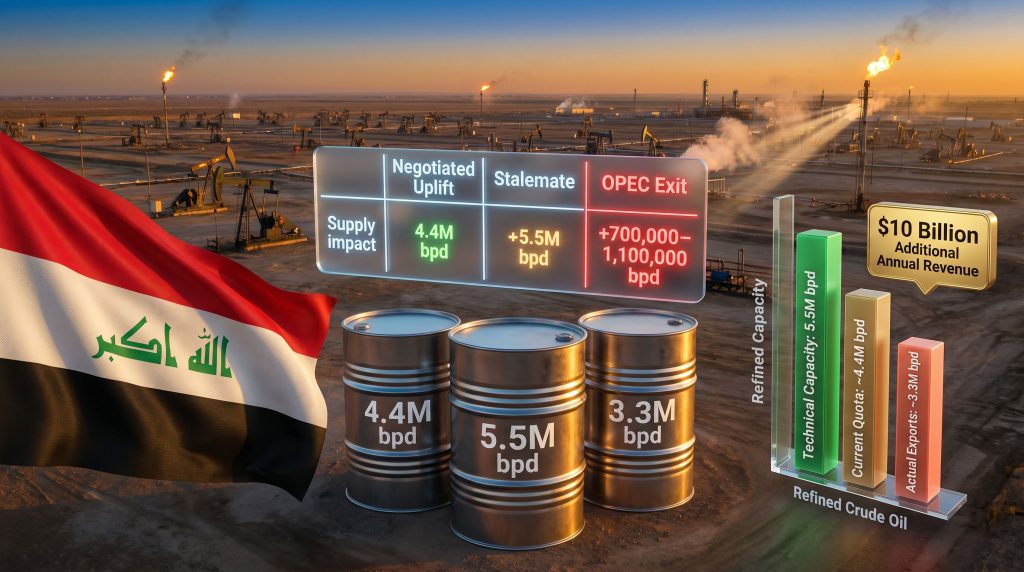
Iraq's position within OPEC+ is defined by a fundamental arithmetic problem. The country holds a verified technical production capacity of approximately 5.5 million barrels per day (bpd), yet its OPEC-assigned quota sits at roughly 4.4 million bpd. That gap of 1.1 million bpd represents infrastructure, investment, and production capability that currently generates no export revenue because the alliance's collective framework prohibits it.
Making the situation more acute, Iraq's actual export volumes run considerably lower than even its assigned quota ceiling. Current shipments are tracking closer to 3.3 million bpd, partly due to operational bottlenecks but also because of a separate compensatory underproduction obligation requiring Baghdad to pump 100,000 bpd below its existing quota level until June 2026. This compensation mechanism was imposed to offset historical periods when Iraq exceeded its assigned limits, creating what amounts to a quota penalty layered on top of an already restrictive ceiling.
The financial arithmetic is stark. A production increase of 300,000 bpd at prevailing crude prices is estimated to unlock up to $10 billion in additional annual revenue for the Iraqi government. For a state whose budget is overwhelmingly dependent on hydrocarbon exports, that figure is not a negotiating preference but a fiscal necessity.
| Metric | Volume |
|---|---|
| OPEC-Assigned Production Quota | ~4.4 million bpd |
| Verified Technical Capacity | ~5.5 million bpd |
| Capacity-to-Quota Gap | ~1.1 million bpd |
| Current Export Volume | ~3.3 million bpd |
| Compensation Underproduction Obligation | 100,000 bpd below quota (until June 2026) |
| Iraq's Requested Quota Addition | ~300,000 bpd |
| Projected Revenue Gain | Up to $10 billion annually |
War Economics and the Urgency Behind Baghdad's Demand
What distinguishes Iraq's current quota dispute from earlier rounds of OPEC negotiations is the geopolitical context that surrounds it. The ongoing Iran-Iraq conflict has imposed severe pressure on Baghdad's public finances, disrupting oil infrastructure logistics, escalating security expenditures, and suppressing foreign investment inflows at precisely the moment the government requires maximum revenue flexibility.
Iraq's fiscal structure is unusually concentrated, with oil revenues accounting for the overwhelming majority of government income. That concentration means any constraint on exportable volumes translates almost mechanically into public sector funding shortfalls, delayed infrastructure programmes, and strain on social services. A senior Iraqi oil ministry official communicated through Reuters reporting that the country is enduring a critical financial crisis on the back of the Iran war, and that a significant increase in its OPEC quota is a matter of the utmost seriousness rather than a routine negotiation point.
This framing matters for how observers should interpret the current standoff. Baghdad is not seeking incremental quota relief as part of a long-term capacity expansion strategy. It is seeking an immediate and substantial revenue bridge to address near-term fiscal distress. In addition, OPEC's market influence over price stability means that any unilateral action by Iraq carries consequences well beyond its own borders.
The Compensation Mechanism: A Constraint Within a Constraint
One element of Iraq's situation that receives less attention than it deserves is the layered nature of its production constraints. The compensation underproduction obligation is a relatively obscure mechanism within OPEC's compliance architecture. When a member state exceeds its quota during a given period, it is typically required to offset that overproduction through below-quota output in subsequent periods. Iraq accumulated a compliance deficit during earlier periods of informal overproduction, and the repayment schedule running through mid-2026 effectively reduces its permitted exports further below an already restrictive ceiling.
This mechanism is important for two reasons. First, it means that even the approved quota level of 4.4 million bpd is not fully accessible to Iraq in the near term. Second, it illustrates how OPEC's internal compliance system can compound fiscal pressure on members already operating under stress, creating a feedback loop where financial need incentivises overproduction, which in turn triggers penalties that deepen the revenue shortfall.
What OPEC+ Has Approved Versus What Iraq Needs
The alliance has not been entirely unresponsive to Iraq's position. OPEC production decisions formally approved a graduated quota increase structured as a monthly increment of 12,000 bpd beginning in April 2026, with the phased schedule targeting a production level of 4.11 million bpd by January 2026. This incremental approach reflects the bloc's broader preference for gradual supply restoration over abrupt volume additions that could destabilise crude benchmarks.
However, the arithmetic of the approved increase falls well short of what Baghdad has sought. A monthly increment of 12,000 bpd, while directionally positive, would take years to close the gap between Iraq's current exports and its technical capacity. Iraqi officials have characterised the phased increase as insufficient and have confirmed that a substantially higher quota revision remains the government's core objective.
Separately, OPEC+ has simultaneously approved broader group-level production increases, including a 206,000 bpd hike for May and a further 130,000–140,000 bpd increase planned from October. These decisions reflect the alliance's deliberate strategy to progressively unwind the deep output cuts implemented during pandemic-era demand collapse. Consequently, Iraq's individual quota request arrives within a moment of broader supply recalibration across the group. According to Al Jazeera, OPEC has warned of a slow recovery in output following recent attacks on regional infrastructure.
The central tension is not whether OPEC+ wants to add supply. It is who controls the pace and distribution of that addition.
Three Scenarios for the Iraq OPEC Quota Dispute
The trajectory of this dispute can realistically branch in three directions, each carrying materially different consequences for global crude supply and OPEC+ institutional credibility.
Scenario 1: Negotiated Quota Uplift Within the Alliance
In this pathway, OPEC+ agrees to accelerate Iraq's quota increase beyond the current phased schedule, potentially approving an additional 150,000 to 300,000 bpd above existing commitments. This outcome requires Iraq to frame its request within the logic of collective market management rather than as a unilateral exception, and to secure meaningful buy-in from Saudi Arabia, which functions as the alliance's de facto swing producer and primary price defender.
For this scenario to materialise, Baghdad would likely need to offer credible compliance commitments, including a structured plan for addressing its historical overproduction record. The price impact would be modestly bearish for Brent crude, with the magnitude depending on concurrent demand signals from China and the broader import complex.
Scenario 2: Prolonged Stalemate With Continued Informal Overproduction
Iraq has a well-documented history of exceeding its assigned quotas during periods of fiscal stress. If formal negotiations stall without a meaningful resolution, the most probable near-term outcome is that Baghdad continues to pump above its allocated ceiling while publicly affirming its commitment to OPEC+ targets. This pattern, sometimes described as "paper compliance," erodes the alliance's price management credibility without triggering a formal rupture.
In this scenario, OPEC+ may impose additional compensation requirements, deepening Iraq's structural deficit with the bloc and adding future constraints on legitimate quota capacity. Market participants observing this dynamic would rationally discount the alliance's stated production figures, weakening the signalling power of any future output cuts. Reuters reporting confirms that a fourth quota hike since the Hormuz closure is now being actively discussed within OPEC+.
Scenario 3: Formal OPEC Exit or Suspension of Membership
The most consequential and least probable near-term pathway involves Iraq formally withdrawing from the alliance to produce freely at or near its 5.5 million bpd technical capacity. Reuters reporting confirmed that Iraqi officials have internally considered OPEC exit as an option, though the current strategic preference remains membership combined with a substantially higher quota.
A formal exit would represent a seismic event for OPEC+ cohesion. The volume impact alone — potentially adding 700,000 to 1.1 million bpd of additional Iraqi supply above current export levels — would exert significant downward pressure on Brent crude. The strategic risk is that other producers, particularly those with similar capacity-to-quota gaps such as Kazakhstan and the UAE, might use an Iraqi exit as cover to pursue their own production increases without formal quota violations.
| Scenario | Additional Supply Impact | Brent Price Direction | OPEC+ Cohesion Risk |
|---|---|---|---|
| Negotiated Uplift | +150,000 to 300,000 bpd | Mildly bearish | Low |
| Stalemate / Overproduction | +50,000 to 100,000 bpd (informal) | Neutral to mildly bearish | Moderate |
| OPEC Exit | +700,000 to 1,100,000 bpd | Strongly bearish | High |
The Saudi Veto and the Precedent Problem
Any meaningful Iraq OPEC quota increase requires collective endorsement from OPEC member states. Saudi Arabia's position is decisive. Riyadh's calculus involves a genuine tension between regional solidarity with an ally facing war-driven fiscal distress and the strategic risk of establishing a precedent that invites quota exception requests from Kazakhstan, the UAE, and other members who have also invested substantially in production capacity.
The precedent problem is arguably the most underappreciated dimension of this dispute. If OPEC+ grants Iraq a substantial quota uplift on humanitarian-economic grounds, it effectively creates a template that other members can invoke. The alliance's price discipline ultimately rests on the credibility of its collective commitment to restraint. Once exceptions become repeatable, the institutional logic underpinning that discipline weakens progressively.
The next major ASX story will hit our subscribers first
Market and Price Implications
JP Morgan has already revised its Brent crude price forecast for the second half of 2026 downward, citing rising Middle East supply as a contributing factor. Mideast fuel oil exports are projected to reach a four-month high in June 2026, though they remain below pre-conflict levels, indicating that regional supply recovery is advancing independently of formal quota decisions.
Iraq has also been expanding its export infrastructure, with northern crude shipments increasing and new routing options reducing dependence on single transit corridors. This infrastructure investment is strategically significant because it strengthens Baghdad's practical ability to deliver higher volumes if a quota increase is secured, narrowing the gap between political permission and operational execution. Movements in Brent and WTI futures will be closely watched as the quota dispute evolves throughout the second half of 2026.
Any further easing of tensions affecting Strait of Hormuz transit would amplify this effect considerably, as smoother flows through the chokepoint would reduce the discount that regional crudes trade at relative to global benchmarks. Analysts tracking crude oil price geopolitics note that even modest quota changes can have outsized market signalling effects in the current environment.
A 300,000 bpd increase in Iraqi output represents roughly 0.3% of global daily oil consumption — a volume that, while not enormous in isolation, carries outsized signalling weight in a market already navigating OPEC+'s broader supply unwinding programme.
Key Takeaways
- Iraq's 1.1 million bpd gap between technical production capacity and its OPEC quota is the structural root of the current dispute
- A 300,000 bpd quota increase could generate up to $10 billion in additional annual revenue, making it a fiscal rather than strategic priority for Baghdad
- OPEC+ has approved only a 12,000 bpd monthly phased increase, far below Iraq's stated requirements
- A 100,000 bpd compensation underproduction obligation running until mid-2026 further restricts near-term Iraqi exports
- Three scenarios ranging from negotiated uplift to formal OPEC exit carry materially different consequences for global crude supply and OPEC+ institutional credibility
- Saudi Arabia's position is decisive, and the precedent implications of granting Iraq an exception may prove as consequential as the volume impact itself
Disclaimer: This article contains forward-looking analysis, scenario projections, and market forecasts for informational purposes only. It does not constitute financial or investment advice. Oil market dynamics are subject to rapid change based on geopolitical developments, demand conditions, and producer decisions. Readers should conduct their own research before making any investment decisions.
Want To Stay Ahead of the Next Major Resource Discovery Reshaping Global Markets?
While OPEC quota disputes and oil market dynamics dominate the headlines, significant mineral discoveries on the ASX can offer equally compelling investment opportunities — and Discovery Alert's proprietary Discovery IQ model instantly notifies subscribers the moment a major discovery is announced, turning complex data across 30+ commodities into clear, actionable insights. Explore Discovery Alert's discoveries page to see how historic ASX discoveries have generated substantial returns, and begin a 14-day free trial at discoveryalert.com.au to position yourself ahead of the broader market.