June 27, 2026
When Quota Architecture Meets Geopolitical Reality: The Forces Reshaping OPEC+ Governance
Multilateral commodity alliances are rarely tested by gradual shifts. They fracture — or evolve — when the gap between institutional design and ground-level reality becomes impossible to ignore. The OPEC+ framework, built around predictable production baselines and voluntary compliance, was not engineered to accommodate member states navigating active conflict zones, collapsed export routes, and emergency fiscal conditions simultaneously. Yet that is precisely the situation now confronting the alliance, with the Iraq OPEC quota review emerging as the clearest stress test of the coalition's long-term governance architecture.
Understanding what is actually at stake requires moving beyond the surface-level narrative of a country demanding more barrels. The deeper question is whether OPEC+'s quota-setting machinery is structurally equipped to handle post-conflict producer states whose production realities diverge sharply from the baselines that were originally certified. Furthermore, OPEC's global influence over supply management means that decisions made in Baghdad ripple well beyond the Gulf.
When big ASX news breaks, our subscribers know first
The Mechanics of OPEC+ Quota-Setting: What Most Analysis Misses
At the core of every OPEC+ production allocation sits a concept called maximum sustainable capacity (MSC) — the theoretical ceiling a member can maintain over an extended period without causing long-term reservoir damage. Quotas are not arbitrary political numbers; they are formally derived from MSC assessments that are periodically reviewed through third-party technical processes.
This architecture matters enormously for interpreting the current Iraq OPEC quota review. The review cycle now underway is specifically calibrated to establish 2027 output baselines — meaning the decisions made in this round will govern permissible production ceilings across the next multi-year phase of alliance management. For Iraq, securing a higher certified MSC figure is not just a short-term negotiating win; it is the mechanism through which any permanent quota increase must flow.
Three structural realities define Iraq's position within this framework:
- As OPEC's second-largest producer, any revision to Iraq's quota creates ripple effects across the entire allocation matrix — other members watch closely to understand what precedent is being set
- Iraq's federal budget remains overwhelmingly dependent on crude export revenues, with oil income accounting for the vast majority of government receipts, making quota levels a direct instrument of fiscal policy rather than just a production target
- The country's oil sector is still in active post-war reconstruction, with long-term export capacity ambitions of 7 million barrels per day (bpd) that require sustained investment in infrastructure the alliance's current baselines do not yet reflect
Iraq's Quota Numbers in Context
The raw figures illuminate why this review has taken on such urgency:
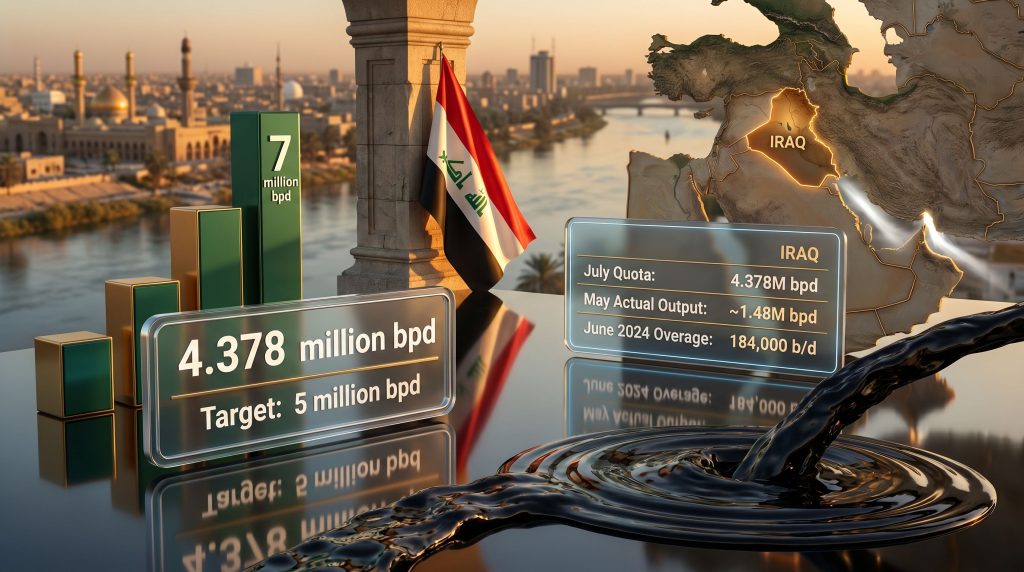
| Metric | Figure |
|---|---|
| Iraq's Official July Quota | 4.378 million bpd |
| Actual Output in May (post-Hormuz disruption) | ~1.48 million bpd |
| Iraq's Stated Quota Target | ~5 million bpd |
| Long-Term Export Capacity Goal | 7 million bpd |
| June 2024 Overproduction Overage | 184,000 bpd above quota |
The chasm between the official July allocation of 4.378 million bpd and actual May output of approximately 1.48 million bpd is not a compliance failure. It is a force majeure-level disruption caused by the temporary closure of the Strait of Hormuz during the Iran conflict — the critical maritime chokepoint through which the preponderance of Iraq's crude exports must pass. This distinction is analytically significant and forms the backbone of Baghdad's case for quota recalibration. Consequently, the oil price geopolitics surrounding this disruption have added additional urgency to the review process.
How the Strait of Hormuz Closure Transformed the Quota Debate
The Strait of Hormuz is one of the world's most consequential energy chokepoints. Approximately 20% of global oil trade transits this waterway, and for landlocked and near-landlocked producers like Iraq, export route disruptions are either non-existent or severely limited in throughput capacity as alternatives. When the strait was temporarily closed during the Iran conflict, Iraq's ability to fulfil its quota became physically impossible regardless of production intentions.
This created a paradox at the heart of the Iraq OPEC quota review: Iraq was simultaneously below its quota in actual output terms and above its quota in historical compliance terms. The May production figure of around 1.48 million bpd represents a collapse that no standard compliance framework was designed to address. Existing OPEC+ rules do not contain formal provisions for force majeure-style production losses caused by regional conflict disrupting export infrastructure.
"The closure of the Strait of Hormuz did not merely reduce Iraq's export volumes — it exposed a fundamental gap in OPEC+'s governance architecture: the absence of any mechanism to distinguish between voluntary overproduction and involuntary production collapse caused by external geopolitical shocks."
The fiscal consequences of this production collapse were immediate. With oil revenues comprising such a dominant share of Iraq's government budget, the shortfall translated directly into constrained public spending, delayed reconstruction investment, and intensified pressure on Baghdad to seek structural relief through the quota review process. Iraq's Oil Ministry confirmed that OPEC has begun gradually restoring Iraq's pre-war production allocations — a move framed as supporting both output capacity recovery and broader oil sector reconstruction.
The Overproduction Paradox: How Iraq's Compliance History Complicates Its Reform Case
There is an uncomfortable irony embedded in Iraq's quota reform argument. In June 2024, Iraq exceeded its assigned quota by 184,000 bpd, a breach that required the submission of formal compensation pledges to the alliance. This compliance record creates a credibility challenge that OPEC+ member states have not overlooked.
When a producer simultaneously argues for a higher baseline while having historically exceeded its existing limits, the negotiating position becomes analytically ambiguous:
- Some OPEC+ members may interpret the quota demand as a retroactive attempt to legitimise chronic overproduction by raising the ceiling to match historical behaviour
- Others may view the overproduction record as evidence that Iraq's true production capacity already exceeds its current quota — which would actually support the case for a higher certified MSC
- The independent MSC review process provides a neutral technical pathway to resolve this ambiguity, as it relies on verifiable production data rather than political negotiation
The compliance architecture itself reveals another structural weakness: compensation pledges under OPEC+ rules rely entirely on voluntary adherence, with no enforcement mechanism beyond reputational cost. Iraq has made such pledges but the framework's soft enforcement has historically limited their effectiveness across multiple member states, not just Iraq.
Baghdad's Two-Track Strategy: Near-Term Relief and Structural Reform
Iraq's current approach to the quota negotiation operates on two parallel tracks that serve distinct but complementary objectives.
Track One: The Voluntary Cut Unwind
OPEC+ has initiated a phased reversal of the voluntary production cuts that were implemented during the period of heightened regional conflict. For Iraq, this process incrementally raises the effective production ceiling as previously agreed reductions are walked back. This addresses Iraq's immediate output recovery needs without requiring a formal renegotiation of baseline quotas.
Track Two: The 2027 Baseline Review
The independent MSC review represents the structural mechanism through which Iraq can secure a permanently higher quota grounded in certified capacity data. Baghdad has formally supported a broader reassessment of OPEC production quotas to better reflect member states' economic and security circumstances — a position that frames Iraq's specific demands within an alliance-wide governance reform argument rather than as a unilateral special-case request.
This framing is strategically significant. By advocating for a systemic reform that could benefit other post-conflict or developing producer states, Iraq elevates its quota campaign from a bilateral grievance to a multilateral governance debate. It is a more durable negotiating posture than simply demanding more barrels.
The next major ASX story will hit our subscribers first
The Exit Signal: Strategic Leverage or Genuine Risk?
Reports of conditional language around Iraq's continued OPEC membership circulated during the peak of quota tensions. However, Iraq's Oil Ministry has clarified the official position: neither Prime Minister Ali Faleh al-Zaidi nor the government has formally raised the prospect of withdrawal, and all disputes should be resolved through OPEC+'s technical mechanisms.
Yet the conditional framing — the suggestion that membership decisions could follow if quota demands went unmet — functions as a calibrated negotiating signal even when officially disavowed. This mirrors a well-established pattern in multilateral resource governance where the language of exit is deployed to accelerate concessions without triggering the institutional destabilisation that a formal withdrawal threat would cause.
The credibility of any such signal rests on a straightforward institutional cost calculation. As the second-largest OPEC producer, Iraq's departure would:
- Remove a significant volume anchor from the alliance's supply management framework
- Create a precedent for other mid-tier producers with post-conflict reconstruction needs to challenge their own quota allocations
- Potentially accelerate a broader unravelling of the collective discipline that underpins OPEC+'s price management function
The institutional cost of accommodating Iraq's quota demands is almost certainly lower than the cost of managing its exit. This asymmetry explains why OPEC+ has already begun unwinding voluntary cuts to gradually expand Iraq's effective production ceiling — a concession that signals the alliance's preference for accommodation over confrontation. In addition, the broader geopolitical trade tensions shaping the global energy landscape have made internal OPEC+ cohesion more valuable than ever.
What OPEC+ Governance Reform Should Look Like
Iraq's situation exposes a genuine design gap in OPEC+'s quota framework. The current architecture was largely calibrated around stable, infrastructure-mature producers with predictable output trajectories. It does not contain explicit provisions for members navigating active post-conflict reconstruction, force majeure export disruptions, or the infrastructure investment cycles that characterise emerging producer states.
Furthermore, trade war oil pressures have amplified the urgency for the alliance to modernise its governance approach before further external shocks expose additional structural weaknesses.
A more resilient governance framework would incorporate several structural reforms:
- Conflict-adjusted quota provisions: A formal mechanism allowing members facing documented infrastructure disruption due to regional conflict to apply for temporary quota adjustments outside the standard review cycle
- Shorter MSC review intervals: Reducing the lag between real-world production capacity changes and official quota implementation would prevent the kind of structural misalignment Iraq currently faces
- Enhanced production verification: Any quota increases should be paired with strengthened third-party output monitoring to reduce the overproduction patterns that have historically undermined alliance discipline
- Force majeure classification protocols: A defined process for classifying production shortfalls caused by external geopolitical events, distinguishing them from voluntary compliance failures
Whether OPEC+ has the institutional appetite for this level of structural reform remains an open question. The alliance has historically favoured incremental adjustment over formal rule changes. However, the Iraq OPEC quota review may be the catalyst that forces a more systematic rethink of how the coalition governs post-conflict producer states — and the precedent it sets will reverberate well beyond Baghdad.
Frequently Asked Questions: Iraq OPEC Quota Review
What is Iraq's current OPEC production quota?
Iraq's official production quota for July stands at 4.378 million bpd, though actual output fell to approximately 1.48 million bpd in May due to the Strait of Hormuz disruption caused by the Iran conflict.
What quota level is Iraq targeting?
Iraqi officials have pursued a target of approximately 5 million bpd, with longer-term export capacity ambitions of 7 million bpd tied to ongoing infrastructure investment.
Is Iraq leaving OPEC?
Iraq's Oil Ministry has officially clarified that the government is not pursuing OPEC withdrawal. Conditional language around membership has functioned as a negotiating signal rather than a firm policy commitment.
What is the OPEC+ independent quota review?
OPEC+ has launched a formal independent review of member states' maximum sustainable production capacity figures to establish 2027 output baselines, which will determine future quota allocations across the alliance.
Why did Iraq's production fall so sharply in 2025?
The closure of the Strait of Hormuz during the Iran conflict severely disrupted Iraq's crude export routes, causing actual output to collapse well below the assigned quota — a force majeure-type production loss rather than a deliberate compliance breach.
Has Iraq previously exceeded its OPEC quota?
Yes. Iraq recorded a production overage of 184,000 bpd above its quota in June 2024, for which it submitted formal compensation pledges to OPEC+.
Disclaimer: This article contains forward-looking analysis, scenario assessments, and commentary on geopolitical and market developments. Such analysis involves inherent uncertainty and should not be construed as investment advice. Readers are encouraged to consult independent financial and energy market advisors before making investment decisions. All production figures and quota data referenced reflect publicly available reporting as of the time of writing.
Want to Stay Ahead of the Next Major Commodity Market Shift?
Discovery Alert's proprietary Discovery IQ model scans ASX announcements in real time, delivering instant alerts on significant mineral discoveries and actionable investment opportunities across more than 30 commodities — explore historic discovery returns on the Discovery Alert discoveries page to understand the magnitude of what early positioning can achieve, and begin your 14-day free trial today to secure a market-leading edge.