June 27, 2026
The Strait of Hormuz: Why One Waterway Can Hold the Global Economy Hostage
Few geographic features carry as much economic leverage as a narrow body of water measuring just 21 miles at its tightest point. The Strait of Hormuz, positioned between the Omani coast and the Iranian shoreline, represents the single most consequential maritime chokepoint on the planet. Approximately 20 to 21 percent of the world's total oil supply transits this corridor daily, alongside a significant portion of global liquefied natural gas shipments. When stability in this waterway is threatened, the reverberations travel immediately into energy futures markets, insurance pricing desks, and the strategic planning offices of governments from Tokyo to Berlin.
That fragility is now at the centre of a rapidly developing confrontation. Trump says Iran violated ceasefire with drone attacks in the Strait of Hormuz, a claim that carries profound implications not just for U.S.-Iran diplomatic relations, but for the security architecture of global energy supply chains heading into the second half of 2026. Furthermore, understanding the broader geopolitical oil price factors at play is essential to appreciating how quickly this situation could reshape global energy economics.
When big ASX news breaks, our subscribers know first
What the Strait Actually Controls: A Quantified Perspective
Understanding why this incident matters requires internalising just how concentrated global energy flows have become through a single corridor.
| Metric | Estimated Figure |
|---|---|
| Share of global oil supply transiting daily | 20-21% |
| Daily oil volume (barrels) | Approximately 17-21 million barrels |
| Key dependent importers | Japan, South Korea, India, China, EU nations |
| LNG share transiting the strait | Significant portion of Gulf-origin LNG exports |
| Strait width at narrowest point | Approximately 21 nautical miles |
Nations like Japan and South Korea have virtually no viable short-term alternative for the volumes they source from Gulf producers. India's expanding energy appetite makes it equally exposed. China, while diversifying through pipeline infrastructure, still relies heavily on seaborne Gulf crude. For these economies, even a partial or temporary disruption to Hormuz traffic translates directly into supply shortfalls, price spikes, and downstream industrial stress.
The rerouting alternative, circumnavigating via the Cape of Good Hope, adds roughly 3,500 nautical miles to a tanker voyage from the Gulf to Asian destinations. That translates into approximately 10 to 15 additional voyage days, meaningfully higher fuel costs, and compounding scheduling disruptions across entire supply chains. In addition, the global LNG supply outlook becomes increasingly precarious when the strait's navigability is in question.
The Ceasefire That Was: Diplomatic Architecture Before the Drones
The U.S.-Iran ceasefire arrangement that Trump referenced had been underpinned by a broader diplomatic process centred on Iran's nuclear programme. The framework included discussions around a memorandum of understanding intended to formalise conditions under which the Strait of Hormuz would remain open to commercial shipping traffic while nuclear negotiations proceeded.
Ceasefires in contested maritime zones carry an inherent structural weakness: they require simultaneous compliance from political leadership, military command chains, and semi-autonomous paramilitary forces. In Iran's case, the Islamic Revolutionary Guard Corps (IRGC) operates with a degree of operational independence that makes top-level political commitments difficult to enforce at the tactical level. This disconnect between political intent and operational action is not unique to Iran, but it is particularly pronounced in asymmetric maritime conflict environments.
The Drone Incident: Sequence, Scale, and Attribution
What Happened Off the Coast of Oman
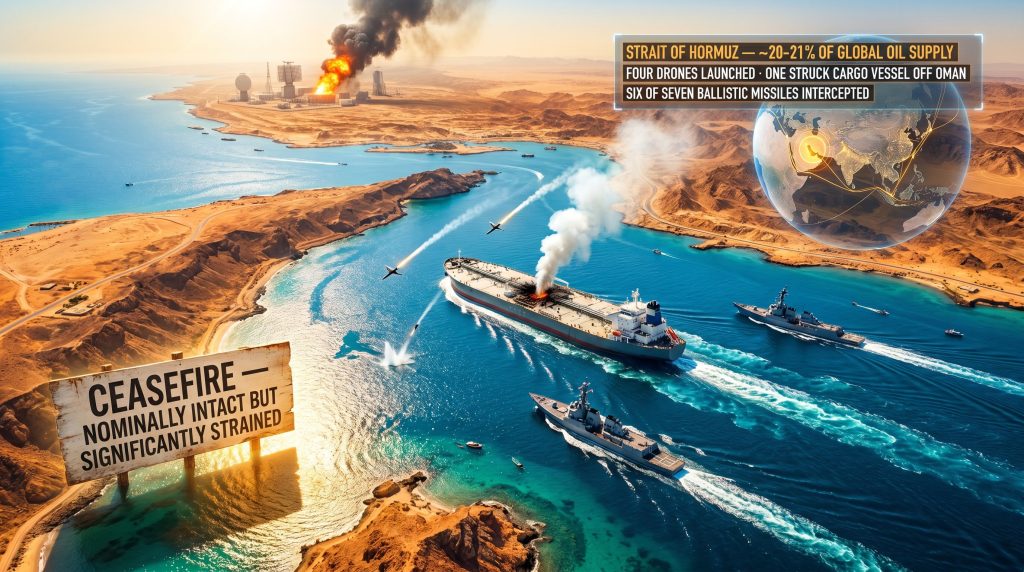
The sequence of events that prompted Trump's public accusation unfolded on Thursday, June 26, 2026. According to U.S. Central Command reporting and Trump's own Truth Social statement, four one-way attack drones were launched toward vessels transiting the strait. U.S. military assets intercepted three of the four. The fourth struck the upper deck of a large cargo vessel positioned off the coast of Oman. The ship sustained damage but retained operational capability and continued its voyage.
Concurrent with the drone launches, Iran conducted ballistic missile launches targeting positions in Kuwait and Bahrain. U.S. interception systems neutralised six of the seven missiles fired, with the seventh reportedly failing to reach its intended target rather than being intercepted in the conventional sense.
The U.S. military responded by striking Iranian coastal surveillance radar installations, specifically targeting sites on Qeshm Island and in Goruk. These strikes were characterised as defensive responses under existing rules of engagement rather than offensive escalation.
Attribution of the cargo vessel strike was assigned to the IRGC by U.S. officials, with reporting from the Wall Street Journal supporting that assessment. Iran offered no formal acknowledgment of involvement.
The Tactical Logic of One-Way Attack Drones
One-way attack drones, sometimes described as loitering munitions or kamikaze drones, represent a particularly disruptive asymmetric warfare tool in maritime contexts for several reasons:
- They are low-cost relative to the assets they threaten, creating an economically asymmetric exchange ratio for defenders.
- Their small radar cross-section makes detection and interception more difficult than conventional missile threats at scale.
- They can be launched from coastal positions, small vessels, or inland sites, making source attribution harder to confirm in real time.
- A single successful strike on a commercial vessel triggers immediate insurance and risk repricing across the entire maritime sector, multiplying the economic impact well beyond the physical damage inflicted.
"The economic damage from a single successful drone strike on a commercial vessel is rarely confined to the physical repair cost. The immediate repricing of war risk insurance premiums, the diversion decisions made by dozens of other operators watching the incident unfold, and the downstream effects on cargo scheduling collectively generate losses that dwarf the cost of the weapon itself."
Trump's Dual-Track Response: Pressure and Preservation
Reading the Strategic Ambiguity in Trump's Public Statements
Trump's Truth Social response to the incident contained two seemingly contradictory signals delivered in rapid succession. The first was a direct accusation characterising the drone launches as a clear violation of the ceasefire agreement. The second was an observation that the broader situation with Iran appeared to be progressing positively.
This rhetorical construction, accusatory in one breath and optimistic in the next, reflects a deliberate strategic posture rather than inconsistency. By publicly naming the violation, the administration maintains domestic and diplomatic credibility while signalling resolve. By simultaneously framing the overall trajectory as constructive, it preserves the diplomatic off-ramp that ongoing nuclear talks require.
Strategic ambiguity of this kind serves several functions simultaneously:
- It applies coercive pressure on Iranian leadership without formally terminating negotiations.
- It provides allied governments with a public record of U.S. resolve without triggering their own escalatory obligations.
- It leaves Iran's leadership with interpretive flexibility, allowing them to characterise the drone attack as an IRGC action independent of political leadership if they choose to de-escalate.
The Military Response: Tactical Calculation
The targeting of Iranian radar infrastructure rather than IRGC naval assets or missile facilities represents a calibrated response designed to degrade Iranian surveillance capability in the strait without crossing thresholds that would obligate a more substantial Iranian retaliation. Destroying coastal surveillance radar reduces Iran's ability to conduct coordinated future strikes, but it does not constitute the kind of kinetic escalation that would formally collapse the ceasefire framework.
Whether this calibration proves effective depends heavily on how the IRGC interprets the action internally and whether Iranian political leadership has the institutional authority to constrain a follow-on response. Consequently, OPEC's global oil influence and its capacity to manage supply responses will become increasingly relevant if the security situation deteriorates further.
The IMO Evacuation Pause: Humanitarian Complexity in a Conflict Zone
The International Maritime Organization had been coordinating an evacuation effort for commercial vessels and their crews stranded in the strait when the incident occurred. IMO Secretary-General Arsenio Dominguez announced a temporary pause in that operation, citing the need to reconfirm that adequate safety guarantees remained in place for vessels on the evacuation list and others in the broader region.
This pause introduced a humanitarian dimension to what might otherwise be analysed purely as a geopolitical and military event. Commercial vessels in the Gulf region are typically crewed by nationals from South and Southeast Asian countries, including the Philippines, India, Sri Lanka, and Bangladesh, populations with limited diplomatic leverage in a conflict between major powers.
War risk insurance implications are significant for operators:
- Premiums escalate sharply when vessels enter designated war risk zones, often within hours of a confirmed incident.
- Ship operators face liability exposure if crew members are harmed in zones where elevated risk was publicly known.
- Reinsurance markets apply their own pricing adjustments, compressing the capacity available to operators seeking coverage for Gulf transits.
Historical precedent for this dynamic exists in the Tanker War of the 1980s, during which Iranian and Iraqi attacks on Gulf shipping triggered the deployment of U.S. naval escorts under Operation Earnest Will. That conflict demonstrated how quickly a contained regional military exchange can evolve into a structural disruption of global energy logistics when the strait remains the central corridor for international oil trade.
The next major ASX story will hit our subscribers first
Iran's Multi-Vector Disruption Toolkit
| Disruption Method | Operational Characteristics | Threat Level |
|---|---|---|
| One-way attack drones | Low cost, precision-capable, difficult to intercept at scale | High |
| IRGC speedboat harassment | Fast, unpredictable, used for boarding and intimidation | Medium-High |
| Sea mines | Covert deployment, long-duration threat, high economic impact | Very High |
| Ballistic missile launches | Strategic deterrent, regional escalation signal | Escalatory |
Sea mines deserve particular attention as an underappreciated threat vector. Unlike drones or missiles, mines can be deployed covertly over extended periods and persist as threats long after a political ceasefire is declared. Their economic impact is disproportionate to their deployment cost because their mere suspected presence is sufficient to trigger insurance premium escalation and voluntary traffic diversion.
A ceasefire agreed at the political level does not automatically neutralise sea mines already in the water. This creates a scenario where commercial shipping remains practically disrupted even under conditions of nominal diplomatic progress.
Scenario Analysis: Three Pathways Forward
Scenario 1: Diplomatic Recovery
Both sides characterise the drone incident as a contained provocation without formal ceasefire termination. The MOU is signed, the strait reopens under monitored conditions, and nuclear talks resume with broader international participation. Energy markets partially unwind risk premiums.
Scenario 2: Managed Escalation
Intermittent military exchanges continue at low intensity. The ceasefire exists on paper but erodes functionally. Commercial shipping operates under persistently elevated risk conditions, war risk insurance premiums remain elevated, and energy prices incorporate a sustained geopolitical premium. However, the oil price trade war impact from broader geopolitical tensions could compound these pressures considerably.
Scenario 3: Ceasefire Collapse
Further Iranian attacks trigger a formal U.S. declaration ending the ceasefire framework. Expanded military operations in the Gulf region draw in Gulf Cooperation Council states. Shipping disruption becomes severe and prolonged, with Brent crude prices responding sharply to effective supply reduction.
"Historical analysis of ceasefire dynamics in asymmetric conflicts consistently identifies the second and third retaliatory cycles as the most dangerous. The initial violation is frequently manageable; the escalation loops that follow are not."
Energy Market Implications: Pricing the Geopolitical Premium
Oil markets have historically responded to Hormuz disruption threats with immediate price spikes, though the sustained impact depends on the duration and severity of the disruption. With approximately one-fifth of global supply transiting the strait daily, even partial or perceived disruption creates measurable supply anxiety in futures markets.
Current market positioning reflects an elevated but not extreme geopolitical risk premium. Futures curve dynamics and options market skew data suggest traders are pricing tail risk rather than a baseline disruption scenario. Strategic petroleum reserve deployment remains available as a policy tool for major consuming nations, though its effectiveness as a sustained substitute for physical supply is limited beyond a few weeks.
Downstream effects extend beyond crude pricing. Petrochemical feedstock costs, shipping container rates, and manufacturing input prices all carry exposure to prolonged Hormuz disruption. For Asian economies with manufacturing-intensive export sectors, this creates a compounding vulnerability where energy cost increases and logistics disruptions arrive simultaneously. Furthermore, analysts tracking global market recession risks warn that a sustained energy supply shock of this nature could accelerate broader economic deterioration across multiple regions.
Frequently Asked Questions
What is a one-way attack drone and why does Iran use them in the Strait of Hormuz?
A one-way attack drone is a single-use unmanned aerial vehicle loaded with explosives and guided to a target, after which it detonates on impact rather than returning. Iran favours these weapons in maritime contexts because they are inexpensive to produce at scale, difficult to intercept reliably, and create outsized economic disruption relative to their cost.
Did Iran officially claim responsibility for the cargo ship strike?
No formal claim of responsibility was issued by Iranian authorities. Attribution was made by U.S. officials and supported by media reporting pointing to IRGC involvement.
What is the IMO doing about ships stranded in the strait?
The IMO had been coordinating a structured evacuation effort for stranded vessels and crew before temporarily pausing the operation to verify that safety guarantees remained adequate across the affected area.
How does Strait of Hormuz disruption affect oil prices?
Historical episodes involving credible Hormuz disruption threats have produced immediate crude price spikes ranging from modest to severe depending on the perceived duration of the threat. Given that roughly 20 to 21 percent of global oil supply transits the strait, any sustained closure would represent a structural supply shock to global energy markets.
Is the U.S.-Iran ceasefire still operative?
As of the events described, the ceasefire framework remained nominally intact but was under significant strain. Trump publicly characterised the drone attacks — stating that Trump says Iran violated ceasefire with drone attacks in the Strait of Hormuz — though no formal termination of the agreement had been announced at the time of reporting.
Situation Summary at a Glance
| Dimension | Current Status |
|---|---|
| U.S.-Iran Ceasefire | Nominally intact but under significant strain |
| Drone Attacks Confirmed | Four launched; one struck cargo vessel off Oman |
| Ballistic Missile Interceptions | Six of seven neutralised; one failed to reach target |
| IMO Evacuation Status | Temporarily paused pending safety confirmation |
| MOU and Nuclear Talks | Ongoing; reported as approaching signature stage |
| Strait of Hormuz Traffic | Disrupted; operating under elevated risk conditions |
This article contains forward-looking assessments and scenario analysis based on publicly available information. Geopolitical situations evolve rapidly and readers should not treat scenario projections as predictive statements. Energy market figures referenced reflect publicly reported estimates and historical data points. This article does not constitute financial or investment advice.
Want to Know Which ASX Energy and Resources Stocks Could Benefit From Rising Oil Prices?
Discovery Alert's proprietary Discovery IQ model scans ASX announcements in real time, instantly identifying significant mineral and energy discoveries before the broader market reacts — explore historic examples of major discovery returns to understand the opportunity, and begin your 14-day free trial at Discovery Alert to position yourself ahead of the next market-moving announcement.