June 26, 2026
The Structural Logic Behind Sovereign Oil Tenders in an Oversupplied World
Sovereign oil marketing is rarely as straightforward as it appears on the surface. When a national oil marketing organisation alters the fundamental mechanics of how it sells crude, the change itself becomes a form of market communication. Pricing architecture, volume disclosure, benchmark selection, and tender timelines each carry embedded information about the commercial reality a producer is navigating. In mid-2026, the Iraq SOMO July-loading oil tender has provided energy market participants with precisely this kind of diagnostic signal, and what it reveals about Middle Eastern crude market dynamics deserves careful examination.
When big ASX news breaks, our subscribers know first
Understanding SOMO's Role and Standard Commercial Framework
Iraq's State Oil Marketing Organisation, known as SOMO, functions as the sole authority responsible for commercialising and selling the country's crude oil on international markets. It sits at the intersection of upstream production and downstream delivery, managing term contracts with refineries across Asia, Europe, and the Americas while periodically issuing spot tenders for volume outside long-term commitments.
Under SOMO's conventional tender framework, the mechanics are relatively predictable:
- A limited number of cargos are offered, typically covering specific loading windows at the Basra Oil Terminal
- Pricing is expressed as a premium or discount to SOMO's Official Selling Price (OSP), a monthly-set reference that provides buyers with pricing certainty and transparency
- Volumes per cargo are declared upfront, allowing buyers to plan logistics and financing with precision
- A single destination-region benchmark is used, aligned with the geography of the intended buyer
This structure has served SOMO well during periods of stable demand and predictable supply. The OSP mechanism in particular functions as a trust anchor in the buyer-seller relationship, creating consistency that supports long-term commercial arrangements with major refiners in Asia and Europe.
What Makes the July 2026 Tender Structurally Unusual
The Iraq SOMO July-loading oil tender departs from every one of these conventions in ways that collectively paint a revealing picture of current market stress.
Most notably, SOMO chose not to specify volumes in this tender. In sovereign crude marketing, this is a significant departure. Volume disclosure is foundational to competitive tendering because it defines the scope of the commercial transaction and allows buyers to assess whether their refinery's throughput capacity and crude diet can accommodate the offer.
The absence of a volume cap in the July tender implicitly communicates that SOMO is willing to place however many barrels the market is prepared to absorb, which in turn suggests the backlog of unsold inventory is substantial.
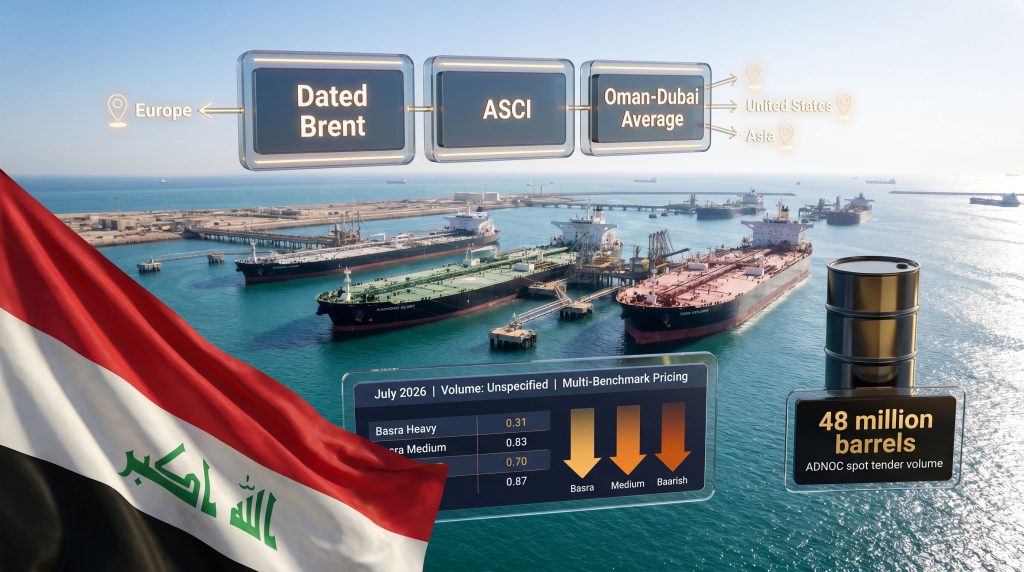
Beyond the volume omission, the tender introduced a three-benchmark pricing structure across destination regions:
| Destination Region | Pricing Benchmark Applied |
|---|---|
| Europe | Dated Brent |
| United States | Argus Sour Crude Index (ASCI) |
| Asia | Average of Oman-Dubai |
Deploying all three of the world's primary crude pricing benchmarks within a single tender is highly unusual for SOMO. Each benchmark represents a distinct pricing ecosystem with its own liquidity pool, participant base, and refinery economics. By addressing European, American, and Asian buyers simultaneously with tailored pricing references, SOMO signalled that it cannot rely on any single region to absorb its current surplus.
Consequently, it is actively competing for crude procurement budgets across the entire global refining complex. Furthermore, the compressed tender window — issued Thursday and closing Saturday — adds another layer of analytical interest. A two-day window is characteristic of urgent inventory clearance activity rather than routine commercial tendering, which typically allows buyers several business days to conduct credit assessments, freight calculations, and internal approval processes.
Basra Heavy and Basra Medium: Grade Characteristics and Competitive Dynamics
The two grades offered in the July tender, Basra Heavy and Basra Medium, are Iraq's primary seaborne export grades and carry distinct refinery processing requirements.
Basra Medium has an API gravity of approximately 29 to 31 degrees and a sulfur content around 2.9%, positioning it as a medium-sour crude suitable for complex refineries with secondary conversion units. Basra Heavy is denser and more sulfurous, with API gravity closer to 24 degrees and sulfur content approaching 3.5 to 4%, placing it firmly in the heavy-sour category.
These grade characteristics matter commercially for several reasons:
- Heavy-sour crude grades require hydrocracking or coking capacity at the refinery level, limiting the pool of eligible buyers to more complex and capital-intensive refining configurations
- When Middle Eastern supply volumes rise sharply, heavy-sour grades face disproportionate pricing pressure because the available refinery configurations that can process them are finite
- Discounts on Basra grades relative to benchmarks compress the netback economics for producers, eroding the per-barrel revenue Iraq receives after accounting for freight and refining margins
The Basra Oil Terminal itself, located within the Strait of Hormuz corridor, serves as Iraq's dominant crude export gateway. Its geographic position creates inherent freight efficiency for Asian buyers, particularly those in China, India, South Korea, and Japan, where the majority of Iraqi crude finds its destination.
However, Strait of Hormuz transit dynamics also introduce geopolitical risk premiums that some European buyers factor into sourcing decisions, adding complexity to SOMO's effort to attract Western hemisphere demand. For further context on how crude oil prices in 2025 were shaped by similar trade and geopolitical pressures, the parallels with mid-2026 dynamics are instructive.
The Supply Architecture Driving Inventory Accumulation
The broader context behind the Iraq SOMO July-loading oil tender is a structural supply surge reshaping physical crude markets across the Middle East in mid-2026. Physical crude cargoes are trading at steep discounts to benchmark prices globally, as rising export volumes from the region test the absorption capacity of the refining complex.
Iran's anticipated production ramp-up, following a temporary reprieve from U.S. sanctions, introduces a particularly significant competitive dynamic for Iraq. Iranian crude grades compete for many of the same Asian refinery slots that Basra grades traditionally occupy. As Iranian barrels re-enter the market, the incremental refinery demand available for Iraqi crude contracts, placing downward pressure on both the volume SOMO can place and the pricing levels it can sustain.
The Abu Dhabi National Oil Company (ADNOC) precedent also warrants careful analysis. Following the UAE's departure from OPEC, ADNOC sold at least 48 million barrels of crude through spot tenders for fuel oil, introducing a substantial volume of Middle Eastern sour crude into the competitive spot market. This activity contributed directly to the discount environment now affecting all producers in the region.
The parallel with SOMO's current approach is instructive: both producers have shifted toward open-market spot tendering without volume caps, a pattern that typically characterises periods when term contract markets have become saturated and sovereign producers are prioritising volume clearance over price optimisation.
"When multiple sovereign producers simultaneously migrate from OSP-linked term sales to uncapped spot tendering, it generally signals that the market has moved beyond a transient supply imbalance and into a more persistent structural oversupply phase that term contracts alone cannot resolve."
Iraq's OPEC Position and the Fiscal Imperative Behind Production Pressure
Iraq occupies a uniquely pressured position within the OPEC architecture. As the group's second-largest producer, its production levels carry material weight in the coalition's overall supply management calculations. Yet Baghdad's fiscal reality creates structural incentives that frequently conflict with collective production restraint. Indeed, understanding OPEC's influence on global oil markets helps contextualise why Iraq's position within the group remains so fraught.
Oil revenues fund over 90% of Iraq's federal budget, meaning that every barrel left unsold or priced at a steeper discount than necessary carries direct consequences for public sector wages, infrastructure spending, and social stability. This fiscal dependency creates a powerful internal pressure to maximise both production volumes and the speed at which crude is converted into government revenue.
Sources with knowledge of internal deliberations have reported, via Reuters, that Baghdad has actively considered leaving OPEC if the group does not agree to a substantial increase in Iraq's production quota. The strategic logic is straightforward: if quota constraints prevent Iraq from producing and selling at its technical capacity, the economic cost of OPEC membership may eventually outweigh the benefits of collective price management.
Furthermore, OPEC's demand forecast revisions for 2025 already pointed to a tightening tension between member ambitions and collective discipline, a tension that has only intensified in the period since.
Three scenarios define the plausible range of outcomes for Iraq's OPEC relationship:
| Scenario | Trigger Conditions | Probable Crude Market Impact |
|---|---|---|
| Quota Renegotiation | OPEC agrees to raise Iraq's production ceiling | Moderate volume increase; potential price floor stabilisation |
| Compliance Drift | Iraq gradually produces beyond quota without formal withdrawal | Sustained downward pressure on sour crude differentials |
| Formal OPEC Exit | Baghdad withdraws from the production agreement entirely | Significant volume surge; accelerated discount environment across all Middle Eastern grades |
The July tender's uncapped volume structure may itself reflect a form of implicit quota resistance. By declining to specify how many barrels it is offering, SOMO preserves maximum commercial flexibility while avoiding a formal declaration that it is exceeding any agreed export ceiling.
Benchmark Economics and the Three-Region Buyer Strategy
The simultaneous use of Dated Brent, ASCI, and the Oman-Dubai average in the Iraq SOMO July-loading oil tender reflects a sophisticated, if commercially pressured, attempt to optimise cargo placement across all major refining hubs.
The Oman-Dubai average is the benchmark of greatest strategic importance for Iraq. Asian buyers, particularly Chinese independent refiners (known colloquially as teapot refineries) and Indian state refiners, routinely use this reference to price Middle Eastern sour crude purchases. China and India together represent the largest destination bloc for Basra grade crude, and the health of their refinery utilisation rates in the July to August 2026 window will be the critical variable determining how much of SOMO's unsold inventory is cleared.
The ASCI linkage for U.S. buyers is analytically interesting given the relative complexity of positioning Iraqi crude in the American market. U.S. Gulf Coast refineries are highly configured for heavy-sour crude processing, making them technically compatible buyers of Basra grades. However, freight economics across the Atlantic and the competitive presence of Western Hemisphere sour alternatives, including Mexican Maya and Venezuelan heavy crude grades, mean that Basra must offer a meaningful discount to capture U.S. refinery procurement budgets.
Dated Brent pricing for European buyers faces similar freight and refinery configuration constraints, but European refineries have historically taken Basra Medium during periods of elevated North Sea or Mediterranean grade pricing, creating opportunistic demand windows that SOMO appears to be targeting. In addition, the oil price shock affecting Canadian energy executives in 2025 illustrated how rapidly benchmark volatility can propagate across unrelated producer regions, a dynamic equally relevant to Baghdad's planning horizon.
The next major ASX story will hit our subscribers first
Key Market Indicators Worth Monitoring
For energy market participants tracking the implications of this tender and the broader structural changes it reflects, several forward indicators carry particular diagnostic value:
- SOMO tender frequency: A sustained pattern of open-volume, multi-benchmark tenders across August and September 2026 would confirm a strategic shift in Iraq's crude marketing posture rather than an isolated commercial response
- Basra grade differentials: The trajectory of Basra Heavy and Basra Medium discounts against their respective benchmarks will quantify real-time market absorption capacity and signal whether the discount environment is deepening or stabilising
- Iraq's OPEC quota negotiations: Any formal movement toward quota revision or exit documentation will have amplified consequences for global sour crude supply balances and Brent pricing
- Chinese and Indian crude import volumes: Aggregate import data for July through August 2026 from these two markets will reveal whether Asian refinery demand is sufficient to absorb the surplus volumes SOMO and other Middle Eastern producers are attempting to place
- Iranian export ramp-up pace: The rate at which sanctioned Iranian barrels re-enter certified trading channels will directly determine the competitive intensity facing Basra grades in the Asian spot market
Moreover, the global crude steel outlook for 2025 serves as a useful parallel indicator, given that industrial demand for energy-intensive sectors often foreshadows broader shifts in crude consumption patterns across major importing economies.
Disclaimer: This article is intended for informational and analytical purposes only. It does not constitute financial or investment advice. All forecasts, scenarios, and market projections discussed involve uncertainty and should not be relied upon as the basis for investment decisions. Readers should conduct independent research and consult qualified financial advisers before making any trading or investment decisions related to crude oil markets.
Want to Stay Ahead of the Next Major Mineral Discovery on the ASX?
Discovery Alert's proprietary Discovery IQ model delivers real-time alerts on significant ASX mineral discoveries, cutting through complex data to surface actionable investment opportunities the moment they emerge — explore historic discoveries and their returns to see what's possible, then begin your 14-day free trial at Discovery Alert to position yourself ahead of the broader market.