May 16, 2026
Understanding the IRMA Framework: A Comprehensive Industry Assessment Tool
Mining operations worldwide face mounting pressure to demonstrate environmental stewardship, social responsibility, and governance excellence. Within this evolving landscape, the Initiative for Responsible Mining Assurance has emerged as a comprehensive framework addressing stakeholder demands for transparent, verifiable sustainability performance across the global mining sector. The IRMA mining certification system represents a critical component of industry evolution trends shaping responsible mining practices.
Core Components of the Initiative for Responsible Mining Assurance
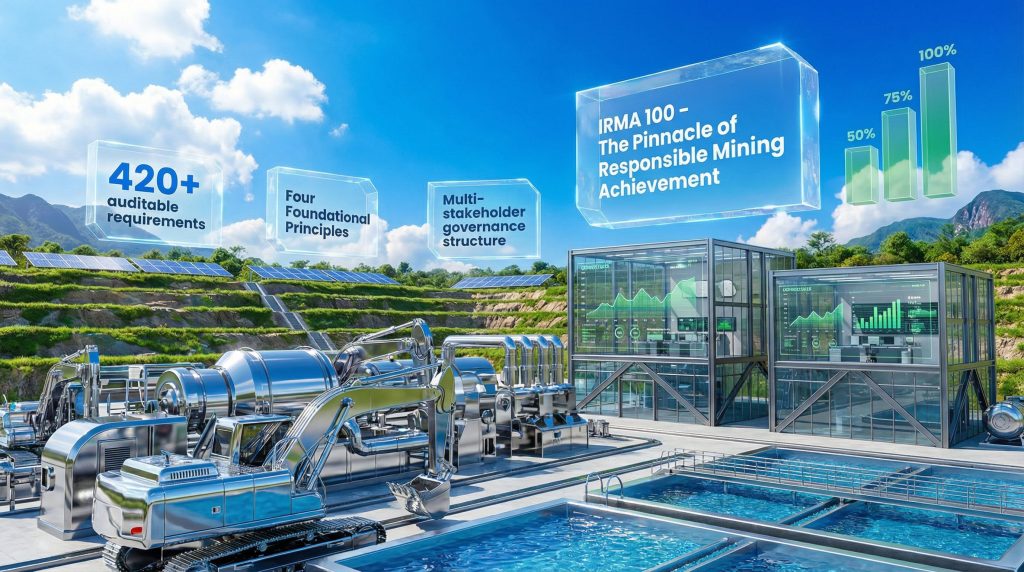
The IRMA mining certification system operates through a rigorous assessment methodology encompassing approximately 400 auditable requirements distributed across four foundational principles. This extensive framework applies to diverse mining operations globally, excluding energy fuels such as oil, gas, coal, and uranium, while covering surface, subsurface, and solution mining methodologies.
The certification structure incorporates multi-stakeholder governance representation from four key constituencies: mining companies, local communities, civil society organisations, and worker representatives. This collaborative approach ensures balanced oversight and prevents industry-dominated standard development common in alternative frameworks.
Independent certification bodies conduct comprehensive site-level assessments, evaluating operational performance against established benchmarks. The methodology requires three-year surveillance cycles to maintain certification status, ensuring sustained compliance rather than momentary achievement snapshots.
The Four Foundational Principles Driving IRMA Standards
Business Integrity forms the ethical cornerstone of IRMA assessment, encompassing transparent governance structures, anti-corruption protocols, and stakeholder engagement mechanisms. Operations must demonstrate systematic approaches to ethical decision-making and accountability frameworks extending throughout corporate hierarchies.
Planning for Positive Legacy addresses long-term community impact beyond operational closure. This principle evaluates mine closure planning, post-mining land use strategies, economic diversification support, and infrastructure development contributing to sustainable regional development.
Social Responsibility encompasses comprehensive human rights protection, community engagement protocols, and cultural heritage preservation. Assessment criteria include indigenous rights recognition, fair labour practices, and participatory decision-making processes affecting local populations.
Environmental Responsibility covers ecosystem protection, resource stewardship, and environmental impact mitigation. Requirements span water management, biodiversity conservation, waste management solutions, and air quality maintenance throughout operational lifecycles.
When big ASX news breaks, our subscribers know first
How Does IRMA Certification Work? The Complete Assessment Process
The IRMA mining certification assessment unfolds through structured phases designed to evaluate both documentation and operational implementation. Independent auditors conduct comprehensive reviews encompassing desktop analysis, on-site verification, and stakeholder engagement validation.
Stage-by-Stage Audit Methodology
Desktop Review Phase initiates the assessment through comprehensive document analysis and preliminary scoring against IRMA requirements. Auditors evaluate management system documentation, policy frameworks, and operational procedures before conducting site visits.
On-site Verification involves physical facility inspections, operational observations, and direct stakeholder interviews. The February 2026 surveillance audit at Anglo American's Minas-Rio operation demonstrated this methodology through confidential employee interviews and community engagement sessions, ensuring comprehensive perspective gathering.
Final Reporting culminates in public disclosure requirements and achievement recognition. Assessment results become publicly available regardless of performance scores, supporting transparency objectives fundamental to IRMA philosophy.
Critical Requirements vs. Standard Requirements
IRMA distinguishes between critical requirements addressing fundamental operational standards and standard requirements covering broader performance optimisation. Critical requirements include child labour prevention, human rights protection mandates, and environmental safety protocols requiring absolute compliance.
Non-conformity with critical requirements triggers timebound corrective action plans with mandatory implementation verification. Standard requirements allow graduated scoring reflecting performance variation while maintaining operational certification eligibility.
Surveillance audit requirements occur within three-year certification cycles, as demonstrated by Anglo American's Minas-Rio system, which maintained IRMA 75 achievement through February 2026 surveillance review. The process ensures that implemented controls remain robust and effective across operational cycles.
IRMA Achievement Levels: From Transparency to Excellence
The IRMA mining certification framework recognises four distinct achievement levels, each representing progressive operational excellence and stakeholder engagement sophistication. These levels provide graduated recognition pathways accommodating diverse operational contexts while maintaining rigorous assessment standards.
IRMA Transparency – The Entry Point for Mining Operations
IRMA Transparency establishes the foundational certification level requiring independent audit completion by approved certification bodies. Operations achieving transparency level commit to public disclosure of assessment results regardless of performance scores, demonstrating initial commitment to stakeholder accountability.
This entry-level achievement serves mines beginning their responsible mining journey, providing baseline measurement against international standards while establishing improvement trajectory foundations. Furthermore, it enables companies to access data-driven operations frameworks for continuous improvement.
IRMA 50 and IRMA 75 – Performance-Based Achievement Tiers
IRMA 50 requires minimum 50% average scoring across the four foundational principles, with substantial compliance demonstrated across relevant critical requirements. This achievement level reflects systematic operational improvements beyond basic transparency commitments.
IRMA 75 demands 75% average performance across foundational principles, representing advanced operational excellence. Anglo American achieved this level at both their Minas-Rio iron ore operation and Barro Alto nickel operation in Goiás state, Brazil, demonstrating consistent performance across diverse commodity types and geographic locations.
The Minas-Rio operation's maintenance of IRMA 75 status through surveillance audit cycles indicates sustained operational performance rather than temporary achievement, reflecting embedded management system effectiveness.
IRMA 100 – The Pinnacle of Responsible Mining Achievement
IRMA 100 represents comprehensive compliance across all applicable requirements, demonstrating industry-leading practices in sustainable mining operations. This achievement level, previously termed certification but now designated as achievement, reflects continuous improvement philosophy rather than static compliance endpoints.
Operations achieving IRMA 100 status demonstrate systematic excellence across environmental protection, social responsibility, business integrity, and positive legacy planning while maintaining stakeholder engagement sophistication. Additionally, these operations often realise significant decarbonisation benefits through their comprehensive sustainability approach.
What Makes IRMA Different from Other Mining Standards?
The IRMA mining certification framework distinguishes itself through structural governance innovations and comprehensive assessment scope compared to traditional industry standards. These differentiating characteristics address common criticisms of industry-led initiatives while ensuring credible third-party verification.
Multi-Stakeholder Governance vs. Industry-Led Initiatives
Unlike industry-dominated standards such as the Conflict-Free Minerals Sourcing Initiative, IRMA incorporates equal representation from mining companies, communities, civil society, and workers throughout governance structures. This balanced approach prevents industry capture while ensuring practical operational relevance.
Independent oversight mechanisms ensure balanced stakeholder interests guide standard development and implementation protocols. Community representatives and civil society organisations maintain equal decision-making authority alongside corporate and worker constituencies.
For instance, the Initiative for Responsible Mining Assurance demonstrates this multi-stakeholder approach through its diverse board composition. Moreover, comprehensive IRMA assessment programs provide transparent evaluation mechanisms for all participants.
Transparency-First Philosophy
IRMA mandates public disclosure requirements for all achievement levels, distinguishing it from confidential assessment frameworks common in industry-led initiatives. Operations must publish assessment results regardless of performance outcomes, supporting stakeholder accountability objectives.
Open access to audit results and performance metrics enables community oversight and investor due diligence. Stakeholder complaint mechanisms and challenge procedures provide recourse pathways for addressing assessment concerns or operational grievances.
The Business Case for IRMA Certification in Mining Operations
Mining companies increasingly recognise IRMA mining certification as essential infrastructure for sustainable operational licensing and market access. The business rationale extends beyond regulatory compliance to encompass investor relations, community engagement, and operational risk mitigation.
Investor and Financial Market Recognition
ESG compliance requirements from institutional investors drive IRMA adoption among publicly traded mining companies seeking capital market access. Investment funds increasingly mandate sustainability certification for portfolio inclusion, creating market incentives for IRMA achievement.
Risk mitigation benefits for insurance providers and lenders reduce operational costs through improved risk profiles. IRMA-certified operations demonstrate systematic risk management across environmental, social, and governance dimensions, supporting favourable insurance terms and lending conditions.
Enhanced market positioning for sustainable mining portfolios provides competitive differentiation in commodity markets increasingly sensitive to supply chain responsibility. Anglo American's dual IRMA 75 achievements across iron ore and nickel operations exemplify corporate sustainability positioning advantages.
Regulatory and Government Relations Benefits
Proactive compliance with evolving environmental regulations positions IRMA-certified operations ahead of regulatory development curves. Certification demonstrates systematic environmental management exceeding minimum legal requirements across operational jurisdictions.
Enhanced social licence to operate in local communities reduces operational disruption risks and community opposition. The stakeholder engagement requirements integral to IRMA assessment build sustained community relationships supporting long-term operational stability.
Reduced regulatory scrutiny and improved government relations result from demonstrated commitment to international standards. Government agencies increasingly recognise IRMA certification as evidence of responsible operational practices, reducing inspection frequency and regulatory intervention likelihood.
Implementation Strategy: Preparing Your Mining Operation for IRMA Assessment
Successful IRMA mining certification requires systematic preparation addressing both documentation requirements and operational practice alignment. Operations must develop comprehensive understanding of assessment criteria while building stakeholder engagement capabilities supporting sustained certification maintenance.
Pre-Assessment Preparation and Self-Evaluation
Comprehensive review of existing management systems identifies gaps between current practices and IRMA requirements. Operations should conduct systematic analysis across all four foundational principles, documenting current performance levels and improvement opportunities.
Gap analysis against IRMA's 400+ requirements provides detailed implementation roadmaps prioritising critical requirement compliance and strategic improvement initiatives. This analysis should encompass documentation review, operational practice assessment, and stakeholder feedback integration.
Internal stakeholder engagement and readiness assessment ensures organisational alignment supporting certification pursuit. Management commitment, worker participation, and community relationship evaluation form essential preparation components.
Selecting and Working with IRMA-Approved Auditors
Criteria for choosing qualified assessment bodies include technical competency, geographic experience, and stakeholder engagement expertise. SCS Global Services, which conducted Anglo American's Minas-Rio surveillance audit, exemplifies internationally recognised third-party auditor capabilities.
Coordination of desktop reviews and site visits requires detailed planning accommodating operational schedules while ensuring comprehensive access for auditor teams. Preparation includes documentation compilation, stakeholder availability coordination, and facility access arrangements.
Managing stakeholder interview processes and community engagement demands cultural sensitivity and confidentiality protection. The confidential employee interviews conducted during Minas-Rio's surveillance audit demonstrate protective measures ensuring honest feedback collection.
The next major ASX story will hit our subscribers first
Global Mining Industry Trends and IRMA Adoption Patterns
The expanding adoption of IRMA mining certification reflects broader industry transformation toward sustainability accountability and stakeholder transparency. Regional implementation patterns reveal diverse approaches to responsible mining integration while highlighting common operational challenges.
Regional Implementation Variations and Challenges
Emerging market adoption rates vary significantly based on regulatory frameworks, community engagement traditions, and corporate governance development. Brazil's dual Anglo American IRMA 75 achievements demonstrate emerging market leadership in sustainable mining practices.
Developed market integration with existing ESG frameworks creates synergies between IRMA requirements and established sustainability reporting protocols. Operations in developed markets often leverage existing ESG infrastructure for IRMA compliance preparation.
Cultural and operational adaptation requirements across different mining jurisdictions necessitate localised stakeholder engagement approaches while maintaining standardised assessment criteria. Community consultation protocols must accommodate indigenous rights frameworks and traditional authority structures.
How Do IRMA and Mining Leadership Trends Intersect?
Contemporary mining leadership trends emphasise sustainability expertise and stakeholder engagement capabilities as core competencies for executive success. Leaders increasingly prioritise ESG performance alongside traditional operational metrics when evaluating strategic initiatives.
Commodity-Specific Considerations for IRMA Implementation
| Commodity Type | Specific Challenges | IRMA Focus Areas |
|---|---|---|
| Iron Ore | Large-scale community impact | Infrastructure legacy planning |
| Nickel | Processing environmental concerns | Water management protocols |
| Precious Metals | Artisanal mining interfaces | Social responsibility frameworks |
| Industrial Minerals | Aggregate operations scope | Environmental restoration requirements |
Base metals operations like Anglo American's iron ore and nickel facilities demonstrate IRMA applicability across diverse commodity types while highlighting commodity-specific assessment considerations. The maintenance of IRMA 75 status across both operation types indicates standardised excellence regardless of mineral focus.
Future Outlook: IRMA's Role in Sustainable Mining Evolution
The trajectory of IRMA mining certification reflects accelerating industry transformation toward comprehensive sustainability integration. Technological advancement, regulatory evolution, and market pressure convergence creates expanding opportunities for IRMA framework enhancement and adoption.
Technology Integration and Digital Monitoring Capabilities
Real-time environmental monitoring and reporting systems enable continuous compliance verification beyond periodic audit cycles. Digital sensor networks provide stakeholder access to environmental performance data supporting transparency objectives fundamental to IRMA philosophy.
Blockchain-based supply chain transparency initiatives complement IRMA certification by providing tamper-proof documentation of responsible sourcing throughout commodity value chains. These technological solutions address downstream manufacturer and consumer brand demands for verifiable sustainability practices.
AI-driven stakeholder engagement and feedback mechanisms enhance community consultation processes while reducing operational burden of sustained stakeholder relationship management. Automated translation services and digital feedback platforms expand participation accessibility across diverse linguistic and cultural contexts.
Market Forces Driving Increased IRMA Adoption
Supply chain due diligence requirements from downstream manufacturers create market demand for verifiable responsible sourcing documentation. Automotive, electronics, and infrastructure sectors increasingly mandate sustainability certification from mineral suppliers.
Consumer brand pressure for responsible sourcing verification drives market premiums for certified sustainable minerals. Brand reputation protection requires supply chain transparency extending through mining operations to final consumer products.
International trade agreement sustainability clauses incorporate environmental and social standards affecting mineral trade flows. IRMA certification provides standardised compliance documentation supporting international market access requirements.
Measuring Success: Key Performance Indicators for IRMA-Certified Operations
Effective measurement of IRMA mining certification success requires comprehensive performance indicator tracking across environmental, social, and governance dimensions. These metrics enable continuous improvement while supporting stakeholder accountability objectives.
Environmental Performance Metrics and Benchmarking
| Environmental Category | Key Metrics | IRMA Requirement Level | Measurement Frequency |
|---|---|---|---|
| Water Management | Consumption reduction %, recycling rates | Critical | Monthly reporting |
| Biodiversity Protection | Habitat restoration area, species monitoring | Standard | Quarterly assessment |
| Waste Management | Tailings stability, waste diversion rates | Critical | Continuous monitoring |
| Air Quality | Particulate emissions, community monitoring | Standard | Real-time tracking |
Water management performance requires quantified consumption reduction targets with recycling rate optimisation demonstrating resource stewardship excellence. Critical requirement status necessitates absolute compliance with established thresholds.
Biodiversity protection metrics encompass habitat restoration areas and species population monitoring providing quantitative conservation impact measurement. Standard requirement classification allows graduated performance recognition while maintaining improvement trajectory expectations.
Social Impact Assessment and Community Benefit Tracking
| Social Category | Measurement Approach | Stakeholder Input Source | Reporting Cycle |
|---|---|---|---|
| Local Employment | Hiring ratios, skills development programs | Community representatives | Semi-annual |
| Cultural Heritage | Protection protocols, indigenous consultation | Traditional landowners | Project-specific |
| Health & Safety | Incident rates, worker satisfaction surveys | Labour unions | Monthly/Annual |
| Economic Development | Local procurement, infrastructure investment | Government agencies | Annual reporting |
Local employment tracking measures hiring ratios favouring community residents while documenting skills development programme effectiveness. Community representative input ensures measurement alignment with local priorities and expectations.
Cultural heritage protection requires protocol implementation documentation and indigenous consultation verification. Traditional landowner involvement ensures cultural sensitivity while maintaining operational feasibility.
Common Challenges and Solutions in IRMA Implementation
Mining operations pursuing IRMA mining certification encounter predictable implementation challenges requiring systematic resolution strategies. Understanding common obstacles enables proactive preparation while accelerating certification timeline achievement.
Stakeholder Engagement Complexities
Multi-language communication requirements challenge operations in linguistically diverse regions necessitating comprehensive translation services and cultural interpretation capabilities. The community engagement sessions conducted during Anglo American's surveillance audits demonstrate effective multi-stakeholder communication protocols.
Conflicting community priorities and expectations require careful navigation balancing diverse interest groups while maintaining operational feasibility. Stakeholder mapping and priority assessment enable targeted engagement strategies addressing primary concerns while managing secondary issues.
Long-term relationship building beyond audit cycles demands sustained engagement investment extending beyond certification maintenance requirements. Three-year surveillance cycles provide framework for ongoing relationship development while ensuring compliance verification.
Operational Integration and Change Management
Existing system alignment with IRMA requirements requires comprehensive management system review and modification ensuring seamless integration rather than parallel compliance structures. The maintenance of robust and effective management systems demonstrated at Minas-Rio reflects successful integration achievement.
Staff training and cultural transformation initiatives enable organisational alignment supporting sustained certification maintenance. Employee engagement in assessment processes, including confidential interviews, requires trust-building and participation incentive development.
Cost-benefit optimisation for sustainable compliance balances certification investment against operational improvement benefits and market positioning advantages. Anglo American's dual IRMA 75 achievements across different commodity operations demonstrates scalable investment returns through systematic excellence implementation.
Disclaimer: This analysis is based on publicly available information and should not be considered as investment advice. Mining operations considering IRMA certification should consult directly with approved certification bodies and conduct comprehensive feasibility assessments. Market conditions, regulatory requirements, and certification standards may vary by jurisdiction and change over time.
Looking to Invest in Responsible Mining Operations?
Discovery Alert's proprietary Discovery IQ model delivers real-time alerts on significant mineral discoveries across the ASX, helping investors identify mining companies demonstrating operational excellence and sustainable practices. Stay ahead of market movements by exploring historic examples of exceptional discovery returns and begin your 14-day free trial today to secure your competitive advantage.