August 13, 2026
The Hidden Economics of Iron Ore Quality and Why AI Is Reshaping the Entire Value Chain
Before a single tonne of iron ore reaches a blast furnace or direct reduction plant, it passes through a series of processing decisions that determine its ultimate commercial value. The grade of ore, the proportion of impurities, and the consistency of the final product all influence what steelmakers are willing to pay. For decades, these outcomes were shaped by human judgment, mechanical thresholds, and process experience passed down through plant operators. That era is ending. Across Brazil's iron ore heartland, a convergence of artificial intelligence, industrial sensors, and integrated data systems is fundamentally changing what is possible inside a mineral processing plant.
The Vale and ABB AI automation in Brazil iron ore sector represents one of the clearest and most technically detailed examples of this transformation currently underway anywhere in global mining.
When big ASX news breaks, our subscribers know first
Understanding the Iron Ore Quality Problem That AI Is Solving
Iron ore is not a single commodity. It exists on a spectrum of grades and compositions, and the difference between a standard pellet feed and a premium direct reduction ore can represent a price premium of tens of dollars per tonne. Understanding iron ore types and deposits helps contextualise why direct reduction iron, or DRI-grade ore, requires iron content typically above 67% Fe with tightly controlled levels of silica, alumina, and phosphorus. Producing this consistently at scale is extraordinarily difficult without precise, real-time process control.
Traditional processing plants managed quality through periodic sampling, laboratory analysis, and manual adjustments. The lag time between a process deviation and a corrective response could stretch to hours. During that window, suboptimal product accumulated in the circuit, valuable iron was lost to tailings streams, and energy was consumed processing material that would ultimately be discarded.
This is the exact problem that data-driven automation addresses. By monitoring hundreds of variables simultaneously and reacting in real time, AI-enabled systems compress that lag to seconds rather than hours.
What the Conceição II Plant Revealed About AI-Driven Processing
Located in Itabira in the state of Minas Gerais, Vale's Conceição II processing plant became the proving ground for a new operational model. Minas Gerais is significant not just geographically but geologically. The Iron Quadrangle region of the state contains some of the highest-grade itabirite and hematite deposits in the world, making it the foundation of Brazil's position as one of the two largest iron ore exporters globally.
The modernisation program at Conceição II involved a scale of instrumentation rarely seen in a single mineral processing upgrade:
| Automation Layer | Scale of Deployment |
|---|---|
| Instruments automated | ~7,300 units |
| Monitoring cameras installed | 100+ units |
| Process variables managed via AI | 400+ variables |
| Annual processing capacity post-upgrade | 11.2 million tonnes |
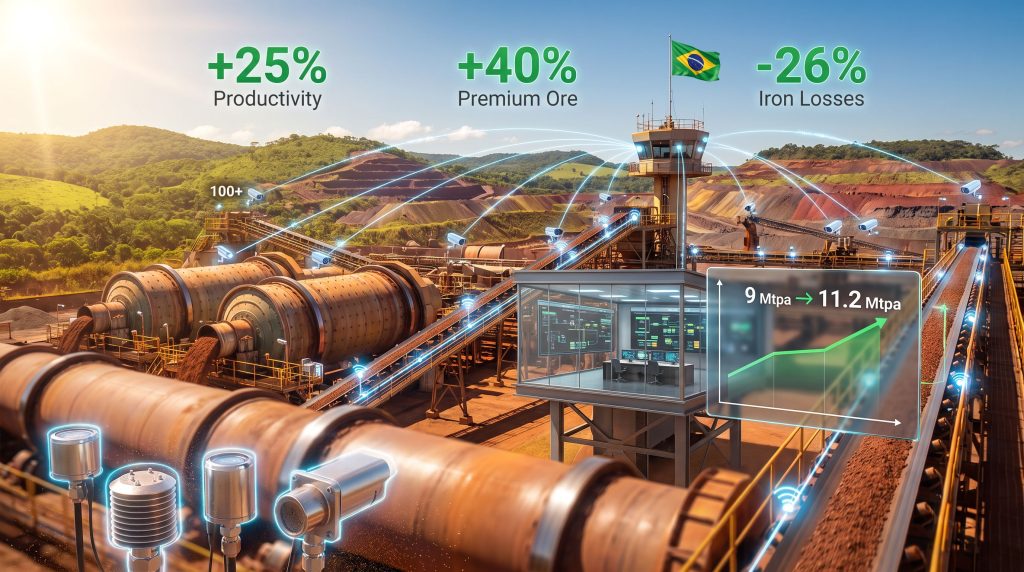
The results measured since the 2024 implementation have been striking across multiple dimensions:
| Performance Metric | Measured Outcome |
|---|---|
| Overall productivity increase | +25% |
| Premium ore for direct reduction | +40% |
| Iron losses to tailings | -26% |
| Processing capacity growth | 9 Mtpa to 11.2 Mtpa |
According to Vale's own reporting on the facility, the 40% increase in premium ore production for direct reduction deserves particular attention. DRI-grade ore commands a substantial market premium because it feeds electric arc furnaces and direct reduction plants that produce lower-carbon steel. As steelmakers globally pursue decarbonisation pathways, demand for this higher-specification product is growing faster than demand for conventional blast furnace pellets. Producing more of it without expanding mine throughput is a pure value creation exercise.
The 26% reduction in iron losses to tailings is equally significant but operates differently. Every percentage point of iron that exits a plant in the tailings stream rather than in saleable product represents a permanent revenue loss. It also represents a waste management burden. Reducing that loss simultaneously improves economics and shrinks the volume of material requiring tailings storage.
How IT/OT Integration Actually Functions in a Processing Plant
One of the most misunderstood aspects of modern mining automation is what IT/OT integration actually means in practice. Operational technology (OT) refers to the hardware and software that directly controls physical equipment: programmable logic controllers, SCADA systems, distributed control systems, and the sensors and actuators connected to them. Information technology (IT) refers to the enterprise computing layer: databases, analytics platforms, enterprise resource planning systems, and communication networks.
Historically, these two worlds were kept deliberately separate. OT systems operated in isolated environments for security and reliability reasons. The result was that enormous quantities of process data were generated but never analysed at an enterprise level.
ABB's role in the Vale partnership centres on bridging this divide. Furthermore, the integrated framework works through a layered sequence:
-
Continuous sensor capture – 7,300+ instruments measure temperature, pressure, flow rates, particle size, density, and chemical composition across the processing circuit simultaneously.
-
Real-time data transmission – Integrated IT/OT infrastructure carries this data stream to centralised control systems without the latency that historically made real-time response impossible.
-
AI-driven variable analysis – Algorithms process 400+ simultaneous variables, identifying correlations and anomalies that no human operator could track manually.
-
Predictive failure detection – The system identifies early indicators of equipment stress or process deviation before they escalate into unplanned shutdowns.
-
Automated response protocols – Corrective adjustments are applied automatically or flagged for operator action, reducing the need for physical field inspections in hazardous plant areas.
-
Continuous model refinement – Historical performance data feeds back into the AI models, progressively improving predictive accuracy over time.
This architecture explains why the Conceição II results are not simply the product of adding more sensors. The value lies in the integration layer that converts raw data into actionable intelligence. In addition, AI-powered mining efficiency gains of this kind are increasingly being replicated across other major operations globally.
The Safety Dimension: Why Fewer Field Interventions Matter
Brazil's mining industry carries a difficult legacy regarding worker safety. The 2019 Brumadinho tailings dam disaster, which resulted in the deaths of 270 people, fundamentally changed how Brazilian society and regulators view operational risk in iron ore mining. The pressure on producers to reduce worker exposure to hazardous environments has intensified significantly since that event.
Automation directly addresses this by reducing the frequency with which workers need to physically enter process areas for inspections, sampling, or fault diagnosis. When an AI system can detect an impending pump failure from vibration and temperature signatures, a maintenance team can intervene in a planned, controlled manner rather than responding to an emergency in a live plant environment.
Vale's Vice President of Operations, Carlos Medeiros, has indicated that the technologies implemented at Conceição II demonstrably improve employee safety alongside the productivity and quality metrics. The safety case for automation is therefore not incidental to the business case. It is integral to it.
The Blueprint Strategy: Why Replication Matters More Than the Pilot
A single plant upgrade, however impressive, does not transform a mining company. What makes the Vale and ABB AI automation in Brazil iron ore arrangement strategically meaningful is the explicit intent to use Conceição II as a standardised template for deployment across multiple Brazilian iron ore operations.
Joachim Braun, President of ABB's Process Industries Division, has described the goal as creating a consistent framework for automation, electrification, and digitalisation that can be replicated across operations at scale. This standardisation approach is significant for several reasons:
- Reduced implementation risk – Each subsequent deployment benefits from lessons learned at Conceição II, reducing the uncertainty associated with novel technology introduction.
- Lower marginal cost – Standardised configurations are faster and cheaper to deploy than bespoke site-by-site solutions.
- Operational consistency – Uniform systems across sites enable enterprise-level performance benchmarking and knowledge transfer between plant teams.
- Data network effects – As more sites generate data within the same framework, the AI models trained on that data become progressively more accurate and generalisable.
Vale has indicated that the rollout will proceed gradually, reflecting a phased deployment logic that manages both capital allocation and operational continuity.
The next major ASX story will hit our subscribers first
How Brazil's Iron Ore Automation Context Differs from Australian Models
A comparison with how other major iron ore producers approach automation reveals important structural differences:
| Operator | Region | Automation Focus | Notable Technology |
|---|---|---|---|
| Vale | Brazil | AI process optimisation, IT/OT integration | ABB control systems, sensor networks |
| BHP | Australia | Autonomous haulage, remote operations | Integrated remote operations centres |
| Rio Tinto | Australia | Mine of the Future program | AutoHaul autonomous rail, AI ore characterisation |
| Fortescue | Australia | Decarbonisation and automation | Autonomous trucks, hydrogen integration |
Australian iron ore operations are predominantly open-pit, relatively flat, and well-suited to autonomous haulage and remote operations centre models. Brazil's operations are more complex geologically, involving underground and semi-underground pit configurations, and the mineralogy of itabirite ore requires significantly more beneficiation processing to achieve saleable product grades.
This means that Brazilian automation investment is weighted more heavily toward the processing circuit rather than the mining phase. The AI system managing 400+ variables at Conceição II is essentially solving a mineral processing optimisation problem that has no direct equivalent in the Pilbara. The two approaches are complementary rather than comparable, addressing different operational bottlenecks within the same commodity.
ESG Implications: Where Environmental and Economic Incentives Converge
The Conceição II results illustrate a growing reality in mining: environmental performance and financial performance are increasingly the same thing. The 26% reduction in iron losses to tailings reduces the volume of material that must be stored in tailings facilities, lowering dam management costs and liability exposure. It also recovers revenue from material that would previously have been discarded.
Furthermore, energy efficiency gains from optimised process control reduce both operating costs and Scope 1 and Scope 2 emissions intensity. Innovations in green iron production and hydrogen iron ore reduction are increasingly complementary to AI-driven process optimisation as Vale pursues its broader decarbonisation commitments. Demonstrable emissions reductions at the plant level contribute directly to corporate climate targets and improve the quality of ESG disclosures available to investors and buyers.
Data-driven operations also provide the measurement infrastructure needed for credible ESG reporting. When every process variable is logged continuously, the audit trail for environmental performance claims becomes substantially more robust than what periodic manual sampling can support.
Frequently Asked Questions: Vale and ABB AI Automation in Brazil Iron Ore
What is the Vale and ABB partnership designed to achieve?
The partnership aims to deploy automation, artificial intelligence, and integrated IT/OT systems across Vale's iron ore processing operations in Brazil, with the primary objectives of improving productivity, worker safety, ore quality, and energy efficiency across multiple sites.
What is the Conceição II Model Plant and why is it significant?
Conceição II, located in Itabira, Minas Gerais, is Vale's first fully AI-enabled processing plant. It serves as the operational template from which a broader multi-site automation rollout will be designed and standardised.
How much did productivity improve at Conceição II after automation?
Since the technology implementation in 2024, the plant has recorded a 25% overall productivity increase, a 40% rise in premium ore production for direct reduction, a 26% reduction in iron losses to tailings, and capacity growth from 9 million tonnes per year to 11.2 million tonnes per year.
What does IT/OT integration mean in the context of iron ore processing?
It refers to connecting the physical control systems that run plant equipment (operational technology) with the enterprise computing and analytics systems (information technology), enabling real-time data-driven decision-making across the entire processing workflow.
Will the automation technology be deployed at other Vale plants in Brazil?
Yes. The stated strategy is to use Conceição II as a blueprint and gradually extend the framework to other iron ore processing operations across Brazil, with the objective of improving productivity and energy efficiency at scale.
How does AI help reduce iron losses to tailings in mineral processing?
By continuously monitoring process variables such as slurry density, particle size distribution, and separation efficiency, AI systems can identify and correct conditions that cause valuable iron particles to exit the circuit in the waste stream rather than in the saleable product.
What is direct reduction ore and why does a 40% output increase matter?
Direct reduction ore is a high-specification iron ore product used to produce DRI, a lower-carbon alternative to pig iron produced in blast furnaces. It commands a price premium and is increasingly in demand as steelmakers seek to reduce their emissions intensity. Producing 40% more of it from the same ore body is a material improvement in revenue capture. The evolving China steel and iron ore market is a key driver of this demand shift.
What the Vale-ABB Model Signals for the Broader Industry
The Conceição II results validate something the mining industry has debated for years: whether AI-driven process control can generate measurable, quantifiable productivity gains at the scale and complexity of a major iron ore operation. The answer, based on verified performance data, appears to be yes.
This matters beyond Vale's operations. Every major iron ore producer globally is now watching the multi-site rollout with interest. If the standardised framework delivers comparable results at subsequent Brazilian plants, it will establish a performance benchmark that competing producers will need to respond to. The competitive pressure this creates is likely to accelerate digital investment timelines across the sector.
For investors, the metrics from Conceição II offer a concrete example of how technology capital expenditure translates into operational performance. As detailed coverage of the Itabira facility confirms, the capacity addition from 9 Mtpa to 11.2 Mtpa achieved through digitalisation rather than physical plant expansion represents a fundamentally different and more capital-efficient growth pathway than traditional volume growth strategies.
The broader lesson may be that in a commodity business where price is largely beyond management control, operational efficiency and product quality are the primary levers available to create value. Vale and ABB AI automation in Brazil iron ore, deployed at the scale and sophistication demonstrated at Conceição II, appears to be a genuinely transformative tool for pulling those levers more precisely than any previous technology has permitted.
This article contains forward-looking statements regarding planned technology deployments and operational targets. Actual outcomes may differ materially from projections. Readers should conduct independent due diligence before making investment decisions based on information contained herein.
Want to Capitalise on the Next Major Mineral Discovery Before the Market Catches On?
The same data-driven revolution reshaping iron ore processing is creating extraordinary opportunities for investors who can identify significant ASX mineral discoveries the moment they are announced — Discovery Alert's proprietary Discovery IQ model scans ASX announcements in real time, transforming complex mineral data into actionable insights for both traders and long-term investors. Explore how historic discoveries have generated substantial returns and begin your 14-day free trial today to position yourself ahead of the broader market.