
August 13, 2026
Why Offshore Lease Sale High Bids Are the Metric That Actually Matters
Measuring the health of offshore investment sentiment requires looking past headline totals. In any given lease sale, the raw number of bids submitted tells only part of the story. What separates serious capital deployment from speculative positioning is the spread between total bids and winning high bids, and how many independent companies are willing to compete against one another for the same block.
When multiple operators bid on identical acreage, that competition drives up values and signals genuine conviction in the geology, the regulatory environment, and the long-term price outlook. A sale where nearly every bid goes uncontested reflects a market selecting acreage cautiously. A sale where bidders overlap frequently on the same blocks reflects a market fighting for access.
This distinction matters enormously for interpreting U.S. Gulf lease sale high bids as a forward economic indicator, not simply a government revenue event. Furthermore, understanding these dynamics requires examining the broader context of crude oil price trends and how they influence operator confidence.
When big ASX news breaks, our subscribers know first
Reading the BBG Series: What the Numbers Reveal About Operator Confidence
A Comparative View Across the Big Beautiful Gulf Lease Sale Series
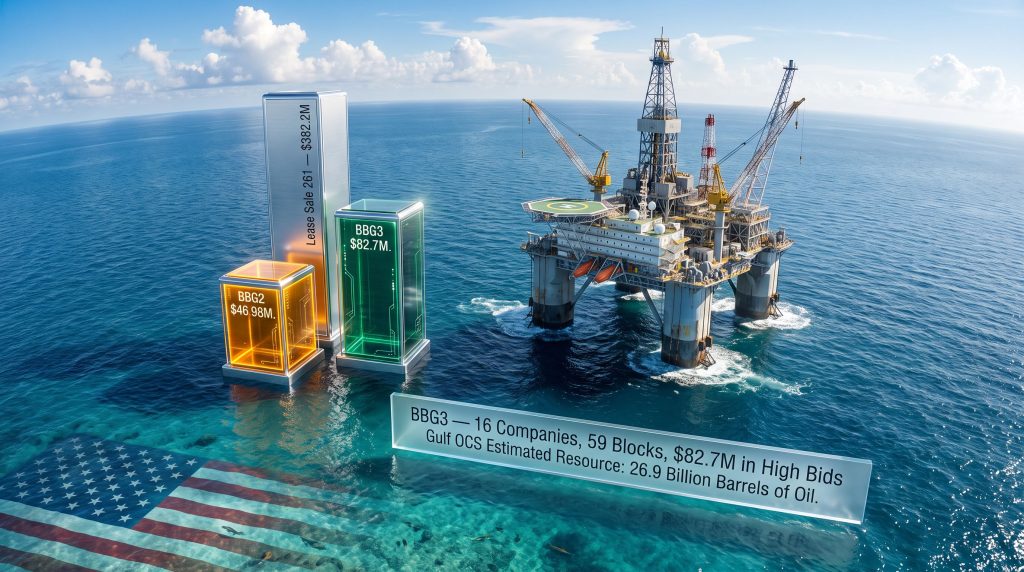
The third installment of the mandated Big Beautiful Gulf lease sale program, held in New Orleans on August 12, 2026, produced results that reinforce a pattern of accelerating engagement from the offshore industry. To understand the significance of BBG3's outcome, it helps to place it within the trajectory established by its predecessors.
| Sale | Date | Companies Participating | Total Bids | High Bids | Blocks Receiving High Bids |
|---|---|---|---|---|---|
| BBG2 | March 11, 2026 | 13 | $69.84M | $46.98M | 25 |
| BBG3 | August 12, 2026 | 16 | $99.5M | $82.7M | 59 |
| Lease Sale 261 (Benchmark) | December 2023 | N/A | N/A | $382.2M | N/A |
The progression from BBG2 to BBG3 is notable across every measurable dimension:
- High bid totals increased by approximately 76%, rising from $46.98 million to $82.7 million
- Total bids grew from $69.84 million to $99.5 million, indicating broader block-level competition
- Participating company count expanded from 13 to 16, suggesting the program is attracting new entrants alongside returning operators
- Blocks receiving high bids more than doubled, jumping from 25 to 59 across the two sales
That last figure deserves particular attention. When the number of blocks attracting competitive interest more than doubles between consecutive sales in the same mandated series, it signals that operators are not simply returning to familiar acreage. They are expanding their prospective acreage footprint, which implies growing confidence in the programme's longevity and the geology being offered.
Contextualizing Against the December 2023 Benchmark
Lease Sale 261, held in December 2023, remains the recent high-water mark for Gulf competitive intensity, with $382.2 million in high bids. BBG3's $82.7 million result sits well below that level, and analysts should resist the temptation to interpret this gap as underperformance.
The December 2023 sale operated under a different market context, including a specific oil price environment, a distinct set of blocks on offer, and a pre-mandate regulatory landscape that created urgency among operators uncertain about future leasing access. The BBG series, by contrast, operates within a congressionally mandated 30-sale framework, which fundamentally changes how operators approach each individual sale.
When future leasing access is guaranteed by statute rather than subject to discretionary approval, operators can afford to be more deliberate in their block selection. This structural shift may actually explain lower per-sale bid totals even as overall programme engagement grows.
The Regulatory Architecture Behind the 30-Sale Mandate
Congressional Authorization and Its Practical Implications
The BBG lease sale series exists because of a specific congressional directive embedded within the 2025 reconciliation legislation. That law requires the Interior Department to conduct 30 Gulf of America lease sales, establishing for the first time a long-duration, legislatively anchored leasing schedule for U.S. offshore waters.
All leases awarded under this series carry a 12.5% royalty rate, representing the statutory minimum under the Working Families Tax Cut Act. This rate determines the portion of production revenue that flows back to the federal government and applies uniformly to every lease issued through the BBG programme.
Administrative oversight for these sales has shifted to the Marine Minerals Administration (MMA), which replaced the Bureau of Ocean Energy Management (BOEM) in this function. Acting MMA Director Matt Giacona has characterised the programme as fulfilling the agency's obligation to deliver the predictable leasing calendar that both Congress directed and industry requires to justify long-horizon capital commitments, according to Interior Department reporting.
Why Schedule Predictability Changes the Investment Calculus
Offshore oil and gas development is defined by extraordinarily long lead times. From the moment a lease is awarded, operators typically spend between 10 and 15 years moving through exploration drilling, appraisal, development engineering, regulatory approvals, infrastructure construction, and finally first production.
This timeline means that capital committed to Gulf acreage today will not generate production revenue until the mid-2030s at the earliest. For a company's board to authorise that scale of upfront spending, the regulatory environment surrounding future leasing access must be legible and stable.
Historically, U.S. offshore leasing operated on a discretionary calendar, meaning each administration could accelerate, reduce, or suspend lease sales based on policy priorities. This discretionary element introduced a structural uncertainty that complicated long-range portfolio construction for offshore operators. A mandated 30-sale series removes that variable from the equation.
Interior Secretary Doug Burgum has framed the ongoing BBG sales as a cornerstone of the administration's domestic energy expansion strategy, emphasising the link between leasing continuity and long-term U.S. production capacity.
The Resource Base Underlying Gulf Leasing Investment
Scale of Acreage and Estimated Undiscovered Potential
BBG3 offered approximately 15,100 unleased blocks covering 80.4 million acres across the Western, Central, and portions of the Eastern Gulf of America planning areas. Available acreage spanned distances ranging from 3 to 231 miles offshore and encompassed water depths from as shallow as 9 feet to greater than 11,100 feet, bridging conventional shallow-water shelf plays and ultra-deepwater frontier environments.
The broader Gulf Outer Continental Shelf encompasses roughly 160 million acres in total. Interior Department estimates of the undiscovered, technically recoverable resource base within that broader acreage position are substantial:
| Resource Type | Estimated Undiscovered Technically Recoverable Volume |
|---|---|
| Crude Oil | 26.9 billion barrels |
| Natural Gas | 45.59 trillion cubic feet |
These figures represent geological potential that has yet to be converted into producing assets. They do not account for resources already discovered or currently under development, meaning the Gulf's long-term production runway extends well beyond what current proved reserves suggest.
The Gulf's Role in U.S. Energy Supply
The Gulf of America currently contributes approximately 14% of total U.S. crude oil production, according to the American Petroleum Institute. Its natural gas contribution is proportionally smaller, at roughly 2% of total U.S. natural gas output, but the region remains the dominant offshore production province in the country by a substantial margin.
However, the broader macroeconomic context also plays a role. Oil price movements driven by trade tensions and geopolitical factors directly influence how aggressively operators bid for new acreage. API Vice President of Upstream Policy Holly Hopkins has pointed to the strategic dimension of this production base, noting that at a time of elevated global energy disruption, continued Gulf investment secures the future supply that both domestic consumers and allied nations will depend on for decades ahead, according to API public statements.
Who Bid and What Bidder Diversity Signals
Participation Metrics as a Proxy for Market Confidence
The 16 companies that submitted bids in BBG3 represent a cross-section of the offshore industry, spanning major integrated producers and independent exploration-focused operators. With 69 total bids distributed across 59 blocks, the average bid density per block was approximately 1.17 bids per block, but certain blocks attracted multiple competing offers, reflecting concentrated interest in specific geological targets.
The expansion from 13 bidders in BBG2 to 16 in BBG3 is meaningful beyond the raw count. It suggests that the programme is achieving one of its core objectives: drawing new participants into a leasing framework that rewards those who can plan investment programmes across multi-year time horizons. In addition, WTI and Brent futures pricing expectations over this horizon factor heavily into operators' willingness to commit capital to new Gulf acreage.
Green Canyon's Repeated Prominence
A pattern that emerged across the BBG series is the recurring focus on Green Canyon, a deepwater Gulf protraction area within the prolific subsalt play trend. In BBG2, BP submitted the highest single bid of approximately $21 million for a Green Canyon block, with Chevron following at approximately $5.89 million for a separate Green Canyon block.
The concentration of major operator interest in Green Canyon across consecutive sales reflects several geological realities:
- Green Canyon sits within established subsalt hydrocarbon fairways where the exploration risk profile is better understood than in frontier areas
- Existing deepwater infrastructure in the vicinity reduces the development cost burden for new discoveries
- Major operators with Gulf deepwater expertise can leverage existing technical knowledge and workforce capabilities in proven play trends
- Tieback economics to existing facilities can dramatically compress the timeline from discovery to first production
The systematic accumulation of Green Canyon acreage across multiple consecutive lease sales suggests that major deepwater operators are executing deliberate portfolio-building strategies rather than opportunistic one-off bids.
Long-Term Investment Implications of a Mandated Leasing Calendar
Capital Allocation Under Structural Certainty
For offshore project economics to work, operators must be willing to commit capital a decade or more before revenues materialise. The BBG programme's 30-sale mandate fundamentally alters the risk framework for that commitment.
When operators can model a known leasing calendar extending years into the future, they can construct integrated exploration and development portfolios with defined entry points, staggered drilling programmes, and coordinated infrastructure investment. This portfolio approach is how major Gulf operators generate returns from deepwater acreage, not through individual well bets, but through systematic basin-wide position building.
NOIA President Erik Milito has emphasised that the energy supply Americans will rely on in the 2030s and beyond is directly determined by the leasing and investment decisions being made today, according to NOIA public statements. This observation reflects a fundamental truth about offshore energy economics: the decisions made in lease sale rooms today have no visible production impact for a decade or more.
Supply Chain and Workforce Effects
A predictable multi-year leasing programme generates investment confidence that extends well beyond the operators themselves. Consequently, the ripple effects across the broader industry are considerable:
- Drilling contractors can justify ordering or refurbishing deepwater rigs when they can project sustained activity across a known multi-year leasing schedule
- Subsea equipment manufacturers can plan production capacity for blowout preventers, Christmas trees, and umbilicals against a visible pipeline of future development projects
- Logistics and marine service providers can make vessel fleet decisions based on anticipated sustained activity rather than boom-bust cycles
- Specialised offshore workforce retention is directly tied to activity continuity; skills accumulated over years are quickly lost during extended leasing gaps
The broader economic argument for leasing schedule predictability therefore extends far beyond the upstream operators themselves. Supply chain resilience, workforce depth, and domestic manufacturing capacity in offshore-specific equipment all depend on a consistent activity baseline. Furthermore, U.S. drilling activity patterns illustrate precisely what happens when leasing uncertainty suppresses long-term capital commitment.
The next major ASX story will hit our subscribers first
From High Bid to Active Lease: The MMA Review Process
Step-by-Step: The Path From Bid Submission to Exploration Commencement
Understanding how a high bid converts into an active exploration lease helps contextualise what BBG3's results actually represent in terms of near-term industry activity.
- Bid submission and ranking – All bids are collected and ranked by block during the sale event itself, with the highest offer per block identified as the high bid
- MMA administrative review – The Marine Minerals Administration evaluates each high bid for financial adequacy, regulatory compliance, and any legal or environmental considerations specific to the block
- Statistical summary publication – MMA is expected to release a final statistical summary of BBG3 results within 90 days of the August 12 sale date
- Formal lease award – Qualifying high bidders receive executed lease instruments that trigger royalty obligations and any associated work commitment requirements
- Exploration phase initiation – Lessees begin geological evaluation, which typically involves reprocessing existing seismic data, acquiring new 3D seismic if needed, and developing well location proposals under the lease terms
Key Lease Terms for BBG3 Awards
| Parameter | BBG3 Specification |
|---|---|
| Royalty Rate | 12.5% (statutory minimum) |
| Offshore Distance Range | 3 to 231 miles |
| Water Depth Range | 9 ft to more than 11,100 ft |
| Total Blocks Offered | Approximately 15,100 |
| Total Acreage Offered | 80.4 million acres |
Frequently Asked Questions: U.S. Gulf Lease Sale High Bids
What does a high bid represent in a Gulf of America lease sale?
A high bid is the largest single offer submitted for a specific offshore block. Where multiple companies target the same block, only the highest offer qualifies as the high bid. Summing all high bids across a sale produces the total competitive value assigned to awarded acreage, which serves as the primary measure of genuine capital commitment from the industry.
Why did BBG3 produce lower high bids than the December 2023 Lease Sale 261?
The December 2023 Lease Sale 261 benchmark of $382.2 million in high bids reflected a specific combination of market conditions, block availability, price environment, and regulatory urgency that does not apply to the BBG series. The congressionally mandated 30-sale schedule changes operator behaviour by removing the scarcity premium that previously drove bidding intensity when future leasing access was uncertain.
What is the Marine Minerals Administration?
The MMA is the Interior Department agency now responsible for administering offshore mineral leasing across the U.S. Outer Continental Shelf, including the Gulf of America. It took over administrative oversight functions from BOEM under the current administration's restructuring of offshore energy management.
How long before BBG3 leases generate production?
Standard offshore development timelines run between 10 and 15 years from lease award through exploration, appraisal, development sanctioning, infrastructure construction, and first production. Leases awarded through BBG3 would realistically begin generating production volumes in the mid-to-late 2030s under an optimistic development scenario. The U.S. oil production decline observed in recent years underscores why sustained leasing investment today is critical to future supply.
What is the total undiscovered resource potential of the Gulf Outer Continental Shelf?
Interior Department estimates place the Gulf OCS's undiscovered, technically recoverable resources at approximately 26.9 billion barrels of oil and 45.59 trillion cubic feet of natural gas. These figures represent geological potential not yet converted into producing assets through exploration investment.
Disclaimer: This article contains forward-looking statements, projections, and analysis based on publicly available information and government estimates. Resource estimates and investment timelines involve material uncertainty and should not be interpreted as guarantees of future outcomes. Readers making investment decisions should conduct independent due diligence and consult qualified financial advisers.
Want to Stay Ahead of the Next Major Resource Discovery?
While Gulf of America lease sales signal where major capital is flowing in offshore energy, Discovery Alert's proprietary Discovery IQ model delivers real-time alerts on significant ASX mineral discoveries — instantly translating complex resource data into actionable investment insights for both short-term traders and long-term investors. Explore how historic discoveries have generated extraordinary returns and begin your 14-day free trial today to position yourself ahead of the broader market.