August 12, 2026
The Electricity Cost Trap at the Heart of Ferrochrome Smelting
Global ferrochrome production sits at a peculiar intersection of geology, energy economics, and industrial policy. Unlike most commodity extraction processes, electric arc furnace smelting is essentially an electrochemical transformation: electrical energy is the reagent, not just the utility. Power typically accounts for 30% to 40% of total ferrochrome unit production costs, which means that electricity tariff decisions made in government offices can render billion-rand industrial assets economically worthless overnight. This is not a peripheral cost variable. It is the central one.
South Africa holds roughly 75% of the world's economically viable chromite reserves, yet that geological advantage counts for very little if the energy required to transform ore into ferrochrome costs more than the market will bear. The Merafe power tariff and Glencore ferrochrome smelters debate, and the eventual settlement at 62c/kWh for the Glencore-Merafe Chrome Venture, is therefore not simply a utility billing story. It is a stress test of whether South Africa's industrial smelting sector can survive in a global market increasingly shaped by Chinese production economics.
When big ASX news breaks, our subscribers know first
Why the Global Ferrochrome Cost Curve Makes South Africa Vulnerable
The Chinese Benchmark That Defines the Game
The global ferrochrome cost curve is not a neutral construct. It is shaped overwhelmingly by Chinese producers, who benefit from integrated captive power plants, coal-based electricity generation at structurally lower costs, and regulatory environments that can absorb periodic losses in exchange for strategic industrial output. South African smelters must compete on this same curve despite operating within a regulated electricity framework built for a diversified industrial economy, not one optimised for energy-intensive ferroalloy production.
The practical consequence of this asymmetry is stark. Any electricity tariff that exceeds the cost-equivalent threshold of Chinese production effectively disqualifies South African ferrochrome from competing for marginal tonnes in global markets. This is precisely why the interim NERSA-approved rate of 87.74c/kWh was commercially untenable as a long-term foundation, even though it was sufficient to bring the Lion smelter back online in late February 2026. Furthermore, the China steel market dynamics continue to exert significant downward pressure on global ferrochrome pricing expectations.
Fixed Costs, Partial Capacity, and the Cost Curve Trap
Electric arc furnace smelting has an important and often underappreciated financial characteristic: it does not respond well to throttling. Unlike an open-pit mine where equipment can be parked and headcounts reduced proportionally, a ferrochrome smelter that operates at half capacity does not incur half the fixed costs. Infrastructure maintenance, mandatory staffing levels, furnace integrity management, and grid connection fees continue regardless of throughput. The result is a cost amplification effect that becomes brutally visible when capacity utilisation collapses.
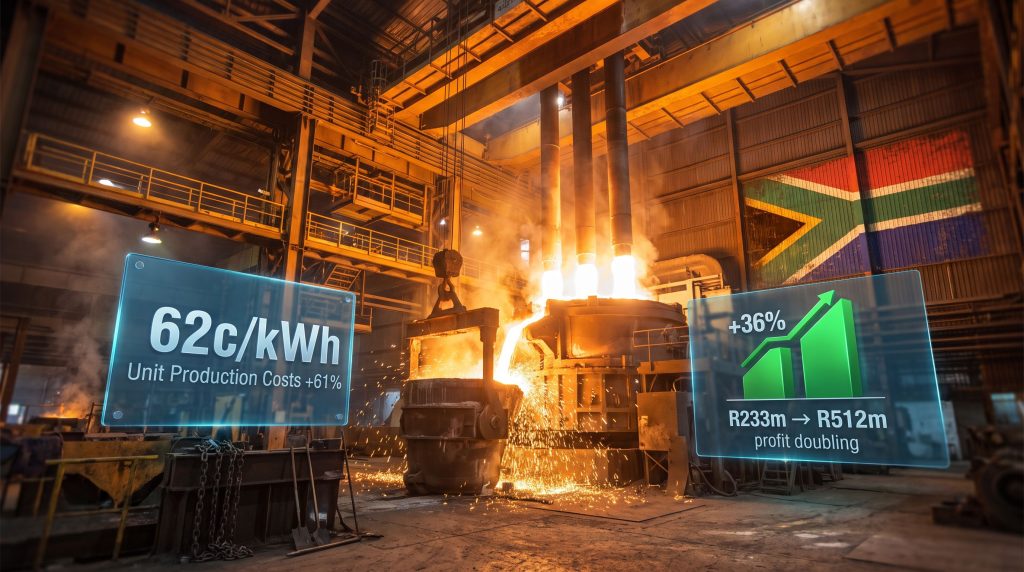
This dynamic played out with precision in the first half of 2026. With Boshoek and Wonderkop suspended, the Glencore-Merafe Venture's attributable ferrochrome production collapsed 75% to just 28,000 tonnes. Fixed costs, however, did not fall proportionally. The outcome was a 61% increase in ferrochrome unit production costs, a figure that illustrates exactly why partial smelter operation is not a viable middle-ground strategy for any extended period.
What the 62c/kWh Tariff Actually Represents
A Snapshot Definition
The Merafe power tariff refers to the electricity pricing framework negotiated between Eskom, NERSA, and the Glencore-Merafe Chrome Venture, covering the operation of South Africa's ferrochrome smelting facilities. According to Eskom, the approved rate of 62c/kWh is structured as a three-year arrangement that positions the venture at approximate cost parity with Chinese producers while embedding an Eskom profit-sharing mechanism that activates if the smelting business returns to profitability.
Critically, this tariff was not designed to generate returns. It was designed to prevent permanent closure. Glencore's South African ferroalloys head, Japie Fullard, was unambiguous on this point during Merafe's half-year results webcast: at 62c/kWh, the venture is essentially making use of its existing infrastructure rather than generating meaningful profit, but it preserves employment and keeps the operational framework intact. The tariff, in his characterisation, is not a silver bullet. It is a competitive floor, not a profit engine.
The Tariff Timeline: From Crisis to Conditional Stability
| Tariff Phase | Rate | Duration | Operational Impact |
|---|---|---|---|
| Industrial grid rate (pre-negotiation) | Above 87.74c/kWh | Ongoing prior period | All three smelters commercially unviable |
| NERSA interim approval | 87.74c/kWh | 12 months | Lion smelter restarted; Boshoek and Wonderkop remained suspended |
| Final negotiated rate | 62c/kWh | 3 years | Boshoek and Wonderkop restarts authorised; Section 189 process lifted |
The movement from 87.74c/kWh to 62c/kWh is not merely a tariff reduction. It is the difference between two fundamentally different operational scenarios: one in which the venture survives in a truncated form, and one in which the full three-smelter architecture can be progressively restored. Indeed, NERSA's tariff decision has been widely credited with directly saving thousands of jobs across the affected smelting operations.
H1 2026 Financial Results: Chrome Ore Carried the Numbers
The Headline Figures
Merafe's half-year results for the period ended June 2026 showed a dramatic improvement in profitability, though the composition of that improvement deserves careful scrutiny.
| Metric | H1 2025 | H1 2026 | Change |
|---|---|---|---|
| Revenue | Baseline | R3.43bn | +36% |
| EBITDA | Baseline | R774m | +60% |
| Profit | R233m | R512m | +120% |
| Headline EPS | 12.6c | 20.7c | +64% |
| Basic EPS | Baseline | 20.5c | +120% |
These are impressive headline numbers. However, the underlying driver was not ferrochrome. Chrome ore sales volumes surged 75% to 380,000 tonnes, with chrome ore revenue rising 78% to R1.79bn, supported by an 11% increase in chrome ore pricing. This volume and price compounding effect was the primary engine of earnings recovery. In addition, the broader South African ferroalloys sector experienced similarly divergent performance between its chrome ore and smelting operations during this period.
The Ferrochrome Reality Underneath the Results
Ferrochrome sales fell a comparatively contained 4% to 73,000 tonnes, which appears almost stable relative to the catastrophic production decline. The explanation lies in inventory drawdown: the venture sold from existing stockpiles to partially offset the production shortfall from suspended smelters. This is a one-time buffer, not a sustainable strategy.
The H1 2026 earnings story is essentially a chrome ore recovery wearing ferrochrome clothing. The smelting business remained structurally impaired throughout the period, and its genuine rehabilitation cannot be assumed from the headline profit figures alone.
Chrome ore unit production costs rose 15% over the period, while ferrochrome unit costs rose 61%, reinforcing the divergence between the two business lines. Investors reading the headline numbers without understanding this distinction risk misinterpreting the venture's underlying operational health.
Mapping the Three Competitive Scenarios for the 62c/kWh Regime
Scenario 1: Breakeven Stability (Base Case)
At 62c/kWh with ferrochrome prices broadly at current levels, the venture sits on the left-hand side of the global cost curve, meaning it can produce without being immediately priced out of the market. This is a survival configuration, not a value-creation one. Fixed costs are absorbed, jobs are retained, and smelter infrastructure is preserved. Margin generation is minimal.
The base case is also the scenario Glencore's ferroalloys leadership explicitly describes as the current reality. The venture is positioned to be competitive, not profitable, at this tariff under prevailing market conditions. Furthermore, the Merafe power tariff and Glencore ferrochrome smelters arrangement must be viewed within the context of the global crude steel outlook, which will ultimately determine whether ferrochrome demand strengthens sufficiently to shift this calculus.
Scenario 2: Profitability Unlocked (Bull Case)
If ferrochrome pricing recovers materially through H2 2026 and into 2027, the 62c/kWh cost base provides genuine operational leverage. Every cent of ferrochrome price improvement above the breakeven threshold flows through to margin at a rate amplified by the scale of the three-smelter operation once fully utilised.
The Eskom profit-sharing arrangement embedded in the tariff structure means the utility participates in this upside. This is strategically important: it reduces the incentive for Eskom to pursue renegotiation during periods of venture profitability, since the utility's interests are directly aligned with the venture's financial performance.
Full restart of Boshoek and Wonderkop by end-2026 is a prerequisite for this scenario. Higher output volumes distribute fixed costs across more tonnes, reducing per-unit costs and expanding the margin window at any given ferrochrome price. Consequently, the trajectory of the global stainless steel market — the primary consumer of ferrochrome — will be decisive in determining whether this bull case materialises.
Scenario 3: Renewed Pressure (Bear Case)
Chinese producers have demonstrated a consistent capacity to reduce their own cost structures over time through technological upgrades, energy mix optimisation, and scale efficiencies. If Chinese ferrochrome costs compress below the 62c/kWh-equivalent threshold for South African production, the competitiveness gap reopens regardless of the negotiated tariff.
The 62c/kWh tariff creates a cost floor for South African ferrochrome smelting. It does not create a competitive moat. The sustainability of that floor depends entirely on variables that neither Merafe nor Glencore can control.
Elevated Chinese ferrochrome supply volumes remain an active risk, creating a structural ceiling on global pricing that limits the upside available to South African producers. Merafe's own CEO, Zanele Matlala, acknowledged that overall second-half profitability will depend significantly on how ferrochrome pricing evolves, with the operating environment described as uncertain and volatile, with ongoing cost pressures expected to continue. The green steel pricing trends emerging globally may, however, introduce new demand dynamics that alter this competitive picture over time.
South Africa vs. China: The Competitive Factor Breakdown
| Competitive Factor | South Africa (Glencore-Merafe) | China |
|---|---|---|
| Electricity tariff | 62c/kWh (negotiated, 3-year) | Structurally lower via captive/coal power |
| Chrome ore access | Domestic, world-class reserves | Largely imported |
| Labour cost structure | Higher, unionised workforce | Lower |
| Regulatory environment | NERSA/Eskom framework | State-directed |
| Cost curve position | Left-hand side (marginal) | Dominant low-cost producer |
| Profit margin at current tariff | Minimal to breakeven | Positive under most conditions |
South Africa's chrome ore access represents a genuine structural advantage that Chinese producers cannot replicate domestically. The Bushveld Igneous Complex hosts chromite deposits of exceptional grade and scale, giving South African operations a raw material cost advantage that partially offsets energy cost disadvantages. However, this ore advantage has proven insufficient to compensate for electricity cost differentials when tariffs exceed commercially viable thresholds.
The next major ASX story will hit our subscribers first
The Three-Smelter Architecture and Restart Sequencing
How the Glencore-Merafe Venture Is Structured
The venture operates three primary ferrochrome smelting facilities: Lion, Boshoek, and Wonderkop. Each facility carries distinct cost profiles and capacity contributions. The sequencing of their restarts is not merely an operational footnote. It is a critical financial variable because the cost curve economics of smelting are acutely sensitive to utilisation rates.
- Lion Smelter: Returned to production in late February 2026 under the 87.74c/kWh interim tariff, providing the only ferrochrome output during the first portion of H1 2026.
- Boshoek and Wonderkop: Remained suspended through most of H1 2026, contributing to the 75% production decline and the 61% rise in unit production costs. Restart processes were initiated following finalisation of the 62c/kWh framework.
- Full ramp-up target: End of 2026, which aligns with Merafe's production guidance of 25% to 29% of installed ferrochrome capacity for the full year.
Capital Allocation for 2026 and 2027
Merafe's capital expenditure guidance signals a measured but committed reinvestment posture:
- Full-year 2026 capex: R500m to R550m
- 2027 capex: R550m to R600m (modest uplift reflecting progressive capacity restoration)
- Chrome ore production target for 2026: approximately 5 million tonnes
The slight capex increase from 2026 to 2027 suggests management anticipates the need for sustained reinvestment as smelters return to full utilisation, rather than a one-time restart expenditure followed by maintenance-level spending.
The Eskom Profit-Sharing Mechanism: Alignment or Future Friction?
One of the less-discussed but structurally significant elements of the 62c/kWh arrangement is the embedded profit-sharing mechanism. Rather than a fixed tariff with no utility stake in outcomes, the framework creates a conditional financial relationship between Eskom and the venture.
This has several implications worth examining carefully:
- Reduced renegotiation risk during profitable periods: Because Eskom participates in upside, it has a direct financial incentive not to disrupt operations through tariff pressure when the venture is performing well.
- Definitional complexity: The specific definition of profit that triggers the sharing mechanism will materially affect distributions. Whether calculated at EBITDA, operating profit, or net profit level determines the quantum and timing of Eskom's participation.
- Chrome ore versus ferrochrome ambiguity: If the venture's profitability in a given year derives primarily from chrome ore rather than ferrochrome smelting, the applicability of a smelter-specific sharing mechanism may create definitional disputes.
- The 2029 renegotiation cliff: The three-year tariff window expires in 2029. By that point, the venture must either demonstrate sustainable operational economics or re-enter tariff negotiations from whatever position the market and its own cost structure dictate.
The Samancor Dimension and Industry-Wide Precedent
The electricity tariff framework that underpins the Merafe power tariff and Glencore ferrochrome smelters arrangement was not constructed exclusively for the Glencore-Merafe Venture. Samancor Chrome, the other major South African ferrochrome producer, was also covered under the broader discount structure. This industry-wide application reflects a deliberate decision to address the competitiveness of the entire South African ferrochrome sector simultaneously, rather than resolving individual operator crises on a case-by-case basis.
The precedent this sets extends beyond ferrochrome. Other energy-intensive industries in South Africa, including aluminium smelting and certain steel production processes, face comparable structural electricity cost challenges. The architecture of the ferrochrome tariff solution, with its profit-sharing mechanism and multi-year certainty, may inform how similar negotiations are approached in adjacent sectors.
Three Non-Negotiable Conditions for Long-Term Viability
The 62c/kWh tariff removes the immediate existential threat to South African ferrochrome smelting. However, three conditions must materialise for it to deliver genuine long-term industrial viability:
- Ferrochrome price recovery must be sustained. Without meaningful improvement in global ferrochrome pricing driven either by Chinese supply discipline or stainless steel demand growth, the tariff delivers operational continuity but not financial sustainability. This variable sits entirely outside South Africa's control.
- Full capacity utilisation must be achieved and maintained. The cost economics of electric arc furnace smelting make partial operation structurally loss-making at almost any tariff level. Full restart of Boshoek and Wonderkop by end-2026, followed by sustained high utilisation rates, is a necessary prerequisite for the tariff to deliver its intended benefit.
- Internal efficiency improvements must reduce the cost floor further. The three-year tariff window functions as a restructuring runway. Glencore and Merafe must pursue efficiency gains in energy consumption per tonne, smelter throughput, and chrome ore cost management to ensure that the venture can demonstrate sustainable economics before the 2029 renegotiation arrives.
Frequently Asked Questions: Merafe Power Tariff and Glencore Ferrochrome Smelters
What is the current electricity tariff for the Glencore-Merafe ferrochrome smelters?
The current approved rate is 62c/kWh, structured as a three-year framework negotiated between Eskom, NERSA, and the Glencore-Merafe Chrome Venture.
Why was the interim tariff of 87.74c/kWh considered insufficient?
At 87.74c/kWh, only the Lion smelter could operate on a commercially viable basis. Boshoek and Wonderkop remained suspended because the rate was too high to achieve cost parity with Chinese ferrochrome producers and did not support long-term smelting viability across the full three-facility operation.
Does the 62c/kWh tariff make the smelters profitable?
Not immediately. The tariff positions the venture at approximate breakeven relative to Chinese production costs. It preserves jobs and infrastructure but does not generate meaningful profit under current ferrochrome market conditions.
What is Eskom's role in the profit-sharing arrangement?
Eskom participates in financial upside if the smelting venture returns to profitability. This incentive alignment is embedded within the three-year tariff agreement and is designed to reduce the risk of future tariff renegotiation friction during periods of venture profitability.
When will Boshoek and Wonderkop be fully operational?
Restart ramp-up for both smelters is targeted for completion by the end of 2026, following finalisation of the 62c/kWh tariff terms.
What is Merafe's ownership stake in the Chrome Venture?
Merafe Resources holds a 20.5% interest in the Glencore-Merafe Chrome Venture, with Glencore holding the majority stake and operating the smelting facilities.
What are the primary risks to the ferrochrome outlook in H2 2026 and beyond?
The main risks include higher ferrochrome supply from Chinese producers, potential global market oversupply, sustained pressure on ferrochrome pricing, and the possibility that Chinese producers further compress their own cost structures, reopening the competitiveness gap even at the negotiated tariff rate.
Disclaimer: This article contains forward-looking statements, financial projections, and scenario analyses that involve inherent uncertainty. Past financial performance and stated production targets do not guarantee future outcomes. Commodity prices, electricity tariff frameworks, and competitive dynamics can change materially. This content is intended for informational purposes only and does not constitute financial or investment advice. Readers should seek independent professional advice before making investment decisions.
Want to Track the Next Major ASX Mineral Discovery Before the Market Does?
Discovery Alert's proprietary Discovery IQ model scans ASX announcements in real time, instantly identifying high-potential mineral discoveries across more than 30 commodities and translating complex data into clear, actionable insights — giving both short-term traders and long-term investors a decisive edge. Explore historic discoveries and the extraordinary returns they generated, then begin your 14-day free trial at Discovery Alert to position yourself ahead of the market.