
June 27, 2026
The Structural Fault Line Beneath Iron Ore Trade
The global iron ore market has long operated on an uncomfortable asymmetry. A small number of mega-producers control the world's highest-quality, lowest-cost deposits, while the buyers on the other side of the ledger, primarily Chinese steelmakers, operate in one of the most margin-compressed industries on earth. For years, this tension simmered beneath the surface of annual contract negotiations. Now, with China Mineral Resources Group (CMRG) acting as a centralised procurement force, that tension is becoming increasingly visible, and Fortescue's planned new product, Fortune Fines, has landed directly in its path.
Understanding why China tells steelmakers not to talk with Fortescue about new iron ore product developments requires stepping back from the headline and examining the procurement architecture that makes such a directive possible in the first place. Furthermore, iron ore price trends suggest this tension is unlikely to resolve quickly, adding urgency to how investors interpret these developments.
When big ASX news breaks, our subscribers know first
How Centralised Buying Is Reshaping Iron Ore Negotiations
The Logic Behind CMRG's Creation
China Mineral Resources Group was established with a clear strategic mandate: to aggregate the purchasing power of China's fragmented steel industry and deploy it as a unified negotiating force against the world's largest iron ore exporters. Before CMRG, individual steelmakers negotiated separately, a structural weakness that major miners could exploit through bilateral pricing arrangements.
By consolidating demand signals and contract discussions under one roof, CMRG fundamentally changes the balance of power at the negotiating table. It transforms what was once a marketplace of competing buyers into something closer to a single monopsonistic force — a buyer with enough volume concentration to credibly threaten supply disruption consequences for sellers who refuse commercially acceptable terms.
The Margin Gap That Makes Conflict Inevitable
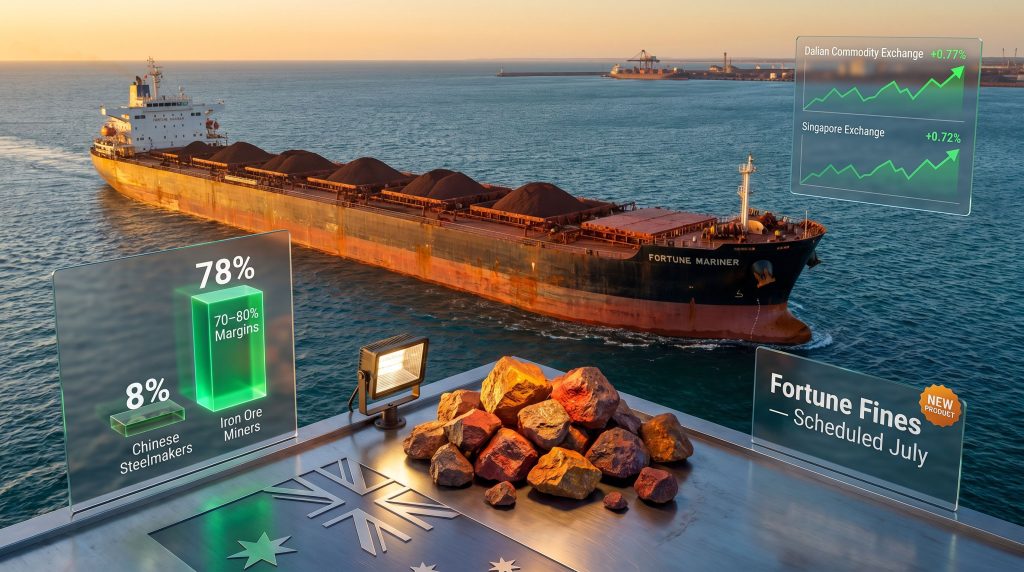
The numbers at the heart of this dispute are stark. Major iron ore miners, including the largest ASX-listed producers, are generating profit margins estimated between 70% and 80%. Chinese steelmakers, by contrast, are operating on razor-thin margins measured in single digits, squeezed between weak domestic steel demand, persistent overcapacity across the sector, and elevated input costs.
When a buyer's operating margins are measured in low single digits and the seller's margins are approaching 80%, the procurement relationship will periodically break down. CMRG's assertive stance reflects a structural economic reality, not simply a diplomatic manoeuvre.
This margin asymmetry provides the ideological and commercial justification for CMRG's increasingly interventionist role in procurement decisions. The organisation frames better contract terms not as opportunism but as a rebalancing of an inequitable commercial relationship. Indeed, the China steel and iron ore market has been navigating these pressures for some time, making the current standoff part of a broader structural pattern rather than an isolated incident.
Fortune Fines: What Is This New Product and Why Does It Matter?
Defining a Lower-Grade Offering in a Grade-Sensitive Market
Iron ore pricing is intensely sensitive to iron content, typically expressed as a percentage of iron (Fe) by weight. Products above 65% Fe command substantial premiums, while lower-grade ores trade at discounts that can be severe during periods of Chinese environmental compliance pressure, when blast furnace operators are incentivised to maximise productivity per unit of emissions.
Fortune Fines sits at the lower end of the grade spectrum. The product is being developed as a cost-competitive offering for price-sensitive buyers who prioritise input cost reduction over metallurgical efficiency. First shipments were reportedly scheduled for July 2026 according to multiple independent trading sources, though the current commercial friction introduces uncertainty around that timeline.
What makes the product commercially interesting is its positioning within Fortescue's broader product strategy. The company has been investing heavily in green iron production and higher-purity iron products for next-generation steelmaking pathways. Fortune Fines represents a parallel track — a volume-oriented, lower-grade product designed to maintain market share across a wider range of buyer profiles while the premium green product pipeline develops.
Market Awareness: A Product Few Have Heard Of
One of the more revealing details to emerge from trading community responses is that many market participants had no awareness of Fortune Fines until the CMRG directive made headlines. This is commercially significant for two reasons.
First, it confirms the product has not yet established a pricing benchmark or traded volume, meaning there is no existing market to disrupt. Second, it suggests CMRG's directive is less about blocking an operational trade flow and more about sending a signal — establishing negotiating leverage before the product achieves commercial traction. BHP and Fortescue have both warned that China's influence over iron ore will only grow, lending further weight to this interpretation.
| Attribute | Fortune Fines | Standard Fortescue Fines | High-Grade Brazilian Ore |
|---|---|---|---|
| Grade Classification | Lower-grade | Mid-grade | High-grade (65%+ Fe) |
| Launch Status | Scheduled July 2026 | Established | Established |
| Primary Target Market | Cost-sensitive buyers | Chinese blast furnace mills | Premium steel producers |
| Price Benchmark | None established | Widely benchmarked | Widely benchmarked |
| Market Awareness | Low (as of May 2026) | Widespread | Widespread |
Decoding CMRG's Negotiating Playbook
The BHP Precedent as a Strategic Template
Earlier in 2026, CMRG engaged in a protracted and reportedly contentious series of contract negotiations with BHP. During that process, a purchasing restriction on certain BHP products was reportedly implemented as a pressure mechanism. The negotiations ultimately concluded, which is important context: the BHP episode demonstrates that CMRG-imposed restrictions are tactical instruments rather than permanent trade realignments.
The pattern is now identifiable. CMRG communicates informally with domestic steelmakers, discouraging engagement with specific supplier products. This creates commercial uncertainty for the targeted producer, weakens their ability to build forward order books, and shifts negotiating leverage toward CMRG. The restriction is then lifted once contract terms are agreed upon.
Reading the Fortune Fines Directive Correctly
The instruction to certain steelmakers to avoid discussions with Fortescue specifically about Fortune Fines is a calibrated move. It does not constitute a formal purchasing ban on Fortescue's existing, established product lines. That distinction matters considerably for assessing the near-term commercial impact.
Fortescue's CEO characterised the CMRG contract talks as an ongoing and difficult negotiation process, a characterisation that aligns with the pattern seen during the BHP discussions. The directive appears designed to create maximum uncertainty around the one commercial initiative where Fortescue is most vulnerable: a product that has not yet launched and therefore has no customer relationships, pricing history, or contractual protections to fall back on.
The strategic elegance of targeting a pre-launch product is that the cost to CMRG of the restriction is near zero, while the potential disruption to the targeted producer's commercial planning is significant.
Iron Ore Futures Markets: Pricing in the Signal, Not the Noise
How Markets Responded to the Directive
Iron ore futures reacted to the CMRG directive with modest gains rather than the declines one might expect from a headline suggesting procurement friction between China and a major Australian exporter. The most-active iron ore contract on the Dalian Commodity Exchange closed up 0.77% on the day the news became public. The benchmark July contract on the Singapore Exchange was 0.72% higher in late trade.
This response reflects sophisticated market interpretation. Traders correctly identified that a restriction on a product with no established volume, no pricing benchmark, and minimal market awareness carries negligible near-term supply implications. Consequently, the market priced the news as a negotiating development, not a supply disruption.
What Futures Markets Are Not Pricing In
What the modest positive reaction does not capture is the potential second-order risk: whether CMRG's directive expands beyond Fortune Fines to encompass Fortescue's existing, established product volumes. That scenario, while assessed as lower probability, would carry material implications for Australian iron ore trade flows and would almost certainly generate a very different futures market response.
The Longer Arc: Green Iron, Decarbonisation, and Aligned Interests
A Near-Term Dispute Within a Long-Term Partnership
China's steelmakers face enormous pressure to decarbonise over the coming decade. Electric arc furnace adoption, direct reduced iron (DRI) processes, and hydrogen iron ore reduction all require higher-purity iron inputs than traditional blast furnace operations. Fortescue's strategic investment in high-purity iron products positions it as a potential preferred supplier for exactly this transition.
This creates an important temporal distinction. The current procurement friction is a near-term contract negotiation dispute rooted in margin asymmetry and pricing leverage. The longer-term commercial dynamic between Fortescue and Chinese steelmakers may be more constructive, as decarbonisation pathways converge around the type of high-value iron products Fortescue is developing. Furthermore, the China iron ore outlook points toward sustained demand for premium-grade inputs as emissions regulations tighten.
Industry-Specific Context: Why Lower-Grade Ore Faces Structural Headwinds
Within the steel industry, the economics of lower-grade iron ore are increasingly complicated by environmental compliance requirements. Chinese blast furnace operators under emissions scrutiny often prefer higher-grade inputs because they reduce the volume of slag produced per tonne of steel, improving furnace productivity and lowering emissions intensity per unit of output.
Fortune Fines, as a lower-grade product, enters a market where its primary competitive advantage — lower price — must be weighed against higher processing costs and potential compliance complications for buyers operating under emissions regulations. This is not fatal to the product's commercial prospects, but it does mean the addressable market is more narrowly defined than a standard mid-grade ore offering.
The next major ASX story will hit our subscribers first
Investor Framework: Separating Signal from Noise
Three Scenarios and Their Market Implications
| Scenario | Probability | Expected Market Impact |
|---|---|---|
| Negotiations resolve; Fortune Fines launches on schedule | Moderate-High | Neutral to mildly positive for Fortescue volumes |
| Purchasing ban limited to Fortune Fines only | Moderate | Limited price impact; product launch delayed |
| CMRG restrictions extended to existing Fortescue products | Low | Significant negative signal for Australian iron ore trade |
Key Risk Factors Worth Monitoring
Investors tracking this situation should focus on several evolving indicators:
- Whether CMRG escalates from informal directives to a formalised purchasing restriction on Fortune Fines
- Whether the July 2026 first shipment schedule proceeds or is deferred due to commercial uncertainty
- The pace and tone of ongoing CMRG contract negotiations with Fortescue
- Whether Chinese steelmaker profitability deteriorates further, intensifying procurement pressure industry-wide
- Any comparable escalation against other major Australian or Brazilian iron ore exporters, which would signal systemic rather than company-specific friction
The Recurring Nature of These Disputes
One of the most important contextual points for investors is that procurement disputes between major iron ore exporters and Chinese buyers are not exceptional events. They are recurring features of the commodity cycle, particularly during periods when Chinese steel sector profitability is under pressure. The BHP resolution earlier in 2026 provides a direct precedent for how these situations typically evolve: tension builds, a restriction is applied, negotiations accelerate, and an agreement is eventually reached.
The asymmetry of information in these situations — where CMRG communicates through indirect signals and unnamed sources — is itself a deliberate negotiating tool. China's state-backed buyer seeking scrutiny of new Fortescue iron ore illustrates precisely how this ambiguity is wielded. The commercial uncertainty created by ambiguous directives can be as powerful as a formal ban, without requiring CMRG to make a commitment it later needs to reverse publicly.
Frequently Asked Questions
What is CMRG and why can it direct Chinese steelmakers?
China Mineral Resources Group is a state-backed centralised procurement entity created to consolidate iron ore purchasing across China's domestic steel industry. By coordinating buying decisions collectively, CMRG can apply negotiating pressure that individual steelmakers, acting independently, could never generate. Its influence over steelmaker procurement decisions stems from its role as the designated representative buyer for term contract negotiations with major global iron ore suppliers.
What is Fortune Fines and when is it expected to ship?
Fortune Fines is a lower-grade iron ore product under development by Fortescue. Trading sources indicated first shipments were planned for July 2026. The product is designed to compete on price for cost-sensitive steel producers, sitting at a different point on the grade-price curve compared to Fortescue's established mid-grade offerings.
Why did iron ore prices rise despite negative procurement news?
Futures markets on both the Dalian Commodity Exchange and Singapore Exchange posted modest gains because traders assessed the directive as having negligible near-term supply impact. Fortune Fines has not yet launched, carries no established pricing benchmark, and has minimal market awareness. A restriction on a non-existent trade flow does not change physical supply balances.
How does this relate to Fortescue's green iron ambitions?
Fortescue has been investing in high-purity and lower-emissions iron products aligned with next-generation steelmaking technologies. Fortune Fines is a separate, lower-grade volume product and represents a distinct commercial track. The situation where China tells steelmakers not to talk with Fortescue about new iron ore product launches does not directly impede the green product pipeline, though the broader negotiating climate creates uncertainty across all forward commercial planning.
Disclaimer: This article is intended for informational purposes only and does not constitute financial advice or a solicitation to trade in any commodity, security, or financial instrument. Forward-looking statements, scenario analyses, and probability assessments represent analytical perspectives only and are subject to significant uncertainty. Readers should conduct their own due diligence before making any investment decisions.
Want to Stay Ahead of the Next Major ASX Mineral Discovery?
While iron ore trade dynamics play out between major producers and centralised buyers, significant mineral discoveries continue to emerge across the ASX — and timing is everything. Discovery Alert's proprietary Discovery IQ model delivers real-time alerts the moment significant ASX mineral discoveries are announced, translating complex data across more than 30 commodities into clear, actionable insights for investors at every experience level. Explore historic discoveries and their exceptional market returns to understand what early positioning can mean, then begin your 14-day free trial to ensure you never miss the next major opportunity.