
August 4, 2026
India's Iron Ore Royalty System Has a Structural Vulnerability — and Odisha Just Exposed It
The mechanics of how mineral royalties are calculated create an inherent tension in any mining jurisdiction. When statutory payments are tied directly to declared ore grade, the financial incentive to misreport that grade is baked into the system's architecture. India's experience with this dynamic is not unique globally, but the scale of alleged Odisha iron ore grade manipulation now surfacing in India's largest producing state has brought that structural tension into sharp focus — and the downstream consequences for one of the world's fastest-growing steel industries are anything but theoretical.
When big ASX news breaks, our subscribers know first
Why Odisha Functions as India's Iron Ore Backbone
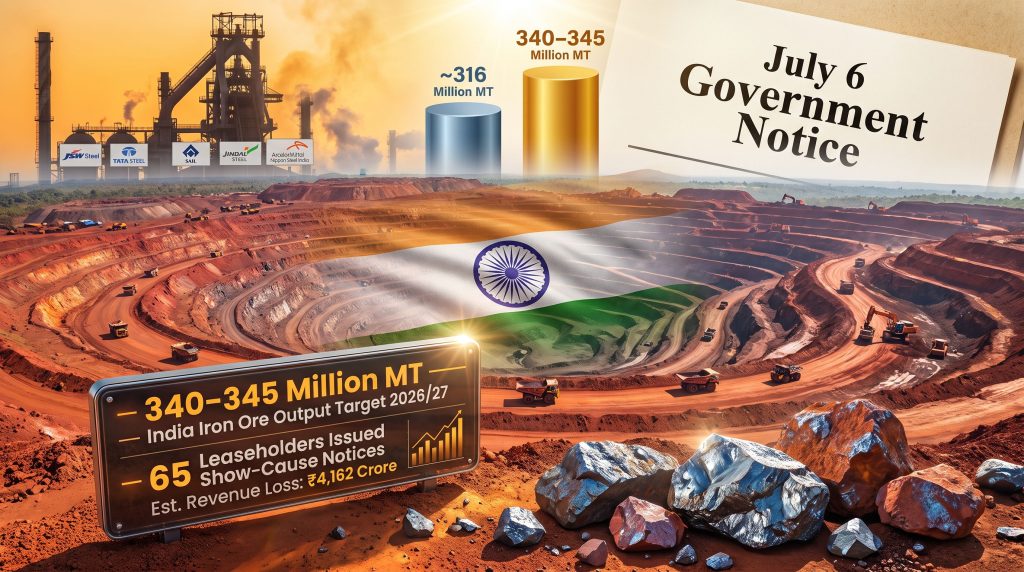
India's position as the world's second-largest crude steel producer, trailing only China, places extraordinary demands on its domestic iron ore supply chain. According to commodities consultancy BigMint, national iron ore output is forecast to reach 340 to 345 million metric tonnes in the 2026/27 production year, rising from approximately 316 million metric tonnes recorded in the prior year. That growth trajectory depends heavily on uninterrupted extraction from Odisha, which contributes a disproportionately large share of national ore supply.
The state's two dominant mining corridors, the Koira and Joda belts, sit within one of the world's most iron-rich geological formations. These belts feed ore directly into blast furnaces operated by some of India's largest integrated steelmakers. The concentration of production capacity within a single state creates an obvious systemic risk: any enforcement-driven contraction in Odisha's output does not disperse evenly across the national supply chain. It concentrates pressure on exactly those steel producers with captive Odisha mining leases.
Furthermore, understanding the broader China steel and iron ore market context helps explain why disruptions in Odisha carry global significance, given how interconnected Asian steel supply chains have become.
Understanding Iron Ore Grade — The Number That Drives Everything
Iron ore grade refers to the percentage of elemental iron (Fe%) contained within extracted ore. This single figure determines almost everything commercially relevant about a shipment: its value, its royalty obligation, its suitability for particular steelmaking routes, and its blending requirements before furnace feed.
In India's regulatory framework, royalty and premium payments are calculated as a percentage of ore value, which is itself pegged to declared grade. The higher the Fe content, the higher the royalty rate applied. This creates a straightforward financial arithmetic. For context on iron ore grades and deposits, the distinctions between high, medium, and low-grade material carry significant commercial and regulatory weight:
| Iron Ore Grade Category | Fe Content | Royalty Implication | Manipulation Incentive |
|---|---|---|---|
| High-grade | Fe >65% | Highest statutory rate | Strong incentive to reclassify downward |
| Medium-grade | Fe 58–65% | Mid-tier rate | Common blending target zone |
| Low-grade | Fe <58% | Lowest rate | Declared destination for misreported ore |
A single grade reclassification across a large-volume lease can represent tens of crores in avoided royalty payments annually. Audit-based estimates reviewed in connection with Odisha's enforcement action place the revenue loss from iron ore-specific grade misreporting cases at approximately ₹4,162 crore, while broader assessments of mining irregularities across the state's sector push the cumulative figure to over ₹20,000 crore.
The Four Mechanisms Behind Grade Misreporting
Regulatory findings and industry-level analysis have identified four primary operational methods through which grade manipulation is carried out in practice. Understanding these mechanisms matters because they inform what corrective technical measures can realistically address the problem:
-
Dilution — High-grade ore is blended with waste rock or low-grade material before it reaches the weighbridge, physically reducing the Fe% of the measured consignment.
-
Blending — Separate ore streams from different zones within a mine are combined to suppress the reported average grade across the batch.
-
Misclassification — Grade categories are incorrectly assigned at the point of dispatch, often with inadequate sampling protocols that lack independent verification.
-
Mis-declaration — Inaccurate grade data is submitted in statutory returns, mining plan reconciliations, and regulatory filings, creating a paper trail that diverges from physical reality.
Each method exploits the same structural gap: the gap between what ore grade actually is in the ground and what grade is declared at the point of royalty calculation. That gap widens when verification infrastructure is weak, inspection frequency is low, and penalties for misreporting are insufficient to outweigh the financial benefit.
The Pre-Auction to Post-Auction Grade Anomaly
One of the more technically significant findings to emerge from this enforcement cycle involves what auditors have identified as an abnormal statistical pattern in grade reporting around the timing of competitive mine auctions. India's mine auction system, which replaced the older lease renewal framework, requires pre-auction geological assessments that establish the expected grade profile of a deposit.
What the Comptroller and Auditor General flagged was a consistent pattern of reported ore grades declining materially after auction completion compared to the grades established during pre-auction assessment. From a geological standpoint, this pattern is difficult to explain through natural variation alone. Ore body composition does not fundamentally shift at the moment a lease changes hands through a competitive bid process.
The statistical regularity of this divergence across multiple leases was interpreted by regulators as a systemic indicator rather than a series of isolated geological anomalies. This finding is particularly significant because it undermines the primary industry defence — that grade variation reflects geological conditions beyond operational control. When the same pattern repeats across different operators in different mining corridors, the geological explanation loses statistical credibility.
Odisha's Enforcement Response: What the Notices Actually Required
Odisha's Directorate of Mines and Geology conducted targeted inspections across multiple active iron ore leases, culminating in a July 6 government notice that documented a consistent pattern of Odisha iron ore grade manipulation among mine leaseholders. According to reporting by the New Indian Express, the state issued show-cause notices to 65 mining leaseholders, requiring written responses within three days or facing departmental action. Local mine inspection officials were simultaneously called to account for lapses in grade verification oversight.
The companies named in the July 6 notice included:
- JSW Steel
- Tata Steel
- Steel Authority of India (SAIL) — the state-owned enterprise
- Jindal Steel
- ArcelorMittal Nippon Steel India
Important note: Inclusion in a government enforcement notice reflects the findings of state inspections and does not constitute a legal determination of wrongdoing. All named parties retain full rights to respond through applicable regulatory and legal processes.
A July 13 meeting between Odisha's steel and mines department, mining associations, and company representatives produced a set of specific directives:
-
Leaseholders must revise mining plans where actual extracted grades differ materially from approved plan grades.
-
Revised plans require formal approval from the Indian Bureau of Mines before operations continue under new grade parameters.
-
Deliberate manipulation, misdeclaration, or suppression of mineral value will be treated as a serious regulatory offence subject to strict enforcement action.
-
Local inspection officials face departmental accountability for failures in grade verification oversight.
How Named Companies Have Responded
| Company | Position Taken |
|---|---|
| Tata Steel | Denied discrepancies; stated royalties are paid according to prescribed norms and that most dispatches fall within the highest royalty grade category |
| JSW Steel | Declined to provide comment |
| SAIL | No response provided to media enquiries at time of reporting |
| Jindal Steel | No response provided to media enquiries at time of reporting |
| ArcelorMittal Nippon Steel India | No response provided to media enquiries at time of reporting |
The Industry's Geological Counter-Argument — And Why It Has Limits
Industry representatives have pushed back on the state's characterisation, arguing that ore grade is fundamentally determined by geological conditions and cannot be operationally controlled. The argument draws on a legitimate technical reality: iron ore deposits are heterogeneous by nature, and grade variation between mine bench levels, between ore zones, and across extraction sequences is a normal feature of mining operations.
However, this geological defence carries weight only in individual cases of grade divergence. Where it weakens considerably is when applied to a pattern of divergence that is:
- Directionally consistent (always downward from approved grades, never upward)
- Temporally linked (occurring consistently after auction completion)
- Geographically distributed (repeated across multiple operators in different mining belts)
BK Bhatia, a mining expert and former Director General of the Federation of Indian Mineral Industries, has noted that because Odisha functions as the country's dominant iron ore producer, any escalation of enforcement-driven supply disruption carries the potential to affect national iron ore availability more broadly. That observation frames the stakes involved: this is not a localised compliance dispute but a systemic governance question with national supply chain consequences.
Market Effects Already Visible in Merchant Ore Trading
The practical market consequences of intensified inspections have begun registering in India's domestic iron ore merchant market within weeks of the enforcement escalation. According to BigMint, offers for lower-grade iron ore in the merchant market have become constrained as operators reduce dispatch activity under heightened regulatory scrutiny. The tightening is concentrated in the lower-grade categories — precisely the material that has been at the centre of misclassification allegations.
This dynamic carries a notable irony: if the alleged manipulation has been suppressing declared grades from high to low, then enforcement pressure that restricts lower-grade supply is simultaneously a signal that some of what was traded as low-grade ore may have been higher-grade material all along. In addition, the iron ore price trends at play globally mean that domestic misreporting does not occur in isolation — it interacts with international pricing benchmarks in ways that compound the market distortion.
For downstream steel producers, a sustained enforcement-driven tightening in Odisha's ore supply creates several pressure points:
- Production planning disruptions for operators with captive Odisha mines requiring plan revisions and Bureau of Mines approvals
- Potential upward pressure on domestic iron ore spot prices if merchant market supply remains constrained
- Margin compression risks for steel producers exposed to higher raw material costs without equivalent pricing power in finished steel markets
Consequently, these iron ore surplus concerns at the global level stand in stark contrast to what is emerging as a localised tightness problem within India's domestic supply chain — a divergence that illustrates how regulatory interventions can produce counter-intuitive market outcomes.
The next major ASX story will hit our subscribers first
The Structural Reforms That This Enforcement Cycle Is Likely to Accelerate
The Odisha crackdown, whatever its legal outcomes, is likely to function as a catalyst for governance reforms that the sector has needed for some time. Several structural changes are already being discussed at industry and regulatory levels. These iron ore market disruptions are prompting renewed scrutiny of verification frameworks across multiple producing regions, not just Odisha.
- Real-time grade monitoring using automated ore grade sensors at weighbridges and dispatch points, removing the reliance on declared data at the point of royalty calculation
- Mandatory third-party assay requirements at the point of dispatch for high-volume leases, introducing independent verification into the grade declaration chain
- Retrospective royalty recalculation mechanisms for leases where systematic misreporting is established through audit
- Post-auction grade monitoring protocols specifically designed to detect the pre/post-auction divergence pattern that the CAG identified as a red flag across multiple sites
The Indian Bureau of Mines, as the technical regulatory authority responsible for approving revised mining plans, sits at the centre of this reform architecture. Its capacity to process revisions across 65-plus leases simultaneously will be a practical test of whether enforcement ambitions can be matched by institutional throughput.
Furthermore, Business Standard's coverage of the crackdown highlights how industry observers are closely watching whether Odisha's enforcement measures translate into durable systemic reform or remain a one-cycle regulatory response.
The revenue recovery imperative is substantial. With Odisha iron ore grade manipulation losses estimated at ₹4,162 crore for iron ore-specific cases and total mining sector irregularities exceeding ₹20,000 crore, the fiscal case for sustained enforcement is unambiguous. Equally important is the competitive equity argument: operators who accurately declare ore grades face a structural cost disadvantage against those that do not, undermining the integrity of the auction system that India designed specifically to introduce transparency into mine allocation.
Key Statistics: Odisha Iron Ore Grade Manipulation at a Glance
| Metric | Figure |
|---|---|
| India's projected iron ore output (2026/27) | 340–345 million metric tonnes |
| Prior year iron ore output | ~316 million metric tonnes |
| Leaseholders issued show-cause notices | 65 |
| Estimated revenue loss (iron ore-specific cases) | ~₹4,162 crore |
| Estimated revenue loss (all mining irregularities) | Over ₹20,000 crore |
| Response deadline for show-cause notices | 3 days |
| Key mining belts under scrutiny | Koira and Joda |
| Regulatory authority for revised plan approvals | Indian Bureau of Mines |
Disclaimer: This article is intended for informational purposes only and does not constitute financial, legal, or investment advice. Revenue loss figures and production forecasts cited are derived from third-party sources and audit findings, and are subject to revision through ongoing regulatory and legal processes. Inclusion of company names reflects publicly reported enforcement actions and does not represent a finding of legal liability.
Want to Identify the Next Major Mineral Discovery Before the Market Does?
While India's iron ore governance crisis highlights how systemic misreporting distorts commodity markets, Discovery Alert's proprietary Discovery IQ model cuts through the noise by delivering real-time alerts on significant ASX mineral discoveries — instantly translating complex data into actionable opportunities for both traders and long-term investors. Explore historic discoveries and the returns they generated on Discovery Alert's dedicated discoveries page, and begin your 14-day free trial today to position yourself ahead of the market.