August 9, 2026
Global Iron Ore Markets Face Transformational Shift as High-Grade Supplies Emerge
The global iron ore landscape stands at a critical inflection point as supply chain architectures undergo fundamental restructuring. Traditional market dynamics, dominated by Australian and Brazilian producers for decades, now confront the emergence of premium-grade alternatives that could reshape pricing mechanisms, trade flows, and strategic resource positioning across multiple continents. The Simandou iron-ore project Guinea represents a particularly significant development in this transformation, extending beyond simple capacity additions to represent a convergence of geopolitical interests, infrastructure development, and technological advancement that will define commodity markets through 2030.
Mining industry analysts recognise that supply diversification initiatives gain momentum when existing producers face operational constraints, environmental regulations, or geopolitical tensions. The timing of new production capacity introductions often coincides with periods of market consolidation, creating opportunities for projects that might otherwise struggle to achieve commercial viability. Understanding these cyclical patterns becomes essential for investors, industrial consumers, and policy makers navigating the evolving resource security landscape.
When big ASX news breaks, our subscribers know first
Africa's Largest Mining Infrastructure Project Reaches Production Phase
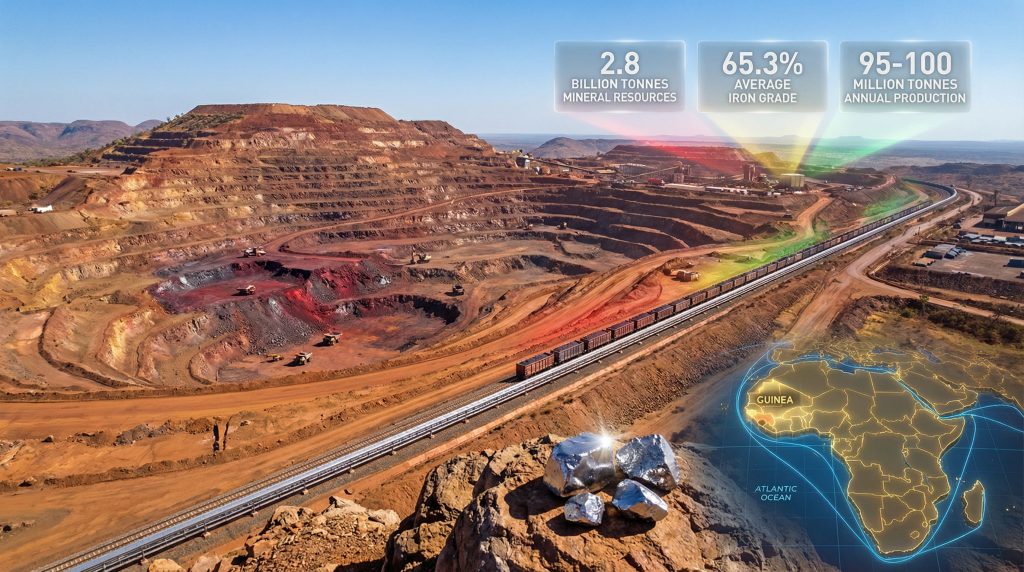
The Simandou iron-ore project Guinea represents the continent's most ambitious mining venture, combining massive resource endowments with integrated infrastructure construction across a 622-kilometre corridor. This project encompasses 2.8 billion tonnes of mineral resources distributed across four mining blocks, with 1.5 billion tonnes converted to proven ore reserves supporting a 26-year mine life at an exceptional 65.3% average iron grade.
Resource Quality Advantage
The geological characteristics of Simandou deposits provide significant competitive advantages in global markets increasingly focused on steel production efficiency and environmental considerations. Furthermore, current iron ore price trends indicate strong demand for high-grade materials that reduce processing costs and environmental impact:
- 65.3% iron content exceeds most global benchmark operations
- Premium pricing potential for high-grade concentrate products
- Reduced blast furnace coke requirements for steel producers
- Lower carbon emissions per tonne of finished steel production
Integrated Development Framework
The project's infrastructure scope extends far beyond conventional mining operations, establishing permanent transportation and port assets that will serve Guinea's broader economic development. In addition, industry analysts studying iron ore demand insights recognise the strategic importance of such integrated approaches:
"The Trans-Guinean railway system creates a new logistics backbone connecting inland resources to Atlantic shipping routes, fundamentally altering West African trade corridor capabilities."
Construction proceeds through a two-phase approach: initial development of the southern Ouelaba mine site with railway and port infrastructure supporting 60 million tonnes annual capacity, followed by northern Pic de Fon mine site activation expanding total production to 95-100 million tonnes annually. The $23 billion total investment establishes this as Africa's largest mining project by capital deployment.
Operational Milestones
Production commenced in November 2025, with the first commercial shipment of 200,000 tonnes arriving in East China's Zhejiang province on January 17, 2026, after a 46-day voyage. This initial delivery demonstrates the integrated mine-to-port functionality and establishes baseline shipping logistics for Chinese steel industry customers. Moreover, this milestone positions the project alongside other largest iron ore mines globally in terms of production capacity and operational sophistication.
Complex Joint Venture Structure Reflects Strategic Resource Competition
The ownership architecture of Simandou reflects the intersection of Chinese state enterprise strategy, international mining expertise, and African resource nationalism, creating a unique governance framework that will influence operational decisions and market positioning. However, this complexity mirrors broader industry trends where strategic iron asset battles demonstrate the high stakes involved in securing premium ore resources.
Ownership Distribution Analysis
| Block | Primary Operator | International Partner | Chinese Participation | Guinea Govt |
|---|---|---|---|---|
| Blocks 3-4 | Rio Tinto (53%) | SimFer JV | CIOH (47%) | 15% |
| Blocks 1-2 | WCS Consortium | Winning International | Baowu acquisition pending | 15% |
Chinese State Enterprise Integration
The Chinese participation structure demonstrates sophisticated resource security planning through multiple ownership pathways:
- Chinalco leads CIOH consortium with 75% ownership
- Baowu Steel holds 20% of CIOH, with additional 49% WCS acquisition pending
- China Rail Construction Corporation and China Harbour Engineering maintain 2.5% stakes each
- Potential 51% operational control option for Baowu during production phase
This multi-layered Chinese involvement ensures demand security while providing operational oversight and technology transfer opportunities. The pending Baowu acquisition of 49% WCS stakes requires regulatory approval, representing the final component of Chinese strategic positioning within the project. For context, the Simandou iron ore project has been recognised as a potential game-changer for global supply dynamics.
Infrastructure Asset Transfer Framework
A critical governance provision specifies that completed infrastructure becomes Guinean state property, creating long-term national assets beyond the mine's operational lifespan. This arrangement ensures permanent transportation and port capacity supporting broader economic development while providing the government with infrastructure ownership following project completion.
West African Resource Corridor Development Accelerates Economic Transformation
The Simandou iron-ore project Guinea catalyses Guinea's transition from a peripheral mining economy to a major mineral exporter, with infrastructure development creating spillover benefits across multiple economic sectors.
Employment and Skills Development
Current workforce statistics demonstrate substantial local participation: 25,200 employees across mine, rail, and port operations with 82% Guinean participation. This employment generation occurs during the construction and initial production phases, indicating sustained job creation as operations expand to full capacity.
The high level of local workforce participation suggests successful skills development programmes and training initiatives, though specific details about technical education, apprenticeship programmes, and knowledge transfer mechanisms require additional documentation from project operators. Consequently, this differs from Australian industry leadership patterns where automation typically reduces direct employment opportunities.
Infrastructure as Development Catalyst
The 536-kilometre dual-track railway mainline with additional spur connections creates permanent transportation infrastructure linking southeastern Guinea to Atlantic port facilities. This transportation network will support:
- Agricultural product movement from interior regions to export markets
- Import goods distribution to previously isolated communities
- Passenger transportation connecting rural areas to urban centres
- Industrial development opportunities along the railway corridor
Regional Economic Integration
Guinea's positioning as a premium iron ore supplier enhances its integration within global commodity markets while strengthening relationships with Chinese industrial consumers. The project establishes Guinea as a reliable alternative to traditional Australian and Brazilian suppliers, particularly for Chinese steel producers seeking supply chain diversification. Furthermore, detailed analysis from Rio Tinto's Simandou operations provides insights into the project's operational framework and strategic importance.
Market Dynamics and Competitive Positioning Through 2030
The introduction of 100 million tonnes annual production capacity from the Simandou iron-ore project Guinea will reshape global iron ore supply-demand balance, particularly in premium-grade segments where quality commands pricing advantages.
Production Capacity Benchmarking
| Operation | Annual Capacity | Iron Grade | Geographic Position |
|---|---|---|---|
| Simandou (full capacity) | 100Mt | 65.3% | West Africa – Atlantic access |
| Pilbara operations | 330Mt+ | 62-63% | Australia – Pacific routes |
| Carajás system | 150Mt+ | 66-67% | Brazil – Atlantic routes |
| Fortescue assets | 190Mt | 58-62% | Australia – Pacific routes |
Supply Chain Rebalancing Scenarios
Gradual Market Integration (2026-2028)
Initial production ramp-up allows market absorption without major price disruption while establishing quality premiums for high-grade concentrate. Chinese steel producers gain experience with Simandou ore characteristics, potentially leading to technical specifications favouring higher iron content materials.
Accelerated Expansion Impact (2028-2030)
Full capacity achievement coincides with potential surplus conditions in global seaborne markets, creating pressure on lower-grade producers while maintaining premium positioning for 65%+ iron content materials. The 6.4% global seaborne trade share that the Simandou iron-ore project Guinea represents at full production will require market share redistribution among existing suppliers.
Geographic Trade Flow Implications
The 46-day shipping duration from Guinea to East China ports provides competitive transportation costs compared to Brazilian routes while offering European steel producers proximity advantages over Pacific suppliers. This positioning creates optionality for Guinean producers between Asian and European markets based on pricing conditions and demand patterns.
Investment Risk Assessment and Operational Challenges
Large-scale mining projects in West Africa face unique operational challenges that could impact production schedules, cost structures, and long-term viability.
Infrastructure Development Risks
The complexity of coordinating mine, railway, and port construction across multiple international contractors creates execution risks:
- Seasonal construction constraints during Guinea's intensive rainfall periods
- Multi-contractor coordination across Fluor, NRW Holdings, and Chinese state enterprises
- Port construction timing requiring alignment with railway completion schedules
- Power generation and water infrastructure dependencies for sustained operations
Equipment and Technology Partnerships
Critical heavy mobile equipment supply relationships with Komatsu and BIA Group include five large production excavators, four production loaders, and over 30 ancillary vehicles. These partnerships ensure maintenance and parts availability but create dependency relationships with specific technology providers.
Regulatory and Political Risk Factors
Multi-decade legal disputes preceded the 2025 production start, indicating complex regulatory environments that required resolution before commercial operations could commence. The 15% Guinean government ownership ensures state participation in project revenues while creating potential for policy changes affecting operational parameters.
The pending Baowu acquisition requiring regulatory approval demonstrates ongoing regulatory oversight, with approval timelines and conditions potentially affecting final ownership structures and operational control arrangements.
The next major ASX story will hit our subscribers first
Long-Term Strategic Implications for Global Resource Security
The successful development of the Simandou iron-ore project Guinea establishes precedents for large-scale mining projects in West Africa while demonstrating Chinese resource security strategies extending beyond traditional Australian and Brazilian suppliers.
Supply Diversification Impact
Simandou's production capacity reduces global dependence on the Australian-Brazilian duopoly in high-grade iron ore markets, creating new supply chain options for steel producers worldwide. This diversification provides:
- Alternative supply sources during disruptions at traditional operations
- Competitive pricing pressure on established producers
- Quality benchmarking opportunities for premium-grade concentrates
- Shipping route optimisation through Atlantic and Pacific alternatives
Technology and Sustainability Considerations
International engineering standards applied through Fluor construction management ensure compatibility with global mining industry best practices. Environmental impact management across the 622-kilometre railway corridor requires ongoing monitoring and mitigation strategies addressing biodiversity, water resources, and community displacement concerns.
African Mining Industry Development
The successful completion of Africa's largest mining project demonstrates continental capacity for megaproject execution while establishing Guinea as a significant player in global commodity markets. This achievement may encourage similar large-scale developments across other African mineral-rich countries, particularly those with underdeveloped transportation infrastructure.
Chinese Resource Strategy Evolution
The multi-faceted Chinese participation in Simandou reflects evolving approaches to resource security that combine state enterprise investment, infrastructure development financing, and technology transfer programmes. This model may be replicated in other strategic mineral developments where China seeks to reduce import dependency while supporting bilateral economic relationships.
The project's success establishes Guinea as a reliable partner for Chinese industrial development while demonstrating African capacity for managing complex international mining ventures. These relationships will likely influence future Chinese resource investment strategies across the continent.
Investment decisions should be based on comprehensive due diligence including geological assessments, regulatory analysis, and market forecasting. The projections and scenarios discussed reflect current industry analysis and may vary based on operational performance, market conditions, and regulatory changes.
Ready to Capitalise on Major Iron Ore Discoveries?
Discovery Alert's proprietary Discovery IQ model delivers real-time notifications on significant ASX mineral discoveries, including iron ore opportunities that could benefit from global supply chain shifts like Simandou. Historic discoveries have generated substantial returns, which you can explore on Discovery Alert's dedicated discoveries page showcasing exceptional outcomes from major mineral finds. Begin your 30-day free trial today to position yourself ahead of the market with instant alerts on actionable iron ore and mineral investment opportunities.