June 20, 2026
Steel Mill Margins and the Iron Ore Price Ceiling: Understanding the Coking Coal Transmission Mechanism
The economics of bulk commodity markets rarely move in isolation. When analysts attempt to explain why iron ore prices behave the way they do, the conversation almost always circles back to one foundational reality: the steelmaking cost stack is a system, not a collection of independent inputs. Understanding how coking coal prices squeeze steel mill margins — and how that squeeze transmits directly into iron ore demand signals — is essential context for anyone tracking why the iron ore price heads for monthly loss as coal spike pressures margins in the current trading environment.
When big ASX news breaks, our subscribers know first
The Blast Furnace Cost Architecture: Why Two Commodities Share One Margin
Integrated steelmaking via the blast furnace route depends on two irreplaceable raw materials: iron ore and metallurgical coal, more commonly referred to as coking coal. These two inputs do not trade in isolation from one another. They co-exist within a shared margin envelope, meaning that when the price of one rises substantially, the economic viability of consuming the other becomes immediately affected.
The blast furnace process requires coking coal to serve dual functions. It acts as the energy source that generates the extreme heat needed to smelt iron ore, and simultaneously operates as a chemical reducing agent that strips oxygen from iron oxide, converting it into liquid pig iron. This dual role means coking coal cannot simply be substituted with cheaper thermal coal or natural gas in a conventional blast furnace without significant capital retooling.
The result is an inelastic input relationship that creates a predictable transmission mechanism:
- Coking coal prices rise due to supply disruptions or demand increases.
- Steel mill input costs increase, with the coal component of the cost stack expanding disproportionately.
- Steel margins compress if finished steel prices do not rise in parallel.
- Discretionary iron ore purchasing slows as mills adopt a more cautious procurement posture.
- Iron ore spot and futures prices face downward pressure as forward demand signals weaken.
This mechanism explains a dynamic that commodity analysts frequently observe: iron ore price corrections that follow coal supply disruptions, even when iron ore's own supply fundamentals remain unchanged. Furthermore, understanding these iron ore market impacts alongside cost-stack pressures helps investors contextualise why prices behave as they do across cycles.
Iron Ore's May 2026 Performance: Mapping the Monthly Decline
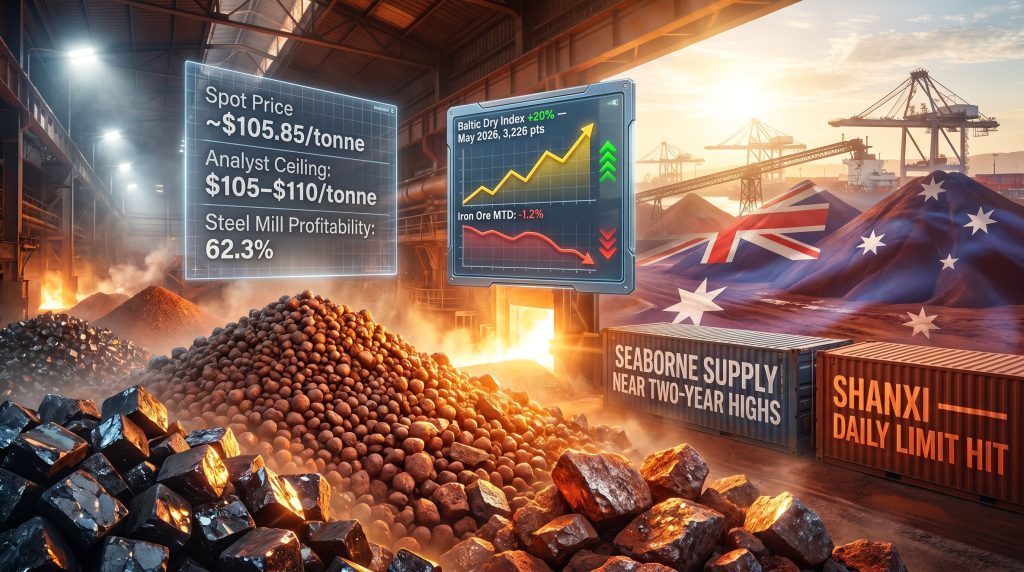
Against this backdrop of cost interdependencies, iron ore markets have delivered a notably subdued performance through May 2026. Singapore iron ore futures are tracking a 1.2% decline across the month, positioning the commodity for its first monthly loss since February 2026. The spot price registered at approximately $105.85 per tonne during late-May trading sessions, while prices touched $109.04 per tonne on May 28, illustrating the volatility that persists even within a range-bound market.
Key Iron Ore Benchmarks: May 2026
| Metric | Value |
|---|---|
| Singapore Futures (Month-to-Date Change) | -1.2% |
| Spot Price (Late May 2026) | ~$105.85/tonne |
| Price on May 28, 2026 | ~$109.04/tonne |
| Analyst Price Ceiling Estimate | $105–$110/tonne |
| FRED Global Iron Ore Index (March 2026) | 107.58 |
Robert Rennie, Head of Commodity and Carbon Research at Westpac Banking Corp, has articulated the structural basis for this price behaviour clearly. His analysis, cited by Bloomberg News via Mining.com, explains that the surge in coking coal prices following the Shanxi province mining accident has reinforced a view that iron ore price decline will persist, with prices remaining structurally capped in the $105–$110 per tonne range, as margin pressure limits mills' appetite to compete aggressively for iron ore supply.
What is particularly instructive about the May price action is the speed with which a brief rally unwound. An initial spike driven by supply disruption anxiety — the natural market reaction to news of a fatal coal mine accident — faded rapidly as traders refocused on what the coal price surge would actually do to steel mill economics. This pattern of event-driven rallies being capped by structural demand-side constraints is a recurring feature of iron ore trading, and understanding it is valuable for both short-term traders and longer-term investors assessing the commodity's directional risks.
The Shanxi Coal Accident and Its Cascading Cost Effects
The proximate cause of May's coking coal price surge was a fatal mining accident in China's Shanxi province, one of the country's most significant coal-producing regions. The incident triggered mandatory safety inspections across regional operations, a standard regulatory response that historically creates asymmetric supply disruptions: abrupt short-term output reductions followed by gradual normalisation as operations clear inspection hurdles.
Domestic coking coal futures responded immediately and aggressively, hitting the daily limit on the Monday following the accident. Near month-end, coking coal prices in China settled at approximately 1,292 yuan per tonne (equivalent to roughly $191 per tonne), representing a 0.2% increase from April 2026, which itself had posted a significant 12% month-on-month gain.
Coking Coal Price Trajectory: March–May 2026
| Period | Price (CNY/tonne) | Month-on-Month Change |
|---|---|---|
| March 2026 | ~1,153 (implied) | Baseline |
| April 2026 | ~1,289 | +12% |
| Late May 2026 | ~1,292 | +0.2% |
| Post-Accident Intraday | Hit daily limit | Acute spike |
A nuance worth understanding here is how China's domestic coking coal market differs from seaborne markets in terms of price transmission speed. Domestic supply disruptions in Shanxi directly impact the cost structure of Chinese blast furnace operators with near-immediate effect, because these mills rely on both domestic procurement and imported seaborne coking coal. Unlike seaborne iron ore disruptions, which unfold over weeks as vessel schedules and port logistics are rearranged, domestic coal supply shocks in China transmit into mill cost structures within days.
A domestic coking coal supply disruption in Shanxi creates a direct and rapid transmission channel to global iron ore markets. Chinese mills account for a dominant share of world steel output, meaning their margin response to elevated coal costs is felt immediately in forward iron ore demand signals.
Premium Lump Ore: The Quality Substitution Strategy Under Margin Pressure
One of the less widely discussed operational responses to elevated coking coal costs is the shift toward premium lump ore procurement. Lump ore, which is iron ore of sufficient size and grade to be charged directly into a blast furnace without prior sintering, offers a meaningful technical advantage when coal costs rise: it improves the coke rate, which is the amount of coke required per tonne of hot metal produced.
When a mill increases its proportion of high-grade lump ore in the blast furnace charge, it can reduce the volume of coke consumed per heat, partially offsetting the higher unit cost of coal. This substitution strategy is particularly rational when the price premium for lump ore is modest relative to the savings achievable through coke reduction.
Robert Rennie's analysis, as reported by Bloomberg News, confirms that Chinese mills have been actively increasing lump ore purchases in response to the current elevated coal cost environment. Consequently, this creates a two-tier demand dynamic within the iron ore complex:
- Standard-grade iron ore fines: Facing softer demand as mills reduce throughput and exercise procurement caution.
- Premium lump ore and high-grade material: Experiencing relative demand resilience as mills seek efficiency improvements in their blast furnace operations.
For investors and analysts tracking iron ore market health, this distinction matters significantly. Aggregate iron ore demand data may appear stable or modestly soft, masking a meaningful quality bifurcation beneath the surface that affects pricing dynamics across different product grades. Monitoring iron ore price trends across product grades is therefore essential for a complete picture.
Chinese Steel Mill Operational Response Framework
- Input Substitution: Increase lump ore share in the blast furnace charge to lower coke consumption per tonne of hot metal.
- Output Price Monitoring: Closely track rebar and hot-rolled coil prices for signs of margin recovery that would justify resuming full procurement activity.
- Procurement Adjustment: Reduce spot iron ore buying if profitability metrics continue declining below sustainable operating thresholds.
- Production Rate Decision: Consider reducing blast furnace utilisation rates only if margin deterioration becomes sustained and material.
Weekly Mysteel data confirms that blast furnace operating rates across China were unchanged week-on-week as of late May 2026, suggesting mills are currently in phase two of this framework: monitoring rather than cutting. However, with steel mill profitability measured at 62.3%, the margin buffer is narrowing. A continuation of elevated coal costs without a corresponding recovery in finished steel prices would likely push operating rates lower.
Seaborne Supply: The Structural Counterweight to Any Demand Recovery
Compounding the demand-side pressures from steel mill margin compression is an equally significant supply-side dynamic. Mysteel shipment data indicates that combined export volumes from Australia and Brazil were approaching a two-year high as of late May 2026, representing a substantial increase in seaborne supply availability at precisely the moment when Chinese mill demand signals are softening.
This supply-demand configuration creates what market analysts describe as a dual constraint on iron ore prices: demand-side caution from margin-pressured mills operating simultaneously alongside supply-side abundance from the world's two dominant iron ore exporters. Indeed, the broader China steel and iron ore market dynamics reinforce why this ceiling remains so difficult to break through.
When seaborne iron ore supply reaches multi-year highs at the same time that steel mill profitability is under pressure, the price ceiling becomes reinforced from both directions. Mills have less incentive to bid aggressively, and ample material availability removes any urgency from procurement decisions.
Potential Supply-Side Disruption: BHP Port Hedland
Against the broadly bearish supply picture, one material upside risk has emerged. Electrical workers at BHP's Port Hedland iron ore export terminal are scheduled to vote on potential industrial action, following six months of stalled enterprise bargaining negotiations between the union and BHP. Port Hedland is Australia's largest iron ore export hub, handling a dominant proportion of the country's total seaborne iron ore shipments.
Any work stoppage at Port Hedland would represent a meaningful supply-side disruption capable of tightening the seaborne market and introducing upside price volatility into an otherwise range-bound environment. This risk sits in the tail of probability distributions rather than base case scenarios, but its potential magnitude warrants monitoring.
The next major ASX story will hit our subscribers first
Freight Markets as a Signal of Physical vs. Paper Divergence
One of the most analytically interesting features of the current iron ore market is the notable divergence between physical trade flows and futures pricing sentiment. The Baltic Exchange Dry Bulk Index climbed 3.3% to 3,226 points in late May 2026, reaching its highest reading of the year. Across May as a whole, the index has risen more than 20%, reflecting robust vessel demand across all major dry bulk segments, including iron ore carriers.
Strong freight rates are a direct confirmation of high physical cargo volumes moving through global shipping lanes. The strength in bulk freight is entirely consistent with the near-two-year-high shipment data from Australia and Brazil, confirming that physical iron ore trade flows remain at elevated levels.
The divergence between this robust physical activity and the softer futures pricing reflects a fundamental characteristic of forward commodity markets: futures prices are forward-looking assessments of demand conditions, not real-time measures of current physical volumes. Furthermore, bulk commodity price movements across both iron ore and coking coal segments reinforce this disconnect between physical flows and paper market sentiment.
| Market Signal | Current Reading | What It Indicates |
|---|---|---|
| Singapore Iron Ore Futures | -1.2% MTD | Bearish forward demand expectations |
| Baltic Dry Index | +20% MTD, 3,226 pts | Strong current physical trade volumes |
| Australia/Brazil Shipments | Near 2-year high | Supply-side abundance |
| Blast Furnace Operating Rates | Flat week-on-week | Stable but cautious mill operations |
| Steel Mill Profitability | 62.3% | Narrowing margin buffer |
Scenario Analysis: Iron Ore Price Pathways Over the Near Term
Given the current constellation of market forces, three plausible near-term scenarios emerge for iron ore prices:
| Scenario | Key Driver | Iron Ore Price Implication |
|---|---|---|
| Bull Case | Coking coal normalises rapidly; margins recover; Port Hedland strike disrupts supply | Potential breakout above $110/tonne |
| Base Case | Margins remain compressed; seaborne supply elevated; blast furnace rates flat | Price range-bound at $105–$110/tonne |
| Bear Case | Mill profitability continues declining; operating rate cuts follow; China demand disappoints | Downside risk toward $100/tonne |
The variables that could shift the equation include:
- Coking coal price normalisation: A rapid easing of coal prices following the completion of Shanxi safety inspections would provide immediate margin relief and could unlock deferred iron ore purchasing activity.
- Finished steel price recovery: An increase in rebar or hot-rolled coil prices would restore mill profitability without requiring coal cost relief, providing an alternative pathway to stronger iron ore demand.
- Australian export disruptions: Industrial action at Port Hedland or other major terminals would tighten seaborne supply and create a potential catalyst for prices to break above the current ceiling.
- Chinese construction activity: Any meaningful policy-driven increase in Chinese property or infrastructure activity would provide demand-side upside that could absorb both existing supply and any incremental production.
The China steel outlook for the remainder of 2026 will ultimately depend on how these variables interact — particularly whether coking coal costs normalise before blast furnace utilisation rates begin to decline materially.
Frequently Asked Questions: Iron Ore, Coking Coal, and Steel Margins
Why are iron ore futures falling while freight rates are rising strongly?
Futures prices reflect forward-looking assessments of demand conditions, particularly what steel mills are expected to purchase in coming weeks and months. Freight rates reflect current physical cargo volumes actually moving through shipping lanes. The divergence indicates that physical trade flows remain robust today, but market participants expect demand to soften as steel mill margins remain under pressure from elevated coking coal costs.
What does a steel mill profitability figure of 62.3% actually mean?
This metric, tracked by Mysteel, represents the percentage of surveyed Chinese steel mills currently generating a profit at prevailing input and output prices. When this figure declines, mills typically reduce discretionary spot iron ore purchases and defer capacity utilisation decisions. A sustained fall below approximately 50% would typically precede more significant production cuts and a meaningful step-down in iron ore demand.
Why do mills increase premium lump ore purchases specifically when coal costs rise?
Premium lump ore can be charged directly into a blast furnace without sintering processing, and its higher iron content improves the thermodynamic efficiency of the reduction process. This translates into a measurably lower coke rate, meaning less coking coal is consumed per tonne of hot metal. When coal costs spike, paying a modest premium for higher-grade iron ore can deliver net cost savings on the overall input stack.
What makes the $105–$110 per tonne range significant for iron ore?
This range represents the current analytical consensus for where iron ore prices are effectively capped by the intersection of steel mill margin capacity and ample seaborne supply availability. For prices to sustain a breakout above this level, the market would require either a meaningful demand-side catalyst such as a recovery in Chinese steel sector activity, or a significant supply-side disruption reducing seaborne availability.
How directly does a coking coal mine accident in Shanxi affect global iron ore markets?
China produces approximately half of the world's steel and is by far the largest buyer of seaborne iron ore. Its domestic coking coal market is tightly linked to blast furnace operating economics. When domestic coal supply is disrupted by mining accidents and subsequent safety inspection shutdowns, the input cost of steelmaking rises rapidly, mill margins compress, and procurement activity for iron ore slows, creating a measurable transmission channel from a domestic Chinese coal supply event into global iron ore price dynamics within days rather than weeks.
Key Takeaways: Reading the Current Iron Ore Market Correctly
The iron ore price heads for monthly loss as coal spike pressures margins story in May 2026 is fundamentally a margin mechanics story rather than a demand collapse narrative. Several critical points emerge from a thorough analysis of current conditions:
- Iron ore is tracking its first monthly decline since February 2026, driven primarily by margin compression within Chinese steel mills rather than a structural reduction in steel output volumes.
- The $105–$110 per tonne price ceiling reflects a genuine structural constraint, not a temporary technical level, imposed by the interaction of elevated coking coal input costs and flat blast furnace utilisation rates.
- Seaborne iron ore supply near two-year highs from Australia and Brazil removes upside price urgency and reinforces the structural cap on prices even if short-term demand improves.
- The premium lump ore preference among Chinese mills is creating quality-tiered demand dynamics that aggregate iron ore price data does not fully capture, with high-grade material experiencing relative resilience while standard-grade fines face softer conditions.
- The Baltic Dry Index strength of over 20% in May to 3,226 points confirms robust physical trade flows, creating an important and informative divergence from the bearish futures narrative that investors should incorporate into their analysis.
- Near-term price direction hinges on three key variables: the speed at which Chinese coking coal prices normalise post-inspection, any recovery in finished steel output prices, and the outcome of potential industrial action at BHP's Port Hedland export terminal.
This article is intended for informational purposes only and does not constitute financial or investment advice. Commodity markets are inherently volatile, and past price patterns are not reliable indicators of future performance. Forecasts, scenario analyses, and analyst commentary referenced in this article represent views current at the time of writing and are subject to change as market conditions evolve. Readers should seek independent financial advice before making investment decisions.
Want to Stay Ahead of the Next Major ASX Mineral Discovery?
Discovery Alert's proprietary Discovery IQ model delivers real-time alerts on significant ASX mineral discoveries, instantly transforming complex commodity data into actionable investment insights for both short-term traders and long-term investors. Explore Discovery Alert's dedicated discoveries page to understand how historic mineral discoveries have generated substantial market returns, and begin your 14-day free trial today to position yourself ahead of the broader market.