June 4, 2026
The Hidden Architecture of Iron Ore Pricing: Why China's Steel Crisis Is the Only Variable That Matters
Commodity markets are rarely as complex as they appear from the outside, but iron ore pricing operates under a structural condition that makes it unlike almost any other globally traded material. Rather than responding to a broad basket of buyers and sellers distributed across continents, iron ore pricing is functionally tethered to a single nation's industrial appetite. Understanding this concentration risk is the essential starting point for interpreting why iron ore prices fall on China demand worries with such speed and severity whenever Beijing's steel ecosystem shows signs of strain.
Approximately 70% of global seaborne iron ore demand originates from Chinese steel mills, according to industry data. This is not a recent development but a structural reality that has evolved over decades of Chinese industrialisation. What it means in practice is that iron ore is less a freely traded global commodity and more a derivative instrument on Chinese construction and manufacturing activity. When those underlying activities contract, the price signal travels through the iron ore market almost instantaneously.
When big ASX news breaks, our subscribers know first
China's Steel Demand Deterioration: Structural, Not Seasonal
The distinction between cyclical and structural demand weakness is critically important for investors and commodity analysts interpreting current market conditions. Seasonal slowdowns in Chinese steel consumption are well-documented and routinely priced in by futures markets. What is harder to price, and more consequential for long-duration positioning, is a structural adjustment rooted in a fundamental shift in the underlying economy.
China steel and iron ore dynamics have historically been anchored by the residential property sector, which has accounted for a disproportionately large share of total steel consumption, with construction-grade products such as rebar forming the backbone of this demand. The ongoing correction in China's property market represents a multi-year deleveraging cycle that has progressively removed a core pillar of steel demand. Unlike a seasonal trough that self-corrects with warmer months, a property sector restructuring suppresses demand across entire economic cycles.
The latest weekly data from Mysteel, a leading Chinese steel market research consultancy, underscores the severity of this deterioration. China's apparent consumption of five major steel products declined by 3.1% week-on-week as of early June 2026, a sharp acceleration compared to the prior week's decline of just 0.5%. That rate of sequential deterioration, not the absolute level, is what signals a market moving in the wrong direction with increasing momentum.
Price Collapse Across Two Exchanges: Interpreting the Simultaneous Signal
When price weakness appears on a single exchange, analysts can often attribute it to exchange-specific factors such as rolling positions, liquidity events, or localised sentiment. When the same magnitude of decline materialises simultaneously across two geographically and structurally distinct venues, however, the interpretation becomes considerably more straightforward.
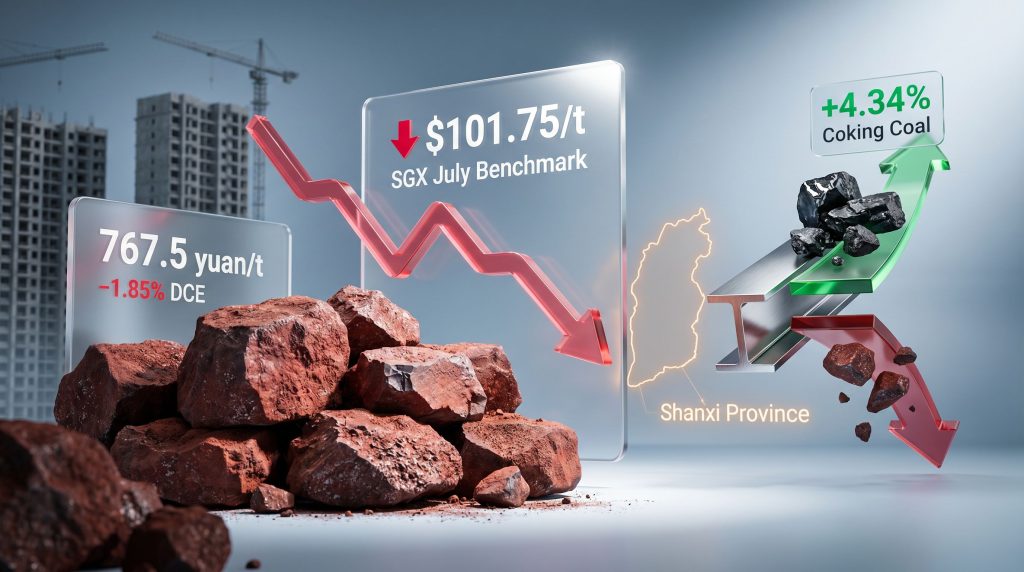
On June 4, 2026, that is precisely what occurred across the global iron ore futures complex, with iron ore price decline signals flashing across both major trading venues simultaneously.
| Exchange | Contract | Closing Price | Daily Change | Notable Context |
|---|---|---|---|---|
| Dalian Commodity Exchange (DCE) | Most-traded contract | 767.5 yuan/t (~$113.32/t) | -1.85% | Weakest close since April 16 |
| Singapore Exchange (SGX) | July benchmark | $101.75/t | -1.84% | Lowest level since March 9 |
Both exchanges recorded their largest single-day percentage declines since April 9, a period spanning approximately 55 trading days. In bulk commodity markets, that kind of synchronised repricing event carries specific informational content: it confirms that the selling pressure originates from fundamental reassessment rather than technical positioning. Traders on two separate platforms, operating under different regulatory frameworks and counterparty structures, arrived at the same conclusion on the same day.
The psychological significance of the SGX benchmark breaking below $102 per tonne should not be underestimated. For market participants who track round-number thresholds as sentiment anchors, sub-$102 proximity to the $100 level introduces a category of concern that can accelerate selling as stop-loss orders activate and margin requirements tighten. Furthermore, iron ore market pressures from the broader trade environment are compounding these technical dynamics.
Steel Mill Margin Compression: The Mechanism Driving Iron Ore Procurement Cuts
Iron ore pricing ultimately traces back to procurement decisions made at individual steel mills. Understanding why those mills are likely to reduce purchasing volumes requires examining the economics of steelmaking itself.
Blast furnace steelmaking combines iron ore with coking coal and coke to produce molten pig iron, which is then refined into various steel products. The profitability of this process depends on the spread between input costs (iron ore, coking coal, coke, energy) and the selling price of finished steel. When input costs rise while finished product prices weaken, margins compress. When margins compress sufficiently, mills face a binary choice: absorb losses or curtail production.
Market signals in early June 2026 strongly suggest mills are moving toward the latter option. Across the Shanghai Futures Exchange, the breadth of weakness in finished steel products confirmed that demand softness spans multiple end-use categories:
| Steel Product | Exchange | Price Movement |
|---|---|---|
| Rebar | SHFE | -0.57% |
| Hot-Rolled Coil | SHFE | -0.44% |
| Wire Rod | SHFE | -0.56% |
| Stainless Steel | SHFE | -2.42% |
The outsized decline in stainless steel, at -2.42%, is a particularly noteworthy signal. Stainless steel demand is more closely linked to industrial, consumer goods, and export manufacturing activity than construction. Its sharp underperformance suggests that the demand contraction extends beyond the well-documented property sector weakness into broader economic softness affecting manufacturing and industrial output.
According to Mysteel senior analyst Steven Yu, steel demand has begun absorbing the inflationary impact of persistently elevated energy prices, a dynamic that simultaneously constrains both consumption and production-side activity. This dual-sided pressure is characteristic of stagflationary stress in industrial supply chains and represents a more complex challenge for policymakers than a straightforward demand trough.
The Coking Coal Counter-Narrative: When Input Costs Move Against Producers
One of the more analytically interesting dynamics in the current ferrous metals complex is the directional divergence between iron ore and coking coal pricing. While iron ore fell sharply, coking coal and coke futures moved in the opposite direction, generating a market bifurcation that has significant implications for steel mill economics.
| Input Commodity | Price Movement | Primary Driver |
|---|---|---|
| Coking Coal | +4.34% | Mine suspensions following Shanxi accident |
| Coke | +2.28% | Downstream supply tightening from coal shortfall |
A fatal underground mining accident in Shanxi Province in late May 2026, China's most important coal-producing region, resulted in at least 82 fatalities. The incident triggered government-mandated safety inspections across the province, leading to widespread production suspensions at numerous mines. Shanxi accounts for a substantial proportion of China's coking coal output, meaning supply disruptions there carry outsized national and global implications.
Analysts at broker Galaxy Futures noted that beyond the immediate impact of mine suspensions, regulatory attention directed at undeclared or off-balance-sheet production capacity could deliver supply reductions that prove more durable than markets currently anticipate, providing sustained upward price support for coking coal over an extended period.
This off-balance-sheet production dynamic is a lesser-known feature of China's coal industry. For years, a portion of actual coal output has been produced by operations that do not appear on official capacity registers, effectively providing a supply buffer that moderates price spikes during periods of formal production disruption. When regulatory crackdowns extend to this shadow capacity, the effective supply reduction can significantly exceed what official mine suspension data alone would suggest.
From a steel mill perspective, rising coking coal prices at the same time that finished steel prices are weakening creates a compounding margin squeeze. Higher input costs cannot be passed through to customers when demand is already contracting, which accelerates the case for production cuts and, by extension, reduced iron ore procurement. Consequently, iron ore demand prospects remain subdued as these pressures persist through the current cycle.
Grade Quality as a Competitive Differentiator in a Margin-Stressed Market
An important and often overlooked dimension of iron ore market dynamics during periods of steel mill margin compression is the quality premium dynamic. When mills are operating under tight margins, metallurgical efficiency becomes paramount. Higher-grade iron ore, typically classified as 62% Fe content and above, delivers better blast furnace productivity, lower slag generation, and reduced energy consumption per tonne of hot metal produced.
In a buoyant demand environment, Chinese mills often accept a wider range of ore grades because throughput volume is the priority. In a margin-compressed environment, that calculus reverses. Mills shift procurement preference toward higher-grade, lower-impurity products to extract maximum efficiency from each unit of input cost. This creates a quality-based price premium divergence within the iron ore market, where high-grade products retain value better than lower-grade alternatives.
For major producers, C1 cash cost positioning below $20 per tonne remains the key threshold separating operations that can sustain profitability at current price levels from those that face earnings pressure. Australia and Brazil dominate seaborne supply, with producers such as BHP and Rio Tinto maintaining cost structures that allow continued profitability even at subdued benchmark prices, though revenue and free cash flow are meaningfully affected.
The next major ASX story will hit our subscribers first
Scenario Analysis: Pathways Forward for the Iron Ore Market
| Scenario | Near-Term Probability | Iron Ore Price Direction (SGX) |
|---|---|---|
| Sustained demand weakness, no policy stimulus | High | Further decline toward $95-$98/t |
| Modest policy support combined with seasonal restocking | Moderate | Stabilisation in $100-$105/t range |
| Major Chinese infrastructure stimulus or supply shock | Low in near term | Potential rebound toward $110-$115/t |
Several factors could stabilise or reverse the current trajectory. Supply-side adjustments from major exporters, particularly any weather-related or operational disruptions in the Pilbara region of Western Australia or the Carajas system in Brazil, would tighten the seaborne market independently of Chinese demand. Seasonal steel mill restocking cycles ahead of peak construction periods can also generate short-duration demand spikes that temporarily support prices.
However, the dominant fundamental narrative as of early June 2026 remains demand-side bearish. Portside iron ore inventories in China are elevated, reducing the urgency for mills to actively seek fresh cargoes. Weekly steel consumption data is deteriorating at an accelerating pace. Furthermore, the China iron ore outlook offers no near-term catalyst for a meaningful Chinese property market recovery in current policy signals, as iron ore prices plummet amid China concerns according to recent market commentary.
Frequently Asked Questions: Iron Ore Prices and the China Demand Connection
Why do iron ore prices fall so sharply when China's steel demand weakens?
Because roughly 70% of global seaborne iron ore trade is directed to Chinese steel mills, pricing is functionally determined by Chinese procurement decisions. Any sustained reduction in steel output or mill purchasing activity removes the marginal buyer from the market, pushing prices lower with limited offsetting demand from other regions. Indeed, iron ore prices fall on China demand worries precisely because no other market can absorb that volume at equivalent price levels.
What is the significance of the $100/t threshold on the Singapore Exchange?
The $100 per tonne level on the SGX benchmark functions as a key psychological and technical reference point for market participants. Trading below or near this level signals that the market has moved into territory not seen since the early part of 2026, activating stop-loss mechanisms and prompting reassessment of long positions across the institutional investor base. Industry analysts tracking multi-month lows as China demand concerns linger have highlighted this threshold as particularly significant.
How does off-balance-sheet coal production affect iron ore markets?
Off-balance-sheet coal production represents output from mines operating outside official capacity registers. When regulatory crackdowns target this shadow capacity in addition to formally registered mines, the actual supply reduction can substantially exceed what public suspension data indicates. This magnifies coking coal price increases beyond market expectations, further compressing steel mill margins and accelerating iron ore demand destruction.
What does iron ore grade mean and why does it matter more in downturns?
Iron ore grade refers to the iron content of the ore, expressed as a percentage. Higher grades, typically 62% Fe and above, deliver superior blast furnace efficiency. During periods of margin compression, Chinese mills preferentially source higher-grade material to reduce energy and processing costs, creating a quality-based price premium that can partially insulate high-grade producers from the full extent of benchmark price declines.
Disclaimer: This article contains forward-looking scenarios and market analysis that involve forecasts and assumptions. These should not be construed as investment advice. Iron ore and ferrous metals markets are subject to rapid change based on evolving macroeconomic, regulatory, and geopolitical factors. Readers are encouraged to conduct independent research before making investment decisions. Pricing data referenced relates to early June 2026.
Want To Stay Ahead of Major ASX Mineral Discoveries Before the Broader Market Reacts?
While iron ore's fate remains tethered to China's steel cycle, Discovery Alert's proprietary Discovery IQ model scans ASX announcements in real time, instantly identifying significant mineral discoveries across 30+ commodities and delivering actionable alerts to subscribers — explore historic discovery returns on the dedicated discoveries page and begin your 14-day free trial today to secure a genuine market-leading edge.